Nevada OHV Permits Explained
Nevada’s OHV decal can be confusing because it serves as registration and a riding permit, while rules for visitors depend partly on where the machine is registered. That leaves riders wondering whether they need another sticker, whether their home-state paperwork counts, and what to carry at the trailhead. This guide explains Nevada OHV permits, reciprocity, the visitor time limit, and practical steps before you ride.
What a Nevada OHV permit actually is
The decal combines registration and riding authorization
Nevada does not generally sell a separate statewide trail permit for ordinary OHV riding. Instead, its OHV registration decal is the key document for eligible machines operated on public land. That includes many places riders think of as simply open desert, such as designated recreation areas and routes managed by the Bureau of Land Management.
This distinction matters because “permit” can mean different things. A Nevada OHV decal is not the same as a site pass, a camping permit, an event permit, or permission to ride a closed road. It addresses the machine’s OHV registration status; land managers can still set their own access rules. For a broader explanation of how the system works, see Nevada OHV Permits Explained.
A useful way to think about it is that the decal answers, “Is this machine properly registered for Nevada OHV use?” It does not answer, “May I ride anywhere I can reach?” Routes can be closed, signed trails may have restrictions, and private property, wilderness boundaries, and other land-use rules still apply.
The decal is not a road-use license plate
Nevada’s OHV decal is not a plate that makes an ATV or UTV street legal. Registration for off-highway use and permission to operate on roads are separate matters. A machine with a current OHV decal may still be prohibited from riding on a public street or highway, except where a specific law or local rule allows it.
That distinction is easy to miss when a route crosses a road or runs near town. A rider may be legally registered for trail use but still need to trailer the machine to the trailhead rather than ride it through a neighborhood. Rules for road use depend on the type of road, the machine, required equipment, and local restrictions. See Street Legal ATVs in Nevada: The Short Answer before planning a ride that involves pavement.
The same caution applies to special access areas. A recreation site may have a fee, a day-use rule, or a separate permit process even when the machine’s Nevada registration is in order. Check the rules for the specific area and route, not just the decal status.
Not every machine or situation is treated the same way
Nevada’s registration requirements include exemptions and exceptions. A machine’s engine size, age, use, ownership, or the rider’s residency may affect what paperwork is required. That is why a friend’s experience with one quad does not always settle the question for a different machine.
For example, certain small machines and qualifying older machines may fall under exemptions. A ranch-use claim may also involve specific conditions rather than a broad “private property” exception. If you think your machine qualifies, confirm the exact category and documentation before treating it as exempt. The guide to Machines Nevada Exempts From Registration explains the kinds of exceptions that may apply.
It also helps to separate machine registration from land access. A machine that does not need the standard decal under a particular exemption is not automatically allowed on every public route. You still need to follow land-manager rules, posted closures, and any requirements that apply to the location.
Nevada OHV registration for residents
Nevada residents generally need Nevada registration
If you live in Nevada and ride an OHV on public land, do not assume a prior registration from another state will cover you indefinitely. Nevada residents are generally expected to comply with Nevada’s OHV registration rules for machines operated here. Moving into Nevada, buying a used machine, or bringing a quad back from another state can all trigger paperwork questions.
A common source of frustration is buying a machine that looks ready to ride: it may have a title, a bill of sale, or a registration from the seller’s home state, but those documents are not necessarily the Nevada OHV decal. Ownership documents help establish who owns the machine; registration documents show a different part of the picture. The guide to Registering an Out-of-State Machine in Nevada can help you sort out that transition.
If you have recently moved, check the registration process and any deadline that applies to your situation instead of waiting until the first trail weekend. Nevada Registration After You Move In covers the move-related question, while Nevada OHV Registration Paperwork Checklist is useful for gathering the documents before you contact a dealer or the OHV section.
How to get a decal
Nevada OHV registration can be handled through participating OHV dealers or through the state process, depending on the transaction and the machine’s paperwork. A dealer can be especially helpful when you have a straightforward purchase and want assistance with the application. If the machine is from out of state, has an unclear ownership history, or needs a VIN inspection, confirm what the dealer can handle before making the trip.
Before starting, gather the machine’s identifying information and proof of ownership. Depending on how you acquired it, that may include a title, bill of sale, previous registration, or other supporting paperwork. If the VIN is hard to read or the ownership chain is incomplete, resolve those issues before assuming the registration can be completed in one visit. The DMV does not perform OHV VIN inspections, so check The VIN Inspection Nevada DMV Will Not Do if a verification is needed.
A Nevada decal is commonly described as costing $20, but fees and procedures can change. Confirm the current amount and accepted application route with the Nevada OHV program or the dealer you plan to use. To understand what the decal fee supports, see Nevada’s $20 OHV Decal and What It Covers. The price is only one part of the process; having the right proof of ownership and machine details can save more time than arriving with payment but incomplete paperwork.
Where to display the decal and what to carry
Once you receive the decal, follow Nevada’s placement instructions for the machine type. A decal that is tucked away in a storage box or placed where it cannot be seen may be difficult to verify during a ride. Placement can differ by machine, so use the official instructions rather than copying the location from a different model.
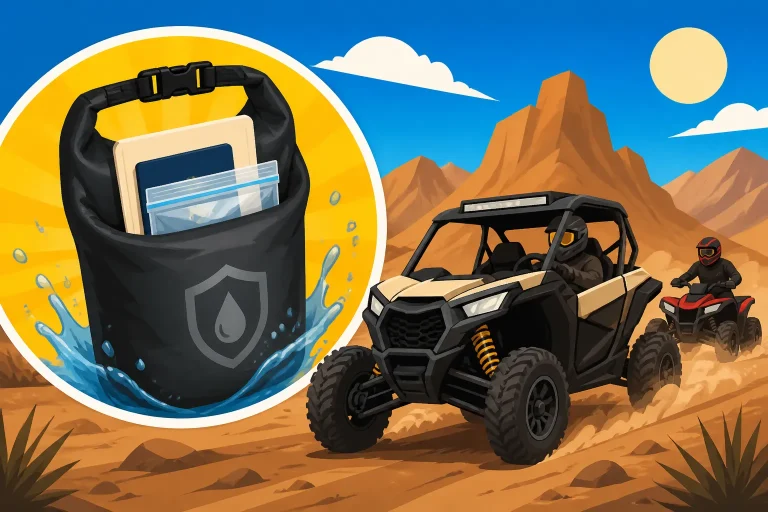
Keep the registration card or other required proof with the machine, and protect it from dust, water, and damage. Desert riding can turn a paper document into a crumpled, unreadable mess surprisingly quickly. A small waterproof sleeve or document pouch can help; some riders look for one on Amazon, but the important thing is that the paperwork remains legible and accessible.
It is also sensible to keep a photo of the paperwork on your phone as a backup. A photo may help you retrieve the information if a card is damaged, but do not assume it replaces whatever physical proof the rules require. For the display details, see Nevada OHV Decal Placement Rules; for practical document storage, Keeping Paperwork Dry in a Dusty Machine offers a related checklist.
Reciprocity for out-of-state riders
Reciprocity is not one universal rule
Reciprocity means one state recognizes certain credentials from another state. But OHV programs vary: one state may issue a registration certificate and sticker, another may use a different permit, and another may have exemptions. Nevada riders should not assume that every out-of-state sticker is automatically accepted in every circumstance.
For visitors, the important questions are whether the machine is currently registered or permitted in its home jurisdiction, whether that credential is valid for the machine, and how long the machine will be used in Nevada. The rider’s state of residence and the machine’s state of registration may not be the same, so check the details rather than relying on a general statement like “Nevada accepts out-of-state stickers.”
The state-specific guides Nevada Reciprocity With California, Nevada Reciprocity With Arizona, and Nevada Reciprocity With Utah can help you focus on the relevant cross-border situation. If your machine is registered elsewhere, verify the current Nevada rule and carry the home-state paperwork that supports your status.
When a visitor’s home-state registration may count
A nonresident who brings a machine with valid registration or a qualifying permit from another jurisdiction may be able to ride in Nevada under the state’s nonresident rules. The exact conditions matter. A current credential is different from an expired sticker, and a document that identifies another machine does not establish that the ATV you brought is covered.
A visitor should carry the original registration or permit information, proof that the machine is properly identified, and any other documentation required by the home state. If the machine has no visible sticker because the home jurisdiction uses another kind of proof, keep that proof accessible and be prepared to explain what it represents. A photograph can be a backup, but it is better not to rely on a phone image as the only evidence.
Before leaving home, check that the credential remains valid for the full trip and that the machine’s VIN or other identifying information matches the paperwork. If you are unsure whether your home-state credential qualifies, ask the Nevada OHV program before traveling. For additional background, see Riding Nevada With an Out-of-State Registration.
What if your home state does not require the same credential
Some riders arrive from places with different registration systems or exemptions. That does not automatically mean Nevada’s requirements disappear. A state’s decision not to require a particular OHV decal is not necessarily a blanket pass for every out-of-state machine operating in Nevada.
The key is to determine which Nevada nonresident provision applies and what evidence it requires. Do not treat a lack of a sticker as proof that a machine is exempt; the rule may depend on residency, how long the machine is in Nevada, whether it is registered in another jurisdiction, and the type of use. If your home state issues no OHV credential, document that situation and ask Nevada officials what alternative proof is accepted.
This is especially important for riders who split time between states, keep a machine at a Nevada cabin, or bring a vehicle to Nevada for an extended stay. A machine’s storage location and the owner’s residency can complicate an otherwise simple weekend-trip answer. Confirm the rule for your circumstances rather than borrowing a neighbor’s interpretation.
The 15-day window and longer stays
How to think about the visitor time limit
Nevada’s nonresident rules include a 15-day window for certain out-of-state machines. That limit is a reason to check the details before a long visit, not a universal guarantee that every visitor can ride for 15 days without any other requirement. The starting point and applicability depend on the situation, so verify the current rule before relying on a calendar count.
This can catch people who arrive with an unregistered machine or a home-state credential that does not qualify. A person who plans a quick weekend may assume the rule will never matter, then return several times or leave the machine at a vacation property. Add up the time and circumstances honestly; a casual “we are only visitors” description may not settle the legal question.
Read Nevada’s 15-Day Window for Out-of-State Machines and When a Visitor’s 15 Days Start Counting for the details that affect the clock. If you are close to the limit, do not wait until the last day to ask what registration path applies. A paperwork problem can take longer to resolve than expected, particularly if the title or VIN needs attention.
Short visits, repeat trips, and machines stored in Nevada
A short visit with a properly registered machine is different from leaving the machine in Nevada for months or using it here repeatedly. Visitors who travel back and forth may find the situation less obvious than a single vacation. Keep a simple record of when the machine enters Nevada and what registration or permit it carries.
A cabin or second home adds another wrinkle. The owner may live elsewhere, but the OHV remains in Nevada and may be ridden on public land over multiple visits. Storage alone does not answer the registration question, but it is a good signal to verify how the nonresident rule applies. See Nevada Registration for a Machine Kept at a Cabin for that scenario.
If your plans change from a short trip to a season of riding, reassess the paperwork before continuing to use the machine. A credential that was adequate for one visit might not cover a longer stay, and the time limit may not reset simply because the machine is parked or a new trip begins. Confirm the current interpretation with the state rather than guessing.
When to register the machine in Nevada
If the machine will remain in Nevada beyond the permitted visitor period, or if it otherwise does not qualify for nonresident treatment, ask about Nevada registration. That does not mean every out-of-state visitor must immediately transfer a machine’s title; registration, title, residency, and ownership are related but distinct questions. Make sure you are following the correct process for the machine’s circumstances.
Start by checking the ownership documents, identifying number, and the route for an out-of-state purchase or existing registration. If you have an unclear title, missing bill of sale, lien, or mismatch in the VIN, those problems can affect how quickly you can complete the application. Nevada’s Form for an Out-of-State Purchase and Nevada OHV Registration Without a Title are useful next reads for those complications.
A good rule of thumb is to sort the question out before the machine is due for its next ride, not while loading the trailer for a long weekend. If the state says the machine needs Nevada registration, ask what documents and inspections are needed and whether an authorized dealer can assist. Keep copies of communications and receipts with the machine’s other ownership records.
Registration, site passes, and other permits
A registration decal does not open every gate
Nevada’s OHV decal does not override access rules set by land managers. The Bureau of Land Management, U.S. Forest Service, state agencies, counties, and private landowners may manage routes differently. A route can be closed even when your decal is current, and an open route may have restrictions on vehicle type, season, or travel direction.
Before a trip, identify the land manager and check the route’s status. An online map can be helpful, but maps may not show a recent closure or a temporary restriction. Calling the appropriate field office is a practical step when a route crosses several jurisdictions or when conditions have recently changed. For more on this distinction, see Nevada Rules for Riding Federal Land and Reading a BLM Travel Management Map.
Do not assume that a visible tire track means the route is open. Desert tracks can be old, created illegally, or lead onto private or protected land. Stay on routes designated for motorized use and turn around when signs, barriers, or current maps indicate a closure.
Recreation-site fees and separate passes
Some riding areas charge a site or recreation fee that is separate from Nevada OHV registration. Sand Mountain is a prominent example of a Nevada riding area with its own fee structure. That site pass does not replace an OHV decal, and an OHV decal does not automatically pay the site fee.
The distinction is easier to remember if you treat them as separate layers: the machine needs whatever registration is required, and the destination may require a fee or pass. A group ride, organized event, or commercial tour can also require additional authorization beyond what an individual rider needs. Check Nevada’s Only Pay-to-Ride Dune and Sand Mountain’s $40 Weekly Pass before making plans there, and confirm current pass details with the site manager.
At free-to-enter areas, the absence of an entrance fee does not mean the area is unregulated. Logandale Trails and Nellis Dunes, for example, still have land-use expectations, route rules, and safety considerations. Confirm access conditions for the area you are visiting rather than assuming “free” means unrestricted.
Organized rides and commercial activities
If you are organizing a club ride, competition, charity event, or guided tour, ordinary machine registration may not be enough. Events on public land can require a special recreation permit or other approval from the managing agency. The organizer may need to address route use, group size, sanitation, insurance, dates, and other operational details.
This is a frequent last-minute headache: a club chooses a route and advertises a date, then discovers the activity needs agency approval. Contact the land manager well before announcing the event, and do not assume that an individual rider’s ability to use a route authorizes a large organized group to use it in the same way. See Permits for an Organized Nevada Group Ride and Applying to the BLM for an Event Permit.
Commercial operators have a separate set of responsibilities. A guided tour may involve business permits, insurance, and machine paperwork that ordinary recreational visitors do not need. If you are joining a tour, ask the operator what permits and registration it handles, and what you need to bring as a passenger or driver.
A practical checklist before riding
Confirm the machine and your status
Begin with the machine itself. Note its type, VIN, registration state, current credential, ownership documents, and where it will be ridden. Then establish whether you are a Nevada resident or a visitor and how long the machine will remain in the state. These details determine which registration or reciprocity rules to investigate.
If you bought the machine recently, make sure the seller’s papers match the VIN. A bill of sale can be valuable, but it may not replace a title or other required ownership document. If a seller cannot locate the title or the machine has never been registered, resolve the ownership question before heading to a public riding area. Buying a Quad With No Paperwork at All covers the kind of purchase that needs extra caution.
For an out-of-state machine, do not stop at “it has a sticker.” Confirm that the credential is current, applies to that exact machine, and qualifies under Nevada’s visitor rules. Carry the documents that demonstrate those facts. If the situation falls into an exemption, keep the supporting details with the machine so you can explain the basis for it.
Check the destination and route
After checking the paperwork, confirm where you will ride. Look up the land manager, designated routes, closures, seasonal limitations, camping restrictions, and any site fees. A route planner should include more than the trailhead name; it should account for road crossings, private parcels, wilderness boundaries, and the route back to the trailer.
For unfamiliar areas, download maps or save key information before leaving town. Cell coverage can be limited in remote Nevada terrain, and an online map that worked in Las Vegas may not load near a trailhead. A printed map or saved offline map is a useful backup, particularly if your route includes multiple access points.
Check the machine’s decal and required documents before the group starts. A quick stop in the parking area is much easier than discovering a missing card or unclear decal during a roadside check. Keep the documents in a sealed pouch, and store a backup photo on your phone. Riders who want a dedicated sleeve sometimes search Amazon, but any secure, dust-resistant holder will do.
Prepare for a roadside or trailhead check
If a ranger or officer asks for documentation, stay calm and make the relevant paperwork easy to find. You may be asked to show registration, proof of ownership, or information that supports a visitor exemption. Carrying documents in a consistent place prevents the awkward search through a dusty glove box while everyone waits.
A digital photo can help you locate a VIN or registration number, but keep the original proof with the machine if required. If you have a rental, ask the rental company what documents it supplies and what you are responsible for carrying. Do not assume the rental agreement alone is proof of OHV registration; the machine should have the required paperwork for its use.
Take a moment to check that the decal is visible and not peeling, obscured, or unreadable. Nevada’s dry heat, grit, and vibration can be hard on stickers. If the decal is damaged or lost, ask how to obtain a replacement before the next ride instead of relying on an old photo. What Happens When You Lose the Registration Card and Ordering a Replacement Decal From Carson City address common paperwork problems.
Common permit mistakes and how to avoid them
Assuming reciprocity applies to every sticker
The most common mistake is treating an out-of-state sticker as a universal Nevada pass. Reciprocity can depend on the issuing state, the credential’s validity, the machine, the rider’s status, and how long the vehicle is in Nevada. A friend’s successful trip does not prove that a different machine or a longer visit is covered.
Avoid this by checking your own state’s rules alongside Nevada’s. Keep the registration card or permit information with the machine, and confirm that the VIN matches. If the home state uses an unusual registration system, explain the situation to Nevada officials before you travel rather than trying to settle it at a trailhead.
Confusing registration with permission to ride a route
A decal is not blanket permission to ride across public land. Riders sometimes see open desert and assume cross-country travel is allowed, only to encounter a closed route, protected habitat, private land, or a route where motorized use is limited. A valid decal does not cure an access violation.
Plan using current travel-management information and obey signs and barriers. If a route is uncertain, ask the land manager. This matters especially near wilderness areas, wildlife habitat, mining claims, and roads that cross several types of land. When in doubt, stay on an established, designated route rather than cutting a new track.
Waiting until the trip to solve paperwork issues
A missing title, illegible VIN, expired home-state registration, or uncertain visitor exemption can turn an easy trip into a frustrating scramble. Paperwork questions are best handled before the trailer is packed. Give yourself time to contact a dealer or state office, gather documents, and arrange any required inspection.
A practical pre-trip routine is simple: check the machine’s credential, confirm the rule for your residency and length of stay, verify route access, and put the documents in a protected place. Keep a digital backup, but do not let that substitute for required originals. If something does not line up, pause and resolve it before riding.
Disclaimer
This article is for general informational purposes only and does not constitute professional advice. Laws, prices and regulations vary by location and change over time. Consult a qualified professional for guidance on your specific situation.