Nevada’s Registration Decal as Your Permit
Nevada riders often assume the word “permit” means a separate trail pass, then discover the state uses its OHV registration decal as the key proof of registration for many rides. That can be confusing when you’re planning a trip, visiting from another state, or deciding whether a site charges a separate fee. This guide explains what the Nevada decal does, what it does not do, and how reciprocity works.
What Nevada’s registration decal means
Registration and permission to ride are related but not identical
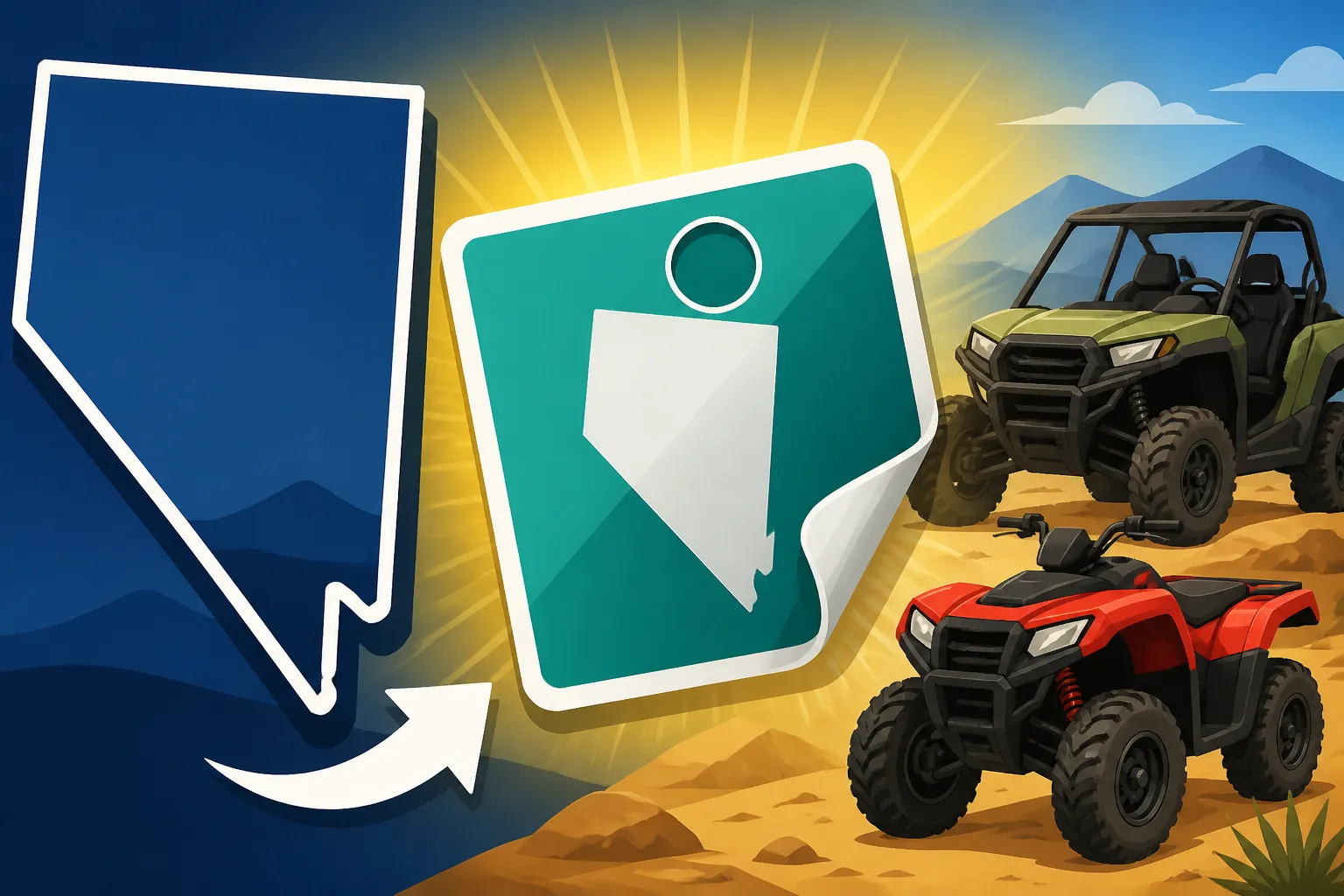
Nevada’s OHV decal is evidence that a machine has been registered under the state’s off-highway vehicle program. For many riders, that registration is also the state-level credential they need when operating on public lands where OHV registration is required. That is why people often describe the decal as a permit.
The wording can make the rules sound simpler than they are. A decal does not grant unrestricted access to every trail, road, dune, or public-land area. It shows that the machine has met a registration requirement; the rider must still follow land-manager rules, route restrictions, closures, and any separate recreation-site requirements.
Think of it as having one important piece of the puzzle, not a universal pass. A Nevada-registered quad may have the correct decal and still be prohibited from entering a closed route, riding across protected habitat, or operating in a place where OHVs are not allowed.
If you are comparing the decal with other states’ systems, Nevada OHV Permits Explained offers useful context on how Nevada’s registration-based approach differs from states that issue a separate trail permit.
Why Nevada uses a decal rather than a trail sticker
Nevada issues an OHV registration decal rather than a conventional license plate for typical off-highway use. The decal is meant to identify the machine as registered in the state’s OHV system. It does not turn a recreational ATV or UTV into a street-legal vehicle, and it is not a substitute for road-use equipment or authorization.
That difference matters when you travel between a trailhead and a town. A machine with a Nevada OHV decal is not automatically legal on public streets or county roads. Road use is governed by separate requirements, and the rules depend on the machine, the road, and the jurisdiction. A registration decal alone does not provide road privileges.
A common misunderstanding is that “permit” means the decal covers every fee connected with a riding area. It does not. For example, a recreation site can have its own access charge or camping rules even when the machine is properly registered. For more on why the state uses this format, see Why Nevada Issues a Decal and Not a Plate.
What the decal does and does not cover
What registration generally proves
The decal indicates that the machine has been registered for Nevada OHV use. It can help show that the owner has completed the state registration process and that the machine is not simply operating without required state documentation. Riders should keep the related registration paperwork available, not rely on the decal alone.
That proof can be useful during a ride when an enforcement officer or land manager asks about the machine’s registration. A decal that is missing, damaged, or too difficult to read can turn a straightforward check into a frustrating conversation. Before a trip, look over both the decal and the registration card so you do not discover a problem at the trailhead.
Registration also helps connect the machine to its ownership and administrative record. It is not the same thing as proof of insurance, proof that a rider has permission to use private property, or a title. Those documents serve different purposes. If you are sorting out which papers to carry, Nevada OHV Registration and Proof of Ownership explains the distinction.
What registration does not authorize
The decal does not make a closed trail open. Public-land managers can restrict routes to protect wildlife, vegetation, cultural resources, or public safety. A route that appears on an old map may have changed status, and a track visible on a phone app is not proof that riding there is allowed.
It also does not replace a site-specific pass or fee where one applies. Nevada riding destinations vary. Some areas offer broad access without a separate day-use charge, while other recreation sites may have their own fee structure or operating rules. Check the particular destination’s current instructions before leaving home rather than assuming the OHV decal covers every cost.
Nor does the decal grant permission to cross private land, drive through a locked gate, or ride across a wilderness boundary. A registration credential cannot override property rights or land-use restrictions. When a route crosses several types of land, the rider needs to understand the rules for each segment, not just the state registration requirement.
| What you have | What it generally shows | What it does not automatically provide |
|---|---|---|
| Nevada OHV decal | The machine is registered in Nevada’s OHV system | Permission to ride every route or enter every recreation area |
| Registration card | Registration details associated with the machine | A title, proof of insurance, or permission to ride private land |
| Out-of-state registration or decal | The machine may be registered under its home-state system | Unlimited Nevada access or an exemption from every Nevada rule |
| Recreation-site pass, where required | Access under that site’s terms | State OHV registration or permission to use unrelated areas |
| Road-legal registration, where applicable | Road-use status under the relevant requirements | Automatic access to closed OHV routes or public lands |
How Nevada registration works for residents
When a Nevada resident needs to register
A Nevada resident who owns an OHV should check whether the machine falls within the state’s registration requirements before taking it onto public land. The rules can depend on the machine’s type and characteristics, as well as any exemption that may apply. Do not assume that an ATV is exempt simply because it is small, old, used only on a ranch, or transported to a riding area rather than ridden on streets.
There are specific exemptions and special cases, but they are not interchangeable. A machine that qualifies under one exemption may not qualify under another, and a rider may need documentation to establish why an exemption applies. If you think your machine is outside the normal registration rules, confirm the exact exemption rather than relying on a seller’s recollection or an informal social-media post.
When buying a used machine, make the paperwork part of the purchase conversation. Ask whether the seller has the title and registration records, check that the machine’s identifying information matches the documents, and find out whether you will need a VIN inspection or additional forms. For a practical starting point, see Nevada OHV Registration Paperwork Checklist.
Decal, documents, and practical preparation
Once a machine is registered, follow the placement instructions and make sure the decal is attached where it can be seen and read. Dirt, sun, abrasion, and pressure washing can all make an otherwise valid decal harder to inspect. Take a moment to check it before each trip, especially if the machine has been stored outside or recently cleaned.
Carry the registration card or other required proof with the machine. A photo on your phone can serve as a convenient backup, but it should not be your only plan. Phones lose power, get damaged, or fail to connect when you are far from service. Keep physical paperwork protected from dust and moisture, and store it somewhere you can reach without unpacking the whole vehicle.
A small waterproof document pouch or dry bag can help keep registration papers from becoming muddy or torn. Riders sometimes look for a compact option at an outdoor retailer or on Amazon, but the important feature is protection, not a particular brand. Keep the pouch secured so it does not become a loose item in the cab or cargo area.
Registration is not the same as a title
A title is evidence of ownership; an OHV registration decal is evidence that the machine is registered for use under the OHV program. One document does not automatically replace the other. This becomes especially important during a private sale, inheritance, move to Nevada, or purchase from another state.
If the seller cannot locate the title, pause before assuming the registration decal resolves the issue. You may be able to complete some registration steps without a title in particular circumstances, but that does not mean ownership questions disappear. The machine’s history, identifying number, and the paperwork available can affect what steps are needed.
It is easier to solve a document problem before a ride than at a counter or roadside stop. If you have a purchase-specific question, Nevada OHV Registration Without a Title and Registering an Out-of-State Machine in Nevada cover situations that commonly confuse owners.
Reciprocity for visitors and out-of-state machines
Why the home-state decal matters
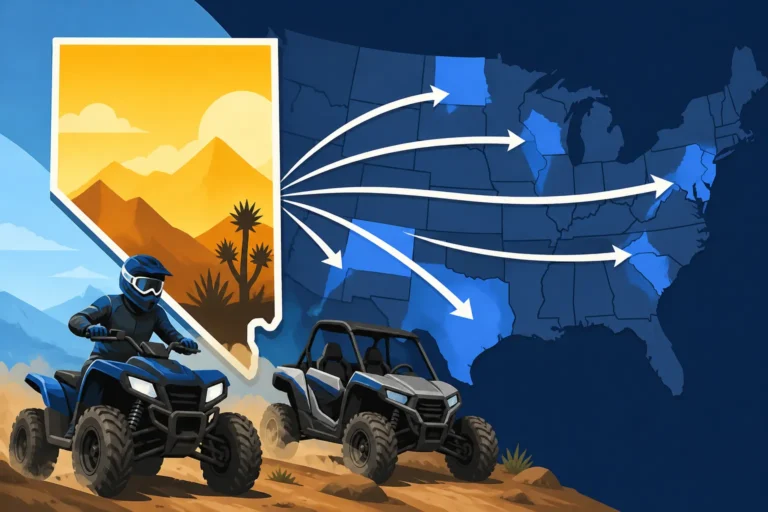
A visitor arriving with an OHV registered in another state should not assume that Nevada’s decal rules work exactly like the rules back home. Reciprocity concerns whether Nevada recognizes an out-of-state registration or decal for a visitor’s machine and under what conditions. The answer may depend on the machine’s status in its home jurisdiction and how long it will be operated in Nevada.
Before traveling, confirm that the registration is valid and that the machine carries the required proof. A faded sticker, an expired registration, or paperwork that belongs to a different vehicle can create problems even if the rider believes their home-state system is accepted. Keep the state-issued documents together and make sure the machine’s identification details match them.
Reciprocity also does not erase local operating restrictions. An accepted out-of-state credential does not turn a closed Nevada trail into an open one, nor does it automatically remove a separate fee at a recreation site. For an overview of visitors’ options, see Nevada OHV Reciprocity With Other States.
The 15-day question and longer stays
Visitors often hear that an out-of-state machine may be operated in Nevada for a limited period before Nevada registration is needed. That limited window is frequently described as 15 days, but riders should confirm how the rule applies to their own situation before relying on it. The type of machine, its registration status elsewhere, and the visitor’s circumstances can matter.
Do not treat the 15-day period as a blanket permission for any machine brought across the state line. It is not a substitute for checking whether the home-state registration is valid or whether the visitor qualifies for the relevant exemption. If the machine is not properly registered in its home state, the rider should not assume that Nevada will treat it as covered by reciprocity.
For a longer stay, or if the visitor is moving to Nevada rather than coming for a short trip, the right next step may be Nevada registration. Those situations are different from a weekend visit. The practical guide Nevada’s 15-Day Window for Out-of-State Machines explains why visitors should identify their category and timeline before riding.
Reciprocity is not identical in every situation
A state may issue an OHV sticker, a registration certificate, a permit, or some combination of documents. Nevada riders crossing a state line should check the destination state’s specific rules rather than assuming a Nevada decal will be accepted everywhere. The same caution applies to visitors bringing machines into Nevada: a familiar sticker from home is not a universal pass.
For a trip that includes several states, make a simple checklist for each jurisdiction. Confirm what proof the machine needs, whether an out-of-state credential is accepted, whether a visitor exemption has a time limit, and whether there are separate fees or land restrictions. It is less stressful to do this at home than to learn about a missing requirement at a remote trailhead.
If you ride across state lines regularly, keep a record of the machine’s registration dates and renewal notices. A folder in your trailer or a secure digital copy can help, but confirm the original documents are available when required. For details on the visitor exemption, Nevada’s Nonresident Exemption in NRS 490.082 is a useful related topic.
Where the decal is not enough
Public land has its own route rules
Nevada’s riding opportunities include areas managed by different public agencies, along with private and locally managed land. Each place can have designated routes, seasonal restrictions, closures, or other conditions. Having a current decal does not give a rider permission to leave the open route and explore wherever the terrain looks passable.
This is easy to overlook in desert country. A wide wash or faint track can look like an inviting shortcut, but it may be closed, cross a protected area, or lead onto private property. Route status can also change because of fire danger, habitat protection, construction, or other management decisions.
Before a ride, check a current land-management map and the destination’s notices. Pay attention to signs at the access point and along the route. If a map and a sign appear to disagree, stop and confirm the rule rather than treating the less restrictive interpretation as permission. Nevada Rules for Riding Federal Land offers more context on public-land responsibilities.
Recreation areas may require separate arrangements
A state OHV registration and a recreation-area pass answer different questions. Registration concerns the machine’s status in the state system. A site-specific pass or fee, when required, concerns access under that location’s rules. The two requirements can apply at the same time.
This distinction matters when planning a destination that is popular, managed, or equipped with facilities. A rider might arrive with a properly registered machine but still need to follow a separate payment, camping, parking, or day-use process. Read the site’s visitor information before departure, especially if the trip includes overnight camping or a holiday weekend.
A good habit is to plan around the actual trailhead or recreation area, not just the nearest town. Confirm where you can park, whether camping is allowed, whether a fee applies, and whether vehicles are restricted to signed routes. The decal is one part of preparation, not a replacement for destination planning.
Private land, wilderness, and closed routes
Neither a Nevada decal nor an out-of-state registration grants permission to ride across private land. A route shown on a consumer map may cross a ranch, mine, or other property. If you do not have permission or clear public access, do not treat the route as open simply because it is visible.
Wilderness boundaries require particular care because motorized travel is generally restricted within designated wilderness areas. The boundary may be difficult to see from the trail, especially in broad desert terrain. Use reliable maps, follow signs, and avoid riding close to a boundary if you are unsure which side of it you are on.
Closed routes are also closed to properly registered machines. This seems obvious, but it is easy to rationalize a short detour when the official trail is blocked or crowded. Resist that temptation. Staying on open routes protects access for other riders and reduces the risk of citations, resource damage, or an expensive recovery from terrain you were not meant to enter.
Avoiding common decal and permit mistakes
Treating the decal as a road-use authorization
The most consequential misunderstanding is assuming that an OHV decal makes a quad or UTV street legal. It does not. Road use has separate rules that may include the type of road, required equipment, operator qualifications, insurance, and vehicle classification. A machine that is properly registered for OHV use can still be prohibited from a particular road.
This often comes up when a rider wants to travel a short distance from a town to a trail system or gas station. “It’s only a few minutes” is not a legal category. Check the road’s status and the machine’s eligibility before riding there, and transport the machine if road use is not permitted.
If you are considering road operation, research the separate requirements rather than trying to infer them from the OHV decal. Street Legal ATVs in Nevada: The Short Answer and Nevada Street Legal UTV Requirements address the distinction between off-highway registration and road use.
Assuming an expired or damaged decal is close enough
A decal that has expired, peeled away, or become unreadable can create avoidable trouble. Owners sometimes believe the registration card alone will settle the matter, or that an old decal is still acceptable because the renewal is “in progress.” Do not leave that to chance. Check the renewal status and make sure the machine displays the current decal as required.
If the decal is damaged or missing, find out how to replace it before your trip. Take care when removing an old decal so you do not damage the mounting surface, and follow the state’s placement instructions for the replacement. It can help to photograph the machine’s identifying information and keep a copy of the registration record, but those backups do not necessarily replace the physical decal.
When packing paperwork, use a pouch that can handle dust and moisture. A clear sleeve or organizer from an outdoor store—or Amazon if that is convenient—can help keep the card legible. Keep the documents separate from tools, snacks, and muddy gloves so they are easy to locate during a check.
Relying on assumptions passed between riders
Advice from a friend can be helpful, but a friend’s trip may not match yours. They may ride a different kind of machine, come from a different state, stay for a shorter period, or visit a different land-management area. Even a confident explanation can leave out the condition that made the rule apply to them.
The same caution applies to online ride reports and old forum posts. Someone may describe a route as open because it was open when they rode it. A temporary closure, fire restriction, or habitat rule can change the situation. Use rider stories for practical tips, but verify legal and access details with the relevant agency or destination.
A simple pre-ride check prevents a lot of stress: confirm that the machine is registered, the decal is current and readable, the documents match the machine, the route is open, and any separate site requirement is handled. Build that check into your packing routine so it does not become a last-minute scramble in the driveway.
A practical pre-ride checklist
Before leaving home
Start with the machine. Check that the decal is current, attached properly, and legible. Then confirm the registration card and any ownership documents are available. If the machine is from out of state, make sure its home-state registration is valid and check whether a Nevada visitor rule applies to your trip length and circumstances.
Next, identify the actual riding area and route. Look for current access notices, closures, seasonal restrictions, and land boundaries. Do not rely on a route line in an app alone. If you are unsure whether a trail is open, get clarification before you leave rather than making a guess once you reach the trailhead.
Finally, separate state registration from site access. Ask whether the destination has a separate fee, pass, reservation, or camping rule. A short planning note on your phone can list the trailhead, the access road, the open route, and the paperwork you need. Keep a physical copy of essential information where service may be limited.
At the trailhead and during the ride
At the trailhead, read posted signs before unloading. They may identify route restrictions, closures, speed limits, quiet hours, or other conditions that were not obvious on the drive in. If the signs indicate a closure, do not use the registration decal as a reason to proceed.
During the ride, remain on the designated open route and keep the required paperwork accessible. If an officer or land manager asks about the machine, answer clearly and show the relevant documents. Avoid digging through a dusty cargo box while holding up traffic; keeping the papers in a secure but reachable place makes the interaction easier.
A phone photo can be a useful extra layer. Save clear images of the registration card and other important documents, and consider storing them offline so you can access them without cell service. Some riders keep those images in a dedicated trip folder, alongside maps and emergency contacts. Do not let the digital copy replace the original documents when originals are required.
If your plans change
Sometimes a trip runs longer than expected, a machine breaks down, or a visitor decides to stay in Nevada for an extended period. Revisit the registration question when the circumstances change. A short visit and a long stay are not necessarily treated the same way, and moving to Nevada can create obligations that do not apply to a temporary guest.
If a trailhead is closed, do not improvise a route across a neighboring property or onto an unsigned track. Find an open alternative through the land manager’s current information. If an area requires a separate pass or has a special access rule, resolve that before riding rather than hoping the decal will cover it.
For families or groups with several machines, check each vehicle individually. One machine may be Nevada-registered, another may carry a valid out-of-state credential, and a third may have an unresolved title or decal issue. Keeping each machine’s paperwork together—and using a document pouch or organizer, including one sourced through Amazon if useful—reduces the chance of mixing up cards when everyone is ready to unload.
Disclaimer
This article is for general informational purposes only and does not constitute professional advice. Laws, prices and regulations vary by location and change over time. Consult a qualified professional for guidance on your specific situation.