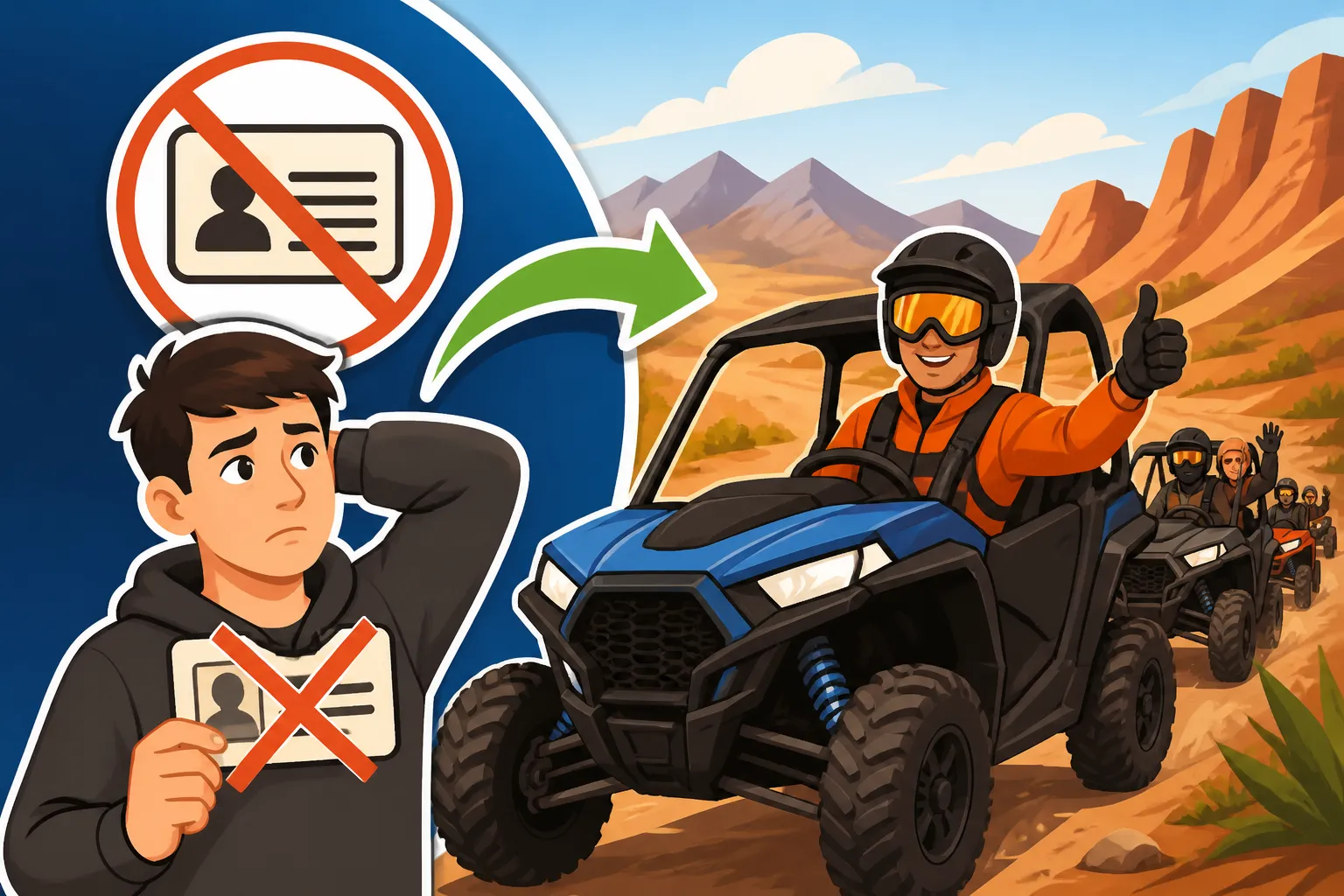
Joining a Guided Ride Without Your Own Permit
Planning a guided ATV or UTV ride in Nevada and wondering whether you need to buy a permit first? In many tours, the operator supplies the machine and handles its registration and land-use arrangements. The key is not to assume that the guide’s paperwork also covers a machine you bring yourself, or every place the group may ride.
When you join on the tour operator’s machine
If you book a guided ride and use the company’s ATV or UTV, you generally do not need to obtain your own Nevada OHV decal for that machine. The operator is responsible for the vehicle it owns or supplies, including the paperwork needed for its fleet. You are not registering the company’s machine in your name simply because you are driving it during a tour.
That does not mean there is no paperwork involved. The operator should have the vehicle’s required registration or decal, and may need separate authorization for a commercial activity or a particular public-land route. What applies depends on where the ride takes place and how the tour is organized. A permit held by the business is not necessarily the same thing as the machine’s registration.
You can ask the operator what it handles before booking. For a tour using company machines, useful questions include:
- Is the machine’s Nevada registration or required out-of-state paperwork current?
- Does the tour price include any site or land-use fee?
- Does the operator have the authorization needed to run commercial tours on the route?
- Will the ride stay on designated routes, or does it include areas with special access rules?
- What paperwork, if any, must the guest carry?
The operator may have a straightforward answer, but it is worth asking rather than treating “guided” as a blanket exemption. A guide can explain the tour’s arrangements; the guest remains responsible for following the briefing and ride rules.
This distinction is especially useful when you are choosing between a tour and bringing a personal machine. For a rented or tour-supplied ATV, the operator’s paperwork is the starting point. For your own machine, your registration status still matters. Nevada Rules for Rented Machines explains the separate responsibilities that can apply when you use a company’s vehicle.
| Ride setup | Do you need your own Nevada OHV decal for the machine? | What to confirm |
|---|---|---|
| Guided tour on the operator’s ATV or UTV | Usually no; the operator handles its machine’s paperwork | The machine is properly registered and the tour is authorized for its route |
| Guided ride on your own Nevada machine | Your own machine generally needs the required Nevada registration | Decal, registration card, and route access |
| Guided ride on your out-of-state machine | Your home-state paperwork and Nevada rules both matter | Reciprocity, any time limit, and whether Nevada registration is required |
| Group ride with a guide but no company-supplied machine | The guide’s presence does not register your machine | Your machine’s paperwork and any event or land-use authorization |
The table is a practical starting point, not a substitute for checking the rules that apply to the exact route and vehicle. If a tour includes a rental, ask whether the operator supplies the vehicle and paperwork or expects you to arrive with your own machine.
What the operator’s permit does and does not cover
“Permit” can mean different things in an OHV conversation. It may refer to a vehicle registration decal, permission to use a particular area, or an authorization for a business to operate a commercial activity. These are not interchangeable.
Nevada’s OHV decal serves as the state’s registration and trail-use credential for machines subject to the requirement. It is not a universal pass that grants access to every road, trail, or parcel of land. Nevada’s Registration Decal as Your Permit describes what the decal does, while What a Special Recreation Permit Covers covers a different kind of authorization tied to certain activities or locations.
A commercial tour operator may need permission to conduct tours on public land, depending on the activity and land manager. That authorization concerns the business’s operation. It does not automatically mean that every customer’s personally owned machine is registered, nor does it override closures, route restrictions, or other rules.
Likewise, a guide’s presence does not make a closed route open. A tour may have approval to use certain routes or areas, but participants should stay with the group and follow the guide’s instructions. If a route changes because of weather, a closure, or a site restriction, the tour operator should be able to explain the alternative.
The paperwork questions to keep separate are:
- Is the machine properly registered? This concerns the ATV or UTV itself.
- Is the business allowed to conduct the tour there? This concerns commercial use or organized activity.
- Is the route open to this machine and this activity? This concerns access restrictions at the specific location.
- Does the guest need to carry anything? This may include a tour confirmation, rental documents, or other information the operator requests.
A guided group ride is not always the same as a commercial tour. Someone may lead friends along a route without operating a business, while another event may involve a paid guide or a formally organized ride. Different land-use requirements may apply. If you are joining an organized event rather than booking a standard tour, ask who is responsible for the event authorization and what participants must provide. [Nevada Group Ride Permit Requirements] offers more context on organized rides.
If the operator cannot explain which paperwork it handles, ask for the distinction in writing before you pay or travel. You do not need to demand confidential business documents, but you should be able to get a clear answer about whether your own vehicle is allowed and what you must bring.
Bringing your own ATV or UTV on a guided ride
If you plan to follow a guide using your own machine, do not assume that joining the tour removes your registration obligation. The vehicle still needs the paperwork required for its status and where it will be operated. A guide may organize the ride, but your machine does not become part of the company’s fleet just because you are riding in the same group.
For a Nevada-owned machine, check that the registration is current and that the decal is properly displayed. Keep the registration card accessible, ideally protected from dust and moisture. Nevada OHV Registration and Proof of Ownership can help clarify the difference between proof of registration and proof of ownership.
If your machine is registered in another state, check Nevada’s reciprocity rules before the trip. Nevada allows certain out-of-state machines to be operated under a limited exemption, but eligibility and timing matter. Do not assume that a home-state sticker is accepted indefinitely, or that every state’s document is treated the same way. Nevada OHV Reciprocity With Other States and Nevada’s 15-Day Window for Out-of-State Machines explain the main issues to verify.
Before arriving with your own ATV or UTV, ask the tour operator:
- Do you allow guests to bring their own machines?
- Does the tour follow a route suitable for my vehicle’s size and type?
- What registration documents or decals will you check?
- Is the route on public land, private land, or a mix?
- Are there equipment requirements, such as a helmet, flag, or required safety gear?
- Is there a separate fee for bringing a personal machine?
- If my registration is from another state, what proof should I carry?
The operator may not be the authority that decides whether your out-of-state paperwork qualifies under Nevada rules. When in doubt, verify with the relevant Nevada OHV office before the trip. The operator can still tell you what it expects to see at check-in and whether it accepts personal machines at all.
For out-of-state riders, do not confuse the time allowed for a visitor’s machine with a tour permit. A visitor exemption concerns the vehicle’s use under Nevada rules. It does not grant access to a closed area or substitute for any land-specific authorization. If you will be in Nevada beyond the applicable period, confirm what registration steps are required before continuing to ride. What a Visitor Does After 15 Days in Nevada covers the next-step question.
What to confirm before you book and on ride day
A little checking ahead of time can prevent a frustrating surprise at the trailhead. Start by identifying what the tour actually includes: a company-owned machine, a rental machine, or a guided route for riders who bring their own vehicles. The phrase “guided ride” alone does not answer that.
Before booking, confirm the operator’s registration and route arrangements. A responsible company should be able to explain whether its machines are properly documented and whether it has the required authorization for the tour activity. If a site charges a separate use fee, ask whether it is included or collected separately. Fees and requirements can vary by location, so verify current details with the operator or the relevant land manager.
Read the tour terms carefully. They may explain who provides the machine, what identification or documents the guest needs, which areas are permitted, and what happens if a route closes. They may also set rules for passenger seating, age, licensing, or safety equipment. Those terms are separate from OHV registration, but they can determine whether you are eligible to participate.
On ride day, bring the information the operator requested. Depending on the tour, that may include identification, a booking confirmation, a driver’s license, or paperwork for your own vehicle. If you are on a company machine, ask where registration information is kept and what you should do if a ranger or officer asks about it. The operator should tell the group how its fleet documents are handled.
If you bring your own vehicle, carry your registration card and make sure the decal is visible and readable. Keep documents protected from water, dust, and damage. A phone photo may be useful as a backup, but do not rely on it as a replacement if the rules or operator require the original document. What Rangers Accept as Proof and Keeping Paperwork Dry in a Dusty Machine offer practical follow-up.
Be cautious if a tour company says that its permit “covers everyone” without explaining what that means. It may mean the business has authorization for its guided commercial activity, not that a personal vehicle is registered or exempt. Ask whether the statement applies to the tour’s land-use permission, the company’s machines, or both. A clear answer can prevent confusion when you arrive.
If you are renting a machine for an independent ride rather than joining a guided tour, the same basic distinction applies: the rental company’s vehicle paperwork is not a separate personal permit for you, and the machine may have limits on where it can go. Check the rental agreement and ask what routes are allowed. Paperwork a Nevada Rental Machine Carries explains what to clarify with a rental provider.
A quick decision checklist
Use this short checklist to work out what you need:
- Identify the machine. Are you riding a tour operator’s vehicle, a rental, or your own ATV or UTV?
- Ask who handles registration. For a company machine, the operator should handle its vehicle paperwork. For your own machine, you remain responsible for its registration status.
- Confirm route authorization. Ask whether the tour operator has permission for the commercial activity and whether the planned route is open to the group.
- Check reciprocity if your machine is from another state. Confirm that your home-state registration qualifies and whether any time limit applies.
- Find out what to carry. Ask about identification, registration documents, booking details, and safety equipment.
- Recheck before departure. Closures, access rules, and operator requirements can change. Confirm current instructions with the operator or the relevant land manager.
For most visitors who book a standard guided tour on a company machine, the operator—not the guest—takes care of the vehicle’s OHV registration. The important exception is when you bring your own machine: your guide’s paperwork does not automatically cover it. Confirm the machine, the route, and the paperwork separately, and you can arrive knowing what is your responsibility and what the operator has arranged.
Disclaimer
This article is for general informational purposes only and does not constitute professional advice. Laws, prices and regulations vary by location and change over time. Consult a qualified professional for guidance on your specific situation.