Riding Nevada on an Oregon Permit
Riding Nevada on an Oregon Permit
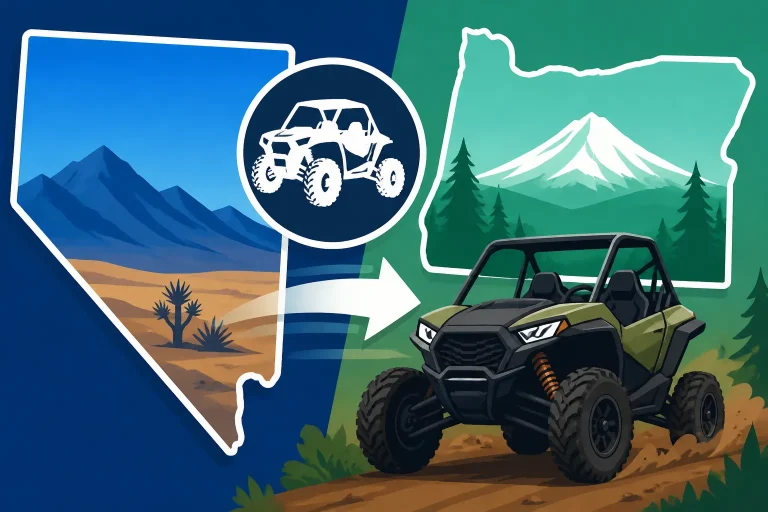
If your ATV or UTV carries an Oregon permit, you may be able to ride it in Nevada without immediately getting a Nevada decal—but the permit is not a blank check for unlimited visits. The answer depends on whether it is valid for your machine, how long you will ride in Nevada, and where you plan to go. Here’s how to check those details before unloading.
Does Nevada Accept an Oregon ATV Permit?
Nevada generally allows a qualifying out-of-state off-highway vehicle to operate there for a limited visit when it has valid registration or a permit from its home state. Oregon riders commonly refer to their document as an ATV permit. For Nevada purposes, the important question is whether that permit is a current, official credential for the specific machine—not just a receipt, application, or trail pass.
Nevada’s nonresident exemption is commonly described as a 15-day window for out-of-state machines. It is a limited exemption, not a transfer of your Oregon permit into a Nevada registration. Before relying on it, check Nevada’s current rule and confirm that your Oregon credential qualifies. The details of the exemption are covered in Nevada’s Nonresident Exemption in NRS 490.082 and Nevada’s 15-Day Window for Out-of-State Machines.
A useful way to think about it:
| Your situation | What to check before riding |
|---|---|
| Short Nevada visit with a current Oregon permit | Confirm the permit is valid for the machine and that the visit fits Nevada’s nonresident exemption |
| Nevada stay longer than the allowed visit window | Ask about Nevada registration before continuing to ride |
| Oregon permit expired or does not cover your machine | Do not assume it counts; resolve the registration or permit issue first |
| Machine is rented or belongs to someone else | Confirm the owner’s paperwork is valid and that you are authorized to operate it |
| Ride includes a fee area or special recreation site | Check for separate site fees, passes, or closures |
This is not the same as saying that every Oregon sticker is accepted for every machine. Oregon has different requirements depending on the machine and where it is operated. Your document should be the correct permit for your ATV or UTV, current for the dates of your trip, and displayed as required by Oregon. If you are unsure what type of credential you have, check with the Oregon agency that issued it before traveling.
Nevada recognition also does not mean your machine is registered in Nevada. A short-term visitor may be able to ride under an exemption, while someone who stays beyond that period may need to register the machine in Nevada. That distinction matters if you are spending an extended season, keeping a machine at a Nevada cabin, or returning repeatedly for longer riding trips. See Riding Nevada With an Out-of-State Registration for the broader rules that apply to visiting machines.
How the 15-Day Window Works
The 15-day period is the key limit for many nonresident riders. Treat it as a limited period of operation in Nevada, not as a fresh allowance every time you cross the state line or move to a different riding area. If your trip could approach that limit, check the current Nevada rule before you ride and keep a clear record of when the machine is being operated in the state.
Do not assume that storing the machine, taking a break from riding, or crossing into another state restarts the clock. The way a time limit is counted can depend on the wording of the rule, and relying on an informal interpretation can leave you exposed to a citation. If you expect to stay beyond the exemption, contact the Nevada OHV program or DMV before the visit window runs out. The practical next steps are discussed in What a Visitor Does After 15 Days in Nevada.
Count the visit conservatively
Make your plan before the trip rather than trying to reconstruct the timeline later. Note the date the machine first enters Nevada, when it is operated, and the date it leaves. If several people share one machine or you move it between camps, keep the record with the machine’s paperwork.
A simple trip note can include:
- The machine’s make, model, and VIN
- The Oregon permit number and expiration date
- The date it entered Nevada
- The dates and areas where it was ridden
- The date it left Nevada
- Any confirmation you received from an official agency
This record is not a replacement for registration, but it can help you explain your situation if a ranger or officer asks how the machine is authorized to operate.
Longer stays call for a different plan
If you are coming for an extended stay, do not treat the short-term exemption as a substitute for Nevada registration. Ask what paperwork applies to your machine, whether a Nevada title is needed, and how to handle a machine with an Oregon permit or title. Requirements can vary with the machine’s ownership history and the documents you have.
Start well before the trip if you can. A missing title, an incomplete bill of sale, or a VIN issue may take time to sort out. For background on the process, see Registering a Machine Delivered From Out of State and Nevada OHV Registration and Proof of Ownership.
Check the Oregon Paperwork Before You Leave
The safest trip starts with a paperwork check at home. A permit that is valid for one machine or riding context may not be the right credential for another. Make sure the document matches the machine you are transporting and that it will remain valid throughout the trip.
Check these points:
- Confirm the permit is current. Look at the expiration date and any renewal status. Do not rely on a seller’s statement that the permit is “good for a while.”
- Match the document to the machine. Verify the VIN, identifying information, and permit details against the machine and your ownership papers.
- Check that it is the right kind of Oregon credential. A receipt, title, temporary document, or land-use pass is not necessarily the same as an operating permit.
- Make sure the permit is displayed correctly. Follow Oregon’s display requirements and avoid covering the number or other identifying information with accessories.
- Carry proof of ownership or authorization. If the machine is borrowed, rented, financed, or jointly owned, bring documents that help explain who owns it and who may operate it.
- Check the Nevada rule close to departure. Confirm the nonresident exemption and any conditions with an official Nevada source, especially if the trip is near or beyond the 15-day limit.
A title and an operating permit serve different purposes. The title generally relates to ownership; the permit or registration relates to operating the machine. Carrying a title does not automatically prove that the machine has a valid operating credential, and an operating sticker does not necessarily settle an ownership question. For help understanding the distinction, see What an OHV Title Looks Like.
Carry the original documents when practical, and keep a backup copy in a separate place. A phone photo can be useful if paperwork gets wet or misplaced, but it should not be your only plan. Store documents where dust, rain, fuel, and a loose water bottle will not ruin them. A small document pouch from Amazon may help keep a paper copy together with your registration card; check that it closes securely and can be kept in a protected part of the machine.
Keep the VIN easy to locate and legible. If it is obscured by dirt, a guard, or an accessory, clean the area before the trip. Do not alter, restamp, or remove identifying marks. If the VIN is damaged or difficult to read, sort that out before traveling rather than waiting for a roadside inspection.
If your machine has an Oregon permit but you cannot find a title, do not assume the permit alone resolves proof of ownership. Gather whatever original purchase, transfer, or estate documents you have and ask the relevant agency what is acceptable. A private sale without good paperwork can create extra problems when you need to establish the machine’s identity or register it in another state.
An Oregon Permit Does Not Cover Every Nevada Ride
A valid Oregon permit and Nevada’s nonresident exemption address the machine’s operating credential. They do not grant access to every trail, road, dune, or parcel of public land. You still need to ride where OHVs are allowed and follow the rules for the specific route and recreation area.
Before setting out, check the managing agency’s current map or route information. Land managers may close routes for habitat protection, fire danger, maintenance, weather, or other conditions. A route shown on an older map may not be open today. The same caution applies to private land, tribal land, military areas, and posted closures: an out-of-state permit does not give permission to enter.
Some riding areas also charge a separate recreation fee or require a site-specific pass. That charge is different from vehicle registration. Nevada’s statewide OHV decal functions as the state’s registration and permit for eligible machines, but a visitor’s Oregon credential does not pay a recreation-area fee. Check the site’s current instructions before you arrive, particularly if you are visiting a fee area such as Sand Mountain. A general overview is available in Nevada Permits for Riding BLM Land.
The practical distinction is:
- Vehicle authorization: whether the machine has the required operating credential.
- Route authorization: whether the route is open to your kind of vehicle.
- Site access: whether the area requires a separate fee, pass, reservation, or permit.
- Road use: whether the machine is allowed on a public road and meets the applicable road-use requirements.
Do not treat a trailhead sign, a state permit, or a map as proof of all four. Check each one separately. A machine can be properly permitted and still be on a closed route; a legal route can still be within an area that requires an additional pass.
Carry the information you need offline. Cell service can be unreliable in remote areas, so download current maps and save the relevant agency contact details before leaving town. You can keep a paper map in a protected pouch, and a phone mount or weather-resistant phone case found through Amazon may make it easier to consult downloaded maps while stopped. Do not handle a phone while riding.
If your route crosses between Nevada and another state, check the rules on both sides. The fact that Nevada accepts an Oregon permit for a limited visit does not mean Oregon will treat a Nevada credential identically, or that a permit from either state is enough for every type of land. Reciprocity is state-specific. Related explanations include Nevada Reciprocity With California, Nevada Reciprocity With Arizona, Nevada Reciprocity With Utah, and Nevada Reciprocity With Idaho.
A Practical Pre-Trip Checklist for Oregon Riders
Use this checklist before loading the machine. It is especially helpful when one person handles the trailer, another carries the paperwork, and the group plans to ride several different areas.
Vehicle and document check
- Confirm the Oregon permit is current and applies to this exact machine.
- Check the VIN on the machine against the permit and ownership documents.
- Bring proof of ownership or permission to operate the machine.
- Keep the documents protected from dust and water.
- Save a backup image of essential paperwork on your phone.
- Record the date the machine enters Nevada and plan around the nonresident limit.
- If the visit may extend beyond the exemption, ask Nevada about registration before riding.
Route and site check
- Confirm that each route is open to the machine and riding type.
- Check for seasonal closures, fire restrictions, and temporary notices.
- Look for separate day-use fees or passes at the destination.
- Download maps before entering areas with weak service.
- Identify fuel, water, and a realistic turnaround point.
- Tell someone where the group plans to ride and when it expects to return.
If your plans change
A short weekend trip can turn into a longer stay because of weather, a breakdown, or a change in plans. If that happens, pause and reassess the paperwork before continuing to ride. Contact the relevant Nevada office, explain that the machine has an Oregon permit, and ask what steps apply to your situation. Keep notes about whom you spoke with and what they told you, but do not treat an informal conversation as a substitute for meeting the actual registration requirement.
If a machine is stopped for a paperwork check, stay calm, provide the documents you have, and answer clearly. Do not present an Oregon permit as a Nevada decal or suggest that the machine is Nevada-registered if it is not. If the question is whether your visit falls within the nonresident exemption, your permit and trip dates are the useful details to have ready.
The best approach is straightforward: make sure the Oregon permit is genuine and current, keep the visit within Nevada’s nonresident allowance, verify access rules for each riding area, and get official guidance before extending the stay. If the visit is longer than planned, do not wait until the last ride to ask about Nevada registration.
Disclaimer
This article is for general informational purposes only and does not constitute professional advice. Laws, prices and regulations vary by location and change over time. Consult a qualified professional for guidance on your specific situation.