Nevada OHV Reciprocity With Other States
Nevada OHV Reciprocity With Other States
Taking an ATV or UTV across a state line can turn a simple ride into a paperwork question: does your home-state sticker count in Nevada, and will Nevada’s decal count when you ride elsewhere? The answer depends on the machine’s registration, how long it will be in Nevada, and the rules of the state or riding area you enter. Here’s how to check reciprocity without mistaking a registration decal for a universal trail pass.
The short answer: reciprocity is conditional
Nevada does not operate under a single nationwide OHV registration system. A current registration or permit from another state may satisfy Nevada’s requirements for a qualifying visitor, but that does not mean every out-of-state sticker is accepted in every situation—or that Nevada’s decal automatically works across state lines.
For eligible nonresidents, Nevada has a limited exemption for some machines registered in another state. The exemption is commonly described as a 15-day window. If you will be in Nevada longer, or your machine does not meet the exemption’s conditions, you may need a Nevada OHV decal. Check the current rule and its details before relying on the exemption. Nevada’s Nonresident Exemption in NRS 490.082 explains the legal framework, while Nevada’s 15-Day Window for Out-of-State Machines focuses on the time limit.
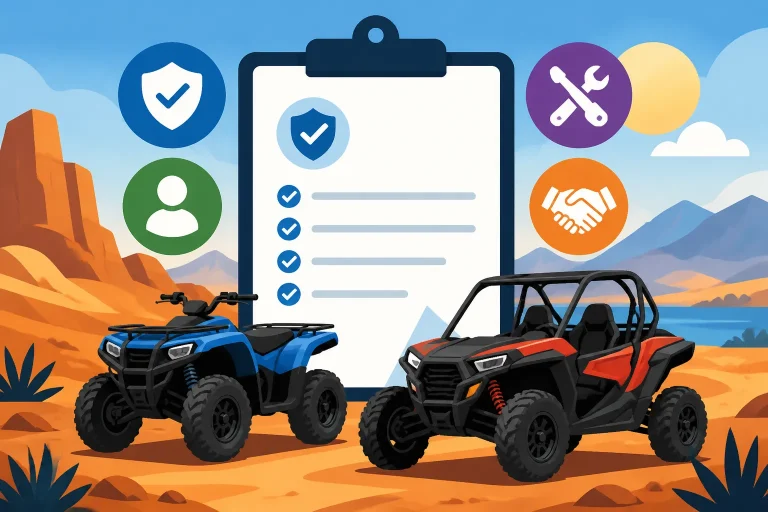
The practical answer is to verify three things separately:
- Your machine’s home-state registration or permit: Is it valid, and does it apply to this particular ATV or UTV?
- Nevada’s visitor rules: Does your machine qualify for Nevada’s nonresident exemption, and are you within the allowed period?
- The place where you plan to ride: Does the land manager, recreation area, or local authority require anything beyond state registration?
A state registration decal is not the same thing as permission to ride every road or trail. It also does not replace a recreation-area fee, an event permit, insurance required for a road-use situation, or rules about vehicle equipment and rider conduct.
| Your situation | What to check before riding |
|---|---|
| You are visiting Nevada briefly with an out-of-state OHV registration | Whether the registration is current and whether your machine qualifies for Nevada’s visitor exemption |
| You will keep the machine in Nevada beyond the visitor window | Whether you must obtain Nevada registration and what application documents are required |
| Your home state issues a permit rather than a conventional registration | Whether Nevada accepts that specific document for the nonresident exemption |
| You are riding a Nevada-registered machine in another state | Whether that state recognizes the Nevada credential or requires its own nonresident permit |
| You are riding at a fee-based or managed recreation area | Whether a separate entrance, recreation, or event fee applies |
| You plan to use roads as well as off-road routes | Whether road access, equipment, licensing, insurance, and local rules allow it |
When the paperwork is unclear, don’t assume that the word “registration” on a card, website, or sticker settles the issue. States use different systems and names for their credentials. Ask the relevant state OHV office or land manager about the specific document you have, the vehicle it covers, and the planned dates of your ride.
What Nevada reciprocity does—and does not—cover
Reciprocity is a form of recognition between jurisdictions. In the OHV context, it usually means one state allows a visitor to use a current credential issued by another state instead of obtaining a separate local registration for a limited situation. But the terms matter. Reciprocity may depend on the visitor’s residency, the machine’s home-state registration, how long the machine is present, and whether the credential is valid for the vehicle being ridden.
Nevada’s nonresident exemption is the starting point for visitors bringing a machine from elsewhere. It is not a general promise that any sticker from any state will be accepted indefinitely. Nor does it mean every visitor can ride without paperwork. If your state does not require the machine to be registered, for example, that may leave you with no current registration to show Nevada. Check the Nevada rule rather than assuming an exemption applies simply because you are a visitor.
It is also useful to separate four kinds of paperwork that riders often lump together:
- State OHV registration or permit: The credential tied to the machine under state law.
- Proof of ownership: A title, bill of sale, or other document establishing who owns the machine. Registration and ownership documents are related, but they are not interchangeable. See Nevada OHV Registration and Proof of Ownership if you are sorting out that distinction.
- Land-access or recreation fee: A charge or permit imposed by a specific recreation area, event, or land manager. A state decal does not necessarily cover it.
- Road-use requirements: Additional rules may apply if you plan to travel on roads open to certain OHVs. Off-highway registration by itself does not make an ATV or UTV street legal.
Nevada’s OHV decal serves a state registration purpose and is associated with riding on places where the state credential is required. It does not give a rider permission to ignore posted closures, travel-management maps, private-property boundaries, or restrictions from a land manager. For the broader distinction between state registration and riding authorization, see Nevada OHV Permits Explained and Nevada Rules for Riding Federal Land.
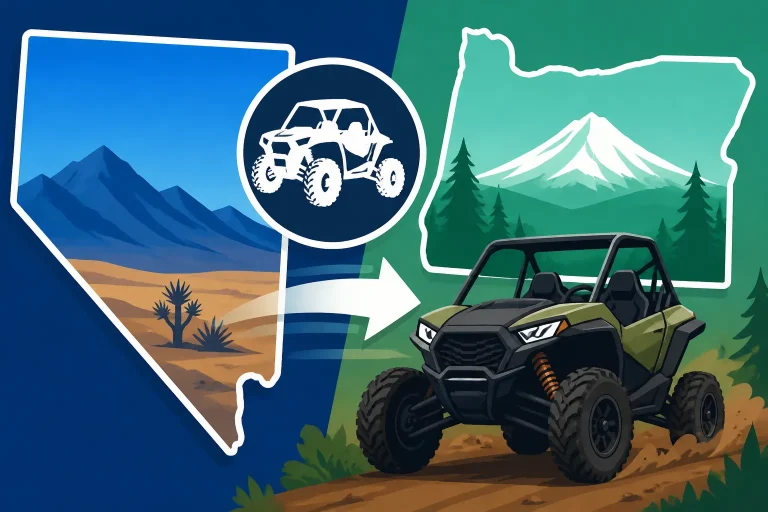
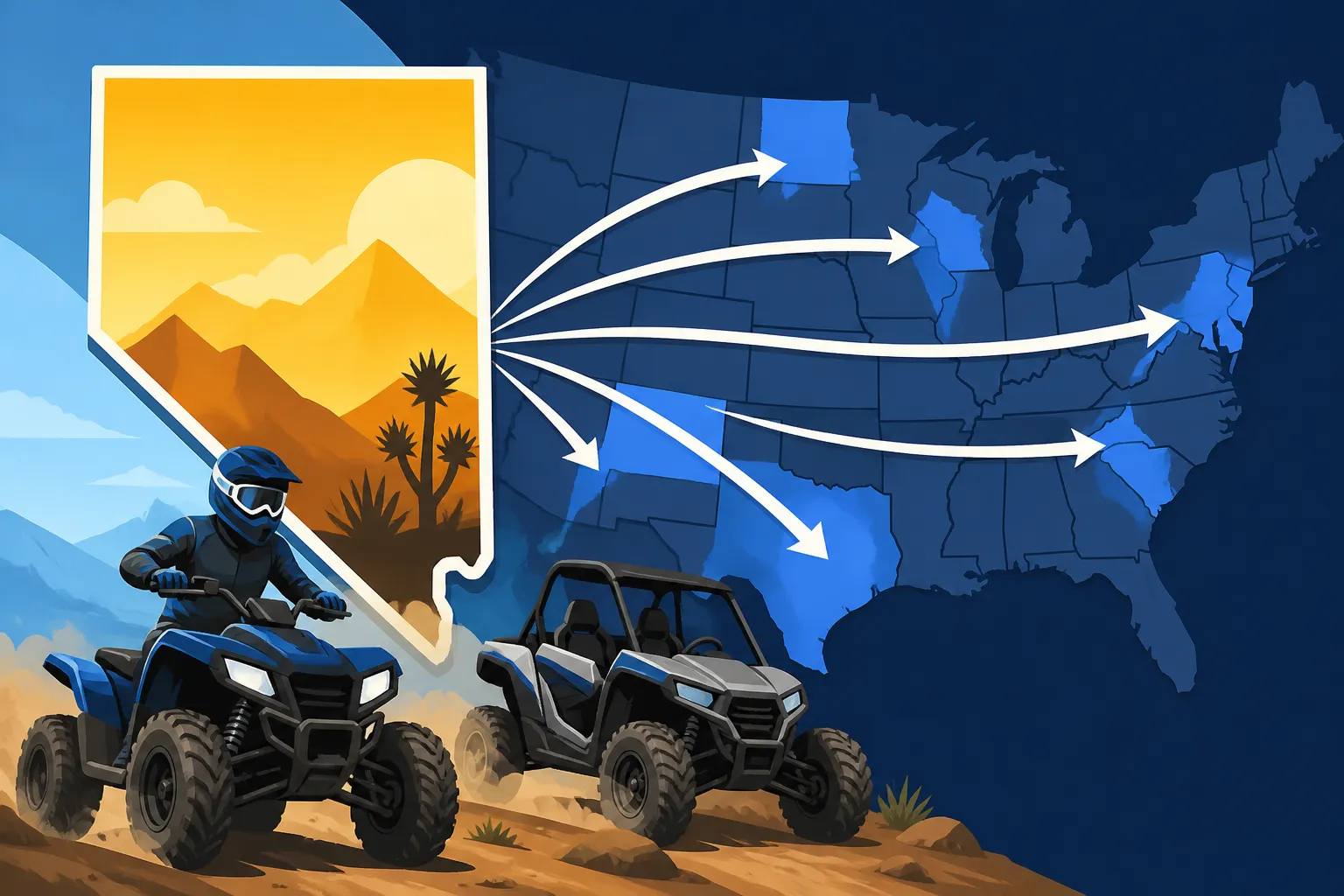
The reverse direction works the same way: Nevada’s decal is not a universal license to ride in other states. A neighboring state may recognize it for some visitors, may require a separate nonresident permit, or may have different conditions based on where the machine is registered and how long it will be there. The right question is not simply, “Does that state have reciprocity with Nevada?” Ask: “Will this state accept my current Nevada OHV credential for this machine, on these dates, at this riding location?”
Bringing an ATV or UTV from another state into Nevada
A visitor should be ready to show that the machine is properly registered or permitted in its home jurisdiction, if that jurisdiction requires it. Carry the registration document and make sure the identifying information matches the machine. If the machine’s VIN, registration number, or owner name differs across documents, resolve that before leaving home.
The decal alone may not answer every question. Some credentials are attached to the machine; others are issued to the owner or operator, and some states use different systems for different vehicle types. Keep any registration card or permit document that came with the sticker. A phone photo can be a useful backup, but it should not be your only record if the original paperwork is available and required.
Nevada’s rules for visitors are especially important if your stay is longer than a weekend. The limited nonresident exemption is not a replacement for Nevada registration for an out-of-state machine that no longer qualifies. Before a lengthy stay, confirm when the allowed period begins, how the days are counted, and whether any exceptions apply to your circumstances. What a Visitor Does After 15 Days in Nevada covers the point at which a visitor may need to change course.
Common home-state credentials
The state name printed on your sticker does not, by itself, determine whether you can ride in Nevada. You need to know what that credential actually is, whether it is current, and whether it covers the machine you are bringing.
| Home state or credential | What to verify before the trip |
|---|---|
| California Green Sticker | Confirm the sticker or registration is current and belongs to the machine; check whether the vehicle qualifies for Nevada’s visitor exemption. See Riding Nevada on a California Green Sticker. |
| Arizona OHV decal or registration | Confirm the credential is valid for that machine and ask how Nevada treats it for a nonresident visit. See Riding Nevada on an Arizona Decal. |
| Utah OHV registration | Check that the registration has not expired and confirm the Nevada exemption applies to the type of machine and trip. See Riding Nevada on a Utah Registration. |
| Idaho OHV sticker or registration | Verify what the credential covers and whether it is current; do not assume the sticker alone settles Nevada compliance. See Riding Nevada on an Idaho Sticker. |
| Oregon permit | Confirm the permit is valid for the vehicle and that Nevada recognizes it under the applicable visitor rule. See Riding Nevada on an Oregon Permit. |
| Another state’s registration or permit | Ask Nevada’s OHV authority whether that exact credential qualifies; “valid at home” does not always mean “accepted everywhere.” |
These examples are not a substitute for checking current state requirements. A credential may have expired, may apply to a different class of vehicle, or may not be a registration at all. If a machine has a street-vehicle plate but no OHV credential, do not assume the road plate automatically satisfies off-highway registration rules. Likewise, an OHV decal should not be treated as a license for ordinary road travel.
Machines with unusual paperwork
Some situations deserve an extra check before departure:
- A newly purchased machine: The prior owner’s paperwork may not establish that your own registration is current or transferable. Ask what documents you need for the ownership change and for riding during the transition.
- A rental machine: The rental business may handle the machine’s registration paperwork, but you still need to follow the rental contract and the riding-area rules. Ask the company what documents are carried with the machine and where you are permitted to ride.
- A machine registered to someone else: Confirm you have permission to use it and that the registration is valid for the vehicle. If the owner’s name and operator’s name differ, bring the documentation the issuing authority recommends.
- A machine with no home-state registration requirement: Do not assume that the absence of a home-state sticker automatically creates a Nevada exemption. Ask Nevada what applies to a nonresident vehicle that has no home-state OHV credential.
- A machine that has been modified or reclassified: A different vehicle category can affect which rules apply. Check the classification rather than relying only on the model name or seller’s description.
If you cannot establish that the credential applies to the machine, resolve the question before loading the trailer. It is much easier to call an issuing office or check an official state page at home than to discover a paperwork problem at a trailhead.
Nevada’s visitor time limit and when to register
The 15-day visitor window is a key part of Nevada reciprocity, but riders should not guess how it applies to their own trip. Confirm the current statutory language and how the days are counted. In particular, ask whether the period is based on consecutive days, total days, or another measure, and whether the clock begins on entry into Nevada, arrival of the machine, or the first day it is operated. Do not assume that leaving the state briefly resets the period.
Keep a simple record of when the machine entered Nevada and when it was used. That record is not a substitute for legal advice or official confirmation, but it helps you answer basic questions accurately if your visit lasts longer than planned. If you are staying at a cabin, storing the vehicle with family, or leaving it in Nevada while you travel elsewhere, ask whether those circumstances affect the deadline. Nevada Registration for a Machine Kept at a Cabin addresses the kind of situation where the owner’s travel plans and the machine’s location do not line up neatly.
If your machine will remain in Nevada beyond the applicable exemption, ask the state OHV office what registration route fits. The application may depend on where and how you acquired the machine, whether you have a title, and whether a VIN inspection is required. A visitor should not wait until the last minute to figure that out, especially if the machine came from outside Nevada or the ownership paperwork is incomplete. Registering an Out-of-State Machine in Nevada and Nevada OHV Registration Paperwork Checklist can help you identify what to gather.
A practical approach is:
- Identify the exact credential. Record the issuing state, registration or permit number, expiration date, and vehicle information.
- Check the machine’s status at home. Make sure the registration is valid for this vehicle and is not merely a prior owner’s expired decal.
- Confirm Nevada’s visitor rule. Ask whether the machine and credential qualify, and how the time period is counted.
- Compare the rule with your itinerary. Include storage and unexpected extensions, not just the dates you initially plan to ride.
- Ask about Nevada registration if the trip could run long. Find out what applications and documents apply before you need them.
- Keep proof accessible. Carry the relevant document in a protected place and keep a separate backup.
If you need a Nevada credential, check whether the office or dealer you plan to use handles the type of application you need. Registration procedures can differ based on whether the machine was bought in Nevada, bought out of state, or acquired in a private sale. Registering Through a Nevada Dealer is useful for understanding the dealer route, while Nevada’s Form for an Out-of-State Purchase helps with the paperwork side of an out-of-state acquisition.
Nevada’s decal does not automatically travel with you
A Nevada OHV decal may meet Nevada’s own registration requirement, but it should not be treated as a portable permit recognized by every other state. Once you cross a border, the state you are entering sets the rules for visiting machines. It may accept a Nevada registration, require a separate state permit, or impose additional conditions for certain areas.
That matters in both directions. A Nevada resident taking a machine to California should check California’s current requirements rather than assuming Nevada reciprocity works there. The same is true when riding in Arizona, Utah, Idaho, Oregon, or elsewhere. A neighboring state may distinguish between a machine registered in another state and one that is merely carrying a trail sticker. It may also set a separate deadline for visitors.
Before leaving Nevada, ask the destination state:
- Does it recognize Nevada’s current OHV credential for a nonresident?
- Does recognition depend on the vehicle being registered to the rider or owner?
- Is a separate nonresident permit required?
- Is there a limit on how long the machine can operate in the state?
- Does the permit apply statewide or only to certain public lands?
- Are there separate passes or fees for the intended riding area?
- Are there road-use rules, safety requirements, or equipment standards that apply in addition to OHV registration?
If the answer is not clear, ask the destination state’s OHV agency or the local land manager. A retailer, online discussion group, or old travel post may describe what worked for someone else but not the current rule for your credential or riding location.
The direction of travel can also make a difference. A Nevada credential may be recognized under another state’s visitor policy but still fail to cover a particular managed area or event. In the same way, a nonresident decal or permit issued by another state may be accepted for state registration purposes in Nevada while a recreation area charges its own access fee.
A good rule is to think of your paperwork as a set of layers rather than one all-purpose sticker:
- Home-state compliance establishes that the machine is properly registered or permitted where it is based.
- Destination-state recognition determines whether that home credential is acceptable for a visitor.
- Local access rules determine where and when you may ride.
- Road-use rules determine whether you may use a road or cross it, and what equipment or operator qualifications apply.
This layered approach prevents the most common misunderstanding: “My machine has a sticker, so I can ride anywhere.” A sticker can be valid and still not authorize access to a closed route, a private trail, a fee-controlled recreation area, or a road that does not allow OHVs.
Registration is not the same as permission to ride
A valid registration answers a limited question: whether the machine has the required state credential for the use covered by that law. It does not automatically answer whether a particular trail is open, whether you may cross private land, or whether the machine meets road-use requirements.
Nevada riders should confirm the land manager’s rules for each destination. Public land can have designated routes, seasonal closures, wilderness boundaries, habitat restrictions, and other limits. A route visible on a general map may not be open to motorized travel. For a specific trip, use current maps and contact the responsible office when the route status is uncertain. Reading a BLM Travel Management Map is a useful companion for interpreting route designations.
Some recreation areas also charge for access or provide facilities under a separate fee system. A state decal should not be assumed to pay that charge. Before leaving, check the destination’s official information for day-use fees, annual or weekly passes, camping rules, operating hours, and closures. Sand Mountain, for example, has its own recreation-area fee structure; that is separate from the general question of whether your machine’s state registration is recognized. See Nevada’s Only Pay-to-Ride Dune for more on that distinction.
Road use is another separate issue. Nevada has rules for particular types of large ATVs and designated road situations, but an ordinary OHV decal does not make a quad or UTV street legal. A road-use decal or classification, if available for a qualifying machine, does not erase county or city restrictions. It also does not grant access to roads that are closed to OHVs. If your trip includes roads, check the route and vehicle requirements independently. Street Legal ATVs in Nevada: The Short Answer provides context for why registration and road access are not the same thing.
Carry the information needed to show the machine’s status, but don’t let paperwork distract from the rest of trip planning. A rider may also need to consider:
- Whether the machine is allowed on the chosen route
- Whether the route is open on the planned date
- Whether a local recreation fee applies
- Whether the vehicle has enough fuel and water for the ride
- Whether the operator and passengers meet applicable rules
- Whether the machine’s equipment is suitable for the route
- Whether weather, fire restrictions, or seasonal conditions affect access
For a machine brought from another state, these checks can be especially important because a rider may be unfamiliar with Nevada’s terrain and local closures. A valid out-of-state sticker cannot make an unsafe route safe or reopen a trail that is closed.
A pre-trip reciprocity checklist
Use this checklist whenever you bring an ATV or UTV into Nevada—or take a Nevada machine to another state.
Confirm the registration document
Read the actual document, not just the sticker. Note the issuing state, vehicle description, registration number, expiration date, and any limitations. Make sure the machine’s VIN or other identifying number is consistent with the paperwork. If the vehicle has changed owners, do not assume the former owner’s credential is sufficient.
A clear document photo can serve as a backup, but carry the original card or permit if the issuing authority expects it. Keep copies separate from the originals so one lost bag does not leave you with no record. A small waterproof pouch can protect papers from dust and water. If you order one from Amazon, check that it closes securely and is large enough for the full-size documents, not just a folded card. You can also use a labeled pouch for each machine when a group is towing several vehicles. Amazon listings vary, so check the dimensions and closure style rather than choosing by the product title alone.
Check the visitor exemption with Nevada
Confirm that Nevada recognizes the particular home-state credential and that your machine meets the conditions for the nonresident exemption. Ask how the time limit is calculated and what happens if the machine remains in Nevada beyond it. If the owner is not the person riding, or the vehicle is stored in the state while its owner is elsewhere, explain those details when you ask.
Do not rely on a verbal summary if you can find the current official rule or get written guidance from the responsible office. If the answer depends on the type of vehicle or credential, state the model and the exact document you hold.
Check the destination, not just the state
Identify the actual trail system, recreation area, public-land route, or private property where you intend to ride. Confirm the route is open to your type of machine and that no extra permit or fee applies. If you are riding with a club, guide, or event organizer, ask who is responsible for any event-specific authorization and what riders must bring.
Review the return trip
If you will cross through more than one state, check the rules for each state in your route. Do not assume that a permit required at the destination is also recognized on the way there, or that a state’s rules are identical for a short border crossing and a longer stay. Keep a note of the state offices or land managers you contacted and the information they gave you.
Keep the paperwork usable
Dust, water, heat, and vibration are hard on paper. Store the registration card where it will not be crushed or soaked, and make sure it can be reached without unpacking the whole trailer. If you have several machines, label each document pouch so you can quickly match the correct paperwork to the correct vehicle. An Amazon pouch may work for that purpose, but any secure, readable, weather-resistant holder is fine.
Do not put your only copy somewhere that requires tools or a long teardown to reach. A roadside or trailhead check is exactly the wrong time to discover the documents are buried beneath cargo.
Common reciprocity mistakes and what to do instead
Assuming all state stickers are equivalent
A decal might be a registration, a trail permit, a land-access pass, or a local fee receipt. Those are different things. Read the paperwork and ask the issuing state what it covers. Then ask Nevada whether that specific credential meets the nonresident rule.
Treating the visitor window as unlimited
A short visit and a long stay are not the same. If the machine will remain in Nevada, confirm the time limit before arriving and keep an eye on the dates. If your trip changes, check what to do before the allowed period ends. Do not assume a brief trip outside Nevada resets the clock.
Confusing registration with ownership
A registration document may identify the machine without proving that you own it. If you bought the ATV or UTV recently, carry the ownership documents you have and check whether the transfer is complete. If you are missing paperwork, resolve that separately; a valid decal may not fix a title or bill-of-sale problem. Nevada OHV Registration Without a Title explains why registration and title questions can be different.
Assuming a Nevada decal works everywhere
Other states set their own rules for nonresident machines. Before an interstate trip, check the destination’s current requirements and any local area rules. This is especially important if your route crosses several states or includes both public and private riding areas.
Believing registration means road access
A machine can be registered for off-highway use and still be prohibited from a public road. If your plan includes riding from town to a trailhead, crossing a highway, or using a county road, verify the road rules for the specific vehicle and location. A standard OHV decal is not a road-use authorization.
Forgetting area-specific fees
A state may recognize your home credential while a recreation area still charges its own entry or camping fee. Check the area’s rules before you arrive, particularly if you are visiting a managed dune or a site with controlled day use.
Relying on a friend’s old experience
Rules can change, and a friend may have had a different type of vehicle, registration, or itinerary. Use personal advice as a lead, not as final confirmation. The correct question is about your document, your machine, your dates, and your destination.
When you are unsure, pause and verify. A few minutes with the right agency can prevent a wasted trip, a citation, or a misunderstanding at the trailhead. More importantly, it helps you avoid treating a registration decal as permission to ride somewhere that is closed or not open to OHVs.
Disclaimer
This article is for general informational purposes only and does not constitute professional advice. Laws, prices and regulations vary by location and change over time. Consult a qualified professional for guidance on your specific situation.