What a Large ATV Decal Costs to Add
Navigating the unique rules for riding off-highway vehicles (OHVs) on Nevada's county roads can feel like trying to solve a puzzle with half the pieces missing. Many riders find themselves scratching their heads, wondering if their beloved side-by-side or ATV can even qualify for limited street use, let alone what it costs to get the necessary permits. This guide is here to untangle the confusion, walk you through the specifics of Nevada's "Large ATV" decal, and break down exactly what you can expect to pay to get your machine legal for those short stretches of pavement.
Understanding Nevada's "Large ATV" Designation and Why It Matters
Before we dive into the costs, it's crucial to understand what Nevada considers a "Large ATV" and why this specific designation even exists. This isn't just a fancy name; it's a legal classification that determines whether your off-highway vehicle can gain limited access to certain paved roads. The state doesn't just hand out street-legal privileges to any ATV or UTV; there are very specific criteria your machine must meet, which are detailed in [What Nevada's NRS 490.043 Counts as a Large ATV].
What Qualifies as a "Large ATV" in Nevada?
So, what exactly does Nevada mean by "Large ATV"? Forget what you might think based on engine size or physical dimensions; Nevada has its own unique definition. Under NRS 490.043, a "Large All-Terrain Vehicle" is essentially a side-by-side (UTV) that meets certain conditions, primarily related to its seating and cargo capacity. It must be designed to carry at least two persons and have a truck bed, or be designed to carry at least four persons. This is a crucial distinction that often catches riders off guard.
For instance, if you have a two-seat sport quad, even if it's powerful and large, it simply won't qualify. The law specifically looks for those multi-passenger or cargo-hauling features typical of a UTV. Think of a utility side-by-side like a Polaris Ranger, a Can-Am Defender, or a four-seat recreation model like a RZR XP 4 1000. These kinds of machines are generally what Nevada is targeting with the "Large ATV" definition. They’re built with features that make them more akin to small trucks or golf carts than traditional single-rider ATVs. The intent is to allow machines that can perform some utility functions or carry multiple people to cross or briefly use paved roads, not to turn every dirt machine into a street cruiser.
The Purpose of the Large ATV Decal
Why bother with this specific decal if you already have a standard OHV registration decal? The regular OHV decal from the Nevada Department of Motor Vehicles (DMV) is primarily for identification and to show you've paid your off-road fees, which help maintain trails. It doesn't grant you any special privileges for road use. The [Nevada Large ATV Decal Cost] specifically addresses the ability to operate on public paved roads.
The Large ATV decal, on the other hand, is your golden ticket for limited on-road use. It signifies that your UTV has been inspected and meets the additional equipment requirements set forth by the state for operation on designated county roads and, in some cases, certain city streets. Without this decal, taking your "large ATV" onto any paved public road, even just to cross it, could lead to a citation. It’s the state’s way of acknowledging that some OHVs, due to their design, can safely share certain road spaces, but only if they meet stricter standards.
How Much Does a Nevada Large ATV Decal Cost?
Now, let's get down to the brass tacks: what does this special decal actually cost you? Compared to the overall investment in your UTV, this fee is relatively modest, but it's an essential part of making your machine road-legal in Nevada.
The Decal Fee Itself
The fee for the Nevada Large ATV decal is typically a flat rate. It’s designed to be an additional permit on top of your standard OHV registration, not a replacement for it. This means you’ll already have paid for your regular OHV decal, whether that was the [Nevada OHV Registration Fee for One Year] or the [Nevada OHV Registration Fee for Three Years]. The Large ATV decal is an extra item you add to your existing registration.
The specific cost for the Large ATV decal is generally a set amount. This fee helps cover the administrative costs associated with processing the application, verifying eligibility, and issuing the decal. It's a one-time fee per application, and it doesn't change based on the value or size of your particular UTV, as long as it meets the definition of a "Large ATV." Be sure to check the Nevada DMV's official OHV section for the most current figures, as these can be subject to change over time.
Understanding Other Potential Costs
While the decal itself has a straightforward fee, it's rare that this is the only cost you'll incur when trying to make your UTV road-legal. There are several other factors and potential expenses to consider:
-
Original OHV Registration: As mentioned, the Large ATV decal is an addition to your existing OHV registration. If your machine isn't already registered, you'll need to pay the standard OHV registration fees first.
-
Required Equipment Upgrades: This is often the most significant "hidden" cost. To qualify for the Large ATV decal, your UTV must meet specific equipment requirements that go beyond what's needed for off-road use. This includes items like:
- Headlights and taillights (visible from certain distances)
- Stop lamps (brake lights)
- Reflectors
- A horn
- Mirrors (typically one on the left side, or a center rearview mirror if the rear view is unobstructed)
- A windshield (unless wearing eye protection)
- Seat belts (for all occupants, if equipped)
- A spark arrester and muffler (which you should already have for off-road use, but they must meet certain standards for road use)
If your UTV isn't already equipped with these items, you'll need to purchase and install them. For instance, many stock UTVs might not come with a street-legal horn or proper mirrors. This is where aftermarket parts come into play. Reputable brands like SuperATV offer a wide array of UTV accessories, from full windshield kits to turn signal and horn combos, that can help your machine meet these crucial requirements. Investing in quality components here is key, not just for compliance but for safety on paved roads.
-
VIN Inspection: Depending on your machine's history and where it was purchased, you might need a Vehicle Identification Number (VIN) inspection. While the DMV typically doesn't do these for OHVs, certain licensed dealers or law enforcement officers can. This might incur a small fee or simply be part of a dealer's service.
-
Dealer Submission Fees: If you're having a dealer handle the application process for you, they might charge a small fee for their administrative services. This is separate from the state's decal fee.
-
Insurance: [Insurance and Nevada OHV Registration] outlines the general requirements, but if you're riding on paved roads, you absolutely must have liability insurance. NRS 485.185 mandates minimum liability coverage for any motor vehicle operating on public roads, and your UTV, when granted road privileges, falls under this. This is an ongoing cost, not a one-time fee.
Table: Nevada Large ATV Decal & Associated Costs (Estimated)
To give you a clearer picture, here's a breakdown of the typical costs you might encounter. Remember, equipment costs can vary wildly based on your machine and chosen brands (like SuperATV for aftermarket parts).
| Item | Description | Estimated Cost (Range) |
|---|---|---|
| Large ATV Decal Fee | State fee for the specialized decal | Check Nevada DMV for current fee |
| OHV Registration Decal | Base registration, required annually or triennially | Check Nevada DMV for current fee |
| VIN Inspection (if needed) | Verification of VIN by qualified entity | $0 – $20 |
| Equipment Upgrades | Mirrors, horn, turn signals, windshield, etc. | $100 – $800+ (variable) |
| Dealer Submission Fee (if used) | For dealer processing your application | $0 – $10 |
| Liability Insurance | Mandatory for road use (ongoing) | Varies by provider/coverage |
Note: All specific dollar figures for state fees should be confirmed with the Nevada DMV for the most up-to-date information, as they can change.
Applying for Your Large ATV Decal in Nevada
Once you've made sure your UTV qualifies as a "Large ATV" and you understand the costs, the next step is the application process. This isn't just a matter of walking into the DMV; there's specific paperwork and potentially a visit to a licensed dealer involved. The goal is to prove your machine meets all the necessary criteria for [Nevada Street Legal UTV Requirements].
The Application Form and Necessary Paperwork
The primary form you'll need to complete is typically found on the Nevada DMV's OHV section website. This form, along with other supporting documents, will be submitted to the OHV office. You'll need to provide:
- Proof of Ownership: This usually means your Nevada OHV title. If you're just getting a title, or if there are any issues, this process can get more complex.
- Proof of Existing OHV Registration: Since the Large ATV decal is an addition, you need to show your machine is already registered for off-highway use.
- Verification of Equipment: This is where the rubber meets the road (literally!). You'll need to affirm that your UTV is equipped with all the required safety features for road use. This isn't just a check box; often, it requires a certified inspection.
- The Completed Application Form: Fill this out carefully, ensuring all information matches your ownership documents. [Applying for a Nevada Large ATV Decal] covers the details.
It's a good idea to gather all your paperwork and review it thoroughly before heading to the submission point. Missing documents can lead to delays and multiple trips, which is a frustration nobody needs.
Where to Submit Your Application
Unlike regular vehicle registrations that can often be done at any DMV office, OHV-specific applications, especially for something as specialized as the Large ATV decal, are often handled by the Nevada DMV's OHV Section. This dedicated department processes all off-highway vehicle registrations and titles. You can usually submit your application by mail or, if you prefer, through a licensed OHV dealer.
Submitting through a licensed OHV dealer can be a convenient option, as they are often well-versed in the specific requirements and can help ensure your paperwork is in order. They might also be equipped to perform the necessary equipment verification if they're also a certified inspection station. While they may charge a small processing fee, the peace of mind that comes from having an expert handle it can be well worth it.
What Your Large ATV Decal Allows (And What It Doesn't)
Having that shiny new Large ATV decal on your UTV opens up some new possibilities, but it's crucial to understand its limitations. This isn't a "street legal everywhere" pass; it's a specific authorization for controlled access to certain roads. Many riders forget this distinction and end up with fines.
Riding Legally on County Roads
The primary benefit of the Large ATV decal is the ability to legally operate your UTV on most minor county roads in Nevada. This is huge for connecting trail sections, getting to a trailhead, or making a quick run into a small town for fuel or supplies. Imagine riding a section of the [Silver State Trail] and needing to cross a paved county road to get to the next dirt segment, or maybe you're riding near Logandale and want to go from your campsite to a local store for ice. The Large ATV decal makes these short transitions legal.
However, even on county roads, there are rules. You must obey all traffic laws, including speed limits, stop signs, and signals. You need a valid driver's license, and all occupants must comply with passenger and helmet laws, which can differ slightly from off-road rules. [Nevada Driver's License Rules for UTV Road Use] details these requirements.
Limitations: Where You Still Cannot Ride
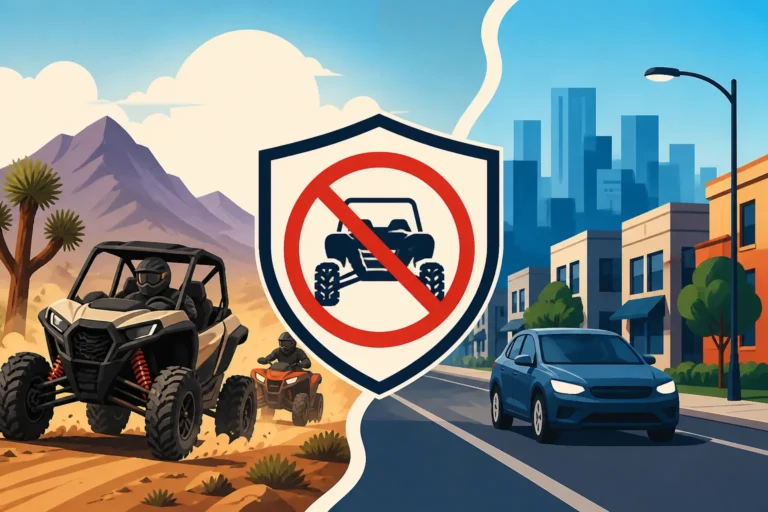
It's equally important to know where this decal doesn't grant you access. This is not an invitation to cruise down the Las Vegas Strip or take a scenic drive on US 95.
- State and Federal Highways: With very few exceptions (like directly crossing a highway at an intersection, which itself has rules), you generally cannot ride your UTV on state or federal highways. These are typically high-speed, high-traffic roads designed for traditional vehicles, and UTVs are not permitted. [Nevada's 2-Mile Limit on Paved Highway] specifically refers to these restrictions.
- Most City Streets: While some smaller, rural towns might have ordinances allowing limited UTV use on specific streets, major cities like Las Vegas, Reno, or Henderson almost universally prohibit OHVs on their streets, even with a Large ATV decal. Always check local ordinances before attempting to ride in a developed area.
- Interstate Highways: This is an absolute no-go. Nevada strictly prohibits OHVs on interstate highways.
- Sidewalks and Bike Paths: These are for pedestrians and bicycles, not UTVs, regardless of your decal.
Failing to adhere to these restrictions can lead to significant fines and penalties. Law enforcement officers, whether it's a Washoe County Deputy or a Ranger at Sand Mountain, are well-versed in OHV laws and will check for proper registration and decals when they encounter machines on paved roads.
Why the Large ATV Decal is Worth the Effort
For many Nevada OHV enthusiasts, the relatively small cost and effort of obtaining a Large ATV decal are well worth it. It provides a layer of convenience and peace of mind that significantly enhances the riding experience.
Convenience and Connectivity
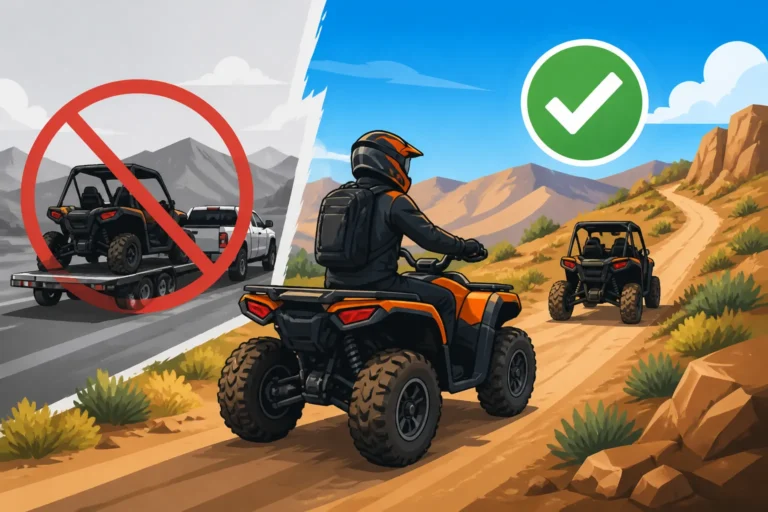
Imagine you're out exploring the vast Nevada landscape, perhaps linking up sections of the [Silver State Trail], and you encounter a short paved section that stands between you and the next stretch of incredible dirt. Without the Large ATV decal, you'd be forced to turn around, trailer your machine, or risk a ticket. With the decal, you can legally and safely navigate that paved connector, keeping your adventure going. This is particularly valuable in areas where public lands are interspersed with private property or small county roads.
This convenience extends to practical matters like fueling up. Being able to legally ride a short distance down a county road to a gas station can save you the hassle of trailering your UTV just for a fill-up, as detailed in [Nevada Rules for Riding Into Town for Fuel]. For those who enjoy extended rides or operate out of more remote camps, this flexibility is a game-changer.
Protecting Your Investment
Beyond convenience, the decal protects you legally. Getting caught on a paved road without the proper authorization can result in fines and potential impoundment of your machine. The cost of a citation far outweighs the decal fee and the time spent on upgrades. By complying with Nevada's regulations and securing the Large ATV decal, you're safeguarding your significant investment in your UTV and ensuring your riding experience remains enjoyable and stress-free.
While Nevada doesn't issue traditional "street legal plates" for UTVs in the way it does for cars, the Large ATV decal serves a similar purpose within its specific context. It's proof that you've met the state's requirements for limited on-road use, allowing you to bridge those paved gaps in your off-road adventures. Ensure your machine is properly equipped, perhaps with durable aftermarket parts from SuperATV, and always ride responsibly.
Disclaimer
This article is for general informational purposes only and does not constitute professional advice. Laws, prices and regulations vary by location and change over time. Consult a qualified professional for guidance on your specific situation.