Trailering Versus Riding the Road There
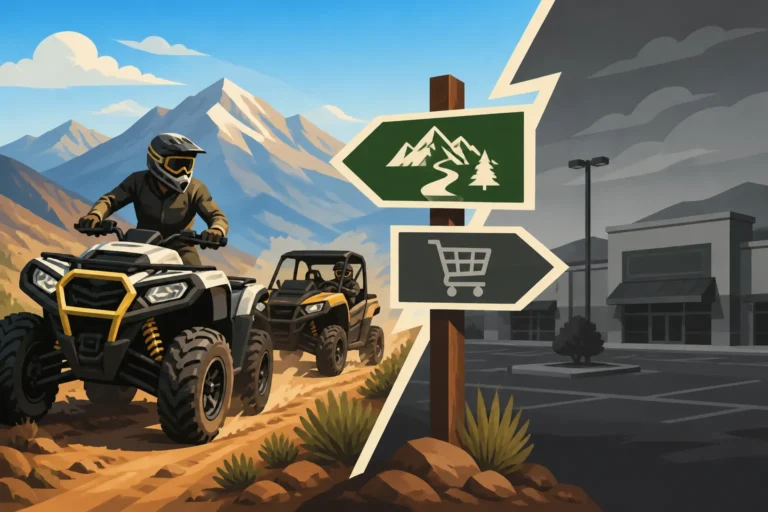
We’ve all been there: you’ve got your off-highway vehicle (OHV) fueled up, gear packed, and you're staring at the open road between your driveway and the nearest trail. The big question looms – do you throw it on the trailer, or can you just ride it there? This dilemma is incredibly common for Nevada riders, and understanding the rules, risks, and practicalities is crucial to making the right choice, saving you from potential fines, or worse, a dangerous situation on pavement. This guide will walk you through the ins and outs of trailering versus riding your ATV or UTV on Nevada roads, helping you navigate the complexities of state and local laws, and ultimately make the best decision for your adventure.
The Core Question: To Ride or to Trailer?
The fantasy of just hopping on your quad or side-by-side and cruising directly to the trailhead is a powerful one. It feels like the ultimate freedom of off-roading, right? No trailer to hitch, no loading ramps, no extra fuel for the tow rig – just pure, unadulterated seat time from the moment you leave your property. For many, this vision is what draws them to powersports in the first place, offering a seamless transition from daily life to outdoor adventure.
However, the reality in Nevada, like most places, is a bit more complicated than that free-spirited ideal. While certain limited scenarios allow for it, the state has specific regulations that dictate where, when, and how an OHV can operate on paved roads. Ignoring these rules can not only lead to costly tickets but also put you and others in serious danger. It’s a classic case where what seems convenient might actually be quite inconvenient (and expensive) in the long run.
The Allure of Riding Directly to the Trail
There’s a genuine appeal to the idea of riding your machine straight out of the garage and onto the open road, heading for the dirt. For one, it eliminates the hassle of towing. Dealing with a trailer means maintenance, storage, and the added stress of maneuvering a larger vehicle combination. It also saves gas for your truck or SUV, a consideration many riders appreciate. For those who live very close to an OHV area, it might seem like a no-brainer, a quick five-minute jaunt down a county road.
Beyond the practicalities, there's an emotional component. It’s part of the off-road lifestyle, feeling the wind, hearing the engine, and experiencing the journey before you even hit the trails. For many, the desire to [Riding to a Trailhead Instead of Trailering] is deeply rooted in the spirit of adventure and a rejection of the perceived constraints of needing a tow vehicle. It’s about maximizing time on the machine and minimizing the perceived "prep work."
Nevada's Stance on OHVs on Paved Roads
Nevada law differentiates significantly between off-road use and on-road use for ATVs and UTVs. Generally speaking, regular ATVs and UTVs are not designed or legally permitted for extensive road use. The state has specific provisions under NRS 490 that define what an OHV is and where it can operate. While there are some exceptions, such as crossing a highway or riding on specific county roads, these are tightly regulated and require your machine to meet certain criteria.
The key takeaway is that Nevada does not make it easy to simply "plate" a standard quad or side-by-side for street use like you would a car or motorcycle. The legal framework is geared towards keeping these vehicles off high-speed public roads for safety reasons. This is why you often see designated staging areas and ample parking for trailers near popular riding spots like Sand Mountain or Logandale Trails – because most people are towing their machines there.
Riding Your OHV on Nevada Roads: The Realities and Risks
If you're considering riding your OHV on public roads in Nevada, you absolutely need to know the rules. It's not a free-for-all, and deputies and state troopers are well-versed in the distinctions between legal road use and illegal joyriding. Misinformation abounds, so understanding the actual statutes is your first line of defense against a ticket or, worse, an accident.
Many riders mistakenly believe that if a machine is registered, it automatically means it can be ridden on the street. This isn't true for most OHVs. Registration primarily allows you to ride on designated off-highway trails and public lands. Road-legal status is a completely separate and much more stringent set of requirements.
Understanding Nevada's "Large ATV" Designation
Nevada law does make a special allowance for what it calls a "large all-terrain vehicle." This is where some UTVs can find limited road-legal status. However, the definition is very specific, and most sport quads or even many smaller side-by-sides do not qualify. A "large ATV" is typically defined as a multi-passenger UTV with specific characteristics, such as a truck bed or seating for four or more passengers. This distinction is critical because it dictates whether your machine even stands a chance of meeting the requirements for limited road use.
For instance, a two-seat sport UTV like a Polaris RZR XP 1000, while powerful and fun, might not meet the "large ATV" criteria for seating or cargo bed. Similarly, a single-rider ATV, regardless of its size, definitely won't qualify. The intent of the "large ATV" designation is generally to allow larger utility-focused side-by-sides, which share some characteristics with small trucks, to access certain roads. Make sure you check [What Qualifies as a Large ATV in Nevada] to see if your machine even fits the bill before going any further.
Essential Equipment for Road-Legal OHVs
If your UTV does qualify as a "large ATV" and you plan to ride it on permissible roads, it needs specific safety equipment beyond what's required for off-road use. This isn't just a suggestion; it's the law, and deputies will be checking. Imagine getting pulled over for missing a mirror!
The list of required equipment for a [Nevada Street Legal UTV Requirements] includes things like:
- Headlights and Taillights: Visible from a certain distance, typically 500 feet.
- Brake Lights: A functional stop lamp is a must.
- Turn Signals: Both front and rear.
- Mirrors: Usually at least one rearview mirror, but often two are safer and preferred.
- Horn: A working audible warning device.
- Windshield: Often a requirement, or at least eye protection if there isn't one.
- Seat Belts: For all occupants, securely fastened.
- Fenders: To prevent debris from being thrown by tires.
- Spark Arrester: Always required, on or off-road, to prevent fires.
- Tires: Must be DOT-approved for street use, not just knobby off-road tires.
- Registration & Decal: You'll need a special [Nevada's Large All-Terrain Vehicle Decal] for road use, not just the standard OHV decal.
- Insurance: Proof of liability insurance is mandatory for road use, just like a car. [Insurance Nevada Requires for Road Use]
Adding all this equipment can be a significant investment, both in parts and installation time. Brands like SuperATV offer a wide range of accessories, from full windshields to DOT-approved tire kits and turn signal systems, that can help you meet these requirements. However, it's not just about bolting on parts; they must be correctly installed and functional.
The Limitations: Where You Can (and Can't) Ride
Even with a fully equipped "large ATV" and the proper decal, you can't just ride anywhere. Nevada has very strict rules about which roads are permissible. You generally cannot ride on state highways, interstates, or within the limits of many larger cities unless there are specifically designated routes.
- County Roads: Your best bet for limited road use will be on minor county roads. However, even within counties, local ordinances can vary. Some counties actively embrace OHV use on specific county roads, while others strictly prohibit it. For example, some parts of Lincoln County might be more open than others. Always check local regulations. Learn more about [Nevada County Roads Open to UTVs].
- Mileage Limits: There's also the infamous [Nevada's 2-Mile Limit on Paved Highway] for crossing a highway or riding a short distance on a paved road to connect to another trail. This isn't a general license to ride two miles anywhere but a specific provision for connecting trails or accessing services.
- City Limits: Many cities, especially larger ones like Las Vegas, Reno, or Henderson, have ordinances that effectively ban OHVs from most, if not all, city streets. These cities are often listed as [Nevada Cities That Require Designated OHV Routes], meaning if there isn't a specific, marked route, you're not allowed. Don't assume you can just cruise through town for a burger.
- Crossing vs. Traveling: There's a big difference between legally crossing a highway at a designated point and using the highway as a travel route. The former is often allowed with proper equipment and caution; the latter is almost always illegal.
The Very Real Dangers of Road Riding
Beyond the legal headaches and financial penalties of [Nevada Fines for No Large ATV Decal], riding an OHV on paved roads comes with significant safety risks. These machines are designed for off-road terrain, not high-speed asphalt.
- Handling Characteristics: OHVs have a higher center of gravity, narrow track width compared to cars, and suspension designed for absorbing bumps, not cornering stability on pavement. This makes them prone to rollovers, especially during sudden turns or evasive maneuvers at road speeds.
- Tires: Knobby off-road tires, while great for dirt and rocks, have poor traction on pavement, especially when wet, and wear out incredibly fast, leading to reduced grip and control. Even DOT-approved street tires for UTVs are a compromise compared to car or motorcycle tires.
- Visibility: OHVs are small compared to other vehicles on the road. They're harder to see, especially at dawn, dusk, or night. Drivers in cars and trucks often aren't looking for OHVs on the road, increasing the risk of a collision.
- Lack of Protection: Unlike a car, an OHV offers minimal crash protection. In a collision with a car, truck, or even a stationary object, riders and passengers are highly exposed. Even with helmets (which are required by [Nevada Helmet Law for Road Riding]), the risk of serious injury is extremely high.
- Operator Skill: Riding on roads requires a different skillset than off-roading. Traffic awareness, lane positioning, and understanding road signs become paramount, skills that many off-road riders haven't honed in a street environment.
Given these dangers, many experienced riders view riding an OHV on public roads as an unnecessary risk, choosing the safety and peace of mind of trailering instead.
The Case for Trailering: Safety, Legality, and Convenience
While the idea of riding directly to the trail has its romantic appeal, the practical reality for most Nevada OHV enthusiasts is that trailering is almost always the superior, safer, and legally sound option. It might involve a bit more upfront effort, but it pays dividends in reduced risk, avoided fines, and machine longevity.
Think of it this way: your truck or SUV is designed for road travel, towing heavy loads, and providing a high level of safety and comfort on paved highways. Your OHV is designed for navigating challenging terrain, climbing hills, and tackling mud or sand. Using each tool for its intended purpose just makes sense.
Trailering as the Default and Safest Option
Trailering your ATV or UTV is, unequivocally, the safest way to get your machine to the trailhead. It removes your OHV from the inherent dangers of sharing the road with cars, trucks, and semi-trucks, where your machine is at a distinct disadvantage. You're protected within the safety cage of your tow vehicle, and your OHV is securely fastened, riding along without accumulating unnecessary wear.
When you trailer, you eliminate the risk of an accident caused by poor visibility, unexpected road hazards, or the handling limitations of your OHV on pavement. This allows you to relax on the journey, knowing your prized possession is safe and sound until it's time to hit the dirt. Plus, you can bring along extra fuel, tools, and recovery gear in your truck without worrying about how to strap it all onto your quad.
Avoiding Legal Headaches and Tickets
Let's be blunt: attempting to ride your OHV on roads where it's not legally permitted is an open invitation for a conversation with law enforcement. Nevada deputies and state troopers are actively patrolling popular OHV areas and the roads leading to them. They know the laws, and they know what to look for, from missing [Nevada Equipment List for Road-Legal UTVs] to expired decals or simply being on a road where OHVs are banned.
Getting pulled over for illegal road use can lead to hefty fines, potentially impounding your machine, and ruining your entire day of riding. It's simply not worth the gamble. By trailering, you completely bypass this risk. You arrive at the staging area, unload your machine, and immediately begin your off-road adventure, confident that you're operating within the bounds of the law. You also don't have to worry about the specific nuances of [How Far You Can Ride Pavement in Nevada] or whether your particular county road is truly open.
Preserving Your Machine
Every mile you put on your ATV or UTV on pavement is a mile of accelerated wear and tear on components that aren't designed for it.
- Tires: Off-road tires wear down incredibly fast on asphalt. The soft rubber and aggressive tread blocks that grip dirt so well will quickly be chewed up by hard pavement, reducing their lifespan for their intended purpose.
- Suspension: While OHV suspension is robust, continuous bouncing and vibrations from road imperfections can stress bushings, bearings, and shocks in ways different from off-road use, potentially leading to premature failure.
- Engine & Drivetrain: Running an OHV at sustained higher speeds on pavement can put different stresses on the engine and drivetrain compared to varied off-road speeds and loads. Your belts on a UTV will likely run hotter, and your clutch might experience different wear.
- Cosmetics: Road grime, rocks kicked up by other vehicles, and general road conditions can quickly take a toll on your machine's plastics, paint, and other cosmetic components.
By trailering, you save your machine for what it was built to do: conquer trails. This extends the life of your expensive parts, maintains performance, and keeps your OHV looking better for longer. It's an investment in your machine's longevity and enjoyment.
Making Your Decision: Factors to Consider
So, how do you decide between trailering and riding directly? It boils down to a careful assessment of several key factors, weighing convenience against legality, safety, and the long-term health of your machine. There's no one-size-fits-all answer, but by asking yourself the right questions, you can make an informed choice that suits your specific situation.
Here's a comparison to help visualize the differences:
| Feature | Riding Directly to Trail (If Permitted) | Trailering to Trailhead |
|---|---|---|
| Legality | Highly restricted; requires "Large ATV" decal, specific equipment, and designated roads only. High risk of fines if non-compliant. | Fully legal on public roads if tow vehicle and trailer are street legal. Low risk of OHV-related fines before reaching dirt. |
| Safety | High risk of collision with road vehicles; OHV not designed for pavement; limited protection in crashes. | OHV safely secured; tow vehicle offers protection; minimal risk of OHV accident on pavement. |
| Machine Wear | Accelerated wear on tires, suspension, drivetrain, and cosmetics due to pavement use. | Minimal wear on OHV during transport; preserved for off-road use. |
| Convenience | No trailer to hitch/store; "seamless" transition to riding (if short distance). | Requires tow vehicle, trailer, loading/unloading; often seen as a hassle but predictable. |
| Cost | Potential for expensive fines; higher maintenance/tire replacement. | Fuel for tow vehicle; trailer maintenance/registration; no fines related to OHV road use. |
| Equipment | Requires significant street-legal modifications (SuperATV parts, lights, mirrors, DOT tires, etc.). | Basic tie-downs and ramps for OHV; standard tow vehicle maintenance. |
| Flexibility | Limited to areas with permissible roads; may need to backtrack. | Can access any trailhead with road access; greater range. |
| Travel Speed | Limited and often slower than surrounding traffic, increasing hazard. | Travel at posted speed limits in tow vehicle. |
Your Machine's Capabilities and Modifications
First and foremost, does your machine even qualify for limited road use in Nevada? As discussed, if you have a sport quad or a two-seat sport UTV, the answer is most likely no, regardless of any modifications you make. Even if you install a SuperATV turn signal kit, horn, and mirrors, your core machine may not meet Nevada’s "Large ATV" definition. Attempting to get a [Why Nevada Will Not Plate a Quad] for street use is a non-starter; it simply doesn't happen.
If you do have a qualifying "large ATV," have you invested in all the necessary street-legal equipment? This includes DOT-approved tires, a functional horn, mirrors, proper lighting, and seat belts. This isn't just about throwing on a few accessories; it's about meeting a specific checklist of legal requirements. Without these modifications, riding on the road is unequivocally illegal.
The Distance and Type of Road
How far is the trailhead from your home? Is it a quick half-mile down a quiet dirt county road, or is it five miles along a busy state route with a 55 mph speed limit? The shorter the distance and the lower the traffic volume, the less risk you assume. However, longer distances, higher speed limits, or riding on heavily trafficked roads dramatically increase the danger and the likelihood of legal issues.
Also, consider the type of road. Are you riding on designated [Nevada County Roads Open to UTVs] that are explicitly friendly to OHVs, or are you trying to sneak along a state highway shoulder? Knowing the specific ordinances of your local area and the nature of the roads you plan to use is paramount. Just because it’s a paved road doesn’t mean it’s an OHV-friendly paved road.
Local Ordinances and Enforcement
Nevada is a big state, and while state law provides the framework, local counties and cities often have their own specific ordinances regarding OHV use on roads. What's permissible in rural Lincoln County might be strictly forbidden in the urban sprawl of Washoe County or Clark County. Some towns, like Mesquite, have reputations for being more OHV-friendly on certain streets, but even those have limits.
It's vital to check with your local county sheriff's office or city hall for their specific rules before venturing out. Deputies are the ones enforcing these laws on the ground, and their interpretation and local directives will dictate whether your road ride ends with a wave or a ticket. Don't rely on hearsay; get the facts from official sources.
Your Personal Risk Tolerance
Ultimately, this decision comes down to your comfort level with risk. Are you willing to gamble with potential fines, machine damage, and, most importantly, your safety and the safety of your passengers by riding on roads not truly designed for OHVs? For many, the peace of mind that comes with trailering far outweighs the minor inconvenience of loading and unloading.
Consider the potential "what ifs." What if you have a mechanical breakdown on a busy road? What if a distracted driver doesn't see you? What if you roll your machine attempting an evasive maneuver? These are serious considerations that should heavily weigh on your decision. For the vast majority of Nevada riders, the answer to the question "Trailering Versus Riding the Road There" will always be: trailer it, and save the riding for the dirt.
Disclaimer
This article is for general informational purposes only and does not constitute professional advice. Laws, prices and regulations vary by location and change over time. Consult a qualified professional for guidance on your specific situation.