Why a Defender’s Truck Bed Meets Nevada’s Definition
Navigating the rules for riding your UTV on paved roads in Nevada can feel like trying to find a clear path through a maze, especially when you hear different things from different riders. Many folks assume that if they have a side-by-side, it's automatically street legal, but Nevada has a very specific definition for what qualifies as a "Large All-Terrain Vehicle" (LATV) for road use, and not every machine makes the cut. This guide is here to cut through the confusion and explain exactly why certain features, like a utility-focused truck bed, are critical for meeting Nevada's road-legal standards.
Decoding Nevada's "Large All-Terrain Vehicle" Definition
It’s easy to get excited about the thought of riding your UTV from your campsite straight into town for supplies, or just connecting trails via a short stretch of pavement. But before you hit the blacktop, you need to understand that Nevada doesn't just hand out "street legal" status to any UTV. The state has a very particular legal framework, primarily outlined in Nevada Revised Statutes (NRS) 490.043, which defines a "Large All-Terrain Vehicle." This definition is your absolute starting point for any aspirations of road riding. Without meeting these criteria, your machine simply won't qualify for the necessary decal.
The Crucial Elements of NRS 490.043
When we talk about NRS 490.043, we're diving into the nitty-gritty details that differentiate a street-legal machine from one meant strictly for the dirt. The statute lays out specific requirements for width, weight, and, crucially, its capacity for carrying passengers and cargo. It’s not enough for your machine to merely be a UTV; it needs to fit within these precise parameters to be considered an LATV. Many riders mistakenly believe that as long as their machine has four wheels and a steering wheel, it should be fine on the street, but the law looks at more than just the basics.
First off, the statute requires the vehicle to be at least 50 inches wide but not more than 70 inches wide. This immediately rules out many standard ATVs (quads), which are typically narrower. It also has a weight limit: the vehicle must have a dry weight of no more than 2,500 pounds. These dimensions are designed to ensure that the vehicle has a certain level of stability and presence on the road, while still distinguishing it from full-sized automobiles. Yet, these are just the foundational elements.
The real game-changer in the definition, and what trips up many enthusiasts, is the requirement related to carrying capacity. An LATV must be "designed by the manufacturer to carry at least two persons" and be "designed by the manufacturer primarily for utility purposes." This "utility purposes" clause is where the conversation about truck beds becomes paramount. A vehicle built for utility is distinct from one designed purely for sport or recreation, even if that sport machine has a small storage compartment.
How a Truck Bed Tilts the Scales
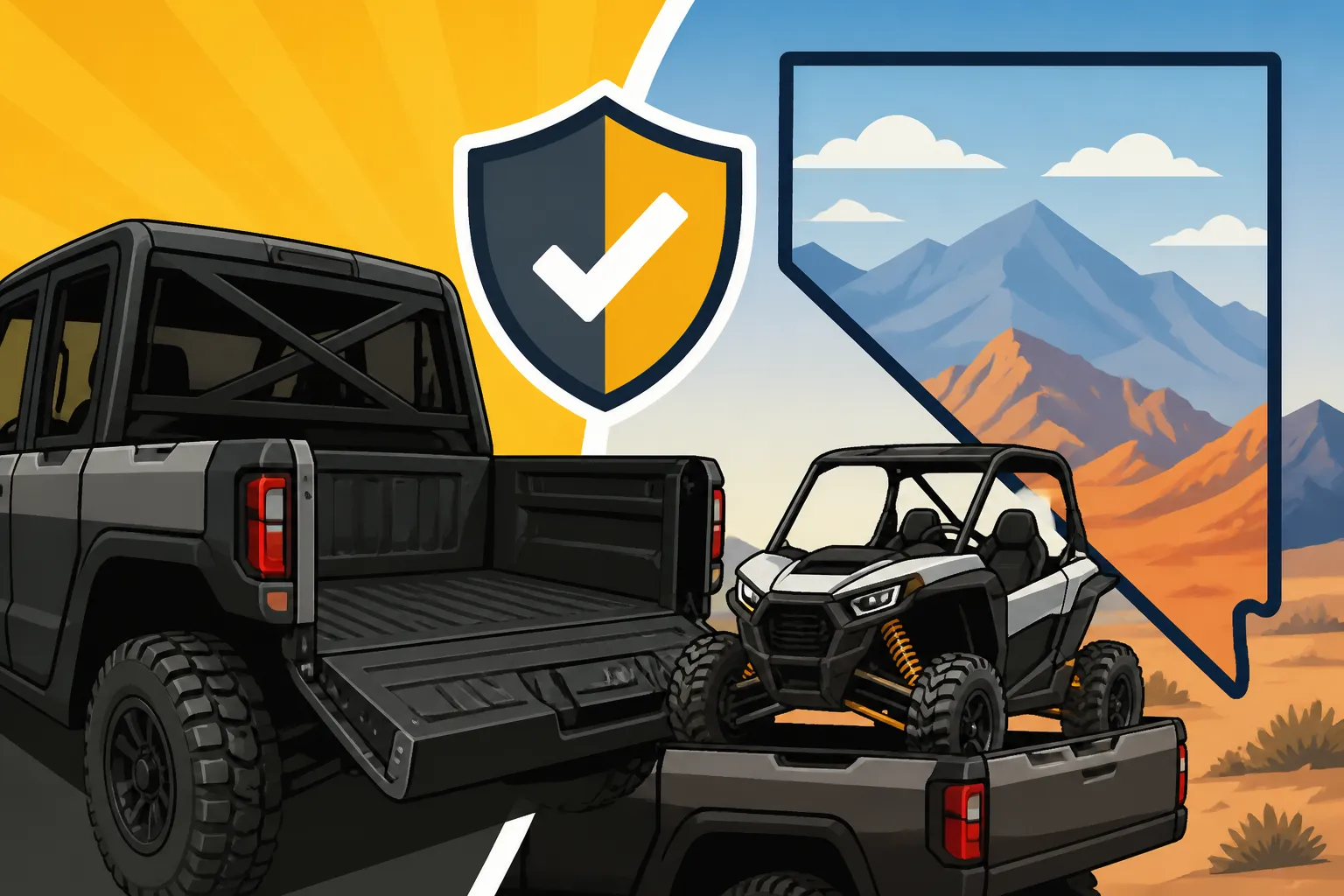
This "designed primarily for utility purposes" phrase is exactly why a machine like a Can-Am Defender, or similar utility-focused side-by-side, often makes the cut for Nevada's Large ATV definition, while many popular sport UTVs do not. Think about the core design philosophy of a Defender: it’s built for work, for hauling gear, for ranching, and for long days of chores. Its most distinguishing feature, the full-sized, integrated truck bed, is a dead giveaway to its utility purpose. This isn't just a small cargo box; it’s a robust, often dump-capable bed designed to transport significant loads.
Consider the contrast with a two-seat Polaris RZR XP 1000 or a Can-Am Maverick X3. While these machines are incredibly capable off-road and may have a small, rear-mounted cargo rack or storage compartment, they are unequivocally designed for high-performance recreation. Their primary purpose is speed, agility, and conquering challenging terrain, not hauling bags of feed or construction materials. The small storage areas on these sport machines are an afterthought for carrying a cooler or a spare belt, not a feature central to their intended "utility."
When Nevada law looks at "utility purposes," it’s looking for design elements that clearly indicate the vehicle's primary function is work-related. A prominent, sturdy truck bed is perhaps the clearest physical manifestation of this intent. It signifies a machine built to do more than just play, distinguishing it from purely recreational models that, despite meeting width and weight requirements, lack the essential utility design. This distinction is crucial, as the state wants to ensure that vehicles sharing the road are equipped for a specific, more practical role beyond just trail riding fun.
Beyond the Bed: Other Requirements for Nevada Road Use
Meeting the "Large All-Terrain Vehicle" definition because your machine boasts a proper truck bed is a huge step, but it's only one piece of the puzzle. Nevada has an extensive list of mandatory equipment and operational requirements that your UTV must meet to be truly road-legal. Ignoring these additional rules is a fast track to a citation, or worse, a dangerous situation on public roads. It's about safety and ensuring your machine is visible and controllable in a mixed-traffic environment.
Essential Equipment for Street Legality
Once your machine qualifies as a Large ATV, you're not done. You then need to ensure it's outfitted with specific safety and visibility equipment that's standard for any road-going vehicle. This isn't optional; it's absolutely critical. First and foremost, you'll need working headlights and taillights that are visible from a specified distance. These aren't just for seeing the trail at night; they're for being seen by other drivers. Along with taillights, a functioning stop lamp (brake light) is non-negotiable, illuminating when you hit the brakes to warn traffic behind you.
Furthermore, a horn is required, providing an audible warning when needed. Mirrors are also a must-have – at least one, but ideally two, to give you a clear view of traffic approaching from behind. A windshield, while not always standard on every UTV, becomes a requirement for road use to protect the driver from debris. SuperATV and other aftermarket companies offer a wide range of DOT-compliant windshields, mirrors, and turn signal kits that can help equip your Defender (or other qualifying LATV) to meet these specific road-legal needs. You'll also need seat belts for all occupants, which most UTVs come with, but it's important to ensure they are properly maintained and used. All this equipment, from the lights to the mirrors, contributes to making your LATV a safer presence on the road. For a deeper dive into these requirements, check out [Nevada Street Legal UTV Requirements].
Driver Qualifications and Insurance
It's not just about the machine; the driver behind the wheel needs to meet certain criteria as well. First and foremost, anyone operating a Large ATV on a public road in Nevada must possess a valid driver's license. This isn't a suggestion; it's the law. This means that if you're under the legal driving age or don't have a valid license for any other reason, you cannot legally drive an LATV on paved public roads, even if the machine itself is fully compliant.
Beyond the driver's license, liability insurance is also mandatory. Just like with your car or truck, if you're operating an LATV on public roads, you need to carry proof of financial responsibility. This insurance is there to protect you and others in the event of an accident. It's a critical safety net that many off-roaders might overlook if they're used to riding strictly on private land or trails where insurance isn't always enforced. Always have your insurance card with you when riding on public roads. For more information on insurance, you can refer to [Insurance and Nevada OHV Registration]. Keep in mind that age restrictions and supervision rules still apply for younger riders, even if they are in a passenger capacity. For specifics on who can drive and under what conditions, understanding [Nevada Driver's License Rules for UTV Road Use] is essential.
Navigating Nevada's Roads: Where You Can (and Can't) Ride
So, your Defender meets the LATV definition, and you've got all the required safety gear installed, perhaps even some sturdy new mirrors and a turn signal kit from SuperATV. Now comes the crucial question: where can you actually ride this road-legal machine? Nevada's laws are quite specific about the types of roads open to LATVs, and it’s not a free-for-all. Understanding these boundaries is just as important as having the right machine and equipment, because riding in an unauthorized area will still land you in hot water.
Permitted Road Types and Restrictions
Nevada Revised Statutes allow Large ATVs to operate on "general county roads" and "minor county roads." These are typically unpaved or lightly paved roads that aren't part of the state highway system. The intent here is to allow riders to access trailheads, connect between off-road areas, or even commute short distances in rural settings. However, there are significant limitations. You cannot just hop on any state highway or interstate. There's a strict "2-mile limit" on paved highways for the sole purpose of connecting two off-highway routes or to get from your off-highway route to a service station, lodging, or food. This means you can cross a highway or ride a short distance along its shoulder to get to a trail, but you can't use it as a primary travel route. For clarity on these specific limits, check out [Nevada's 2-Mile Limit on Paved Highway].
It's also vital to remember that not all "county roads" are fair game. While the state law allows for it, individual counties and even cities have the authority to create ordinances that restrict or completely prohibit OHV travel on roads within their jurisdiction. This means a road that's legal to ride in one county might be illegal just across the county line. This patchwork of rules can be confusing, but it's imperative to do your homework before you ride. If you're looking for where you can ride legally, studying [Riding County Roads Legally in Nevada] will be a good starting point.
The Importance of Designated Routes and Local Ordinances
The key takeaway here is that you cannot assume open season on all public roads. Many cities, especially larger ones, have explicitly designated routes or outright bans on OHV use within city limits. For example, Washoe County, which includes Reno, has Ordinance 1507, which severely restricts OHV use on county roads. Conversely, some smaller, more rural towns, like Mesquite, are often known for having more open street access for OHVs, but even there, you still need to adhere to the 2-mile rule and avoid major highways. The landscape of what’s allowed can change from one town square to the next.
Always, always check local regulations before you venture out. Local law enforcement officers are well-versed in their area's specific ordinances and won't hesitate to issue citations for non-compliance. You should also be aware of private land. Even if a road looks like a public right-of-way, it might cross private property where OHVs are prohibited. Respecting posted signs and private property boundaries is not just good etiquette; it's a legal requirement to avoid trespassing charges. When planning a trip, consider [Riding to a Trailhead Instead of Trailering] to minimize your time on restricted pavement, and familiarize yourself with areas listed in [Nevada Counties That Ban OHVs on County Roads] to avoid issues.
Applying for the Nevada Large ATV Decal
So you've done your homework, confirmed your UTV's utility bed qualifies it as an LATV, and you've kitted it out with all the necessary street-legal accessories, maybe even a new set of mirrors and a signal kit from SuperATV. Now it’s time to make it official and get that special decal that allows you to ride on approved Nevada roads. This isn't the same as your standard off-highway vehicle registration; it’s a distinct process with specific requirements, leading to a different kind of decal.
The Application Process and Paperwork
Applying for the Nevada Large ATV decal involves a few key steps to ensure your machine meets all state requirements. The first critical step is a VIN inspection. Unlike regular OHV registration where you might just submit paperwork, getting a Large ATV decal requires a physical verification of your vehicle's identification number and often its equipment. This inspection ensures that the VIN on your machine matches your documentation and that it is legitimately a "Large All-Terrain Vehicle" as defined by state law. You'll typically need to visit a licensed OHV dealer or contact a sworn law enforcement officer to complete this. For more details on this process, see [Nevada OHV VIN Inspection Requirements].
Once the VIN inspection is complete, you'll need to submit the appropriate application forms to the Nevada DMV's OHV section. This application will require proof of ownership, such as a title or manufacturer's certificate of origin (MCO), and typically proof of insurance. It's crucial to specify that you are applying for the Large ATV decal and not just a standard OHV registration, as the requirements and resulting decal are different. This specific decal, not a license plate, is what signifies your UTV's legal status for limited road use. To understand the form requirements, check out [Applying for a Nevada Large ATV Decal]. Make sure all your paperwork is in order before you go, as missing documents can significantly delay the process.
Maintaining Your Road-Legal Status
Once you've successfully obtained your Large ATV decal, it's essential to understand that maintaining your road-legal status is an ongoing responsibility. This isn't a "set it and forget it" situation. The decal itself will have an expiration date, and you'll need to renew it periodically to keep your privileges. Just like your standard OHV decal, this specialized decal needs to be prominently displayed on your machine in the designated area, typically on the left side or rear, where it's easily visible to law enforcement. You can learn more about proper placement by reading [Nevada OHV Decal Placement Rules].
Beyond the decal itself, you must ensure that all the required safety equipment you installed remains functional and compliant. A broken headlight, a missing mirror, or non-working brake lights can revoke your road-legal status on the spot, potentially leading to fines or other penalties. Regularly inspect your machine, especially before hitting paved roads, to ensure everything is in working order. Neglecting these checks can be costly; officers specifically look for these things during roadside stops. If you're caught riding on a public road without a valid Large ATV decal or with non-compliant equipment, you could face significant fines. For a clear understanding of the consequences, consult [Nevada Fines for No Large ATV Decal]. Staying vigilant and keeping your machine up to spec is the best way to enjoy your road-legal UTV without unnecessary hassle.
| Feature / Category | Standard OHV (Recreational) | Large All-Terrain Vehicle (LATV) for Road Use |
|---|---|---|
| Purpose | Primarily off-road recreation | Utility/Work, limited road use |
| Width | Varies, often narrower | 50-70 inches |
| Dry Weight | Varies | Up to 2,500 pounds |
| Seating Capacity | Varies (1-4+ persons) | At least 2 persons |
| Cargo Feature | Small storage bin/rack | Designed with a truck bed for utility |
| Headlights/Taillights | Often basic | Required, visible 500 feet |
| Brake Light | Often basic | Required |
| Horn | Optional | Required |
| Mirrors | Optional | At least one, ideally two, required |
| Windshield | Optional | Required |
| Seat Belts | Standard | Required for all occupants |
| Registration | Standard OHV Decal | Specific Large ATV Decal (additional process) |
| Road Use | Limited/Prohibited | General/Minor county roads, 2-mile limit |
Disclaimer
This article is for general informational purposes only and does not constitute professional advice. Laws, prices and regulations vary by location and change over time. Consult a qualified professional for guidance on your specific situation.