Paperwork a Nevada Rental Machine Carries
Paperwork a Nevada Rental Machine Carries
Renting an ATV or UTV in Nevada does not mean you need to register the machine yourself, but you should know what paperwork proves it is authorized for the ride you have planned. The rental company handles the vehicle’s registration; your job is to confirm what is on board, what you need to carry, and whether your route has separate requirements.
What the Rental Company Should Have for the Machine
A rental machine used on public land should have the applicable Nevada OHV registration and decal, or another valid basis for operating there. The rental company is responsible for the machine’s registration status. You are not expected to register a company-owned vehicle in your own name just to rent it for a day.
Nevada uses an OHV decal rather than a conventional license plate for most off-highway machines. The decal is evidence of registration, and Nevada’s registration system also serves as its general OHV permit for riding where that registration is accepted. Read more about Why Nevada Has No Separate Trail Permit and Nevada’s Registration Decal as Your Permit.
The decal is only one part of the picture. Before setting off, ask the rental company what documents are kept with the vehicle and what you will be given to carry. Depending on the machine and rental arrangement, that may include a registration card or other proof of registration, a rental agreement, and instructions about where the machine is allowed to go.
| Item | Who normally provides it | What it helps establish |
|---|---|---|
| Nevada OHV decal | Rental company | The machine is registered for OHV use when the decal and registration are valid |
| Registration card or other proof | Rental company | Identifies the registered machine and supports the decal |
| Rental agreement | Rental company and renter | Shows who has the machine and the terms or permitted area of use |
| Driver’s license or other required identification | Renter | Establishes the renter’s identity and, where required, driving eligibility |
| Proof of insurance | Rental company, when applicable | Supports road use if the machine is being operated where insurance is required |
| Site or event pass | Renter or rental company, depending on the arrangement | Covers a separate recreation-area fee, event permit, or other site-specific requirement |
The exact documents and who carries them can vary. A rental shop may keep some records in its office, provide a copy in a document pouch, or explain how staff can verify the machine’s registration. Do not assume that a verbal assurance is the only proof available. Ask specifically whether a registration card or other registration document accompanies the machine, and where it is stored.
The machine should also match its paperwork. Check that the decal is attached to the vehicle and appears readable, and ask the rental provider to confirm the registration applies to that specific machine. If the decal is missing, damaged, or difficult to read, have the company resolve the question before you ride. Nevada’s decal placement rules can depend on the type of machine; Nevada OHV Decal Placement Rules explains what to check.
A decal does not prove that every route is open to the vehicle. It is not a substitute for permission to cross private land, a closed route, or a restricted area. It also does not automatically cover a site-specific charge or event permit. Think of registration as one necessary piece of the paperwork rather than a universal access pass.
What to Check Before You Leave the Rental Counter
The easiest time to clear up a paperwork question is before the machine leaves the lot or unloading area. Have the rental employee identify the decal, show you where the registration document is kept, and explain what to do if you are stopped or the paperwork becomes separated from the machine.
Confirm the machine and decal match
Look over the vehicle with the rental employee. The decal should be attached where it can be seen, rather than stored loose in a glove box or handed over as an unattached sticker. Ask the employee to confirm that the decal is current and belongs to the machine you are taking.
If anything seems inconsistent, pause the handoff. A picture of a different machine’s registration or a receipt for a decal purchase is not a useful substitute for resolving whether this vehicle is properly registered. The shop should be able to confirm the vehicle’s status before you head out.
Ask where the documents are
Find out whether the machine has a registration card or other proof of registration in a storage compartment, document pouch, or another designated place. If the shop gives you paperwork to carry, keep it protected and return it with the vehicle as instructed.
A small waterproof pouch can help protect documents from dust, water, and vibration. If the rental does not provide one, ask whether the paperwork can remain in a secure, vehicle-mounted compartment. A document pouch is also easy to source from a retailer such as Amazon, but it should not replace following the rental company’s directions about where official paperwork belongs.
Do not leave documents unsecured where they can blow away or fall out when the machine is moving. Avoid placing them where they could interfere with controls, block visibility, or become difficult to retrieve safely.
Read the rental agreement for route limits
The rental agreement matters as much as the registration when deciding where you may take the machine. It may restrict riding to named areas, prohibit travel on paved roads, set limits on transporting the vehicle, or spell out what happens if the machine is taken outside the permitted area.
Ask the company to explain any limits you do not understand. In particular, confirm:
- Which riding areas are allowed under the agreement.
- Whether the machine may be ridden on any public road, or only on designated off-highway routes.
- Whether you may cross a road to reach a trail.
- Whether travel to a different riding area requires trailering the machine.
- What to do if you get lost, break down, or need recovery.
- Whether the rental company or renter is responsible for any separate area pass.
Do not assume that because a road is unpaved, the rental agreement permits riding on it. Nor does a machine’s OHV decal make it street legal. Nevada’s rules for road use are separate from ordinary off-road registration. For context, see Street Legal ATVs in Nevada: The Short Answer and Nevada Rules for Renting Machines.
Keep a copy of the agreement and emergency details
Before leaving, make sure you know how to reach the rental company during the ride and after hours, if applicable. Keep the agreement or its accessible copy with you, along with the company’s contact details and instructions for reporting a problem.
If a rental employee uses an electronic agreement, ask how you can retrieve it without cell service. Save the company’s phone number before leaving coverage and follow its directions about storing any paper copy. A rental agreement does not replace vehicle registration, but it helps explain why you are in control of the machine and what the company has authorized.
Your Paperwork, Site Passes, and Road Use
The rental company handles the machine’s registration; the renter still has personal responsibilities. Bring the identification the rental company requires, comply with age and license rules that apply to the rental, and carry any documents the company instructs you to keep with the machine. A rental agreement is not a substitute for a required driver’s license or other eligibility requirement.
If a law enforcement officer or land manager asks about the vehicle, be ready to identify yourself and show the documents the company supplied. Keep the paperwork accessible without reaching for it while moving. Stop in a safe place before retrieving anything from a storage compartment.
A rental decal does not cover every fee
Some recreation areas charge an additional entrance, day-use, or camping fee. Those charges are separate from Nevada OHV registration. Sand Mountain, for example, has its own recreation-area fee system; a Nevada decal does not automatically pay that charge. Confirm what is due and who is responsible for paying it before arriving. The rental company may include a pass, tell you to obtain one yourself, or restrict the rental to areas without that separate fee. Check What the $20 Decal Buys You for how Nevada’s OHV decal differs from other site charges.
A separate permit may also be needed for a particular organized activity, event, or commercial use. A standard personal rental does not give the renter permission to organize an event or use a closed area. If you are joining a guided tour or group activity, ask the operator which permits it handles and whether any pass or fee remains your responsibility.
For visitors bringing their own machine, Nevada has specific reciprocity and visitor rules. Those are not the same as paperwork for a Nevada rental vehicle. A renter should not assume that an out-of-state sticker on another machine, or an exemption that applies to a visitor’s own machine, changes the rental company’s obligations. See Nevada OHV Reciprocity With Other States and Nevada’s 15-Day Window for Out-of-State Machines for the separate visitor situation.
Registration is not the same as road authorization
A decal for off-highway use does not, by itself, authorize riding on public streets or roads. Some machines can qualify for additional road use under Nevada rules, but that depends on the vehicle’s type, equipment, registration or decal category, insurance, driver eligibility, and the road itself. A rental company may prohibit road use even where a specific machine could otherwise qualify.
Ask the rental provider directly whether the exact route you have in mind is allowed. If the answer is unclear, plan to trailer the machine to an approved riding area rather than using a public road to connect trailheads. Do not rely on a map route or another rider’s advice as proof that the rental is allowed there.
Where road use is permitted, additional documents or equipment may be required. Insurance rules for road riding differ from the basic question of whether an OHV is registered. A rental agreement may also exclude road use, leaving the renter responsible for violating the contract even if a route has some form of public access. Review Insurance Nevada Requires for Road Use and Nevada Paperwork for a Large ATV Decal if the rental provider says the machine is approved for road use.
If the machine is stopped or paperwork is missing
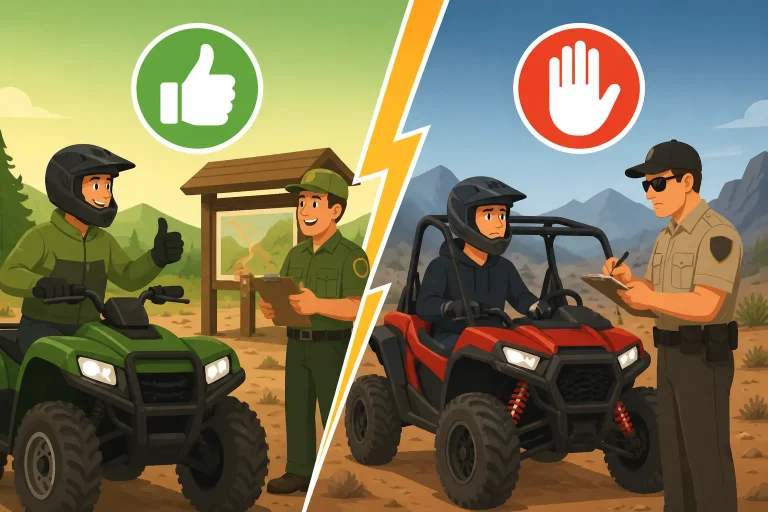
If you are asked to show paperwork, stop safely and follow the officer’s or land manager’s instructions. Present the documents the rental company gave you and explain that the vehicle is rented. If a registration document is missing or the decal cannot be identified, contact the rental company rather than trying to settle the registration question on the trail.
If the paperwork is lost, damaged, or left behind, do not assume a phone photo will satisfy every check. A photo may help you explain the situation, but acceptance can depend on the circumstances and the person checking the vehicle. Call the rental provider and ask how to proceed. Keep a record of the guidance you receive and do not continue into an area where the machine’s authorization is in doubt.
A Practical Handoff Checklist
Use this quick checklist before riding. It does not replace the rental company’s instructions or rules for the specific riding area, but it helps catch common gaps while staff are still available to answer questions.
- Identify the vehicle. Make sure the machine you are taking is the one on the rental agreement.
- Locate the decal. Confirm it is attached, readable, and confirmed by the company as current for that machine.
- Ask for registration proof. Find out whether a registration card or other document is on the machine or provided separately.
- Read the agreement. Note permitted areas, road restrictions, return instructions, and how to contact the company.
- Confirm separate passes. Ask whether the route or recreation site requires a fee or permit beyond the OHV decal.
- Check your own eligibility. Bring the identification and license required by the rental company and applicable rules.
- Secure the paperwork. Store documents as directed, protected from dust and water and easy to access when stopped.
- Save the company’s number. Do this before leaving cell coverage, and ask what to do in a breakdown or emergency.
- Verify the route. Confirm that the machine and rental agreement allow the roads and trails you intend to use.
- Resolve gaps before departure. Do not leave with an unclear decal, missing proof, or uncertainty about where the machine may go.
If the company cannot explain the registration status or the permitted route, ask for a different machine or a clear answer before accepting the rental. Paperwork questions become much harder to resolve once you are away from the rental location, especially where cell service is limited.
Frequently Asked Questions
Do I need to register a Nevada rental ATV in my own name?
Usually, no. The rental company is responsible for the registration of its machine. Confirm that the vehicle has the appropriate decal and ask what proof of registration accompanies it.
Does the rental company’s decal pay every riding-area fee?
No. An OHV decal is not a universal pass for every recreation area, event, or activity. Ask whether your destination charges a separate fee and who must obtain or pay for it.
Should I carry the rental agreement while riding?
Follow the rental company’s instructions. Keeping the agreement or an accessible copy with you is practical because it identifies the rental arrangement and explains the company’s route limits. It does not replace registration proof or a required license.
Can I ride a rented ATV on a public road if it has a decal?
Not on the basis of the decal alone. Road use has separate vehicle, route, equipment, insurance, and driver requirements, and the rental agreement may prohibit it. Get specific confirmation before using any public road.
What should I do if the registration paperwork is missing?
Stop before entering a riding area where the machine’s status may be checked, and contact the rental company. Do not assume that a photo or verbal assurance will resolve the issue.
Disclaimer
This article is for general informational purposes only and does not constitute professional advice. Laws, prices and regulations vary by location and change over time. Consult a qualified professional for guidance on your specific situation.