Riders Crossing the Line Near Mesquite
Mesquite riders can reach the Nevada-Arizona line quickly, but a registration decal does not automatically settle what is allowed on both sides. The practical question is whether your machine’s paperwork is recognized where you plan to ride, and whether your route itself is open. Here’s how to check Nevada’s limited out-of-state exemption and plan a border-area ride without assuming the rules carry across state lines.
What Nevada’s 15-day exemption covers
According to Off Road Nevada, an OHV registered or certified in another state does not need Nevada registration while it is located in Nevada for not more than 15 days. That is a Nevada rule about registration while the machine is in Nevada; it is not a blanket permit for every trail, route, or neighboring state.
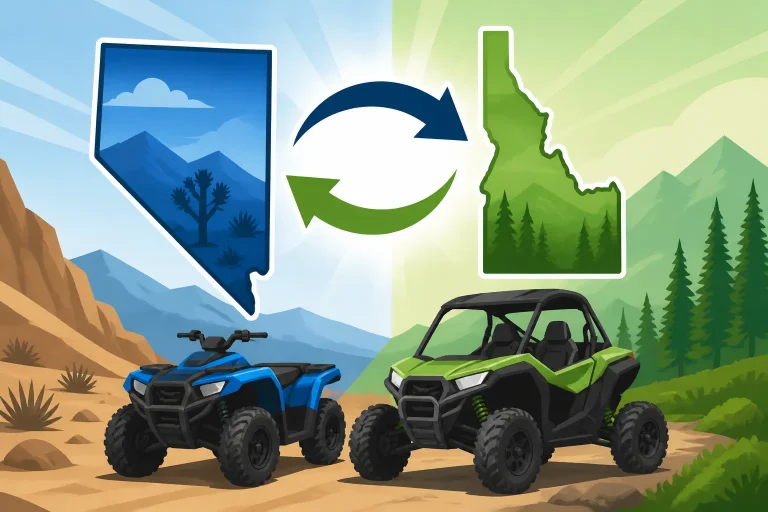
The distinction matters near Mesquite. If you bring an ATV or side-by-side from Arizona into Nevada, the machine’s Arizona registration or certification may fit Nevada’s short-stay exemption. If your machine is registered in Nevada and you ride into Arizona, Nevada’s exemption does not answer whether Arizona accepts that registration or requires something else. Check the destination state’s current rules before crossing.
The exemption is also limited by time spent in Nevada. It does not mean that an out-of-state machine can stay there indefinitely without Nevada registration. If your plans could keep the machine in Nevada beyond the stated period, confirm how the state counts the days and what paperwork it requires next. For the rule and its practical limits, see Nevada’s 15-Day Window for Out-of-State Machines and What a Visitor Does After 15 Days in Nevada.
| Your situation | What the Nevada rule tells you | What you still need to check |
|---|---|---|
| An out-of-state OHV is in Nevada for a short visit | Nevada’s exemption applies to machines registered or certified in another state and located in Nevada for not more than 15 days, according to Off Road Nevada. | Whether your out-of-state paperwork is accepted by the state where you plan to ride, and whether the route is open. |
| A Nevada-registered OHV crosses into Arizona | The Nevada exemption is not a rule about Arizona. | Arizona’s current registration, permit, and riding requirements. |
| An out-of-state OHV will remain in Nevada longer | The stated Nevada exemption is limited to not more than 15 days. | Whether Nevada registration or other paperwork is needed and when the period begins. |
| You are unsure whether your paperwork qualifies | The exemption refers to an OHV registered or certified in another state. | Ask the relevant state agency whether your specific machine and document meet the rule. |
Don’t treat “it has a sticker” as the end of the check. A decal, certificate, or registration document may be relevant to registration, but it does not establish that every route is open to OHVs or that the machine can be used on a public road. Nevada’s Department of Motor Vehicles says liability insurance is not required for OHV registration because OHVs may not be used on public roads and highways. That registration rule is not permission to ride a street or highway.
For broader background on how state rules interact, see Nevada OHV Reciprocity With Other States and Nevada Reciprocity With Arizona. If you are bringing an Arizona-decaled machine into Nevada, Riding Nevada on an Arizona Decal is also a useful next read.
Plan the ride as two separate rule checks
A border-area ride is easier to plan when you treat Nevada and Arizona as separate legal areas. First confirm that your machine’s documents are accepted in the state where it will be located. Then check that the particular route, trail, or riding area is open to your type of machine. A rule that addresses registration does not confirm route access.
Start with the trip outline. Note where you will unload, where you expect to ride, whether the route crosses the state line, and where you intend to finish. If you are not sure which side of the line a route follows, check a current map rather than relying on a remembered turn or an old track on a phone. Nevada Trail Finder is a resource for off-road trail maps throughout Nevada, according to the Nevada Off-Highway Vehicles Program. Use it to research Nevada routes, then check the relevant Arizona information for the other side.
Before leaving, verify these details:
- Where the machine will be located. Work out whether the machine will be in Nevada, Arizona, or both, and for how long. Nevada’s 15-day exemption applies to a machine located in Nevada; it does not set Arizona’s rules.
- What document you actually have. Check that you can identify the machine’s registration or certification and that the document corresponds to that vehicle. If you are uncertain whether it qualifies under the Nevada exemption, ask the appropriate office instead of relying on a verbal description of the paperwork.
- Which routes are open. Look for current route information and any closures or restrictions. A route that appears continuous on a recreational map may not be open to OHVs for its full length.
- Whether the trip uses a public road. Do not assume an OHV registration decal authorizes road use. Check the rules for any road connection or crossing separately. Nevada Rules for Crossing a State Route can help with the Nevada portion of that question.
- What you will carry. Keep your registration documents accessible and protected from dust and moisture. A waterproof document pouch is a simple option; if you need one, Amazon is one place to look. A phone photo can be useful as a backup, but don’t assume it replaces a required original or accepted proof.
This two-part check prevents a common planning mistake: confirming that your paperwork works in one state and assuming that settles the whole ride. It does not. State registration, land access, road-use rules, and temporary closures answer different questions. Confirm each one with the relevant official source before setting out.
If you are bringing an out-of-state machine into Nevada
If your trip starts on the Arizona side and includes riding in Nevada, focus on the machine’s Nevada status and the amount of time it will be located there. According to Off Road Nevada, the Nevada registration exemption covers an OHV registered or certified in another state that is located in Nevada for not more than 15 days. If your plans go beyond that, or you are uncertain how the time limit applies to your itinerary, ask the Nevada OHV registration office what you need to do.
For machines that require Nevada registration, timing can matter. According to Off Road Nevada, an OHV must be registered within 30 days of purchase from a dealer or private party. Off Road Nevada also says every owner of an OHV purchased on or after July 1, 2012, must obtain a certificate of title within 30 days of purchase. Those purchase deadlines are not the same as the short-stay exemption for a vehicle already registered or certified in another state. If you are moving a machine to Nevada or buying one there, read Registering a Machine Delivered From Out of State and Registering Here After a Long Stay before treating a temporary visit and a longer stay as the same situation.
If you need an answer about registration or title paperwork, Nevada’s DMV OHV Unit handles OHV registration by mail, according to the Nevada Off-Highway Vehicles Program. The program lists 775.684.4381 for registration information. Calling with the machine’s registration document and your planned dates can help you ask a specific question: whether your paperwork fits the Nevada exemption and what process applies if it does not.
Don’t wait until you are at the trailhead to sort out an unclear status. Registration and title processing may experience a backlog of up to 30 days, according to the Department of Motor Vehicles. That does not mean every application takes that long, but it is a reason to confirm requirements ahead of time if your trip depends on new paperwork.
If your Nevada machine will cross into Arizona
A Nevada decal answers a Nevada registration question; it does not, by itself, establish that Arizona’s requirements are satisfied. Before leaving Mesquite for a ride that enters Arizona, check Arizona’s current requirements for the machine and the places you intend to ride. Confirm whether the state recognizes your Nevada paperwork for that use, whether another permit is needed, and whether your selected routes are open.
Keep these questions separate when you call or check official information:
- Does Arizona accept the Nevada registration or decal for the planned riding?
- Does Arizona require a separate permit or document for this machine?
- Are the intended trails or roads open to the type of OHV you are bringing?
- Does any part of the route involve a public road, a crossing, or a restricted area?
- What document should the operator carry while riding?
Ask about your specific vehicle and itinerary. An ATV and a side-by-side may fall under the same broad OHV category in one context, but you should not assume that every route or restriction treats them identically. Give the agency the machine type, where it is registered, and the location you plan to ride. If your trip stays entirely on one side of the line, say so; if it crosses, describe where.
Plan for a change of route, too. A closed trail, a private-land boundary, or a road that is not open to OHVs can disrupt a route even when the registration question is settled. Carry a current map and check route information shortly before the ride. For general Nevada route research, use Planning a Ride With Trail Finder. For registration questions specific to out-of-state machines, Registering an Out-of-State Machine in Nevada can help you distinguish a short visit from a move or longer stay.
The simplest rule for Mesquite riders is to verify both sides independently. Nevada’s short-stay exemption may help an out-of-state machine while it is in Nevada, but it is not an Arizona permit and does not open a trail. Confirm the paperwork, the route, and any road crossings before you ride across the line.
Sources
- Off Road Nevada — Frequently asked questions about off-highway vehicle registration in Nevada | Off Road Nevada (checked November 3, 2026)
- Nevada Off-Highway Vehicles Program — Off-Road Nevada | OFF-ROAD Nevada (checked November 3, 2026)
- Department of Motor Vehicles — Register your Off-Highway Vehicle | Off Road Nevada (checked November 3, 2026)
Disclaimer
This article is for general informational purposes only and does not constitute professional advice. Laws, prices and regulations vary by location and change over time. Consult a qualified professional for guidance on your specific situation.