Nevada Paperwork for a Large ATV Decal
Trying to navigate the maze of Nevada's off-highway vehicle (OHV) laws, especially when you're dreaming of legally cruising your UTV or a larger ATV on county roads, can feel like an impossible task. It's not just about having the right machine; it's about proving to the state you meet their very specific criteria for on-road use. This guide will meticulously walk you through all the necessary paperwork and the process to secure that coveted Nevada Large ATV Decal, helping you avoid common headaches and get out there faster.
Understanding Nevada's Large ATV Decal
Before we dive into the stack of forms, let's clear up what the "Large ATV Decal" actually is and why it exists. This isn't your standard off-road registration decal that simply proves you've paid your dues to ride the trails. This is a special designation, specific to Nevada, that allows certain larger off-highway vehicles to legally travel on designated county roads and highways for limited distances. Many riders initially assume their regular OHV registration is enough, but that’s where the confusion often begins.
Why This Decal Is Different
The regular Nevada OHV registration decal is for off-road use only. It lets you tear up the dunes at Sand Mountain or explore the [Logandale Trails Outside Las Vegas], but it does not grant you permission to drive on paved roads. The Large ATV Decal, on the other hand, is a bridge between the dirt and the blacktop. It acknowledges that certain larger, typically utility-focused side-by-sides or massive quads, are substantial enough to share specific public roadways under strict conditions. Think of it as Nevada's way of trying to accommodate the practical needs of riders who might use their UTVs for quick runs into town from a remote cabin, or to connect two fantastic trail systems that are separated by a short stretch of pavement. It's a pragmatic solution, but one that comes with its own detailed rulebook.
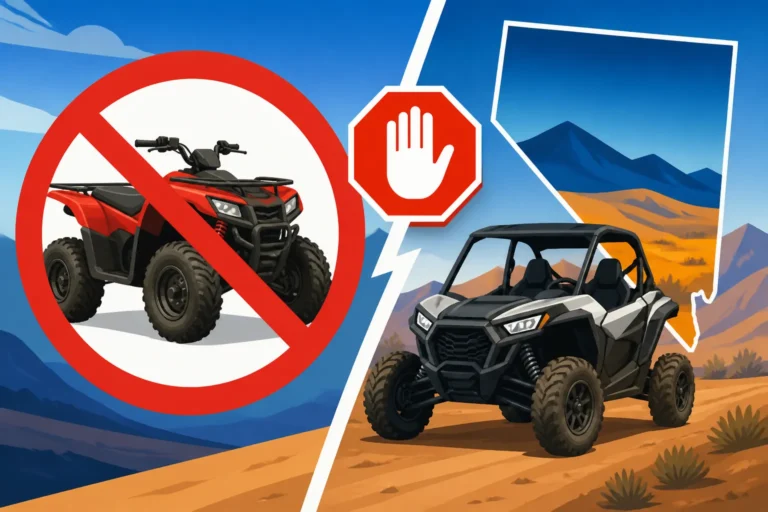
The state of Nevada explicitly prohibits plating ATVs for general street use, as you might do with a car or motorcycle. This means you won't be getting a license plate for your quad or UTV from the DMV to use it on the freeway or main city streets. The Large ATV Decal is the closest you'll get to "street legal" status for these machines, and it's a very conditional legality. It's designed for machines that meet specific size and equipment criteria, and it strictly limits where and how you can ride. If your goal is full street legality, you'll quickly discover [Why Nevada Will Not Plate a Quad] for that purpose. This decal is for those specific situations where you need to traverse county roads to get to a trail, a fuel stop, or a nearby destination, without trailering your machine.
What Qualifies as a "Large ATV" in Nevada?
This is where many riders get tripped up, thinking their sport quad or even a smaller side-by-side will qualify. Nevada's definition of a "large all-terrain vehicle" is very specific and outlined in [What Nevada's NRS 490.043 Counts as a Large ATV]. It's not just about engine size or horsepower. The law looks at structural features that imply a higher degree of stability and utility. Primarily, your machine needs to have a gross dry weight of 900 to 2,500 pounds, a width of 50 to 65 inches, and be equipped with a steering wheel and non-straddle seating for at least two people. Crucially, it must also have a truck-like bed or an enclosed cargo box.
This means that many popular machines, especially sport quads or even compact, two-seat UTVs that lack a significant cargo bed, simply won't make the cut. [Why a Two-Seat Sport Quad Fails Nevada's Test] is a common frustration for riders. Even some larger UTVs might need a careful look; for instance, [Does a Four-Seat RZR Pass Nevada's Seating Test?] often depends on whether it meets the cargo bed requirement, not just the seating. The intent behind the law is to allow more utilitarian or family-oriented side-by-sides to access roads, not high-performance recreational machines. This distinction is paramount because if your machine doesn't physically fit this description, no amount of paperwork will get you the decal.
The Essential Paperwork Checklist
Alright, let's talk about the actual documents you’ll need to assemble. Getting the Large ATV Decal isn't a quick grab-and-go from the DMV. It requires careful preparation and making sure you have every single piece of paper in order. Missing just one item can send you back to the drawing board, causing delays and frustration. Consider this your definitive checklist.
Required Application Forms
The process begins with the right forms. You’ll be looking for specific documents related to OHV registration and titling. While the exact form numbers can sometimes change slightly, you'll generally need the following:
- Application for Registration/Title: This is your primary form for both titling and registering your OHV. It asks for all the basic information about you and your machine, including VIN, make, model, year, and purchase details. Ensure every blank is filled accurately and completely. If you’re purchasing from a dealer, they often help complete this form, but always double-check it.
- Affidavit of OHV Equipment: This specialized form is where you certify that your "large ATV" meets all the specific equipment requirements for road use in Nevada. This isn't just a simple checkbox; it's a declaration that your machine has proper [Nevada Headlight Requirements for Road Use], a [Nevada Horn Requirement on a Road Machine], [Nevada Mirror Requirements for a Road UTV], and other safety features like [Nevada Seat Belt Rules in a Side-by-Side]. You're essentially promising the state that your machine is road-ready according to their standards. You'll sign this form, affirming under penalty of perjury that all information is true.
Beyond these, if your machine is new or has never been titled in Nevada, you’ll need proof of ownership. This typically means a Manufacturer's Certificate of Origin (MCO) for new machines or a properly endorsed title from the previous owner if you bought it used. If you're coming from out-of-state, your existing title or registration will be crucial. Remember, the DMV is a stickler for detail, so neatness and accuracy on these forms are non-negotiable.
Proof of Ownership and Identification
This is fundamental for any vehicle transaction. The DMV needs to know you are who you say you are, and that you legally own the machine you're trying to register.
- Proof of Identity: A valid, government-issued photo ID is essential. Your Nevada driver's license or state ID card is typically sufficient. If you're new to Nevada, you'll need to establish residency and often provide additional documentation to do so. Remember, [The Driver's License Nevada Wants on Roads] for operating an OHV with a large ATV decal is generally a standard Class C driver's license.
- Proof of Ownership for the OHV: This means your vehicle's title. If your OHV is already titled in Nevada in your name, great! If you just bought it, you'll need the properly signed-over title from the previous owner or the Manufacturer's Certificate of Origin (MCO) if it's brand new from a dealer. If you're bringing in an OHV from another state, you'll present its out-of-state title. Make sure there are no liens recorded that haven't been released, as this can cause significant delays. Without clear proof of ownership, the DMV cannot issue a title or registration in your name.
- Bill of Sale: While not always strictly required if you have a properly endorsed title, a bill of sale is highly recommended, especially for private party purchases. It provides crucial details about the transaction, including the purchase price (for sales tax calculation, if applicable), date of sale, and identifies both buyer and seller. This is particularly useful if there's any ambiguity on the title or if the machine came from a state that doesn't issue titles for OHVs.
Proof of Insurance and VIN Inspection
These two items are critical because they directly relate to public safety and proper vehicle identification. Without them, you won't get far in the process.
- Proof of Liability Insurance: When you're talking about taking an OHV onto public roads, even limited ones, insurance becomes a non-negotiable requirement. Nevada mandates liability insurance for any motor vehicle operating on its roads. You'll need an active policy that meets the state's minimum coverage limits. Present your insurance card or a declaration of coverage from your insurer. This is more than just a formality; it protects you and others in the event of an accident. Familiarize yourself with [Liability Insurance Nevada Requires Under NRS 485.185] to ensure your policy is adequate. Many riders already have OHV insurance for trail riding, but you should confirm with your provider that it extends to road use under the Large ATV Decal rules.
- VIN Inspection: Every OHV needs a Vehicle Identification Number (VIN) inspection to ensure the machine is what its paperwork claims it is and that the VIN hasn't been tampered with. This is a critical step for preventing theft and ensuring accurate records. For OHVs, this inspection can be done by a Nevada licensed OHV dealer or a sworn law enforcement officer. The Nevada DMV itself typically will not perform VIN inspections for OHVs, which is a common point of confusion for those used to car registrations. You can find detailed information on [Nevada OHV VIN Inspection Requirements] and even [Which Dealers Can Inspect a VIN in Nevada] or the process for [Asking a Sworn Officer to Verify a VIN]. Make sure whoever performs the inspection fills out the correct form, usually a VIN verification form provided by the DMV or available through the inspecting entity, and signs it appropriately.
The Application Process: Step-by-Step
Once you've meticulously gathered all your paperwork, the next step is actually submitting it. While it might seem straightforward, knowing the sequence and having an idea of what to expect can smooth out the bumps in the road.
Getting Your VIN Inspected
As mentioned, the VIN inspection is a vital pre-submission step. You can't just show up at the DMV with your machine and expect them to send someone out. You need to handle this beforehand.
- Finding an Approved Inspector: Your best bet is to contact a licensed Nevada OHV dealer. They are set up to do these inspections and often process the associated paperwork efficiently. Call ahead to confirm their inspection hours and any fees they might charge. Many dealers also specialize in aftermarket accessories like those from SuperATV, which can be great if you need to quickly add required equipment like mirrors or a horn before your inspection. Alternatively, a sworn law enforcement officer (like a Sheriff's Deputy or Highway Patrol Trooper) can perform the inspection. This often involves calling their non-emergency line and arranging a time and place, which can sometimes be less predictable. Make sure the inspector uses the official form and accurately records the VIN and their credentials.
- What Happens During the Inspection: The inspector will visually verify the VIN on your machine matches what's on your title or MCO. They'll check for any signs of tampering and confirm the basic description of your OHV (make, model, year). They are essentially verifying the machine's identity. This isn't a mechanical inspection for roadworthiness beyond ensuring basic required equipment is present as per the affidavit you'll sign. Once complete, they'll sign and date the VIN verification form, which becomes part of your application packet.
Submitting Your Application
With all your forms filled out and signed, your proof of ownership, ID, insurance, and the VIN inspection complete, you're ready to head to the DMV.
- At the Nevada DMV OHV Section: While you're visiting a DMV office, remember you're specifically dealing with the OHV section. Not all DMV counters handle OHV registrations, so it’s wise to check the specific office you plan to visit. Some offices have dedicated OHV specialists. You'll present your complete packet of documents to the clerk. They will review everything meticulously for completeness and accuracy. Be prepared for questions, and don't be afraid to ask for clarification if anything is unclear. This is where your thorough preparation pays off; a missing signature or an incomplete field can result in being sent home to rectify it. If everything is in order, they'll process your application, collect any applicable fees, and issue you a temporary operating permit, sometimes valid for a limited period, while your decal is being processed. This is also where you'll pay the [Nevada Large ATV Decal Cost].
- What to Expect Post-Submission: After submission, the DMV will process your application. This can take a bit of time, especially during peak seasons. You will eventually receive your official Large ATV Decal by mail, which you'll need to affix to your machine according to [Nevada OHV Decal Placement Rules]. Generally, it goes on the left side or rear, clearly visible. You'll also receive your updated registration card. This card, along with your driver's license and proof of insurance, are the documents you absolutely must carry with you whenever you operate your OHV on designated Nevada county roads. Remember, just having the decal isn't enough; you need the supporting paperwork readily available if a law enforcement officer asks for it.
Common Pitfalls and How to Avoid Them
Even with the best intentions, it's easy to make mistakes when dealing with government paperwork. Here are some common issues riders face and how you can proactively avoid them.
Incorrect Machine Classification
This is perhaps the biggest hurdle for many. You might think your machine qualifies as a "large ATV," but Nevada's legal definition is very precise and narrow.
- Misunderstanding the Requirements: Many people purchase a new UTV or ATV with the intention of riding it on county roads, only to discover it doesn't meet the specific width, weight, seating, or cargo bed requirements. For example, a sleek two-seat sport side-by-side, while powerful and fun, might not have the "truck-like bed" or meet the weight criteria of [What Qualifies as a Large ATV in Nevada]. It’s heartbreaking to get all your paperwork ready only to be told your machine simply doesn't fit the legal definition. Before you even start the paperwork process, or ideally, before you even buy the machine, thoroughly review the statutory definition of a "large all-terrain vehicle" in Nevada.
- Aftermarket Modifications: While SuperATV and other brands offer fantastic aftermarket accessories that can enhance your machine, adding things like a bigger bed or wider stance after purchase usually won't change its fundamental classification as determined by its Manufacturer's Certificate of Origin (MCO) or original specifications. The state generally looks at the machine's design as it came from the factory or its inherent characteristics. Be wary of advice that suggests extensive modifications can magically transform a non-qualifying machine into a "large ATV" for registration purposes. Focus on machines that already meet the core criteria.
Missing or Incomplete Documentation
This is a classic paperwork headache. A single missing piece of paper or an uninitialed box can halt your entire application.
- The "I Thought I Had It" Syndrome: It’s easy to overlook a signature line on a form, forget a copy of your ID, or assume the DMV has a record of your insurance. Before you even leave your house, create a physical checklist of every single document and item required. Lay them all out and double-check each one against the DMV's official list (often available on their website or as part of the application packet). Make copies of everything you submit for your records. This includes copies of your title, VIN verification, and insurance.
- Title Troubles: A common issue for used purchases is a title that isn't properly signed over, has white-out on it, or has a lien that hasn't been officially released. If you're buying a used machine privately, insist on a clear title that is properly endorsed by the seller, and check the VIN carefully against the machine itself. If the seller "can't find the title," or if the title is damaged, you could be in for a much longer and more complicated process. Always verify the title's validity before money changes hands.
Not Meeting Equipment Standards
Beyond the basic definition, your machine needs specific safety equipment to be eligible for the decal. This isn't just a suggestion; it's a legal requirement.
- Overlooking the Finer Details: The Affidavit of OHV Equipment isn't just a formality. You are attesting that your machine has working headlights and taillights visible from [Headlights and Taillights Visible 500 Feet], a functioning [The Stop Lamp a Nevada Road Machine Needs], appropriate [Nevada Mirror Requirements for a Road UTV], a [Nevada Horn Requirement on a Road Machine], and a spark arrester. It also needs seatbelts for all seating positions, and a windshield if the machine originally came with one or if you've added one. These aren't just for looking good; they are for safety on the road. Many riders have all the big stuff but forget a horn or ensure their mirrors provide adequate rear visibility.
- Getting Prepared: Take the time to physically inspect your machine against the [Nevada Equipment List for Road-Legal UTVs]. If you're missing something, like a horn or suitable mirrors, now is the time to install them. Many aftermarket parts suppliers, including SuperATV, offer kits and individual components specifically designed to help UTVs meet road-legal requirements. Installing these before your VIN inspection ensures you're ready when it's time to certify your machine. Don't wait until the last minute, as rushing can lead to mistakes or overlooked items.
Getting your Nevada Large ATV Decal doesn't have to be a frustrating ordeal. By understanding the requirements, carefully gathering your paperwork, and preparing your machine, you can navigate the process smoothly and unlock new riding opportunities on Nevada's scenic county roads.
Disclaimer
This article is for general informational purposes only and does not constitute professional advice. Laws, prices and regulations vary by location and change over time. Consult a qualified professional for guidance on your specific situation.