Commercial Filming Permits on Nevada BLM
Commercial Filming Permits on Nevada BLM
Planning to film an ATV or UTV video on Nevada public land? Whether you need a permit depends on more than whether the footage will earn money. The crew, equipment, location, and effect on other visitors all matter. Here’s how to sort out the likely requirements, contact the right BLM office, and avoid treating filming permission as permission to ride anywhere.
When Commercial Filming May Need BLM Authorization
The Bureau of Land Management manages large areas of public land in Nevada, but public access does not automatically include permission to conduct a commercial production there. Filming may require authorization when the activity uses the land in a way that goes beyond ordinary recreational use or could affect other visitors, resources, or BLM operations.
The distinction is important for ATV and UTV productions. A person recording a casual ride with a phone is not necessarily in the same situation as a production crew using multiple vehicles, camera rigs, lighting, a staging area, and paid talent. The fact that footage may eventually appear in an advertisement, a monetized video, or a commercial project does not, by itself, answer whether a permit is required.
Federal rules and BLM guidance can distinguish between types of filming and production activity. Certain small-scale filming may qualify for an exemption, but eligibility depends on the applicable rules and the details of the shoot. Don’t assume that carrying a handheld camera means you are automatically exempt, and don’t assume that monetization alone automatically requires a permit. Ask the BLM office responsible for the location to assess the actual plan.
Consider the whole production, not just the camera
When you describe a shoot to the BLM, include what the crew will do on the ground. Factors that may matter include:
- How many people and vehicles will be present
- Whether crew members will travel separately from the riders
- Whether the production will use tripods, lighting, large camera rigs, drones, or other equipment
- Whether a crew needs to park, stage, or store gear on public land
- Whether the production wants to block, reserve, or control an area
- Whether the crew will use props, temporary structures, or marked-off filming zones
- Whether filming will take place on a route open to motorized travel
- Whether the activity involves a paid tour, organized event, or commercial operator
- Whether the production could disturb wildlife, cultural resources, other visitors, or land-management work
These details are not a substitute for the BLM’s permit criteria. They are a practical way to identify issues the office may need to review. A small crew filming riders as they pass through an open area may present a different set of concerns from a production that wants exclusive use of a popular trailhead.
A camera mounted on a machine also does not make an unauthorized route legal. The production still has to follow the land-use rules that apply to the location. For help separating open routes from routes that are closed or restricted, see Nevada Rules for Riding Federal Land and Reading a BLM Travel Management Map.
Filming permits and recreation permits are not interchangeable
A filming authorization and a Special Recreation Permit address different activities, though a production may need to ask about both. A filming permit concerns the production’s use of BLM land for filming. A Special Recreation Permit may be relevant when the activity also involves organized recreation, commercial guiding, or an event on public land.
For example, a production that hires a guide to lead riders may need to understand the guide’s authorization as well as the production’s filming requirements. A commercial shoot built around an organized group ride may raise questions that a camera crew filming a few riders on an ordinary outing does not. The BLM office can explain which authorizations apply to the combined plan.
For a broader overview of recreation authorizations, see BLM Special Recreation Permits in Nevada. If the shoot is tied to a group ride or organized activity, Permits for an Organized Nevada Group Ride may also help you identify the separate questions to raise.
Plan the Location and Route Before You Apply
A useful permit inquiry begins with a specific location. “Somewhere near Las Vegas” or “on BLM land outside Reno” is not enough for staff to determine whether the proposed site is available, which office handles it, what routes are open, or whether another authorization may apply.
Nevada’s public lands are divided among different BLM offices and field offices. The office responsible for one filming area may not manage another site nearby. Start by identifying the proposed filming location as precisely as you can, then contact the BLM office that manages it. If you are uncertain about the boundary or which office to call, describe the nearest access point and ask for help identifying the responsible office.
Check route access separately from filming permission
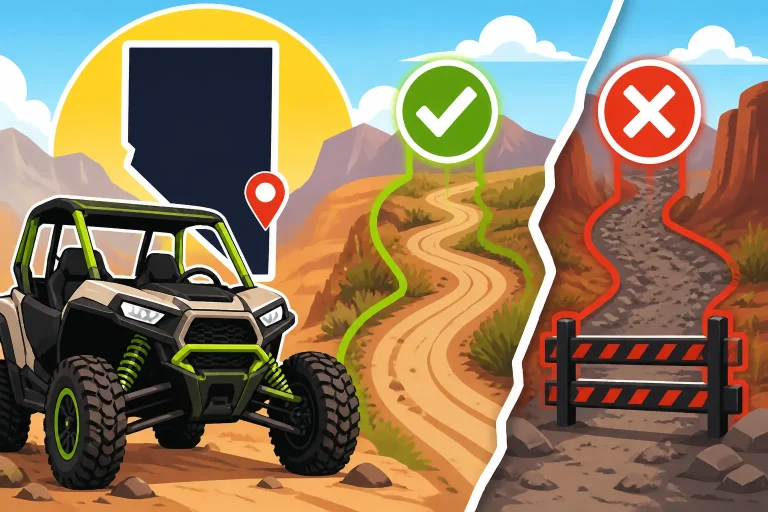
A filming permit does not necessarily authorize riding on a route that is closed to motor vehicles. Nor does an open route automatically mean a production may set up equipment, reserve space, or conduct a commercial shoot there. Treat these as two separate checks:
- Land-use access: Can the ATV or UTV legally travel on the proposed route?
- Production activity: Does the filming plan require a permit or other authorization at the location?
This distinction matters when a shot list includes a trail, wash, dry lake, dune area, or road crossing. Some areas may allow motorized travel only on designated routes. Others may have seasonal restrictions, temporary closures, resource protections, or access conditions that are not obvious from a road map or a social media post.
Review the available travel information, then confirm the route with the responsible office if the production depends on it. Riding Open BLM Land Versus Marked Trail explains why open public land should not be treated as permission for unrestricted cross-country riding. If your crew plans to travel beyond Nevada, check the rules that apply across the entire route rather than assuming a Nevada authorization covers another state.
Think about how the shoot affects other users
Public land remains open to other visitors unless the BLM specifically authorizes some form of restriction. A production should not assume it can stop trail traffic, reserve a trailhead, or tell other riders to wait. If the shot requires control over a location, explain that clearly in the application inquiry. The BLM can tell you whether the request is possible and what conditions might apply.
Busy sites can make filming harder even when the production is authorized. Riders, trucks, campers, and changing trail conditions may affect sound, camera placement, and safety. A crew that needs a clean background or a quiet stretch of trail may need a different location or schedule rather than an attempt to claim an area that is open to the public.
Also consider whether the proposed site is close to sensitive resources, private land, a mine, a wildlife area, or a managed recreation facility. If the production’s route crosses land with different managers, a BLM permit may not cover the whole route. Identify each segment and ask which agency or landowner controls it.
What to Include in a Permit Inquiry or Application
Before submitting paperwork, send the BLM office a clear description of the project and ask which authorization applies. The goal is to give staff enough detail to assess the shoot without making them guess about the production’s scale or footprint.
An organized application or inquiry will usually describe:
- The purpose and general nature of the production
- The proposed filming dates and hours
- The exact filming locations and planned routes
- The number of crew members, riders, and vehicles
- The kinds of cameras, support equipment, and props
- Where vehicles and equipment will be staged
- Whether the shoot needs exclusive or controlled access
- The expected movement of people and vehicles during filming
- Any paid guides, organized rides, or commercial operators involved
- How the crew will protect public access and avoid resource damage
- The production’s safety plan and emergency contact arrangements
- Any insurance information requested by the BLM
A production that uses an ATV or UTV as a camera platform should say so. Explain whether the machine will carry a rider, camera operator, or equipment, and how it will travel while filming. If a drone, temporary structure, or special effect is part of the plan, list it rather than treating it as a minor detail. Extra equipment or a change in crew size can affect what the office needs to review.
Ask about insurance and operating conditions
The BLM may require proof of insurance or other risk-management information, depending on the activity and authorization. Don’t assume a production’s general business policy will meet the agency’s requirements. Ask the office what coverage and documentation it needs, and whether there are conditions related to vehicles, riders, equipment, or third-party contractors.
A permit may also include location-specific terms. Those can address where vehicles may travel, where equipment can be placed, when the crew may work, how the production will avoid interfering with other visitors, or what to do if conditions change. Read the authorization carefully before filming, and make sure the people in charge on location understand its limits. For more context on insurance questions for recreation authorizations, see Insurance a BLM Permit Requires.
If the shoot involves an organized event rather than a small production, requirements may differ. Applying to the BLM for an Event Permit and Lead Times on a BLM Event Permit cover issues that may be relevant when a film project includes a planned group ride, event activity, or a larger organized gathering.
Ask about fees and timing instead of relying on old figures
Permit costs, application requirements, and processing timelines can vary with the activity and may change. There is no safe universal price or deadline to apply against. Ask the responsible office what fees apply, what documents are required, and how far ahead to submit the request.
Allow time for staff to review the location, proposed routes, insurance, and possible resource concerns. A complicated shoot, a sensitive site, a request for controlled access, or a plan involving multiple land managers may take more coordination than a straightforward filming proposal. Don’t book a crew, promise a client a specific location, or announce a fixed production date until you know whether the location and permit timing are workable.
The BLM may need to revise the plan or suggest a different location. That does not necessarily mean the project cannot happen. A smaller crew, a different route, less equipment, or a change in timing may address the concern. Ask which changes would make the proposal easier to review rather than assuming the first location is the only option.
Keep the Ride Legal and the Production Within Its Authorization
Once the BLM has explained what applies, make sure the production team understands the difference between its filming authorization and each rider’s obligations. A filming permit is not an ATV registration, a trail pass, a road-use permit, or permission to ignore posted closures. Nor does it necessarily cover a rental company, guided tour, event organizer, or contractor unless those activities are included in the authorization.
Nevada’s OHV registration system is a separate issue from filming on BLM land. Nevada residents and visitors need to meet the registration or decal rules that apply to their machines. Visitors should check whether their home-state paperwork is recognized and what limits apply to an out-of-state machine. See Riding Nevada With an Out-of-State Registration for the separate reciprocity question.
A production should also make sure riders know the route rules before filming. The route may change because of a closure, weather, fire restrictions, resource protection, or a safety issue. A producer’s shot list does not override a closure sign or an instruction from land managers. Build in a plan to stop, relocate, or reschedule if the authorized area becomes unavailable.
Put one person in charge of permit compliance
Designate a production contact who can speak with BLM staff and relay conditions to the crew. That person should have the authorization available on location and know which sites, dates, activities, and equipment it covers. The rest of the crew should know who to contact before changing the plan.
This matters when a production is working with multiple teams. A camera operator may suggest moving to a nearby ridge for a better angle, while a rider may take a different route to avoid dust. Those changes can take the crew outside the approved area or onto a route that is not open to motorized use. Agree in advance that no one will change locations or add activities without checking the authorization and contacting the responsible person.
Keep copies of important paperwork in a secure, accessible place. A digital copy can help, but a phone with a dead battery or no signal is not a dependable sole backup. Store contact details and authorization documents so the field lead can retrieve them offline.
Protect people, equipment, and public access
A filming setup can create hazards even on a familiar route. Tripods, cables, parked machines, and crew members standing near a trail can surprise approaching riders. Position people and equipment where they are visible and do not create an avoidable obstruction. If a shot requires a temporary pause in traffic, ask the BLM in advance what is permitted rather than improvising a roadblock.
Dust can also affect visibility and the safety of riders and camera operators. Plan camera positions away from blind corners, narrow trail sections, and places where a vehicle may lose traction. Avoid directing riders into terrain that is unsuitable for their machines or beyond their skill level just to get a shot. If the production uses a spotter, make sure that person has a clear view and a reliable way to communicate with the riders and crew.
Respect other visitors. They may not want to be filmed, may be using the route for their own ride, or may need to pass through the area. Avoid framing public access as a nuisance or implying that a permitted production owns the landscape. If a scene depends on privacy, choose a different setting or ask the BLM about options that do not interfere with public use.
Stop when conditions or boundaries change
Desert conditions can shift quickly. A route that was passable earlier may become unsafe after rain, high winds, heat, or a flash-flood warning. Smoke, fire restrictions, resource concerns, or a temporary closure can also change what is allowed. The field lead should know how to get current information and have authority to pause filming.
Do not move a production into a nearby area just because it looks similar. A small change in location can cross a management boundary, enter a closed area, or place the crew on private land. If the planned location is unavailable, contact the BLM office or land manager before relocating. The same caution applies when the production follows a route toward a trailhead or filming site: verify where public land begins and ends, and do not assume the whole access route is under BLM management.
Frequently Asked Questions
Does every monetized ATV video need a BLM filming permit?
Not necessarily. Monetization alone does not settle the question. Permit requirements depend on applicable federal rules and the details of the production, including its scale, equipment, location, and effect on public use. Ask the BLM office responsible for the site whether an exemption applies.
Does a filming permit let the crew ride anywhere on BLM land?
No. The permit does not automatically make a closed route legal or authorize cross-country riding. Confirm that each planned route is open to motorized use and follow closures and other land-use restrictions.
Does a filming permit replace a Nevada OHV decal?
No. Filming authorization and machine registration are separate. Riders still need to meet the OHV paperwork rules that apply to their machines and residency.
Should a production apply even if the shoot is small?
First contact the responsible BLM office with a concise description of the plan. The office can explain whether the proposed activity is exempt, needs an authorization, or should be changed. Do this before committing to a location or schedule.
Disclaimer
This article is for general informational purposes only and does not constitute professional advice. Laws, prices and regulations vary by location and change over time. Consult a qualified professional for guidance on your specific situation.