Riding County Roads Legally in Nevada
It's a familiar scenario for many off-highway vehicle (OHV) enthusiasts in Nevada: you've got your side-by-side or ATV, and you just want to get from your campsite to the trailhead, or maybe dash into town for a forgotten bag of ice. The idea of trailering your machine for every short hop feels cumbersome and defeats the spirit of adventure. This guide aims to cut through the confusion and explain exactly how you can legally ride your OHV on Nevada county roads, navigating the specific rules and requirements.
The Nevada Dream vs. Reality: Why Road Riding is Tricky
We all love the freedom of hitting the dirt, but sometimes, those dusty trails are interrupted by a stretch of pavement. For many OHV riders, the dream is simple: to connect those trails, bypass a dusty dirt road, or just quickly run into a small town for supplies without having to load the machine onto a trailer. It feels like it should be easy, a natural part of the off-road lifestyle, but the reality of Nevada's road laws can feel like a tangled mess of regulations and restrictions. You’re not alone if you’ve felt frustrated trying to figure out what's allowed and what's not.
The Allure of Paved Connections
Imagine rolling out of your remote campsite and simply driving your UTV a few miles down a quiet county road to reach the next section of trail or a scenic overlook. Or perhaps you're on a long-distance multi-day trip, and a quick jaunt through a small, friendly town is the only way to refuel or grab a bite. This convenience isn't just about saving time; it's about enhancing the entire off-road experience, making trips more fluid and less reliant on a tow vehicle. It allows for exploration that feels more expansive and less constrained, truly connecting the dots of Nevada’s vast open spaces.
There's a genuine appeal to using your OHV as a means of practical transportation for short distances, especially in the rural parts of Nevada where county roads often serve as access points to incredible riding areas. The ability to legally transition from dirt to pavement and back again opens up new possibilities for adventure, turning what might otherwise be a logistics headache into a seamless part of your journey. It's about blending the utility of a vehicle with the thrill of off-road exploration, allowing you to access more remote areas while still having essential services within reach.
The Core of Nevada's OHV Road Laws
At the heart of Nevada's regulations for OHVs on paved roads lies Nevada Revised Statute (NRS) 490.043. This is the crucial piece of legislation that defines what an "all-terrain vehicle" must be to even be considered for limited road use. It specifically carves out an exception for a certain class of OHVs, often referred to as "Large ATVs" or utility task vehicles (UTVs), to operate on designated county roads under specific conditions. The law isn't a blanket permission for all OHVs; it's a carefully crafted set of rules designed to balance the interests of off-road enthusiasts with public safety concerns on shared roadways.
Understanding NRS 490.043 is the first and most critical step. It dictates not just where you can ride, but what kind of machine qualifies. Without meeting these foundational requirements, any attempt to ride your OHV on a paved county road will put you in violation of the law. This statute sets the stage for all other rules, from required equipment to driver qualifications, forming the bedrock of legal OHV road use in the Silver State. It's a testament to the state's recognition of the popularity of side-by-sides, distinguishing them from traditional ATVs in the eyes of the law.
Common Misconceptions and Costly Mistakes
One of the biggest misconceptions riders often have is assuming that if their OHV is registered and has a current decal, it's automatically street legal for short distances. This is absolutely not the case in Nevada. A standard OHV registration decal only permits off-road use; it doesn't magically transform your machine into a road-legal vehicle. Many a rider has learned this the hard way, pulling off a trail onto a paved road only to be met by a deputy who quickly points out the error – and issues a citation. The state of Nevada draws a very clear line between off-road registration and limited on-road privileges, and it’s a line that many riders inadvertently cross.
Another common mistake is to think that because a road looks like a dirt path or is unpaved, it automatically falls under "off-road" rules, even if it's technically a county road. While many minor county roads are indeed unpaved, the distinction isn't always about the surface; it's about its legal classification. Relying on appearance rather than proper identification of road types can lead to unforeseen fines. Furthermore, out-of-state plates or "street legal" conversions from other states often don't translate to legal road use in Nevada, as the state has its own unique set of requirements for what is considered a [Large All-Terrain Vehicle Decal]. Don't assume that what works in Arizona or Utah will automatically pass muster with a Nevada Highway Patrol trooper or county deputy.
What Exactly Qualifies as a "Large ATV" in Nevada?
This is where the rubber meets the road, quite literally. Nevada's law, specifically [What Nevada's NRS 490.043 Counts as a Large ATV], doesn't just open up county roads to any old ATV. It creates a very specific category of machine, which they term a "Large All-Terrain Vehicle." This definition is crucial because if your machine doesn't fit it, you simply cannot legally operate it on paved county roads, regardless of what equipment you've added or how much you wish it could. Understanding this definition is the absolute cornerstone of riding legally on Nevada's roadways.
Seating Capacity and Vehicle Bed Requirements
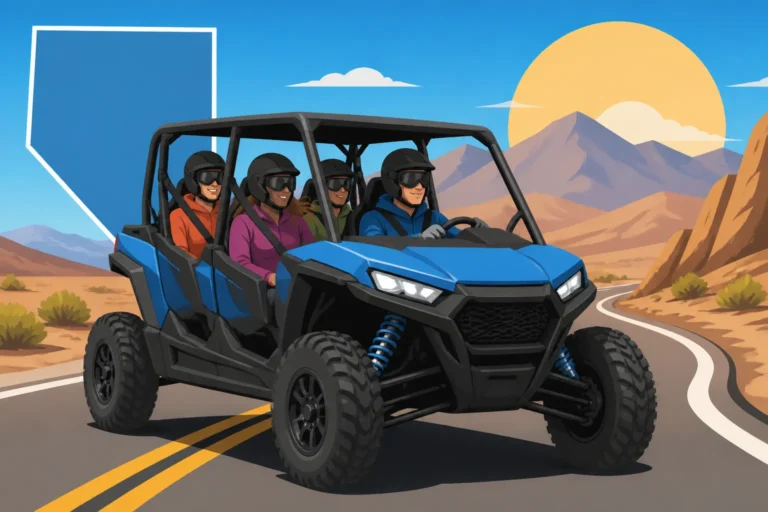
For an OHV to qualify as a "Large All-Terrain Vehicle" in Nevada, it generally needs to meet one of two primary criteria related to its design. First, it must be designed by the manufacturer to carry four or more passengers. This means a side-by-side with two rows of seating, or perhaps a model specifically engineered for a larger group. The number of seatbelts is often a good indicator here, but the key is the manufacturer's original design intent. You can't just bolt on extra seats to a two-seater and call it a day; it needs to come from the factory configured for more than three occupants.
Alternatively, the vehicle can qualify if it's designed by the manufacturer to have a vehicle bed with a load capacity of at least 200 pounds. This criterion often applies to utility-focused UTVs, such as many popular models from Polaris, Can-Am, or Yamaha, which are built to haul gear, tools, or supplies. The presence of a substantial cargo bed that can carry a significant weight payload is a clear signal that the machine is intended for more than just sport riding. These machines are built for work, or at least for carrying serious equipment, and this distinction is what the Nevada law leverages to allow them on roads. For example, a Can-Am Defender or a Polaris Ranger, with their integrated cargo beds, often fit this description perfectly.
Why Your Sport Quad Won't Make the Cut
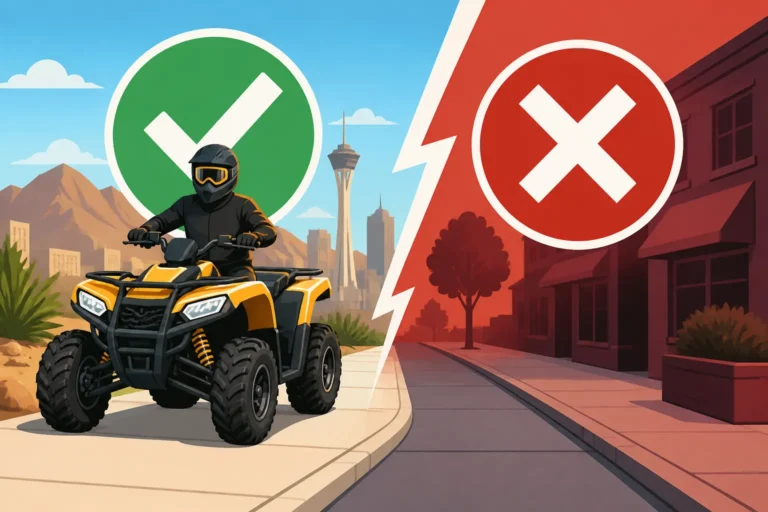
This particular section is often a source of disappointment for many riders, but it's important to be clear: your traditional sport quad, no matter how powerful or accessorized, will almost certainly not qualify as a "Large ATV" under Nevada law for road use. The definition of a "Large ATV" focuses on multi-passenger capability (four or more seats) or a substantial utility bed. A sport quad, by its very design, typically seats only one or two riders and lacks the integrated, high-capacity cargo bed that the law specifies. Therefore, attempting to ride a two-seat sport quad on a paved county road, even with a [Nevada Large ATV Decal Cost] and all the required equipment, will generally lead to a citation because the base machine itself doesn't meet the statutory definition. This is explicitly covered in resources like [Why a Two-Seat Sport Quad Fails Nevada's Test].
Even if you modify your sport quad with signals, mirrors, and a horn, it still won't meet the fundamental structural requirements. The law is concerned with the manufacturer's original design for passenger capacity or utility, not aftermarket additions. It’s a bitter pill to swallow for those who love their sport quads and wish for that same road-connecting flexibility, but the legal framework simply doesn't allow for it. So, if you're rocking a Yamaha Raptor or a Honda TRX, plan on keeping it strictly off-road or trailering it everywhere, because paved county roads are almost certainly off-limits for that machine in Nevada.
Comparing Machines to Nevada's Definition
Let's look at some practical examples to help clarify what qualifies. Most modern side-by-sides (UTVs) are strong candidates for meeting Nevada's "Large ATV" definition. A four-seat Polaris RZR XP 4 1000, designed with seating for four, would easily meet the passenger capacity requirement. Similarly, a Can-Am Defender MAX, with its multiple seats and robust cargo bed, often satisfies both criteria. Utility-focused machines like a Kawasaki Mule or a John Deere Gator, which are primarily built with large cargo beds, are also excellent examples of vehicles that typically align with the legal definition. These machines are engineered from the ground up to handle more passengers or significant payloads, making them distinct from the smaller, more agile ATVs.
On the other hand, traditional ATVs, whether they are single-rider sport models or two-up touring models, almost universally fail to meet the "Large ATV" criteria. Even if an ATV is larger or heavier than some side-by-sides, if it doesn't have the four-plus passenger seating or the substantial 200-pound capacity cargo bed as designed by the manufacturer, it won't qualify. This distinction is vital, and it means riders need to be honest about their machine's factory specifications rather than what they've added to it later. It’s a matter of inherent design, not just how it looks or how big it is.
The "Large ATV Decal": Your Ticket to Nevada County Roads
Once you've confirmed your machine fits the "Large ATV" definition, the next step is obtaining the specific permit that allows you to operate it on designated county roads. This isn't your standard OHV registration decal; it's a separate, distinct decal that specifically grants these limited on-road privileges. Without this decal, even a qualifying machine with all the right equipment is still technically not permitted on paved county roads in Nevada. Think of it as an extra layer of authorization, an acknowledgment that your machine meets the stringent requirements for limited road use.
Applying for the Decal: Paperwork and Process
Applying for your [Nevada Large ATV Decal] involves a specific set of paperwork and a clear process through the Nevada Department of Motor Vehicles (DMV) or a certified OHV dealer. You'll typically need your proof of ownership (title), a completed application form (often a variation of the OHV-001 or OHV-002, specifying large ATV designation), and sometimes a VIN inspection to verify the vehicle's identity and ensure it's not stolen. It's a bit more involved than simply registering for off-road use, as the state needs to confirm your vehicle genuinely meets the "Large ATV" definition.
The process often requires a trip to the DMV or a participating dealer, as not all OHV registration points handle the "Large ATV" decal. Be prepared to provide all necessary documentation and be patient, as the review process can take a little time to ensure everything is in order. It's not a complicated process, but it does demand attention to detail to avoid delays. Having all your ducks in a row – title, application, and proof of identification – will make the experience much smoother. Remember, the goal is to prove your machine fits the specific legal criteria, so any documentation supporting its manufacturer-designed seating or bed capacity can be helpful.
What the Large ATV Decal Actually Permits
The [Nevada Large ATV Decal] isn't a license to ride your UTV everywhere like a regular car. It grants very specific, limited privileges. Primarily, it allows you to operate your qualifying "Large ATV" on minor county roads that are specifically designated as open to OHV use. This is a critical distinction: it does not permit you to ride on state highways, interstates, or within the city limits of many larger Nevada municipalities unless those cities have their own specific ordinances allowing it on designated routes. For instance, you can't just drive down the Las Vegas Strip in your RZR, no matter how many seats it has or how fancy your decal is.
The decal is meant to facilitate access to trail systems, connect segments of off-road routes, or allow quick trips through rural areas. It's about bridging gaps, not replacing traditional vehicles. It's also important to remember that even on designated county roads, all other traffic laws apply, and you must adhere to speed limits, stop signs, and signals just like any other vehicle. This decal is about limited access, not unrestricted freedom on all public roads. It's about getting from point A to point B on specific, approved pathways, ensuring you have the ability to connect to the riding experiences you love without constant trailering.
Costs and Renewal Considerations
Obtaining a [Nevada Large ATV Decal Cost] involves a fee, similar to a standard OHV registration, but it specifically includes the "Large ATV" designation. The exact cost can vary depending on whether you choose a one-year or three-year decal, and if any additional fees apply for titling or processing. It's important to check the current rates with the Nevada DMV or a licensed OHV dealer, as these figures can change. Think of it as an investment in your riding freedom, allowing you to legally broaden your machine's utility.
Like all vehicle registrations, the Large ATV decal will have an expiration date and will need to be renewed periodically. It's crucial to keep track of this date, as operating with an expired decal, even on a qualifying machine on a permitted road, will lead to fines. Many riders set reminders or note the expiration date from their current decal. Staying on top of renewals ensures your continuous legal access to those county roads and helps you avoid unnecessary penalties. The renewal process is typically simpler than the initial application, often handled online or by mail, assuming your vehicle information hasn't changed.
Essential Equipment for Nevada Road-Legal OHVs
Even if your OHV qualifies as a "Large ATV" and you've secured the special decal, you're still not ready to hit the pavement without making sure your machine is properly equipped. Nevada law mandates specific safety and operational equipment for any "Large ATV" being operated on public roads. This isn't optional; it's a legal requirement designed to ensure your visibility and safety, as well as the safety of other road users. Think of it as bringing your OHV up to a minimal "street-ready" standard, ensuring it can interact safely with other traffic. The [Nevada Equipment List for Road-Legal UTVs] is quite comprehensive, and missing even one item can result in a ticket.
Lighting, Reflectors, and Audible Warnings
When you're sharing the road with cars and trucks, being seen and heard is paramount. Nevada law requires your "Large ATV" to have at least one headlight that emits a white light visible from 500 feet to the front. This isn't just a dim trail light; it needs to be substantial enough to project clear visibility. Similarly, you'll need at least one taillight emitting a red light, also visible from 500 feet to the rear. This dual visibility ensures that you're noticed coming and going, especially during dusk, dawn, or other low-light conditions. [Headlights and Taillights Visible 500 Feet] is a key benchmark.
Beyond basic lights, a stop lamp is mandatory, activating when you apply the brakes to clearly signal your deceleration to traffic behind you. Reflectors are also crucial. If your taillight assembly doesn't include a reflector, you'll need to add separate red reflectors to the rear. And for audible warnings, a working horn or other warning device capable of emitting a sound audible from at least 200 feet is a must. This allows you to alert other drivers or pedestrians to your presence, an essential safety feature on any shared roadway. Many riders find SuperATV a great resource for DOT-compliant lighting kits, mirrors, and horns to meet these specific requirements without compromising their machine's off-road capabilities.
Mirrors, Windshields, and Other Safety Gear
Visibility isn't just about what others see of you; it's also about what you can see of them. A rear-view mirror, or mirrors, is required to give you a clear view of traffic approaching from behind. Many UTVs come with a center rearview mirror, but adding side mirrors can significantly improve your situational awareness, especially given the wide stance of many side-by-sides. If you choose aftermarket mirrors, ensure they are securely mounted and provide an unobstructed view.
While not always explicitly mandated like lights or mirrors, a windshield can be a highly recommended safety accessory for road use. It protects you from road debris, insects, and wind, making the road-riding experience much more comfortable and safer. Some manufacturers, like SuperATV, offer robust windshields that are scratch-resistant and easy to install. Beyond these, a secure seating system, including seatbelts for all occupants, is paramount. Even if your machine came with basic lap belts, ensuring they are in good working order and always used is non-negotiable for safety on public roads.
Tires, Exhaust, and Spark Arresters
The tires on your "Large ATV" are another critical component for road legality. While knobby off-road tires are perfect for gripping dirt and rocks, they may not be ideal or even legal for extended pavement use. Tires must be in good condition, with adequate tread depth, and suitable for the speeds and surfaces encountered on county roads. Some states specifically require DOT-approved tires for road use, so it's wise to ensure your tires meet these standards, if applicable, for Nevada's interpretation of "safe operating condition."
An approved muffler and exhaust system are also required. This isn't just about noise levels; it's also about emissions and safety. Specifically, a spark arrester is a must. This device prevents hot carbon particles from escaping the exhaust and potentially igniting dry vegetation, which is a significant fire hazard, especially in the arid Nevada environment. Even if you're only on the road, the risk of a spark arrester being absent or non-functional is something deputies will check, particularly during fire season. Ensuring your exhaust system is quiet and safe is part of being a responsible road user.
Navigating Nevada's Road Network: Where You Can and Cannot Ride
This is perhaps the most confusing aspect for many riders: understanding precisely which roads are permissible. Nevada’s laws are specific, and simply seeing a paved road doesn’t mean it’s open to your "Large ATV." The key lies in understanding road classifications and local ordinances. Failure to grasp these distinctions is a primary reason riders find themselves facing fines, even with all the correct equipment and decals. It's not enough to be street-legal; you must also be street-legal on the right street.
Understanding "Minor County Roads" and Designated Routes
Nevada law specifically permits "Large ATVs" on "minor county roads." But what exactly constitutes a "minor county road"? Generally, these are roads maintained by the county, often unpaved or lightly paved, that primarily serve rural areas, provide access to private property, or lead to recreational areas. They are distinct from state highways (like US-95 or SR-160) or interstate freeways, which are strictly off-limits to OHVs. The intention is to allow passage where traffic is minimal and speeds are generally lower, making it safer for OHVs to integrate.
However, even within the category of minor county roads, local jurisdictions retain the power to designate specific routes as open or closed to OHV traffic. This means that a road open in one county might be closed in an adjacent one. It's crucial to check with the local county sheriff's office or the county's public works department for maps or ordinances detailing which roads are open. For example, some areas around Logandale might have designated routes that allow OHVs to connect the town to trailheads, which is extremely convenient for riders. Always look for signage, and if in doubt, inquire locally.
The Strict 2-Mile Paved Highway Limit
One of the most critical and often misunderstood aspects of Nevada’s OHV road laws is the "2-mile paved highway limit" for crossing. While "Large ATVs" can use minor county roads, they are generally prohibited from riding along state highways. However, the law does provide a narrow exception: a "Large ATV" may cross a paved highway or ride along its shoulder for a distance of up to two miles to connect two approved off-road trails or open county roads. This is clearly detailed in [Nevada's 2-Mile Limit on Paved Highway].
This 2-mile limit is not for joyriding or extending your county road journey; it's strictly for transit purposes, to bridge a gap between legitimate riding areas. You cannot use this provision to ride into town on a state highway for lunch if it's more than two miles, nor can you use it to access a trailhead beyond that limit. It's a pragmatic allowance to prevent riders from having to trailer their machines for very short, unavoidable paved sections. Always exercise extreme caution during these crossings or shoulder rides, as you'll be sharing space with much faster-moving traffic.
Cities and Counties With Specific Ordinances
While the state law provides a general framework, individual cities and counties in Nevada have the authority to enact their own ordinances regarding OHV use on local roads. This means that even if a county road generally allows "Large ATVs," a specific city or town within that county might have an ordinance prohibiting OHVs on its streets, or limiting them to very specific designated routes. It's a localized patchwork of rules that demands careful research.
For instance, [Washoe County Ordinance 1507] has specific provisions that can affect OHV riders in the Reno-Sparks area. On the flip side, some communities, like Mesquite, have earned a reputation for being more OHV-friendly, with specific routes designated for access. However, even in OHV-friendly towns, there are often restrictions on which streets can be used, and you still can't typically ride on major thoroughfares or busy commercial strips. The best advice is always to check the specific municipal code or inquire with the local police department or sheriff's office before riding on any roads within city or town limits. Assuming general permissibility can lead to an unwelcome and expensive conversation with law enforcement.
| Road Type | Large ATV Allowed (with decal) | Notes |
|---|---|---|
| Minor County Roads | Yes, with certain limitations and under specified guidelines. Ensure local municipality laws are observed. | These are the primary roads where a "Large ATV" can legally connect from one off-road trail to another or access rural points. |
| State Highways | Yes, limited to crossing or riding the shoulder for a maximum of 2 miles. | Strict limits apply only to connect two off-road areas. Not for general travel or riding along. |
| Interstate Freeways | No | Absolutely prohibited. |
| City Streets (Major Cities) | Generally No, unless specifically designated by local ordinance. | Most larger cities prohibit OHVs on their streets. Always check local city ordinances. |
| City Streets (Small Towns/Rural) | Sometimes, depending on local ordinances. | Some smaller towns might have designated routes. Always check local rules. |
| — | — | — |
| Minor County Roads | Yes, with limitations. | The primary function of "Large ATV" on county roads is to connect to trail systems or access outlying rural communities. However, always verify current laws with local authorities or county websites, as specific roads can have explicit rules or closures. Keep in mind that "minor" often implies less traffic and lower speeds, which is why these are targeted for use. |
| State Highways (e.g., US-95, SR-160) | Yes, crossing or shoulder use for up to 2 miles. | This is a very specific, limited allowance to bridge gaps between legal riding areas. It's not for traveling along the highway. Be extremely cautious due to high-speed traffic. |
| Interstate Freeways (e.g., I-15, I-80) | No | Absolutely prohibited. No exceptions. |
| Other Major Roadways / Principal Arterials | No | Refer to local authorities for definitive answers, but assume these are generally restricted to OHVs. |
| Commercial Streets (with limited routes) | Sometimes, depends on city ordinances. | Typically, these vehicles are mostly kept off of major city streets unless there are specific, clearly marked routes designated by the city or county. Even then, they might be restricted to certain hours or conditions. You'll want to avoid being surprised by local law enforcement, so always look for specific rules. |
Driver Requirements, Insurance, and Passenger Rules
Beyond the vehicle itself and the roads it's allowed on, the driver and passengers also need to meet certain criteria. Nevada takes driver qualifications, insurance, and passenger safety seriously, especially when an OHV transitions from an off-road environment to shared public roads. These rules are in place to ensure that anyone operating or riding in a "Large ATV" on a county road is doing so responsibly and safely.
Driver's License and Age Restrictions for Road Use
To legally operate a "Large ATV" on a Nevada county road, the driver must possess a valid driver's license. This isn't just a matter of identification; it means you need to be licensed to operate a motor vehicle, typically a standard Class C driver's license. [The Driver's License Nevada Wants on Roads] is a regular vehicle operator's license, not just an OHV safety certificate or a permit. The reason is simple: you're sharing the road with licensed drivers in conventional vehicles, and you're expected to have the same understanding of traffic laws and rules of the road.
Furthermore, there are age restrictions. While younger riders can operate OHVs off-road under supervision, to drive a "Large ATV" on a county road, the operator must meet the minimum age for holding a standard driver's license. This generally means being 16 years old or older. Anyone under the age of 16, even if they have an OHV safety course certificate, is not permitted to drive a "Large ATV" on public county roads. This aligns with standard vehicle driving laws and ensures a certain level of maturity and driving experience for road use.
Mandatory Liability Insurance for Road-Legal Machines
When you take your "Large ATV" onto a county road, it becomes subject to the same liability insurance requirements as other motor vehicles. Nevada Revised Statute (NRS) 485.185 mandates that any motor vehicle operating on public roads must have specific minimum levels of liability insurance. This is non-negotiable. [Liability Insurance Nevada Requires Under NRS 485.185] is critical; it protects you and others in the event of an accident where you are at fault. Without this insurance, you're not just risking a ticket; you're exposing yourself to potentially devastating financial consequences if you're involved in a collision.
It's vital to ensure that your specific OHV insurance policy includes coverage for on-road operation, especially for county roads. Not all off-road policies automatically extend this coverage, so you'll need to confirm with your insurance provider. Carrying proof of insurance with you, such as an insurance card, is also a requirement and something a deputy will ask for during a roadside stop. Don't assume your existing ATV policy is sufficient; always verify it explicitly covers limited road use in Nevada.
Passenger Rules, Helmets, and Child Safety
Passenger rules for "Large ATVs" on county roads are also important. All passengers must be seated in manufacturer-designed seating positions and use the provided seatbelts. Overloading your machine beyond its designed capacity, or allowing passengers to ride in unauthorized areas (like standing in the bed), is illegal and extremely dangerous. The "Large ATV" designation itself implies multi-passenger capability, but that capability comes with responsibilities.
Regarding helmets, Nevada's helmet laws apply to OHVs on public roads. Generally, if you are riding an OHV on a public road, the state's helmet laws for motorcycles apply, which means helmets are typically required. While some UTVs with full roll cages might have nuances in interpretation, it's always safest to wear a DOT-approved helmet, especially when sharing the road with other vehicles. For children, the same rules apply: they must be secured in an appropriate seating position with a seatbelt, and if helmets are required for adults, they are certainly required for children. Ensure that any child passengers also meet any minimum age or height requirements for safe seating and seatbelt use, as outlined by the manufacturer of your UTV.
Roadside Stops and Enforcement: What Deputies Look For
Even with all your paperwork in order and your machine perfectly equipped, the reality is that you might still encounter law enforcement. Understanding what a deputy is looking for during a roadside stop can make the difference between a smooth interaction and a frustrating, ticket-inducing one. Officers are primarily concerned with safety and compliance, so being prepared and respectful goes a long way. This isn't about challenging authority; it's about demonstrating that you're a responsible operator following the rules.
Documentation You Need to Carry
When a deputy pulls you over on a Nevada county road, they will expect you to have specific documents readily available. First and foremost, you'll need your valid driver's license. As mentioned earlier, this is a non-negotiable requirement for operating any motor vehicle on public roads. Next, you must have proof of your "Large ATV" registration and the special decal. This usually means carrying your physical registration card.
Finally, you must provide proof of liability insurance that covers your OHV for on-road use. This is often an insurance card provided by your insurer. It's a good idea to keep these documents in a waterproof and dustproof container on your machine, like a small dry bag, to protect them from the elements you'll encounter on the trails. A deputy or ranger, like those described in [What a Nevada Trooper Looks For on a County Road], will check for these documents immediately. Having them organized and easily accessible shows you're prepared and serious about legal riding.
Common Infractions and Penalties
Operating a "Large ATV" on Nevada county roads carries responsibilities, and violations can lead to citations and fines. Common infractions include operating without the proper "Large ATV" decal, lacking the required equipment (e.g., no horn, no mirrors, improper lights), driving without a valid driver's license, or not having the mandatory liability insurance. Riding on roads that are explicitly closed to OHV traffic, or exceeding the 2-mile limit on paved highways, are also frequent reasons for tickets.
Penalties can vary depending on the severity of the infraction and whether it's a first offense. Fines can range from tens to hundreds of dollars, and repeated offenses can lead to more serious consequences, including impoundment of your vehicle or revocation of your riding privileges. Law enforcement officers, whether county deputies or game wardens, have the authority to enforce these regulations. It's much cheaper and less stressful to ensure compliance proactively than to pay a fine and deal with the aftermath of a citation.
The Importance of Knowing Your Local Rules
While state law provides the overarching framework, the nuances of local ordinances cannot be overstated. A road that's perfectly legal for a "Large ATV" in one rural county might be strictly prohibited just across the county line or within the limits of a small town. This patchwork of rules means that before you embark on any road-riding segment, you must do your homework for that specific area.
Checking county websites, calling local sheriff's offices, or consulting with local OHV clubs are excellent ways to get up-to-date information on designated routes and restrictions. Don't rely on assumptions or what you've heard from a buddy, as rules can change. Ignorance of the law is never a valid defense, and local law enforcement expects you to know the regulations in their jurisdiction. Being proactive in understanding the local rules helps maintain a positive relationship between the OHV community and local authorities, and ensures you can enjoy your ride without any unwelcome surprises.
Strategic Riding: Connecting Trails and Fueling Up Legally
Ultimately, the ability to ride your "Large ATV" on county roads is about enhancing your off-road experience. It's about connectivity, convenience, and expanding your horizons. But to do this effectively and legally, you need a strategic mindset. It's not just about what's possible, but what's smart and compliant with the spirit of the law, which is often about connecting trail systems rather than general transportation.
Riding to the Trailhead: A Calculated Risk?
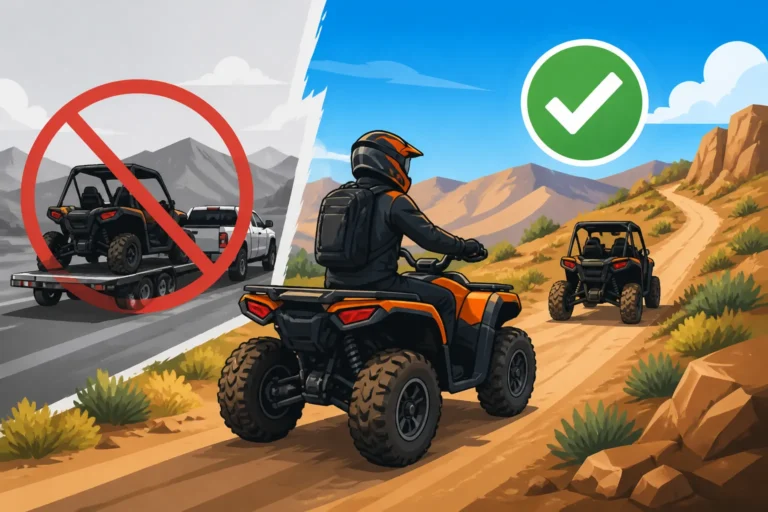
For many, the biggest draw of road-legal OHVs is the ability to [Riding to the Trailhead, Not to the Store]. Instead of trailering your UTV a few short miles from your cabin or campsite to the start of a fantastic trail system, imagine just hopping in and driving. This is precisely what the "Large ATV" designation and decal are largely designed for. It saves time, effort, and fuel, making those short connecting trips much more enjoyable.
However, even when riding to a trailhead, it's essential to consider the length of the paved road, the traffic conditions, and whether the road is truly a "minor county road" open to OHVs. While the convenience is undeniable, the "calculated risk" comes from factors like busy periods, areas with limited visibility, or roads that might be reclassified. Always prioritize safety and legal compliance over convenience. If the paved section is long, high-traffic, or unclear in its designation, trailering might still be the smarter choice.
Fueling Up and Resupplying in Town
Another huge benefit of limited road legality is the ability to access services in small, rural towns. Imagine exploring remote areas and realizing your fuel is low, or you're out of water. Being able to legally ride into the nearest small town to refuel at a gas station or grab supplies from a general store is a game-changer. It vastly increases the self-sufficiency and range of your OHV adventures, allowing for longer, more extensive trips without needing a chase vehicle.
When you ride into town, remember that all traffic laws apply. Park legally, be mindful of pedestrians, and drive respectfully. You're representing the entire OHV community, and positive interactions help foster acceptance. Be aware that even if a town allows OHV access on certain roads, there might be specific areas like busy main streets or certain commercial districts that remain off-limits. Plan your route to the gas station or store carefully, adhering to all local signage and ordinances.
Planning Your Route to Stay Compliant
The most effective way to ensure a legal and enjoyable road-riding experience is meticulous route planning. This means more than just looking at a dirt trail map; it means incorporating road maps and understanding county boundaries and designations. Use resources like the Nevada Trail Finder, Google Maps, and county planning websites to identify and verify "minor county roads" that are open to OHVs. Look for signs indicating OHV-friendly routes or, conversely, those prohibiting OHV traffic.
Pre-planning your route allows you to avoid state highways except for the permitted 2-mile crossings, bypass prohibited city streets, and minimize your time on paved surfaces. It's about weaving together dirt and pavement seamlessly, turning logistical challenges into part of the adventure. A well-planned route reduces stress, minimizes the risk of fines, and maximizes your enjoyment of Nevada's diverse landscapes, ensuring you spend your time riding, not worrying about legalities.
Disclaimer
This article is for general informational purposes only and does not constitute professional advice. Laws, prices and regulations vary by location and change over time. Consult a qualified professional for guidance on your specific situation.