Nevada Equipment List for Road-Legal UTVs
You've just invested in a fantastic UTV, maybe dreaming of those wide-open Nevada trails, but then the reality hits: what about riding it on actual roads? The idea of making your side-by-side "street legal" in Nevada can feel like navigating a maze of regulations and equipment requirements. It's frustrating to know your machine is capable, but not understand exactly what steps you need to take to legally get it from your driveway to the trailhead without worrying about a ticket. This guide aims to clear up that confusion, giving you a detailed breakdown of the mandatory equipment your UTV needs to qualify for a Nevada Large All-Terrain Vehicle decal and ride legally on designated county roads.
Defining a Road-Legal UTV in Nevada
Before we dive into the specific equipment, it’s crucial to understand what Nevada considers a "road-legal UTV" in the first place. This isn't just about sticking a decal on your machine; it's about meeting a very particular set of criteria that most standard ATVs and many sport-oriented UTVs simply don't fulfill. The state differentiates significantly between simply registering an off-highway vehicle (OHV) for trail use and equipping one for limited road use.
What Nevada's NRS 490.043 Counts as a Large ATV
Nevada Revised Statute (NRS) 490.043 defines a "large all-terrain vehicle" as a specific type of OHV. This is the classification that allows for limited road use on designated county roads. The key here is that it must be designed by the manufacturer for off-highway use and also meet one of two crucial criteria: it must have either a width exceeding 50 inches, and have four or more wheels and a non-straddle seating position, or it must be designed to carry a load in a cargo box, like a small pickup truck bed, and have a non-straddle seating position.
Think about it: this definition immediately excludes most traditional ATVs, which require a straddle seating position. It also excludes many smaller, two-seat sport UTVs, unless they happen to have that specific cargo box feature or meet the exact width and seating criteria. For example, a two-seat Polaris RZR XP 1000, while a blast off-road, typically won't qualify under this definition for a [Nevada Large All-Terrain Vehicle Decal] because it lacks the cargo bed and might not meet the combined width/seating criteria in the way the law intends for a "large ATV." On the other hand, a four-seat Can-Am Defender with its cargo bed or a four-seat Polaris General would likely fit the bill, as would many utility-focused side-by-sides. This distinction is vital because if your machine doesn't qualify as a "large ATV," then the road-legal equipment discussion becomes moot.
The Distinction Between Registration and Road-Legal Status
It’s easy to confuse registering your OHV for trail riding with making it road-legal. Many riders assume that once they get their [Nevada's Annual OHV Registration] decal, they can just cruise down any paved road to get to the trails. This is a common and often costly misconception. The standard Nevada OHV decal is for off-highway use only. It allows you to ride on designated trails and unpaved roads where OHVs are permitted. It does not grant you permission to ride on paved public roads, except for very limited circumstances like crossing a highway at a 90-degree angle, or riding a very short distance (up to [How Far You Can Ride Pavement in Nevada]) on the shoulder to connect trails, if allowed by local ordinance.
To legally ride on specified minor county roads, even for short stretches, your UTV needs the separate "large all-terrain vehicle" designation and decal, which comes with its own set of equipment requirements. This is where the frustration often sets in, as many owners find their capable trail machine needs significant modifications and inspections to meet these road-use standards. It’s not just about paying a fee; it’s about transforming your UTV into something that more closely resembles a conventional road vehicle in terms of safety and visibility features.
Mandatory Equipment for a Nevada Road-Legal UTV
Once your UTV qualifies as a "large all-terrain vehicle" under Nevada law, you'll need to ensure it's outfitted with specific safety equipment. This isn't an optional list; these items are mandated to get that special decal and avoid fines from local law enforcement, like [What a Nevada Trooper Looks For on a County Road]. Skipping any of these could put you in a tough spot during a roadside check.
Lights and Visibility: Headlights, Taillights, Stop Lamps, and Reflectors
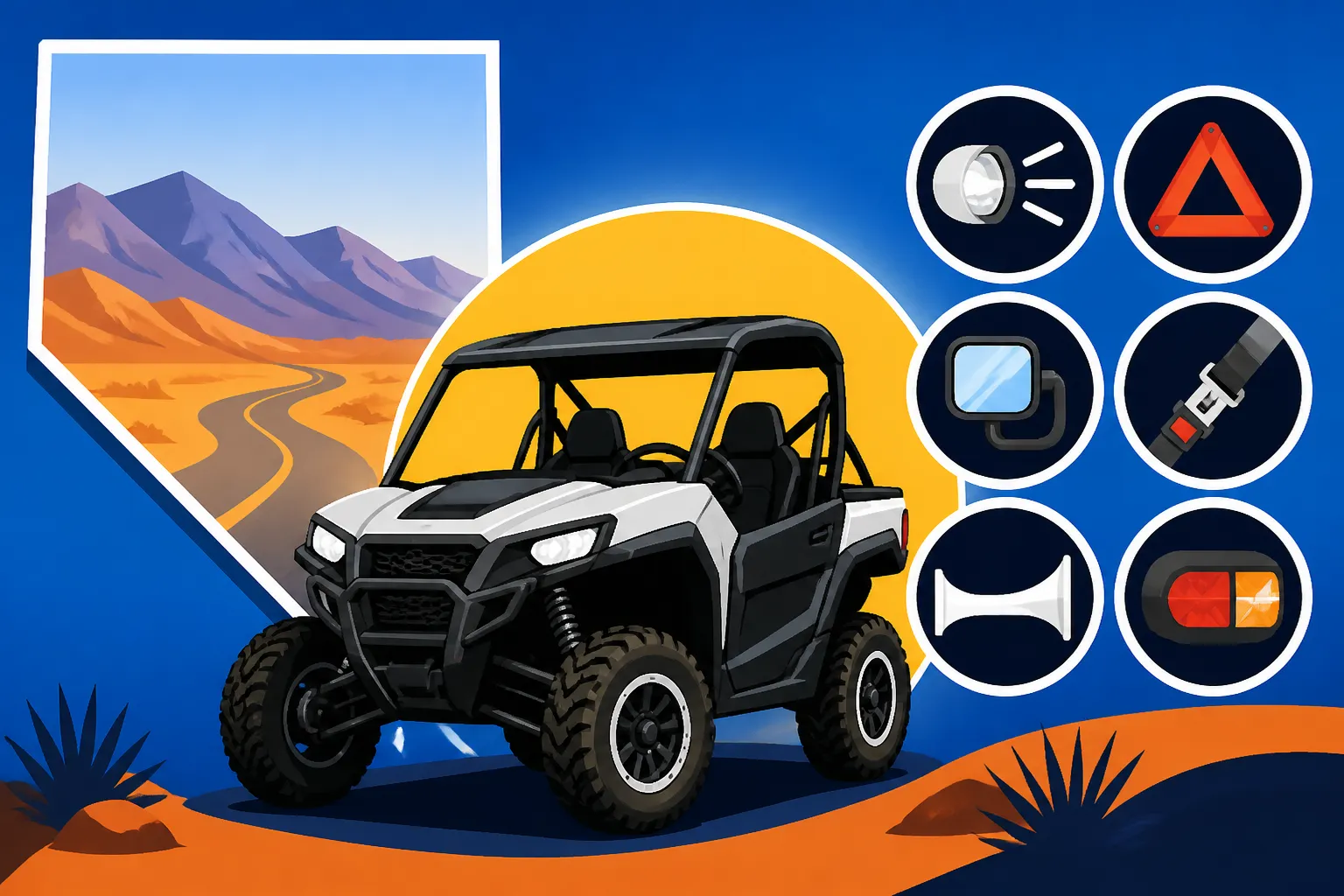
For your UTV to be considered road-legal, its lighting system needs to be up to snuff. This means having functional headlights, taillights, a dedicated stop lamp, and appropriate reflectors.
- Headlights and Taillights: Your UTV must be equipped with at least one headlight and one taillight. The critical part is that these lights must be visible from a distance of 500 feet. Many factory UTV headlights are designed for off-road visibility, but their beam pattern and intensity might not meet the specific requirements for on-road use, especially if you're riding at night. You might find yourself needing to upgrade to brighter, DOT-compliant lights or adding auxiliary lighting. Similarly, your taillights need to be clearly visible from 500 feet to the rear. If your current setup isn't robust enough, aftermarket lighting kits, like those offered by SuperATV, can provide the necessary brightness and compliance to help ensure you're seen by other motorists. It's not just about avoiding a ticket; it's about genuine safety.
- Stop Lamp: This is essentially your brake light. When you apply the brakes, a red light visible from 500 feet to the rear must illuminate. Most modern UTVs come with a brake light function integrated into their taillights, but it’s crucial to verify its functionality and visibility. An unreliable stop lamp is a serious safety hazard on any road, putting you and others at risk. Ensure the wiring is sound and the bulb is bright enough, especially if you’ve been riding rough trails that can jar connections loose.
- Reflectors: Your UTV also needs to have a red reflector on the rear, visible from 500 feet. Often, this is integrated into the taillight assembly, but it's worth checking to make sure it's present and clear. Additionally, it must have at least one amber reflector on each side, visible from 200 feet, to help other drivers see the length of your vehicle. These small, often overlooked details contribute significantly to your visibility, particularly during dawn, dusk, or adverse weather conditions when other drivers might struggle to see your machine.
Audible and Signaling Devices: Horn and Mirrors
Beyond lighting, communication and awareness are key for road safety. Your UTV needs to be able to signal its presence and for you to be aware of your surroundings.
- Horn: A working horn is not just a polite courtesy; it's a mandatory safety feature. Your UTV must have a horn that emits a sound audible from 200 feet. Many UTVs don't come with a horn from the factory, or if they do, it might be a weak, almost toy-like beep. You'll likely need to install an aftermarket horn that meets the required decibel level and audibility. This is crucial for alerting pedestrians, cyclists, or other drivers to your presence, especially in blind spots or at intersections. Imagine pulling out of a side road and needing to signal a distracted driver – a proper horn is indispensable.
- Mirrors: You must have at least one rearview mirror installed that allows you to see 200 feet behind your vehicle. While a single rearview mirror mounted on the dash or roll cage might suffice, it's highly recommended to have both a center rearview mirror and two side mirrors. Side mirrors provide a much better field of vision, helping you monitor traffic to your sides and rear, which is critical when navigating turns or shared roadways. Companies like SuperATV offer robust, vibration-resistant mirrors designed for UTVs that can withstand the rigors of both trail and road use, ensuring you maintain optimal visibility. A wider field of vision means fewer blind spots and a safer ride for everyone.
Safety and Emissions: Windshield, Seatbelts, and Spark Arrester
These elements focus on driver/passenger protection and environmental responsibility, ensuring your UTV is safe for its occupants and compliant with basic emission controls.
- Windshield: Your UTV must be equipped with a windshield. This isn't just about comfort; it's a safety measure to protect occupants from debris while on the road. The law generally implies a full windshield, not just a small half-windshield or deflector. The material should be durable and provide clear visibility without distortion. While some UTVs come with a basic windshield, ensure it's securely mounted and in good condition. You can find various aftermarket windshields, including those with durable polycarbonate or even glass options, from suppliers like SuperATV, to meet this requirement. A cracked or heavily scratched windshield can impair vision and be a reason for an officer to stop you.
- Seatbelts: Every occupant in your road-legal UTV must have a functional seatbelt. This is non-negotiable for safety. Most UTVs come equipped with factory seatbelts, often three-point harnesses, but it’s imperative that they are in good working order, not frayed, and properly latch. If your UTV has aftermarket seats, ensure they are compatible with the seatbelt system and that all mounting points are secure. [Nevada Seat Belt Rules in a Side-by-Side] are just as important on county roads as they are in any other vehicle. This is a basic safety standard that saves lives and prevents serious injury.
- Spark Arrester: While often associated with off-road fire prevention, a spark arrester is also required for road-legal UTVs. This device is designed to prevent hot carbon particles from exiting the exhaust system, reducing the risk of wildfires. Most factory UTV exhaust systems come with an integrated spark arrester, but if you've installed an aftermarket exhaust, you must ensure it also includes a US Forest Service-approved spark arrester. Failure to have one isn't just a fire hazard in dry Nevada conditions; it's a clear violation that can lead to fines. [Spark Arresters on Nevada Roads] are a crucial, often overlooked, piece of safety equipment.
Tires and Muffler
While not always explicitly listed with the same specificity as lights and mirrors, these components are implied by general vehicle safety and nuisance laws.
- Tires: While Nevada statutes don't explicitly require DOT-approved tires for large ATVs on county roads (unlike some states that "plate" ATVs as cars), it is highly recommended to use tires designed for mixed-surface use if you plan on riding pavement frequently. Aggressive mud tires, for example, wear out extremely fast on pavement, provide poor traction, and can make steering difficult and unpredictable. DOT-rated tires offer better grip and durability on asphalt, ensuring a safer and more comfortable ride. Even if not legally mandated, it's a wise practical choice for anyone looking to maximize their UTV's road-worthiness.
- Muffler: Your UTV must have a muffler that is in good working order and prevents excessive or unusual noise. [Nevada Muffler Rules for Road Riding] are in place to prevent noise pollution. Modified or removed mufflers are a surefire way to attract unwanted attention from law enforcement. While an aftermarket exhaust can enhance performance, ensure it still meets legal sound limits and maintains a functional muffler. You don't want your road-legal UTV to become a nuisance to residents along those scenic county roads.
Here’s a quick summary of the essential equipment:
| Category | Specific Item | Requirement |
|---|---|---|
| Visibility | Headlight(s) | Visible 500 feet forward |
| Taillight(s) | Visible 500 feet to the rear | |
| Stop Lamp (Brake Light) | Red, visible 500 feet to the rear when brakes applied | |
| Rear Reflector | Red, visible 500 feet to the rear | |
| Side Reflectors | Amber, at least one on each side, visible 200 feet | |
| Signaling | Horn | Audible 200 feet |
| Rearview Mirror | Allows view 200 feet behind (side mirrors highly recommended) | |
| Safety | Windshield | Full, clear, securely mounted |
| Seatbelts | For every occupant, functional and secure | |
| Emissions/Fire | Spark Arrester | USFS approved |
| Other (Highly Recommended) | DOT-rated Tires | For better performance and safety on pavement |
Practical Advice Beyond the Letter of the Law
Meeting the letter of the law is one thing, but truly being ready for the road involves a bit more foresight and responsibility. Getting your UTV equipped is a great first step, but being a responsible rider also means being prepared for anything and understanding the nuances of where you can and cannot ride.
Carrying Essential Documentation
Just like driving your car, you need to have your important papers with you when operating your road-legal UTV. This means more than just your driver's license.
- Driver's License: This one is obvious, but often forgotten when you’re used to riding off-road where a license might not be strictly enforced depending on age and location. For road use, you absolutely need a valid [Nevada Driver's License Rules for UTV Road Use]. Law enforcement will check this during any stop.
- Registration and Decal: You need to have your current [Nevada Large ATV Decal Cost] and physical registration card. It’s always a good idea to keep a copy of your registration card in a waterproof bag on your machine. Sometimes, the physical decal can fade or peel, especially with the harsh Nevada sun, so having the card to prove your vehicle is properly registered is invaluable. [What the Registration Card Must Show] is important if you get stopped.
- Proof of Insurance: [Does Nevada Require ATV Insurance on Roads]? Yes, for road use, your UTV falls under similar liability insurance requirements as other vehicles. You'll need to carry proof of liability insurance. Check with your insurance provider to ensure your policy covers limited road use for your UTV. It’s a costly mistake to assume your regular OHV insurance automatically extends to paved roads, as many policies have exclusions. A deputy in Nye County will definitely ask for [Insurance Cards and Roadside Stops in Nye County].
Rider Responsibilities and Safety Gear
Even with a road-legal UTV, your personal safety gear and adherence to traffic laws remain paramount. Road riding introduces different risks than off-road adventures.
- Helmets: While not always required for adults in enclosed UTVs on Nevada county roads (depending on the specific local ordinances and vehicle design), [Nevada Helmet Rules on Nevada Roads] for motorcycles often serve as a guide. It's an absolute no-brainer for passengers or riders under 18. However, wearing a helmet is always the safest choice, regardless of legal requirements. The protection it offers against head injury is incomparable. If you are riding an open UTV, or if local ordinances specify it, a helmet is a must.
- Traffic Laws: When you're on a public road, your UTV is subject to all the same traffic laws as cars, trucks, and motorcycles. This means obeying speed limits, stop signs, traffic lights, and lane markings. Don't assume that because your vehicle is an OHV, regular road rules don't apply. They absolutely do, and officers are well within their rights to ticket you for violations.
- Supervising Young Riders: If you have younger riders, be aware of [Nevada Minimum Age to Ride on a County Road] and [Nevada Rules for Riders Under 16 on Roads]. Specific supervision requirements and age restrictions apply when children are operating or riding in a UTV on public roads. This is a critical safety and legal consideration for families who enjoy riding together.
Understanding Where You Can Actually Ride
Perhaps the biggest frustration for many UTV owners is realizing that "street legal" in Nevada doesn't mean "any street legal." It’s a limited privilege.
- Designated County Roads: The "large ATV" decal primarily allows you to ride on [Nevada County Roads Open to UTVs]. These are typically minor county roads, often unpaved, or short sections of paved roads specifically designated by local ordinance. You cannot just hop on any state highway or city street. [Nevada Cities That Require Designated OHV Routes] exist, and many urban areas, like [Las Vegas City Limits and OHV Routes] or [Reno Streets and Where OHVs Cannot Go], have strict prohibitions on OHV use on paved roads.
- Limited Paved Road Use: Even on permissible paved county roads, the intent is usually to connect trails or access services like fuel in small towns, not for general transportation. [Nevada Rules on Riding Into Town for Fuel] might allow short excursions, but you generally cannot ride to the grocery store or on major thoroughfares. The state's 2-mile rule for crossing pavement is designed for short transitions, not extended travel. Always check local ordinances, as [Nevada Counties That Ban OHVs on County Roads] exist, and what’s allowed in one county might be forbidden just across the border. Knowing where you can ride around places like [Mesquite and Its Reputation for Open Streets] is crucial to avoid tickets.
- Crossing State Routes: You might be able to [Nevada Rules for Crossing a State Route], but this usually means a direct 90-degree crossing, not riding along it. Understanding these precise limitations is key to enjoying your UTV safely and legally on Nevada's roads.
Disclaimer
This article is for general informational purposes only and does not constitute professional advice. Laws, prices and regulations vary by location and change over time. Consult a qualified professional for guidance on your specific situation.