Crossing a Highway on an ATV in Nevada
It's a familiar scenario for any off-road enthusiast in Nevada: you're out on an incredible trail, the dust is flying, the scenery is breathtaking, and then you hit a paved road. Suddenly, that sense of freedom is replaced with a knot of anxiety. Is it legal to cross? Can you ride a short distance to the next trail segment? This guide is here to untangle the often-confusing rules surrounding crossing highways and roads on your ATV or UTV in the Silver State, helping you stay on the right side of the law and maximize your riding adventures.
The Reality of Nevada Highways for OHVs
Let's be completely upfront: Nevada's laws are generally quite strict when it comes to operating Off-Highway Vehicles (OHVs) like ATVs and UTVs on paved public roads. This isn't just a casual suggestion; it's enshrined in state statutes. Many riders, especially those new to the state or new to the sport, assume that because they're registered and insured, they have carte blanche to ride anywhere. That simply isn't the case on the vast majority of paved roads in Nevada.
The General Prohibition
The baseline rule is simple: ATVs and UTVs are primarily designed for off-highway use and are generally prohibited from operating on paved highways, roads, and streets. Think of your machine as a specialized tool for dirt, rock, and sand, not for asphalt. This prohibition exists for a number of reasons, primarily public safety. OHVs often lack certain safety features found on street-legal vehicles, like full crash protection, proper signal lights for dense traffic, and the ability to maintain consistent highway speeds. Their tires are also not designed for road grip, making them less predictable on pavement.
When you encounter a paved road, your first thought should always be, "How can I avoid riding on this?" This mindset will save you a lot of potential headaches, and possibly fines. It's not about being overly cautious; it's about respecting the design limitations of your machine and the legal framework set up to protect everyone on the road, including you. The vast majority of riding in Nevada will be on dirt roads, designated trails, and public lands, all of which are fair game for your registered OHV.
Why the Rules Are So Strict
The strictness isn of these laws isn't arbitrary. It's rooted in a combination of safety concerns, vehicle design, and the need to manage traffic flow. Imagine a low-speed, high-revving ATV trying to merge with 70 mph highway traffic. The risk of a severe accident is dramatically increased for everyone involved. OHVs also tend to be louder and produce more dust and emissions than street vehicles, which can be disruptive in residential areas or near businesses. Furthermore, the tires on many off-road machines are knobbed for traction in loose terrain, making them less stable and predictable on smooth, hard pavement, especially during braking or quick maneuvers.
Another factor is the sheer diversity of OHV types. Nevada law tries to create a clear line between what can and cannot be on a paved road, and a blanket prohibition, with very specific exceptions, is often the easiest way to manage this for all the different ATVs, UTVs, dirt bikes, and other off-road vehicles out there. It simplifies enforcement for local law enforcement agencies and helps prevent confusion among riders, though as we'll see, there are still plenty of nuances to navigate.
The Exception, Not the Rule
While the general rule is "no OHVs on paved roads," there are indeed exceptions, but it's critical to understand that these are exactly that: exceptions, not broad permissions. These exceptions are specifically designed to allow riders to access trails, cross from one off-road area to another, or sometimes use certain less-trafficked county roads for very limited distances. They are not an invitation to commute to the grocery store or take a scenic drive down a state highway.
These exceptions often come with stringent conditions, including specific equipment requirements, time limits, and distance restrictions. Failing to meet even one of these conditions can quickly turn a legal crossing into an illegal one. For instance, you might be allowed to cross a highway at a 90-degree angle to connect two trails, but riding along the shoulder for even a hundred feet might be strictly prohibited. This is where many riders get into trouble, misunderstanding the precise scope of the permitted activity. Knowing the exact parameters of these exceptions is key to avoiding a citation or worse.
Understanding Nevada's Highway Crossing Laws
Navigating the legal landscape of OHV use on Nevada's roads can feel like learning a new language. The state's statutes, particularly Nevada Revised Statutes (NRS) Chapter 490, lay out the framework. It's not always straightforward, but understanding the core definitions and specific provisions is essential for any rider looking to legally cross or briefly use a paved road. The penalties for non-compliance can be significant, ranging from fines to impoundment of your machine, so taking the time to learn these rules is well worth it.
Defining "Highway" in Nevada Law
Before we talk about crossing them, it's crucial to understand what Nevada law means by "highway." When you read NRS 490, the term "highway" isn't limited to just multi-lane interstates. It broadly encompasses "the entire width between the boundary lines of every way or place in this State open to the use of the public for purposes of vehicular traffic, whether or not the entire width thereof is paved." This means that a small, two-lane paved road out in the middle of nowhere, maintained by the state or county, can still be considered a "highway" in the legal sense, even if it doesn't feel like one.
This broad definition is important because it means that the restrictions apply to a much wider range of paved surfaces than many riders might initially assume. It includes state routes, most county roads, and city streets. The key takeaway here is that if it's paved and open to public vehicular traffic, assume it falls under the "highway" definition for OHV rules unless explicitly stated otherwise by a specific exemption or local ordinance. This umbrella term aims to prevent confusion and ensure consistent application of the law across different road types.
Specifics of NRS 490.100 and Crossing
The core of Nevada's OHV road use regulations can be found in NRS 490.100, which states that generally, "An off-highway vehicle must not be operated on a highway." However, it then immediately provides the critical exceptions we discussed. The most relevant exception for crossing is that an OHV may be operated on a highway "for the purpose of crossing a highway, street or highway structure by the most direct route." This specific wording is vital. It means you can go straight across, from one side to the other, to connect segments of an off-road trail or access public lands.
This direct route provision is strictly interpreted. You cannot ride down the highway for any appreciable distance, even if it's just to find a slightly easier crossing point. The intention is for a quick, efficient, and safe traversal. Furthermore, the statute details other conditions, such as crossing at a right angle (or as near as practicable) to the flow of traffic, coming to a complete stop before entering the highway, and yielding to all oncoming traffic. These aren't suggestions; they are legal requirements designed to minimize risk during these brief interactions with paved roads. This statute, combined with the "two-mile rule," defines the primary ways an OHV can interact with paved surfaces.
The Driver's License and Insurance Mandate
Another critical element often overlooked when considering highway crossings is the requirement for the operator to hold a valid driver's license and for the OHV to be covered by liability insurance. Even for a momentary crossing, if you are operating an OHV on a highway, these requirements kick in. NRS 490.060 states, "A person shall not operate an off-highway vehicle on a highway unless the person has a valid driver's license…" and further specifies insurance. This means that if you're under 16 and don't have a driver's license, you cannot legally operate an OHV on a highway, even to cross it. [Nevada Minimum Age to Ride Off-Road] addresses age restrictions for off-road riding, but road interaction adds the driver's license requirement.
This is a major point of enforcement for deputies and troopers. They're not just looking for registration decals; they're also checking the driver's qualifications. Without a valid driver's license and proof of insurance, even a legal crossing becomes illegal, opening you up to serious penalties. Therefore, before even contemplating putting a tire on pavement, ensure that both you, the operator, and your machine meet these fundamental prerequisites. Carrying your license and insurance proof on your person, in a waterproof bag, is always a smart move. [Insurance and Nevada OHV Registration] provides more detail on the necessary coverage.
The "Two-Mile Rule" and Its Nuances
Beyond simple crossings, Nevada law does offer a limited allowance for OHVs to travel on certain paved roads, often referred to as the "two-mile rule." This rule is an expansion of the exceptions, recognizing that sometimes a short stretch of pavement is unavoidable to connect vast off-road areas. However, like all exceptions, it comes with its own set of very specific conditions and limitations that riders absolutely must understand to avoid breaking the law. It's not a free pass to ride two miles of highway whenever you feel like it.
When the Two-Mile Limit Applies
The two-mile rule primarily allows an OHV to operate on a highway for a distance of up to two miles "to get from one area of off-highway use to another area of off-highway use if the highway is the only reasonable route between those areas." This is specified in [Nevada's 2-Mile Limit on Paved Highway]. The "only reasonable route" clause is key here. It implies that if there's an unpaved alternative, even if it's longer or more challenging, you should generally take it. This rule is designed for those unavoidable stretches of pavement that bisect trail systems or connect staging areas to trailheads.
It's also important to remember that this rule applies to designated off-highway vehicles, which in Nevada, often implies that your machine is also considered a "Large All-Terrain Vehicle" under NRS 490.043 if it has a specific set of features (four or more wheels, a weight over 900 pounds, a width over 50 inches, or a truck bed/seating for more than two). If your machine qualifies as a Large ATV and is properly equipped, these rules might apply more broadly. Otherwise, for smaller ATVs or dirt bikes, the direct crossing rule is usually the only option for pavement interaction.
Interpreting "Adjacent" and "Directly Across"
While the two-mile rule allows for limited travel, the concept of "adjacent" and "directly across" remains paramount, especially for simple crossings. "Directly across" means literally perpendicular to the road, minimizing time spent in traffic lanes. You're not supposed to zig-zag or move diagonally. This helps reduce your exposure to fast-moving traffic and makes your intentions clear to other drivers. Similarly, when utilizing the two-mile rule, your path should be as close to the edge of the road as safely possible, often riding on the shoulder if one exists and it's safe to do so. [Riding a Nevada Highway Shoulder] delves into the specifics of this.
The law is not designed to let you meander. It's about efficient and safe movement between off-road areas. If you're on a multi-lane highway, you should ideally be crossing at a designated intersection with clear sight lines, not just anywhere. This attention to detail and conservative interpretation of the rules is what will keep you out of trouble. Troopers and deputies are often looking for riders who are clearly abusing these limited privileges, so making your intention and path as direct and safe as possible is always the best approach.
Riding Nevada Shoulders and Ditches
When you do find yourself on a paved road, whether for a direct crossing or within the two-mile limit, where exactly should you ride? Nevada law offers some guidance, though it's still crucial to prioritize safety and common sense. Typically, you should ride on the far right of the paved portion, often utilizing the shoulder if one is present and wide enough to safely accommodate your machine. The shoulder keeps you out of the main flow of traffic, which is beneficial for both your safety and that of other motorists.
Riding in the ditch or off the shoulder is often tempting, especially if the shoulder is narrow or nonexistent. However, this comes with its own set of hazards, including uneven terrain, hidden obstacles, and unexpected drops or culverts. While it might feel like you're "more off-road," a fall in a ditch near a busy highway can be incredibly dangerous. Stick to the paved shoulder when available and safe. Always be aware of your surroundings, scan for hazards, and be prepared to merge briefly into a lane if the shoulder disappears or becomes unsafe, ensuring you do so only when absolutely clear and safe. For more specifics, consider [Ditch Riding Versus Shoulder Riding].
Essential Equipment for Any Road Interaction
Even for the briefest highway crossing or the permitted two-mile stretch, your ATV or UTV must be equipped with certain safety features. These aren't just suggestions; they are legal requirements designed to make your off-highway vehicle more visible and controllable when interacting with conventional road traffic. Neglecting these can not only lead to a citation but significantly increase the risk of an accident. Many riders invest in aftermarket accessories from brands like SuperATV to ensure their machines meet these safety standards and often exceed them for better visibility and durability.
Lights, Brakes, and Reflectors
First and foremost, your OHV needs proper lighting and braking systems. This includes at least one functional headlight that can illuminate objects for at least 500 feet, and a taillight that is visible from at least 500 feet to the rear. If you're riding at night or during periods of low visibility, these become non-negotiable. Furthermore, your machine must have a functional brake system capable of stopping the vehicle effectively. This seems obvious for any vehicle, but sometimes older or poorly maintained machines might have compromised brakes that are fine for slow trail riding but insufficient for road conditions.
In addition to lights, your OHV should have appropriate reflectors. These passive safety devices help other drivers see you, especially from the sides, even if your lights are off or malfunctioning. Check your state's specific requirements for reflector placement and color, as these details can vary. Ensuring your headlights are bright enough, perhaps with an upgrade from a company like SuperATV, is vital for visibility to oncoming traffic. The better you can see and be seen, the safer your brief road encounter will be. [Headlights and Taillights Visible 500 Feet] details these requirements further.
Mirrors, Horn, and Spark Arresters
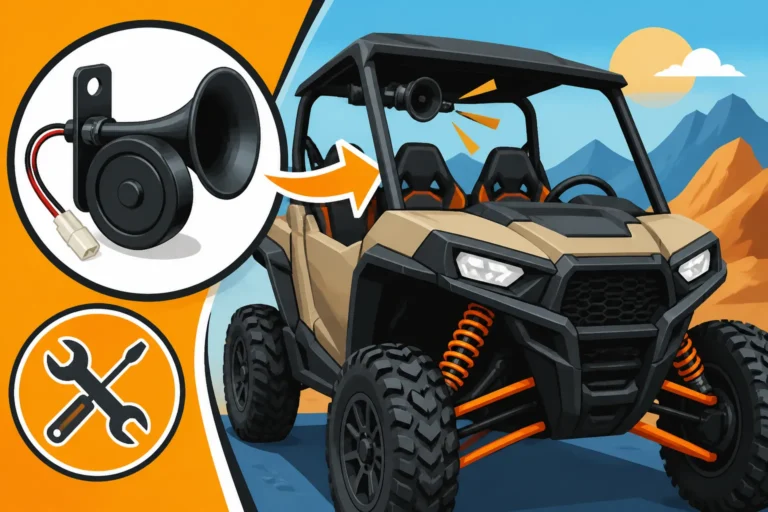
Beyond lights and brakes, several other pieces of equipment are mandatory for any road interaction. You'll need at least one mirror, securely attached to the left side of the OHV, that provides a clear view of traffic to the rear. This is crucial for checking for oncoming vehicles before crossing or merging. A working horn or other warning device is also required, allowing you to alert other drivers or pedestrians to your presence. These seem like minor details until you desperately need them to avoid a collision.
And let's not forget the spark arrester. While primarily an off-road requirement to prevent wildfires, it's a mandatory piece of equipment for any OHV operating on public lands, which includes highways. Your machine must have a United States Forest Service-approved spark arrester in good working order. Without it, you're not only risking a fire but also facing a fine. Adding robust mirrors, like those available from SuperATV, isn't just a legal requirement for road interactions; they enhance overall trail safety by giving you a better view of your surroundings and your riding companions. [Nevada Equipment List for Road-Legal UTVs] covers a full list of necessities.
Helmets for Road Travel
Nevada has specific helmet laws that apply when operating an OHV on a highway. While off-road helmet rules might vary based on age, if you are on a paved public road, even for a crossing, the helmet requirement often becomes universal. NRS 486.231 states that "a person shall not drive or ride as a passenger upon a motorcycle, moped or trimobile on a highway unless he or she is wearing a safety helmet…". While ATVs and UTVs are not motorcycles, when they operate on a highway, they generally fall under similar safety expectations, and in many jurisdictions, the helmet law is enforced universally for OHVs on pavement.
It is always safest to wear an approved helmet, whether on-road or off-road, regardless of the specific law. However, for highway crossings, assume a helmet is legally required for everyone on board, especially for the operator. This is a critical safety measure that can literally save your life in the event of an accident with a motor vehicle. Don't take chances; strap on your helmet before you hit any pavement. [Helmet Rules on Nevada Roads] offers more comprehensive information on this topic.
Here's a quick summary of essential equipment for road interaction:
| Equipment Feature | Requirement for Road Interaction (Crossing/2-Mile Rule) | Notes |
|---|---|---|
| Headlight(s) | Yes, visible 500 feet | Essential for visibility, especially at dawn/dusk or night. |
| Taillight(s) | Yes, visible 500 feet | Essential for being seen from the rear. |
| Stop Lamp (Brake Light) | Yes | Must activate when brakes are applied. |
| Reflectors | Yes | Specific placement and color may vary; check local statutes. |
| Brakes | Yes, fully functional | Capable of stopping the vehicle safely and effectively. |
| Mirror(s) | Yes, at least one on the left side | Must provide clear view of traffic to the rear. Some UTVs might benefit from two for better visibility. |
| Horn/Warning Device | Yes | Must be audible at 200 feet. |
| Spark Arrester | Yes, USFS-approved | Mandatory for all public land operation. |
| Helmet | Yes, for operator and often passengers | Legally required for highway operation in many cases, always recommended. |
| Driver's License | Yes, valid for operator | Mandatory for anyone operating an OHV on a highway. |
| Liability Insurance | Yes, for the OHV | Mandatory when operating on a highway. |
Navigating Different Road Types
Not all paved roads are created equal when it comes to OHV rules. The specific regulations can vary depending on whether you're dealing with a state highway, a county road, or a city street. Understanding these distinctions is crucial, as what's permissible on one type of road might be strictly forbidden on another. This often comes down to who has jurisdiction over the road and what specific ordinances they've enacted.
State Routes Versus County Roads
State routes (like US 95, SR 169, etc.) are generally the most restrictive. They are designed for higher speeds and higher volumes of traffic, making OHV operation on them highly dangerous and largely prohibited, even for short distances. The "direct crossing" rule (NRS 490.100) is virtually the only interaction permitted on these types of highways, and even then, extreme caution is warranted. You should never assume you can ride along a state route shoulder for any distance.
County roads, on the other hand, can sometimes be more forgiving. Many rural Nevada counties have ordinances that designate certain minor county roads as open to OHV traffic, especially if they provide access to popular riding areas. This is often where the "two-mile rule" for connecting trails is most applicable. However, this is not universal. Some counties may ban OHVs entirely from their paved roads, while others may only allow them on specific routes. It's imperative to check with the local county sheriff's office or planning department for specific regulations in the area you plan to ride. [Nevada County Roads Open to UTVs] offers more context.
City Ordinances and Designated Routes
City streets present another layer of complexity. While Nevada state law sets a baseline, individual cities and towns have the authority to enact their own ordinances regarding OHV use within their municipal limits. Many cities, especially larger ones like Las Vegas, Reno, Henderson, or Sparks, have very strict prohibitions against OHVs on city streets, with limited or no exceptions, even for crossings. The density of traffic, pedestrians, and residential areas makes such operation unsafe and unwelcome.
However, some smaller, more rural towns might have designated OHV routes that allow riders to travel on specific streets to access fuel, food, or staging areas. Mesquite, for instance, has a reputation for being more OHV-friendly in certain areas. [Mesquite Riders and the 2-Mile Rule] provides specific examples. But never assume. Always look for signage or consult local city codes. Riding on a prohibited city street can lead to immediate citations and impoundment, as local police often have zero tolerance for such violations due to safety and nuisance concerns.
Crossing Intersections and Divided Highways
When you're making a legal crossing, whether it's a state route or a county road, how you approach and execute that crossing matters. You should always choose an intersection if possible, as these are designed for vehicles to enter and exit the flow of traffic. At an intersection, you'll find clearer sight lines and potentially traffic control devices (stop signs, lights) that can aid in a safer crossing.
Crossing a divided highway, especially one with a median, requires even more caution. You might need to cross one direction of traffic, wait in the median, and then cross the other direction. Treat each segment of the crossing as a separate event, yielding to all traffic. Remember to stop completely before entering any traffic lane, look both ways multiple times, and proceed only when you have a clear and sufficient gap in traffic. Your machine's acceleration might be different from a car's, so factor that into your decision-making. [Nevada Rules for Crossing a State Route] is a vital read for this scenario.
Safety First: Best Practices for Highway Crossings
While legal compliance is essential, your personal safety and the safety of others on the road should always be your top priority. Even when following all the rules, interacting with fast-moving highway traffic on an OHV carries inherent risks. Adopting a defensive riding posture and following best practices can significantly reduce these risks. Think beyond just "what's legal" and focus on "what's safest."
Situational Awareness and Visibility
The key to safe highway crossing is hyper-awareness. Before you even approach the pavement, slow down and scout the crossing point. Look for clear sight lines in both directions. Pay attention to traffic speed and volume. Is there a crest in the road that limits visibility for oncoming drivers? Is there a curve? Avoid crossing in areas with limited visibility for either you or approaching motorists.
Once at the crossing, stop completely and look, then look again. Listen for traffic you might not see. Wait for a significant gap in traffic; don't try to "beat" a car. Assume other drivers might not see you, as OHVs are smaller and less common on roads than cars or trucks. Maximize your visibility: wear bright clothing, ensure your lights are on (even during the day), and consider adding a flag to your OHV. Making yourself as conspicuous as possible is your best defense against distracted or unaware drivers.
Group Riding and Communication
If you're riding with a group, highway crossings require extra coordination. Before reaching the road, designate a leader and discuss the crossing strategy. The leader should identify the safest crossing point and ensure everyone understands the plan. When executing the crossing, it's often safer to cross one machine at a time, or in very small, tight groups, rather than a long, strung-out procession. This minimizes the time the entire group is exposed to highway traffic.
Effective communication is paramount. Hand signals, radio communication, or even just waiting for the leader to signal "all clear" can prevent miscommunications and ensure everyone crosses safely. Never assume the rider in front of you saw the same gap in traffic that you did. Maintain adequate spacing, but not so much that you create an unsafe delay for following riders or block traffic for an extended period. [Supervising a Teenager on a County Road] highlights the importance of group communication and supervision, especially for younger riders.
Respecting the Speed Limit
Even if you're briefly on a paved road under the two-mile rule, you must adhere to the posted speed limits. OHVs are not designed for high-speed road travel, and exceeding the limit not only increases your risk of losing control but also makes you an easy target for law enforcement. Remember, the tires on your OHV are designed for dirt, not pavement, and high speeds on asphalt can lead to unpredictable handling, especially if you need to brake or swerve suddenly.
Beyond the legal speed limit, consider the safe speed for your machine and the specific road conditions. If the shoulder is rough, or traffic is heavy, you might need to go slower than the posted limit to maintain control. Your goal is to blend as safely and unobtrusively as possible into the traffic environment, for the shortest duration necessary. Aggressive driving or exceeding speed limits on paved roads will quickly draw unwanted attention and negate any legal allowance you might have.
Consequences of Non-Compliance
Ignoring Nevada's OHV road rules can lead to a host of unpleasant consequences that can quickly ruin your day, or even your entire riding season. Law enforcement in Nevada, including county deputies, state troopers, and even BLM rangers, are well-versed in these regulations and are not shy about enforcing them. Understanding the potential repercussions is a strong motivator to always stay compliant.
Fines and Citations
The most common consequence of illegally operating an OHV on a highway is a citation, which comes with a fine. The amount of the fine can vary significantly depending on the specific violation, the county, and whether it's a first offense or a repeat. For instance, operating an unregistered OHV, riding without a valid driver's license, or simply being on a prohibited road can each carry distinct financial penalties. [Nevada Fines for No Large ATV Decal] gives an example of specific fines related to road use. These fines can quickly add up, easily costing you hundreds of dollars.
Beyond the initial fine, a citation can also mean points on your driving record, which could impact your automotive insurance rates. While an OHV violation might not always directly affect your car insurance, it can be reported to the DMV and impact your overall driving privileges. These aren't just minor tickets; they are violations of motor vehicle laws and are treated with seriousness by the legal system.
Impoundment and Other Penalties
In more severe cases, or for repeat offenders, law enforcement has the authority to impound your off-highway vehicle. This means your machine is towed away at your expense, and you'll incur impound fees, storage fees, and potentially other charges before you can even get it back. This can be incredibly costly and disruptive, especially if you're far from home. Imagine your UTV being impounded while you're on a multi-day trip!
Beyond impoundment, there can be other penalties, particularly if the illegal operation results in an accident or property damage. You could face liability for damages, and if personal injury is involved, the legal ramifications could be far more severe, potentially including criminal charges. Operating an OHV on a highway without liability insurance, as required for road use, can further exacerbate these issues, leaving you personally responsible for all costs. This is why having your machine properly registered and insured is not just a formality but a critical layer of protection.
Impact on Insurance and Future Privileges
A history of OHV violations, particularly those involving road use, can have a long-term impact. Insurance companies might view you as a higher risk, potentially leading to increased premiums for your OHV insurance or even your regular vehicle insurance. In extreme cases, repeated violations could lead to the suspension or revocation of your OHV registration privileges, making it impossible to legally ride on public lands at all.
Furthermore, if you're cited for operating without a valid driver's license while on a highway, this can affect your regular driver's license and driving record, potentially impacting your ability to drive any vehicle, not just your OHV. The system is designed to discourage illegal road use, and the consequences reflect that seriousness. Always verify your compliance and consider calling the local authorities for clarification if you are unsure about a specific road or crossing.
Planning Your Route to Minimize Pavement
The best way to avoid issues with highway crossings and road use is to minimize your need for them in the first place. Strategic route planning is a hallmark of an experienced off-road rider. By proactively identifying and utilizing designated trails, staging areas, and unpaved routes, you can often enjoy extensive riding without ever putting a tire on a paved public highway.
Utilizing OHV Maps and GPS
Modern technology has made route planning significantly easier for off-road enthusiasts. The Nevada Off-Highway Vehicles Program, in conjunction with the Nevada Commission on Off-Highway Vehicles, provides excellent resources, including online maps and trail finders. Websites like the Nevada Trail Finder allow you to explore designated OHV routes, identifying connections, staging areas, and potential road crossings. [Planning a Ride With Trail Finder] is an invaluable resource.
Many dedicated GPS units for off-road use, or smartphone apps with robust mapping capabilities (like Gaia GPS, OnX Offroad, or Polaris Ride Command), allow you to download offline maps that highlight OHV trails, dirt roads, and public land boundaries. Use these tools to plan your entire route, identifying any necessary road crossings in advance. This allows you to scrutinize those points for safety and legality before you even leave home. Look for routes that offer continuous dirt access, even if it means taking a slightly longer path to your destination.
Identifying Designated Crossing Points
When a highway crossing is truly unavoidable, use your maps and local knowledge to identify the safest and most legal crossing points. These are typically at intersections, where visibility is better and traffic control might be present. Avoid crossing mid-block, especially on busy roads, as this significantly increases the risk of an accident and is almost certainly illegal.
In some areas, local authorities or land managers might have even marked designated OHV crossing points. These are the gold standard for crossing, as they usually indicate the safest and most accepted locations. Always prioritize these if available. If no such points are marked, look for wide, clear intersections with good sight lines in all directions. Call the local BLM field office or sheriff's department if you are unsure about a specific area. [What a Nevada Trooper Looks For on a County Road] might give you an idea of what officials are watching for.
Trailering Versus Riding to the Trailhead
A critical decision for many riders is whether to trailer their OHV to the trailhead or attempt to ride it there. For most paved roads, especially state highways and city streets, trailering your machine is by far the safest and most legally compliant option. It completely eliminates the need for your OHV to interact with high-speed road traffic and avoids all the associated equipment, licensing, and insurance requirements for road use.
While it might seem more convenient to just hop on your machine and ride from your house or campsite, weigh that convenience against the potential fines, safety risks, and legal troubles of riding on prohibited roads. For any significant distance on pavement, or any stretch of high-traffic road, trailering is almost always the recommended approach. Save the riding for the trails and designated off-road areas. [Trailering Versus Riding the Road There] offers a more detailed comparison of these options.
Disclaimer
This article is for general informational purposes only and does not constitute professional advice. Laws, prices and regulations vary by location and change over time. Consult a qualified professional for guidance on your specific situation.