Riding Two-Up on a County Road
Trying to enjoy a casual cruise on a county road with a passenger in your ATV or UTV in Nevada can be a real headache, especially with all the confusing rules about what's actually allowed on public roads. It feels like every time you think you've got it figured out, there's another caveat or definition to trip you up, making you wonder if it's even worth the hassle. This guide will cut through the confusion and explain exactly what Nevada law says about riding two-up on a county road, ensuring you understand the vehicle requirements, passenger rules, and essential equipment needed to stay legal and safe.
The Nuance of Nevada's "Large ATV" Classification for Road Use
When you dream of cruising down a scenic Nevada county road with a buddy by your side, the first hurdle you'll encounter is Nevada's very specific definition of what kind of off-highway vehicle (OHV) is even permitted on these paved or graded surfaces. It's not as simple as "if it has wheels, it can go." The Silver State has carved out a unique legal category called a "Large All-Terrain Vehicle," and understanding this distinction is the absolute bedrock for any aspirations of riding two-up on a public road here. Without meeting this fundamental requirement, your machine simply isn't eligible, no matter how many mirrors or turn signals you bolt on. This isn't just bureaucratic red tape; it's a safety measure designed to distinguish between true off-road machines and those equipped for limited road use.
What Nevada Counts as a Large ATV
Nevada Revised Statute (NRS) 490.043 defines a "large all-terrain vehicle" in a way that often surprises riders, particularly those coming from other states with more lenient rules. For your machine to even be considered for limited county road use, it needs to be designed to carry at least four passengers or have a bed that can haul cargo, like a pickup truck. Think about that for a second. This isn't just about having two seats; it's about a much larger, more stable platform that behaves differently on paved surfaces. Most modern side-by-sides, or UTVs, are the primary candidates for this classification, especially the four-seat models or utility-focused models like a Can-Am Defender or a Polaris Ranger. The law specifically looks for inherent design features, not just how many people you can squeeze in. This distinction is critical because it immediately filters out a huge number of machines that might feel capable but don't meet the legal standard. For a deeper dive, you can check out [What Nevada's NRS 490.043 Counts as a Large ATV].
Consider a scenario: you're eyeing a brand-new four-seat Polaris RZR XP 4 1000. This machine, by its very design with four dedicated seating positions, fits the "designed to carry at least four passengers" clause. It has factory-installed seatbelts for all four occupants and is built with a wider stance and more robust suspension that lends itself better to a paved road than a typical sport quad. On the other hand, if you own a two-seat Honda Pioneer 1000 with a small cargo bed, that too could qualify under the "bed that can haul cargo" provision, even though it only has two passenger seats. The key takeaway here is that Nevada prioritizes machines with greater inherent stability and passenger capacity, clearly delineating them from traditional, often narrower, ATVs.
Why Your Two-Seat Sport Quad Fails the Test
Now, this is where many traditional ATV enthusiasts get stuck. Despite how stable or powerful your two-seat sport quad might feel, or even if you've added a passenger seat kit, it almost certainly will not qualify as a "large all-terrain vehicle" under Nevada law for road use. The definition is explicit: it must carry at least four passengers or have a cargo bed. A standard two-seat sport quad has neither. This often comes as a shock to riders who are used to more relaxed rules in other states or on private land. The law is not concerned with the number of wheels or the engine size; it's about the vehicle's structural capacity for multiple passengers and cargo. Even if you've got a fantastic aftermarket passenger seat from a company like SuperATV, if your machine started life as a two-seat ATV, it's not going to pass this particular test.
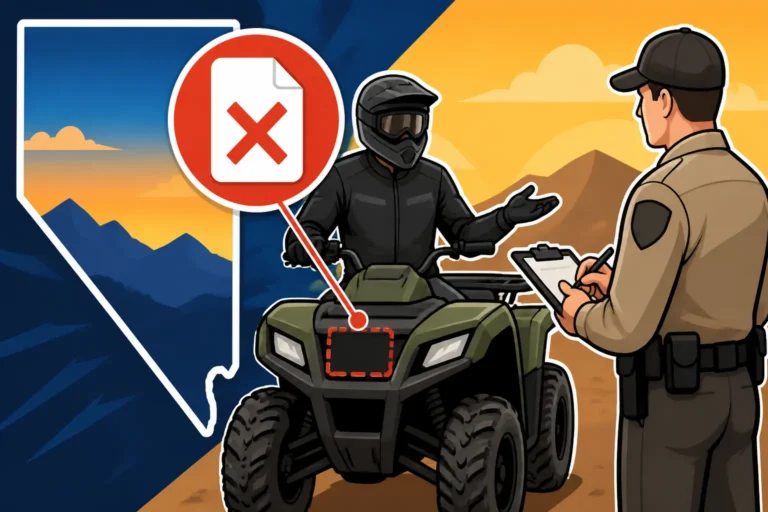
Imagine planning a trip with a friend through the scenic roads near Caliente to get to a remote trailhead. You've got your two-seat Yamaha Raptor, your buddy has their helmet, and you're ready to roll. You’ve even strapped on a rear passenger seat for comfort. However, a local deputy pulls you over. Despite your good intentions and safety gear, your Raptor simply doesn't fit the "large ATV" definition because it wasn't designed for four passengers or equipped with a cargo bed. You'd likely receive a citation for riding an unregistered or improperly equipped OHV on a county road, even if your ultimate destination was a legal trail. This is a common pitfall, and it highlights the importance of understanding the specific legislative language. For more information, read [Why a Two-Seat Sport Quad Fails Nevada's Test].
Distinguishing County Roads from State Highways
It's also crucial to understand where you are legally allowed to ride a "large all-terrain vehicle" in Nevada. The law specifically refers to "county roads" and "minor county roads," not state highways or interstates. This is a significant distinction that often gets overlooked. County roads are generally maintained by the county and serve local traffic, often leading to rural properties, trailheads, or connecting small communities. State highways, on the other hand, are part of the state's main transportation network and are typically much busier with higher speed limits. Nevada explicitly bans OHVs from interstate highways entirely, and with very limited exceptions, from state highways.
So, while you might be able to ride your qualifying side-by-side on a graded dirt county road leading out of Logandale to a trail, you absolutely cannot jump onto State Route 169 to get there, even if it's just a short distance. There's a critical difference between a rural two-lane county road and a highway like US 93. Even if a county road is paved, it might still fall under the "minor county road" classification, allowing for limited OHV use. However, some larger cities and counties have also enacted their own ordinances to restrict or ban OHV use on any public road within their limits, even those considered county roads. Always check local ordinances for the specific area you plan to ride. Understanding the difference between these types of roads is just as important as knowing your vehicle's classification. For more on this, consult [Nevada's General and Minor County Roads].
Understanding Passenger and Supervision Rules on Nevada County Roads
Once you've confirmed that your OHV meets Nevada's "Large ATV" definition, the next set of regulations you need to master revolves around passengers and, if applicable, the supervision of younger riders. It’s not enough to simply have the right vehicle; you also need to ensure that everyone on board is riding legally and safely. Riding two-up (or more) means you’re responsible for more than just yourself, and Nevada law is quite clear about who can ride, where they can sit, and what safety measures must be in place. This isn't just about avoiding a ticket; it's about preventing serious injury, especially when you're sharing the road with other vehicles.
Who Can Ride As a Passenger in a Road-Legal UTV
For a UTV (which is the most common type of "large all-terrain vehicle" eligible for limited road use) to carry passengers on a Nevada county road, there are specific requirements concerning seating and age. Each passenger must occupy a seat designed by the manufacturer for carrying passengers, and crucially, they must be secured by a safety belt or harness. This means no riding on laps, no standing in the bed, and no informal seating arrangements. If your machine is a four-seater, it means four distinct seating positions, each with its own seatbelt. If it's a two-seater with a cargo bed, only two people can ride in the designated seats, and no one can ride in the bed while on a county road.
Furthermore, there are age restrictions for passengers. While there's no blanket minimum age for a passenger in an OHV on a trail, when you bring that machine onto a county road, you're essentially operating a vehicle under rules closer to those for cars. Children need to be of an age and size where they can properly utilize the vehicle's safety restraints. For children under six years old, Nevada law generally requires them to be secured in an approved child restraint system when in a motor vehicle on a highway. While an OHV on a county road might not technically be a "highway," deputies often apply similar common-sense safety standards. If a child cannot be safely secured in the factory-installed seat and safety belt, they should not be riding as a passenger. Your machine should have adequate space and proper restraints to keep everyone safe. You can also refer to [Nevada Helmet Rules for Passengers] for other considerations.
Supervising Young Riders on County Roads
For younger riders who might be operating the OHV themselves on a county road, Nevada has clear supervision rules. Generally, anyone under the age of 16 operating an OHV on public land must be under the direct supervision of an adult who is at least 18 years old. This adult must also be operating an OHV and be close enough to provide immediate assistance and direction. When riding on a county road, these supervision rules become even more critical because you're interacting with different types of traffic and potentially higher speeds than on a designated trail. The adult supervisor must not only be present but actively ensuring the minor is following all road rules, including speed limits, traffic signs, and safe operating practices.
Let's say you have a 15-year-old who is a competent rider, and you want them to drive your two-seat side-by-side down a short stretch of county road to reach a specific trailhead. Under Nevada law, they would need to be directly supervised by you (or another adult 18+) who is also operating an OHV. This isn't about letting them get a head start; it's about constant oversight. The adult must be able to intervene immediately if the minor encounters an unexpected situation, like an oncoming vehicle or a sudden road hazard. This applies not just to operating the machine, but also to understanding traffic flow and road etiquette. Nevada wants to ensure that inexperienced operators have immediate guidance when sharing public roads.
The Importance of Designated Seating and Seatbelts
This point cannot be stressed enough: every passenger, and the driver, must be in a seat specifically designed by the manufacturer for carrying people, and they must use the corresponding seatbelt or harness. This is a non-negotiable safety and legal requirement. Aftermarket accessories are great for customization and performance, and companies like SuperATV make fantastic products, but when it comes to fundamental safety equipment like seating and seatbelts for road use, factory design is king. If your machine has a "bench" seat designed for two, then only two people are permitted in that space, each with their own seatbelt. Trying to cram three people onto a two-person bench, even if they're small, is not only illegal but incredibly dangerous.
Consider the dynamic forces involved in a sudden stop or a swerve, especially if you're pulling a trailer or encountering uneven road surfaces. A factory-installed seat and seatbelt system are engineered to keep occupants secured during these events. Without proper restraints, passengers can be thrown from the vehicle, suffering severe injuries. This is why deputies are so vigilant about this particular rule. They're not just looking for a simple headcount; they're looking at whether each person is properly seated and restrained. This attention to detail is paramount for the safety of everyone in your party when you venture onto public roads.
Essential Equipment for Road-Legal Two-Up Riding
Beyond the vehicle type and passenger rules, equipping your "Large ATV" correctly is absolutely non-negotiable for riding on Nevada county roads. This isn't just about making your machine look road-ready; it's about installing and maintaining specific components that are legally required and crucial for safe operation alongside traditional vehicles. Missing even one of these items can lead to a citation and, more importantly, compromise your safety. Think of it as preparing for a different kind of adventure – one where you need to communicate effectively with other drivers and be highly visible.
Mandatory Lighting, Reflectors, and a Horn
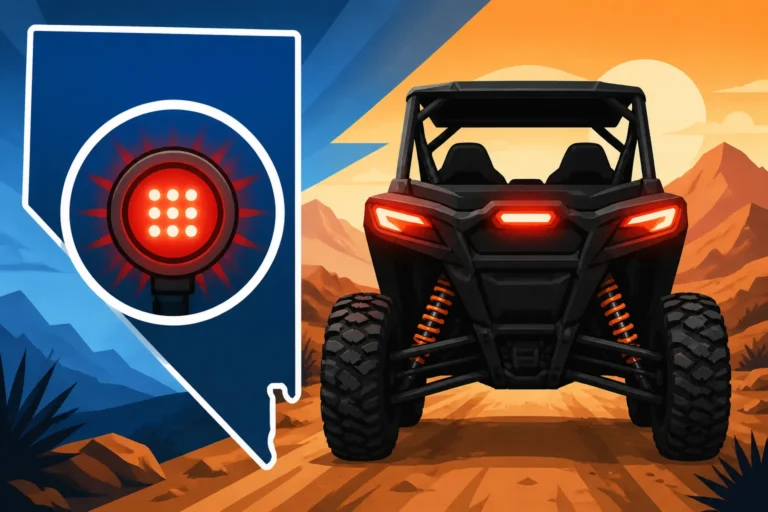
When you take your UTV onto a county road, especially if you plan to ride at dusk, dawn, or in low visibility, you must have appropriate lighting. This includes functional headlights and taillights that are visible from at least 500 feet. These aren't just for you to see; they're for other drivers to see you. Headlights need to illuminate the road ahead, and taillights need to clearly mark your presence from behind. Furthermore, your machine must be equipped with a red stop lamp (brake light) that activates when you apply the brakes, signaling your deceleration to vehicles following you. This is a critical safety feature often overlooked on purely off-road machines.
In addition to active lighting, you'll need reflectors. Nevada law specifies that if your taillight doesn't also function as a reflector, you'll need separate red reflectors at the rear, visible from a certain distance. This ensures that even if your lights fail, you still have some passive visibility. And, like any road-going vehicle, your UTV needs a horn. This isn't just for startling wildlife; it's a vital tool for alerting other drivers to your presence or impending maneuvers. Imagine approaching a blind curve on a rural county road and needing to signal your approach to an unseen vehicle. A functioning horn can prevent an accident. You can find more detail on this in [Headlights and Taillights Visible 500 Feet] and [The Stop Lamp a Nevada Road Machine Needs].
Mirrors and Safety Gear
Mirrors are another essential piece of equipment for road use. Nevada requires at least one rearview mirror, positioned to give the operator a clear view of the road behind the vehicle. While many UTVs come with a center rearview mirror, adding side mirrors is a smart move for enhanced visibility, especially when you have passengers or are navigating shared roads. Good mirrors are indispensable for checking blind spots, observing traffic, and making safe lane changes or turns. Companies like SuperATV offer a wide range of durable and easy-to-install mirrors that can significantly improve your situational awareness on county roads.
Beyond mirrors, consider your personal safety gear. While helmets aren't universally mandated for all occupants in a "large ATV" on a county road (unlike riding a traditional ATV off-road or a motorcycle on any road), they are always a good idea, especially for the driver and any passengers. The desert environment can be unpredictable, and a helmet provides crucial protection in case of a rollover or collision. Eye protection is also highly recommended to shield against dust, debris, and sun glare. Even with a windshield, dust and small rocks can find their way into the cab. Finally, seatbelts, as discussed, are paramount and legally required. For more specific mirror rules, see [Nevada Mirror Requirements for a Road UTV].
Spark Arresters and Mufflers
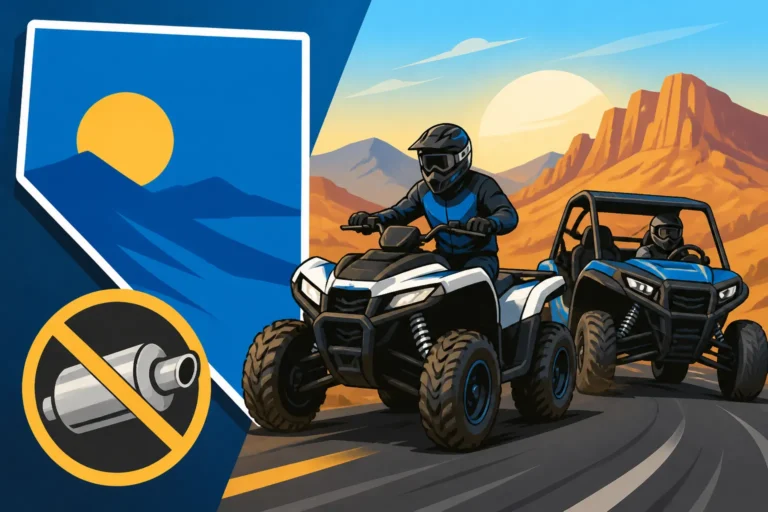
Maintaining your OHV's exhaust system to meet Nevada's standards is also important when riding on county roads. Your machine must be equipped with a muffler in good working condition to prevent excessive or unusual noise. This isn't just about being a good neighbor; it's a legal requirement. Loud, modified exhausts can draw unwanted attention from law enforcement and upset local residents, potentially leading to increased restrictions on OHV access. The goal is to keep noise levels reasonable, especially in areas where homes or other public spaces are nearby.
Additionally, a spark arrester is a crucial piece of equipment, especially in Nevada's dry, fire-prone environment. A spark arrester prevents incandescent particles from exiting your exhaust system and potentially igniting dry vegetation. While primarily an off-road requirement for fire prevention, its presence on any machine used on county roads, which often traverse rural and wildland-urban interface areas, is critical. Ensure your spark arrester is U.S. Forest Service approved and in good working order. Both proper mufflers and spark arresters contribute to responsible OHV use, helping preserve access for everyone.
Driver Licensing, Insurance, and General Road Etiquette
Even if your "Large ATV" is perfectly equipped and your passengers are seated safely, there are still crucial aspects of driver eligibility and responsibility you need to cover before hitting those Nevada county roads. Driving an OHV on a public road isn't like driving on a private trail; it comes with the same legal responsibilities as driving any other motor vehicle. This means having the proper license, carrying adequate insurance, and understanding the specific limitations on where and how far you can ride. Ignoring these details can quickly turn a fun outing into a costly headache, so let's make sure you're fully prepared.
Driver's License and Liability Insurance Requirements
Just like driving your car, operating a "Large ATV" on a Nevada county road requires you to possess a valid driver's license. This isn't a special OHV license; it's your standard Class C (or equivalent) driver's license. If you're old enough to drive a car, you're old enough to drive a road-legal UTV on an approved county road, provided you have that license in hand. Letting an unlicensed driver operate your machine on a public road, even a quiet county road, is a serious offense and can lead to significant penalties for both the driver and the owner. For more on driver's license requirements, see [Nevada Driver's License Rules for UTV Road Use].
Beyond the license, liability insurance is also a mandatory requirement. Nevada Revised Statute (NRS) 485.185 specifies that every driver and owner of a motor vehicle (which a road-legal UTV now becomes in this context) must maintain continuous liability insurance coverage. This protects you financially in case you're involved in an accident that causes injury or property damage to others. Without proper insurance, you could face hefty fines, suspension of your driver's license and vehicle registration, and personal financial ruin if an accident occurs. Always carry proof of insurance with you when operating your UTV on county roads. It’s not just a good idea; it’s the law. For more on this, check out [Liability Insurance Nevada Requires Under NRS 485.185].
The "2 Miles of Nevada Pavement" Rule and Its Limits
One of the most commonly misunderstood rules for OHV use on Nevada roads is the "2-mile limit." This rule permits OHVs (including qualifying "Large ATVs") to operate on a paved portion of a county or state highway for a distance of up to 2 miles solely for the purpose of getting from one unpaved section of a designated OHV route to another, or to access a fuel or service station. It's a very specific exception, not a general license to cruise on pavement. This rule is designed to help riders connect segments of trails or briefly access essential services, not for joyriding or commuting.
It's crucial to interpret this rule strictly. You cannot ride 2 miles one way, turn around, and ride 2 miles back for fun. The intent must be to transition between off-road areas or to get to a service point. Furthermore, this 2-mile limit does not apply to interstate highways, which are entirely off-limits to OHVs. Some counties and cities also have ordinances that prohibit OHV use on any paved roads within their jurisdiction, even if it's a county road that would otherwise fall under the 2-mile rule. Always check local regulations, as they can override state rules in specific areas. Misinterpreting this rule is a common cause of citations. You can learn more about this specific limitation by reading [Nevada's 2-Mile Limit on Paved Highway].
Respecting Local Ordinances and Other Road Users
Finally, a truly responsible off-highway vehicle enthusiast understands that riding on county roads isn't just about legality; it's about good citizenship and safety. Many larger Nevada cities (those with populations over 100,000) have specific ordinances that severely restrict or outright ban OHV use on public streets within their city limits, even designated county roads. For example, cities like Las Vegas, Reno, and Henderson generally do not allow OHVs on their streets unless they are on specifically designated routes. You can find more information about this in [Nevada Cities Over 100,000 and Designated Routes]. This means you can't simply ride your UTV into town for groceries or a casual dinner, even if you meet all other requirements.
When you are legally on a county road, remember that you are sharing that road with cars, trucks, and possibly bicycles. Operate your OHV defensively, obey all traffic laws, including speed limits, stop signs, and yield signs. Signal your turns, maintain a safe following distance, and be mindful of your vehicle's width and turning radius. Avoid kicking up excessive dust on dirt county roads, especially when passing homes or other vehicles. Respecting private property boundaries and being courteous to other road users goes a long way in fostering positive relationships between the OHV community and local residents, helping to ensure continued access to our amazing trails and roads in Nevada.
Nevada "Large ATV" Road Equipment Checklist
To summarize, here's a quick checklist for what your "Large ATV" needs to be legally ridden on a Nevada county road with a passenger:
| Feature | Requirement | Notes |
|---|---|---|
| Vehicle Type | Must be a "Large ATV" (designed for 4+ passengers OR has a cargo bed). | This is the foundational requirement. A 2-seat sport quad, even with an aftermarket passenger seat, generally does not qualify. Utility UTVs and 4-seat sport UTVs are common candidates. |
| Passenger Seating | Each passenger must be in a manufacturer-designed seat with a safety belt/harness. | No riding in the bed (unless factory-designed seating), no lap children if not properly secured, no squeezing extra people into a designated seat. |
| Driver's License | Valid Class C (or equivalent) driver's license. | The operator must be licensed to drive a motor vehicle. |
| Liability Insurance | Proof of current Nevada liability insurance. | Mandatory for any vehicle on a public road. |
| Headlights | Must be visible from 500 feet. | Essential for visibility, especially during low-light conditions. |
| Taillights | Must be visible from 500 feet. | Ensures your presence is known from the rear. |
| Stop Lamp (Brake Light) | Red, functional, activates when brakes are applied. | Crucial for signaling deceleration to following vehicles. |
| Reflectors | Red rear reflectors (if taillight doesn't suffice). | Passive visibility, important if lights fail. |
| Horn | Audible from 200 feet. | For alerting other drivers and signaling. |
| Rearview Mirror | At least one, providing a clear view to the rear. | Enhances situational awareness. Side mirrors are highly recommended. |
| Muffler | In good working condition, prevents excessive noise. | Essential for noise control and legal operation. |
| Spark Arrester | U.S. Forest Service approved. | Prevents wildfires, required for all OHVs on public lands/roads. |
| Local Ordinances | Always check for city/county specific restrictions. | Some municipalities ban OHV use on any roads within their limits, even if state law allows it. |
| 2-Mile Rule Awareness | Understand limitations for paved county/state highways (for transition or access only). | This is a very specific exception, not a general allowance for riding on pavement. |
| Supervision (for minors) | Adult 18+ must supervise minor operators on another OHV. | Minors operating on county roads require direct adult supervision. |
| Helmet | Recommended for all occupants; legally required for riders under 18 off-road (and often a good idea). | Always a smart safety choice, especially for the driver and any younger passengers, though not strictly mandated for all occupants of a Large ATV on county roads. |
| Safety Belts | Must be worn by all occupants in designated seats. | Non-negotiable for safety and legality. |
This table provides a comprehensive overview of [Nevada Equipment List for Road-Legal UTVs] and other key considerations.
Disclaimer
This article is for general informational purposes only and does not constitute professional advice. Laws, prices and regulations vary by location and change over time. Consult a qualified professional for guidance on your specific situation.