Certifying a Rider Under Sixteen
A Nevada parent may hear that a rider under sixteen needs an ATV safety certificate and wonder whether it is a legal requirement, a trail permit, or simply good preparation. Those are different things. Here’s what certification means in practice, how training fits with youth supervision rules, and what to check before a young rider heads out.
Does a Nevada rider under sixteen need a safety certificate?
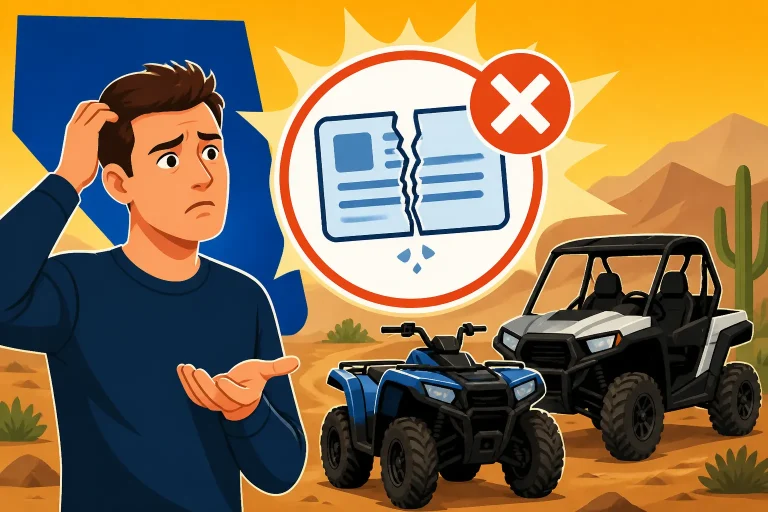
Nevada does not require every ATV or UTV rider under sixteen to earn a state safety certificate before riding. A course can still be worthwhile, but completing one is not the same as obtaining a Nevada riding license or an OHV registration decal.
That distinction matters because the word “certification” can refer to several different things:
- A course-completion credential: A training provider may give a rider a card, certificate, or digital record after the rider completes its course. It shows completion of that provider’s training; it is not automatically a state-issued permit.
- An OHV registration decal: Nevada’s decal relates to the machine, not the rider’s age or training. It does not certify that the person operating the machine has completed a safety course.
- Adult supervision: Youth riding rules and supervision requirements are a separate issue. A course certificate does not replace them.
- A rental company’s requirements: A rental business may set its own age, training, or supervision conditions. Those conditions apply to the rental transaction, even when they are not the same as a statewide certification rule.
Nevada has no mandatory OHV safety course requirement for all riders. For the broader legal distinction, see Nevada Has No Mandatory Safety Course and Does Nevada Require an ATV Safety Course?. A course may still help a young rider learn basic operating skills, recognize hazards, and understand how to share trails.
Parents should also avoid treating an online course as a substitute for hands-on instruction. A rider can learn concepts such as safe speed, protective equipment, and riding position on a screen, but that does not show whether the rider can control a particular ATV or UTV on uneven ground. Training is most useful when it is paired with an adult’s direct supervision and practice in a suitable, low-risk area.
The practical answer is: do not assume a Nevada safety certificate is legally required just because the rider is under sixteen. Instead, check the current youth-operation rules for the setting where the child will ride, confirm that the machine is properly registered or otherwise eligible to operate, and decide whether a safety course will help the rider prepare.
What training can do for a young rider
A good course gives a beginner a structured way to learn before riding in a busy or unfamiliar area. It can introduce safety habits that are easy to overlook when a child is excited to get moving: checking the machine, choosing protective gear, keeping a safe following distance, and recognizing when terrain is beyond the rider’s ability.
Course content varies, so a parent should review what a program actually teaches before enrolling a child. Look for clear coverage of the machine type the rider will use, basic controls, protective equipment, riding conditions, and safe decisions around other people. An ATV course may not cover every detail that matters for a side-by-side, and a general online module may not assess practical riding skills.
Online learning and hands-on practice
Online instruction can be convenient for learning basic safety concepts at home. It is also a useful way to discuss rules with a child before a ride. But finishing an online lesson does not prove that a young rider can start, stop, turn, or handle a slope safely.
Hands-on practice should be gradual. Start with familiar controls and simple maneuvers in an appropriate area, away from traffic, steep ground, and other riders. Let the child show steady control before increasing speed or attempting more challenging terrain. A parent or supervising adult should remain close enough to intervene, rather than relying on a certificate to judge readiness.
The Voluntary Nevada Offroad Course is one topic to review when considering training options. Check the provider’s current course details, age suitability, subject coverage, and the kind of completion record it issues. Do not assume a course is state-approved or required unless the provider or a relevant official source clearly confirms that status.
Picking a course and keeping proof
Before signing up, ask the provider:
- Is the course designed for the rider’s age and experience?
- Does it cover ATVs, UTVs, or both?
- Is the course online, hands-on, or a combination?
- Is there a knowledge check or practical assessment?
- What proof of completion does the rider receive?
- Does the course meet any requirement imposed by a specific rental company, event, or riding program?
Keep a copy of the completion record if the rider earns one. A paper card or saved digital document can make it easier to show a rental business or other organization that asks about training. Still, carrying proof does not make the document a Nevada registration decal, and it does not override age, supervision, equipment, or land-use requirements.
For an overview of the state’s youth-related requirements, read Nevada ATV Safety Certificate for Minors. That distinction is especially useful when a course provider uses the word “certificate”: the name of the document alone does not tell you whether it is legally required or accepted for a particular purpose.
Supervision, machine choice, and where the child rides
Whether or not a child has completed a course, parents need to consider the rules and risks that apply to the actual ride. Nevada youth-operation requirements include adult-supervision considerations. Check the current rule for the rider’s age and the type of operation, and do not assume that a course certificate waives a supervision requirement.
The adult should be able to observe the rider and respond if something goes wrong. A child riding out of sight on a distant section of trail is not meaningfully supervised simply because an adult is somewhere in the same riding area. The exact legal requirements can depend on the circumstances, so confirm them with the relevant official source before the trip.
Machine fit is just as important as the rider’s certificate status. A child should use a machine suited to the rider’s size, strength, experience, and ability to reach and operate its controls. A large, powerful ATV is not made suitable for a young rider by completing a course. Likewise, a child’s ability to operate a machine in a driveway does not necessarily mean the child is ready for loose sand, steep terrain, traffic around a trailhead, or a group ride.
| What to check | Why it matters | Practical next step |
|---|---|---|
| Rider’s age and supervision | Youth rules may impose conditions separate from course completion | Confirm the current rule for the ride and location |
| Machine size and controls | A rider must be able to operate the machine safely | Check fit, reach, braking, and handling before riding |
| Training format | Online lessons may not assess real control skills | Pair classroom learning with supervised practice |
| Registration status | The decal concerns the machine, not the rider’s training | Review the machine’s paperwork before departure |
| Riding area | Access rules and hazards vary by land and route | Check closures, permitted routes, and local rules |
| Protective gear | Training does not remove the risk of injury | Use properly fitted protective equipment for the ride |
The Nevada Minimum Age to Ride Off-Road and Nevada Supervision Rules for Young Riders are useful related topics. Rules may also differ depending on whether the child is riding on public land, private property, a designated OHV area, or a road. A place that is open to off-road riding is not automatically open to every machine or every rider without conditions.
Parents should also distinguish riding on public land from riding on private land. Private land does not mean every safety or legal concern disappears; the owner’s permission, machine suitability, and supervision still matter. On public land, route restrictions, closures, and land-manager rules can add another layer of requirements. Check those before unloading rather than relying on a course card or a machine decal to establish that a particular route is open.
For a machine used by a young rider on public land, Nevada Rules for a Youth Machine on Public Land can help frame the questions to ask. Confirm that the machine itself is properly documented. Nevada OHV registration applies to eligible machines, while a safety course concerns the rider. For background on how those concepts differ, see Nevada’s Registration Decal as Your Permit.
A practical checklist before the first ride
A certificate can be a useful record of learning, but it is only one piece of preparation. Before a young rider leaves home, work through the following steps:
- Confirm the current youth and supervision rules. Check the rules that apply to the child’s age, the machine, and the place where the ride will happen. If the ride involves a rental, event, or organized program, confirm whether it has extra conditions.
- Choose an appropriately sized machine. Check that the child can comfortably reach and use the controls and can handle the machine at a safe speed. A bigger machine is not automatically a better choice as the child gains confidence.
- Inspect the machine. Check that it is in safe operating condition, that controls work as intended, and that required registration or other paperwork is in order. A course completion record does not replace machine documents.
- Discuss and practice the basics. Cover starting and stopping, turning, safe spacing, what to do if the machine tips or gets stuck, and how the rider should communicate with the supervising adult.
- Select an appropriate first route. Start with terrain that matches the rider’s skill. Avoid beginning on a crowded trail, steep slope, difficult sand, or route with hazards the child has not practiced handling.
- Use suitable protective equipment. Make sure the rider has properly fitted gear for the machine and conditions. A certificate is not protective equipment and does not reduce the need for it.
- Carry relevant documents and contact information. Keep the machine’s required paperwork available and make sure the child knows how to get the adult’s attention. Store documents so dust, water, and vibration are less likely to damage them.
- Reassess as conditions change. Heat, fatigue, dust, traffic, and unfamiliar terrain can make a ride harder. Turn back or take a break if the child is losing focus or the route becomes too challenging.
If a course is being considered because a parent wants a formal credential, verify what the credential actually represents. Ask whether it records course completion, whether there is hands-on evaluation, and whether the organization requesting proof will accept it. This avoids paying for a course under the mistaken belief that it is a statewide license or a substitute for adult supervision.
A child who has completed safety training may be better prepared to make sound decisions, but readiness still has to be judged on the machine and terrain. Skills develop through instruction, practice, and careful supervision. A certificate is helpful evidence of learning; it is not permission to ride any machine, on any route, without regard to Nevada’s rules.
Disclaimer
This article is for general informational purposes only and does not constitute professional advice. Laws, prices and regulations vary by location and change over time. Consult a qualified professional for guidance on your specific situation.