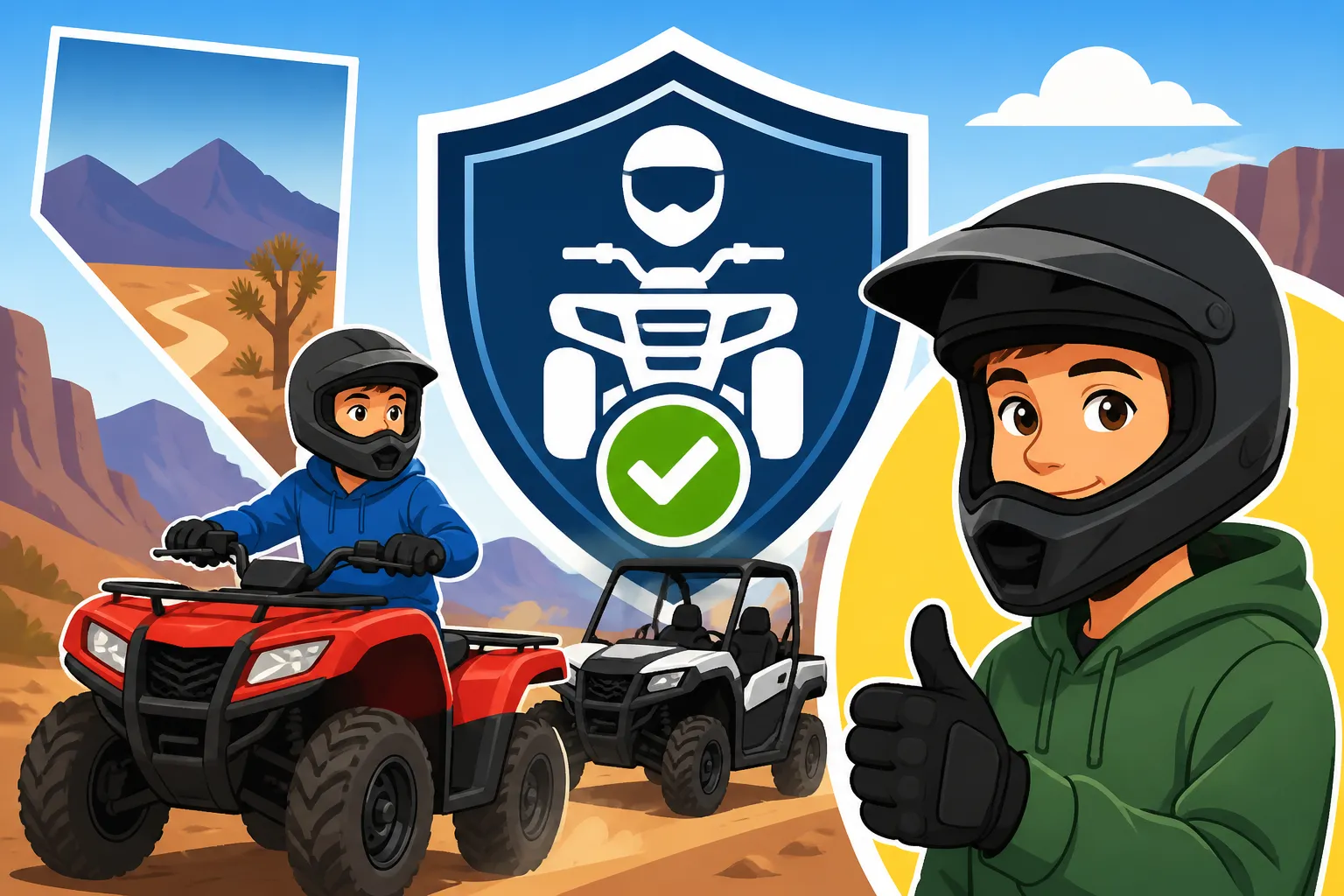
Nevada ATV Safety Certificate for Minors
A parent may expect a Nevada ATV safety certificate to be a legal requirement before a child can ride. In general, Nevada does not require every minor to hold a state safety certificate to operate an off-highway vehicle. That does not mean a child can ride without limits: supervision, age and machine suitability still matter, and local land or rental rules may add conditions.
Does Nevada require an ATV safety certificate for minors?
Nevada does not generally require minors to complete a state-approved safety course or carry a safety certificate just to ride an ATV or UTV off-road. A course can still be a sensible step, especially for a new rider, but it should be understood as training rather than a substitute for the rules that apply to the rider, machine and riding area. For more background, see Nevada Has No Mandatory Safety Course.
The distinction is useful because “not required” can sound like “not important.” A certificate may help a young rider learn basic controls, safe spacing, terrain awareness and what to do when something goes wrong. It does not automatically authorize a child to ride a particular machine, remove an adult-supervision requirement, or make a closed route open to OHVs.
| Question | Practical answer |
|---|---|
| Must every Nevada minor earn a state ATV safety certificate? | Generally, no statewide certificate is required simply to ride an OHV off-road. |
| Is a safety course still worthwhile? | Yes. Training can help a young rider build skills and recognize hazards before riding independently. |
| Does a certificate replace adult supervision? | No. Follow the age and supervision rules that apply to the rider and setting. |
| Does a certificate permit riding anywhere? | No. Land access, route closures, registration and other rules still apply. |
| Could a rental company or event require training? | It may set its own participation conditions. Ask before booking or attending. |
There are situations where a course or certificate may be required by someone other than the state. A rental operator, organized event, training program, land manager or insurer can set conditions for participation. Those conditions can differ from Nevada’s general rules for OHV operation. If a child is riding through a guided tour or club activity, ask the organizer what credentials it accepts and whether the child must complete a briefing or course first.
Also keep the machine’s paperwork separate from the rider’s training. A safety certificate does not register an ATV, prove ownership or replace a decal. Review Nevada OHV Registration and Proof of Ownership and Nevada Rules for a Youth Machine on Public Land when planning a ride on public land.
What a course teaches and how to choose one
A useful youth course should give the rider more than a completion document. Look for instruction that covers the machine the child will actually use, the conditions they are likely to encounter and the limits of their experience. A short lesson on controls and protective equipment is a starting point, not a substitute for careful adult supervision or practice in a controlled area.
Course content can include:
- Basic controls, starting and stopping, turning, and braking.
- Choosing a route that matches the rider’s ability and the machine.
- Protective gear, including a properly fitted helmet and eye protection.
- Safe riding distances and awareness of other vehicles.
- How to approach hills, loose surfaces, obstacles and changing terrain.
- What to do after a breakdown, injury or loss of communication.
- Respect for posted closures, private property and sensitive areas.
Nevada has voluntary OHV safety education resources. The Voluntary Nevada Offroad Course can be a starting point for a family seeking structured instruction, and Nevada ATV Safety Course Online may help identify online learning options. Confirm the current course provider, format, age suitability and whether any organization you plan to ride with recognizes the course. A course’s completion document may be useful for your records, but do not assume every rental company or event will accept it as proof of a specific requirement.
An online course can introduce safety concepts, but it cannot show whether a child can control a machine confidently. If possible, pair classroom or online learning with supervised practice on a suitable machine in a safe, open area. Keep the first sessions short, set simple goals and stop when the rider is tired, frightened or having difficulty following instructions.
Choose a course and machine based on the child’s size and current skill, not on a certificate alone. A young rider may have trouble reaching controls, using the brakes effectively or managing a vehicle that is too heavy or powerful. Review the manufacturer’s guidance and make sure the rider can operate the controls while seated properly. A child who can explain a safety rule may still need more practice before handling it on rough terrain.
Supervision, age and machine fit still matter
The absence of a general certificate requirement does not remove Nevada’s rules for young riders. Supervision requirements depend on the rider and circumstances, and riding on a public road involves different rules from riding off-road. Before setting out, check the specific requirements in Nevada Supervision Rules for Young Riders and Nevada Minimum Age to Ride Off-Road. Do not treat course completion as permission to ride alone or on a machine beyond the child’s ability.
A parent or supervising adult should be close enough to observe the child, intervene when needed and communicate clearly. Simply being somewhere in the riding area may not be adequate supervision in a busy or spread-out setting. Agree on where the child may ride, a signal to stop, and what to do if the group becomes separated. In unfamiliar terrain, keep the child within sight and choose a route that allows the adult to respond quickly.
The ATV or UTV should fit the rider as well as the task. A machine that is too large can be difficult to steer, stop or recover from a mistake. Check whether the child can sit in the intended position, reach the controls comfortably, operate the brakes and keep a stable grip while turning. For a UTV, passengers need to be seated and secured as designed; an adult should not assume a child can safely ride in any seat just because it is available.
Protective gear is part of the preparation, not an optional extra because the rider has taken a course. Use a properly fitted helmet and eye protection, plus clothing and footwear appropriate to the terrain and weather. Check the vehicle before riding, including tires, controls, brakes and fuel or battery condition. Set a pace that leaves room for the child to react rather than asking them to keep up with experienced adults.
Weather and terrain change the risk. Dust can hide other riders, loose sand can make steering harder, and heat can tire a child faster than expected. A certificate does not prepare a young rider for every condition. Choose a beginner-appropriate area, take breaks, bring water and turn back if visibility, fatigue or the child’s confidence becomes a concern. For route and land-access planning, see Nevada Rules for Riding Federal Land.
A practical checklist before a minor rides
Use this checklist whether or not the child has completed a safety course. It helps keep training, supervision and vehicle readiness from being confused with one another.
- Confirm the riding area is open to OHVs. Check the route, land manager’s restrictions and any seasonal closures. A course certificate does not grant access to closed or private land.
- Check the rules for the child’s age and riding situation. Review the applicable supervision requirements, especially if the plan includes public roads or a special event.
- Choose a machine the child can control. Follow the manufacturer’s age and size guidance, and make sure the rider can reach and use the controls.
- Consider structured instruction. A voluntary course can provide a useful foundation. Confirm the course is appropriate for the child and machine, and ask an organizer or rental provider whether it has its own training requirements.
- Fit protective gear. Check the helmet and eye protection before leaving, and dress for dust, sun, temperature and possible contact with brush or debris.
- Explain the ride plan. Set boundaries, agree on signals and make sure the child knows when to stop and wait for the adult.
- Inspect the vehicle and carry essentials. Check basic condition and bring water, a communication option and any required documents.
- Start conservatively. Use a low-traffic area, keep the first ride short and supervise closely. Add difficulty only when the child shows consistent control and judgment.
If you are renting, call ahead rather than relying on a general statement about Nevada law. Operators may set minimum ages, require a parent or guardian, limit which machines minors can use or require a safety briefing. Those requirements can change by company, vehicle and activity. A certificate may not override the operator’s age limit or contract terms.
If you are bringing your own machine, keep the vehicle’s registration and ownership documents in order and make sure the decal is current when required. Keep the child’s training record separately, if they have one. This makes it easier to show that the machine’s paperwork is in order without suggesting that a training certificate is a registration document.
The practical answer is straightforward: Nevada generally does not require a minor to hold an ATV safety certificate just to ride an OHV off-road, but training is still valuable. Check the rules for the child’s age and riding area, supervise appropriately, and make sure the machine fits the rider. Confirm any additional requirements directly with the land manager, event organizer or rental company before the ride.
Disclaimer
This article is for general informational purposes only and does not constitute professional advice. Laws, prices and regulations vary by location and change over time. Consult a qualified professional for guidance on your specific situation.