Does Nevada Require an ATV Safety Course?
Nevada does not generally require an ATV safety course just to register or ride an off-highway vehicle. That does not mean training is unnecessary—or that every riding situation has the same rules. Here’s how to tell whether a course is legally required, when a provider may ask for one, and what riders should check before heading out.
Does Nevada require an ATV safety course?
For ordinary off-road riding, Nevada does not have a general statewide rule requiring every ATV or UTV rider to complete a safety course. A safety certificate is not a standard prerequisite for getting a Nevada OHV registration decal, and the decal is not proof that you have completed training.
That distinction matters because riders sometimes assume an ATV must have both a registration decal and a course certificate before it can be used on public land. Nevada’s general registration system is separate from safety education. To understand the registration side, see Nevada’s Registration Decal as Your Permit and Nevada OHV Registration and Proof of Ownership.
A course may still be required by a particular rental company, event organizer, land manager, or other provider as a condition of taking part in an activity. That is a separate requirement set by the organization or site, not a universal Nevada course rule. If you are renting, ask the company what it requires before booking; What a Rental Agreement Covers explains why rental policies can add conditions beyond state registration.
Rules can also change with the type of machine and where you ride. An OHV used off-road is not automatically treated like a vehicle authorized for road use. Some county-road riding has additional driver, equipment, insurance, and route rules. A course certificate does not replace those requirements. For the separate road-use rules, see Nevada Driver’s License Rules for UTV Road Use.
| Question | General answer | What to check |
|---|---|---|
| Is a course required for every Nevada ATV or UTV rider? | No general statewide course requirement applies to ordinary off-road riding. | Check for rules tied to your land, event, rental, or specific activity. |
| Does a course replace OHV registration? | No. Safety training and registration are separate. | Confirm what registration applies to your machine and situation. |
| Can a rental company ask for training? | It may set participation requirements for its own rentals or tours. | Ask the provider before paying or traveling. |
| Does a course make an ATV street legal? | No. Training does not grant road-use permission or replace road requirements. | Check the route and the machine’s eligibility for road use. |
| Is training worthwhile even if it is not required? | Often, especially for new riders and young operators. | Choose instruction that fits the machine and rider’s experience. |
For a focused explanation of the statewide rule, Nevada Has No Mandatory Safety Course is a useful companion. The practical takeaway is simple: do not confuse “not generally required by Nevada” with “never required by anyone.”
What a safety course does and does not do
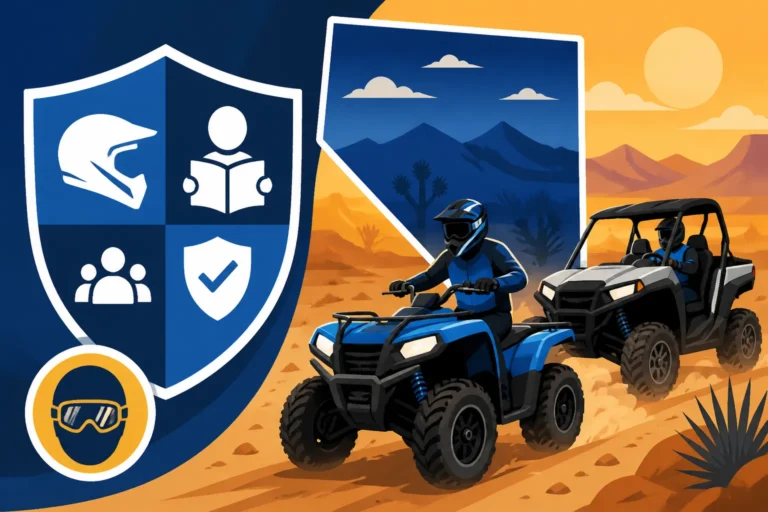
A well-designed ATV or UTV course teaches riders to make safer decisions before and during a ride. Depending on the course, topics may include basic controls, protective gear, turning and braking, riding within the machine’s limits, avoiding rollovers, reading terrain, and responding to an emergency. A useful course also emphasizes that a passenger should ride only in a machine designed for passengers and that riders should avoid riding beyond their ability.
A course is educational, not a substitute for permission to ride. Completing one does not:
- Register a machine or establish ownership.
- Authorize riding on a closed route, private property without permission, or land where OHV use is prohibited.
- Provide permission to ride county roads or highways.
- Replace a rental company’s contract conditions.
- Guarantee that a rider meets every age, supervision, or equipment rule that applies to a particular ride.
Nor does a certificate necessarily transfer from one provider’s program to another’s. If an event, rental business, or land manager asks for proof of training, ask what course or documentation it accepts. A generic online completion record may not meet a provider’s specific condition.
Registration and land access are separate checks too. Nevada’s OHV decal functions as the state’s registration-related permit for applicable machines, but it does not grant access to every trail or parcel. Riders still need to follow route designations, closures, and land-use rules. Nevada Rules for Riding Federal Land and [Nevada Rules for Riding a Closed Route] cover those separate questions.
Likewise, a course certificate does not settle whether an out-of-state machine can ride in Nevada without local registration. Visitors should look at the rules for their machine, its current registration, and length of stay. Nevada Reciprocity With California and Nevada Nonresident Exemption in NRS 490.082 can help clarify that issue for travelers.
The distinction is especially important when a machine will be used on both trails and roads. An off-road safety class can improve riding judgment, but it does not make an ordinary quad street legal. If your plan includes a county road, check the requirements for that specific use before assuming a course is enough.
Who should consider taking a course?
Although Nevada does not generally require a course for every off-road rider, training can be valuable for people who are new to ATVs or UTVs, returning after a long break, changing to a larger or less familiar machine, or riding with children. It is also useful for experienced drivers who have little practice on loose sand, steep terrain, narrow trails, or shared routes.
Young and inexperienced riders
A child’s age, physical ability, machine size, and supervision all matter. A safety course can help a young rider learn controls and judgment in a structured setting, but it does not override any applicable age or supervision rules. Parents and guardians should check the rules for the rider, the machine, and the land before going. See [Nevada Minimum Age to Ride Off-Road] and Nevada Supervision Rules for Young Riders for the related legal questions.
A youth rider should not be placed on a machine simply because an adult can operate it. The child must be able to reach and use the controls, understand instructions, and handle the machine without being overwhelmed by its power or weight. Adult supervision should be close enough to respond, not just somewhere in the riding area.
If a program offers instruction for young riders, ask whether it includes hands-on practice, what age and machine types it is designed for, and whether the supervising adult needs to participate. Hands-On Training for Riders Under 16 is relevant when deciding what kind of instruction may suit a younger operator.
New machine, new terrain, or a group ride
A rider who has used a small ATV for years may still need an adjustment period when moving to a heavier UTV, a machine with different controls, or a vehicle carrying passengers. UTVs have different dimensions and rollover risks from quads. Before a group trip, each operator should understand the machine they will drive and the route they will follow.
Terrain also changes the skills required. Sand, rocks, mud, hills, and narrow trails each call for different speed and spacing choices. A course cannot prepare someone for every site, but it can reinforce core habits: look ahead, leave room to stop, avoid sudden maneuvers, and do not follow another rider into terrain you have not assessed.
For a club ride, event, tour, or rental, verify the organizer’s expectations directly. Some providers may require an orientation or limit who can operate a machine. Others may rely on their own briefing rather than accept an outside certificate. Check before you arrive, and do not treat a course certificate as permission to ignore the provider’s instructions.
Choosing an online or hands-on course
Online learning can be convenient for basic safety principles and terminology. It cannot give a rider practice controlling a machine, judging braking distance, or responding to changing terrain. Hands-on instruction can address those skills, particularly for a new rider or a child, but quality and scope vary. Ask what the course covers, whether practical riding is included, and what documentation the provider supplies.
If the aim is simply to become safer, select a course based on instruction quality and relevance rather than assuming that any certificate is accepted everywhere. If an organization says training is mandatory for its activity, ask it to name the accepted course before enrolling.
Gear matters, too, but buying equipment is not a substitute for instruction. If you shop through Amazon or another retailer, check that protective equipment is designed for the intended use and fits the rider; do not rely on a product listing alone to confirm that it meets a specific event or provider’s requirements.
What to check before you ride
A short pre-ride check can prevent a course-related misunderstanding from turning into a canceled trip. Follow these steps:
- Identify the ride type. Decide whether the plan is strictly off-road or includes a public road, organized event, rental, or guided tour. Different rules and provider policies may apply.
- Check the machine’s paperwork. Confirm whether the machine needs Nevada OHV registration and carry the documents the ride requires. A safety certificate does not replace registration.
- Confirm where riding is allowed. Review current route information and closures for the specific area. A valid decal or completed course does not authorize riding outside open routes.
- Ask the provider about training. If renting or joining an event, ask whether a course, orientation, minimum experience, or particular certificate is required. Get the answer before making plans.
- Match the rider to the machine. Make sure the operator can comfortably use the controls and that the vehicle is designed for any passengers it carries.
- Use appropriate protective equipment. Wear a properly fitting helmet and other gear suited to the conditions. Check the provider’s rules where the ride is organized or rented.
- Set limits for the group. Agree on speed, spacing, hand signals or other communication, regrouping points, and what to do if someone becomes separated or a machine breaks down.
If your ride is part of a rental or tour, do not assume the operator handles every safety detail. Ask who gives the briefing, what protective gear is included, whether passengers are permitted, and what happens if a rider is not comfortable operating the machine. Those questions are more useful than asking only whether a course is required.
For independent rides, training is one part of preparation. Check weather, daylight, route difficulty, water, fuel, and communication options as well. Riders can be properly trained and still get into trouble by choosing terrain beyond their ability or continuing after conditions worsen.
The bottom line: Nevada does not generally require every ATV or UTV rider to complete a safety course for ordinary off-road riding. Training can still reduce risk, and a rental company, event, or site may impose its own conditions. Check the specific ride, and keep safety education separate from registration, land access, and road-use requirements.
Disclaimer
This article is for general informational purposes only and does not constitute professional advice. Laws, prices and regulations vary by location and change over time. Consult a qualified professional for guidance on your specific situation.