Taking a Nevada Decal Into Oregon
Taking a Nevada Decal Into Oregon
Planning to ride an ATV or UTV in Oregon with a Nevada decal? The key question is whether Oregon recognizes that decal as a valid out-of-state OHV permit—and what other rules still apply. Reciprocity can help you avoid buying a second permit, but it does not make every Nevada-registered machine legal on every Oregon trail. Check the machine, riding area, and required documents before you travel.
Does Oregon Recognize a Nevada OHV Decal?
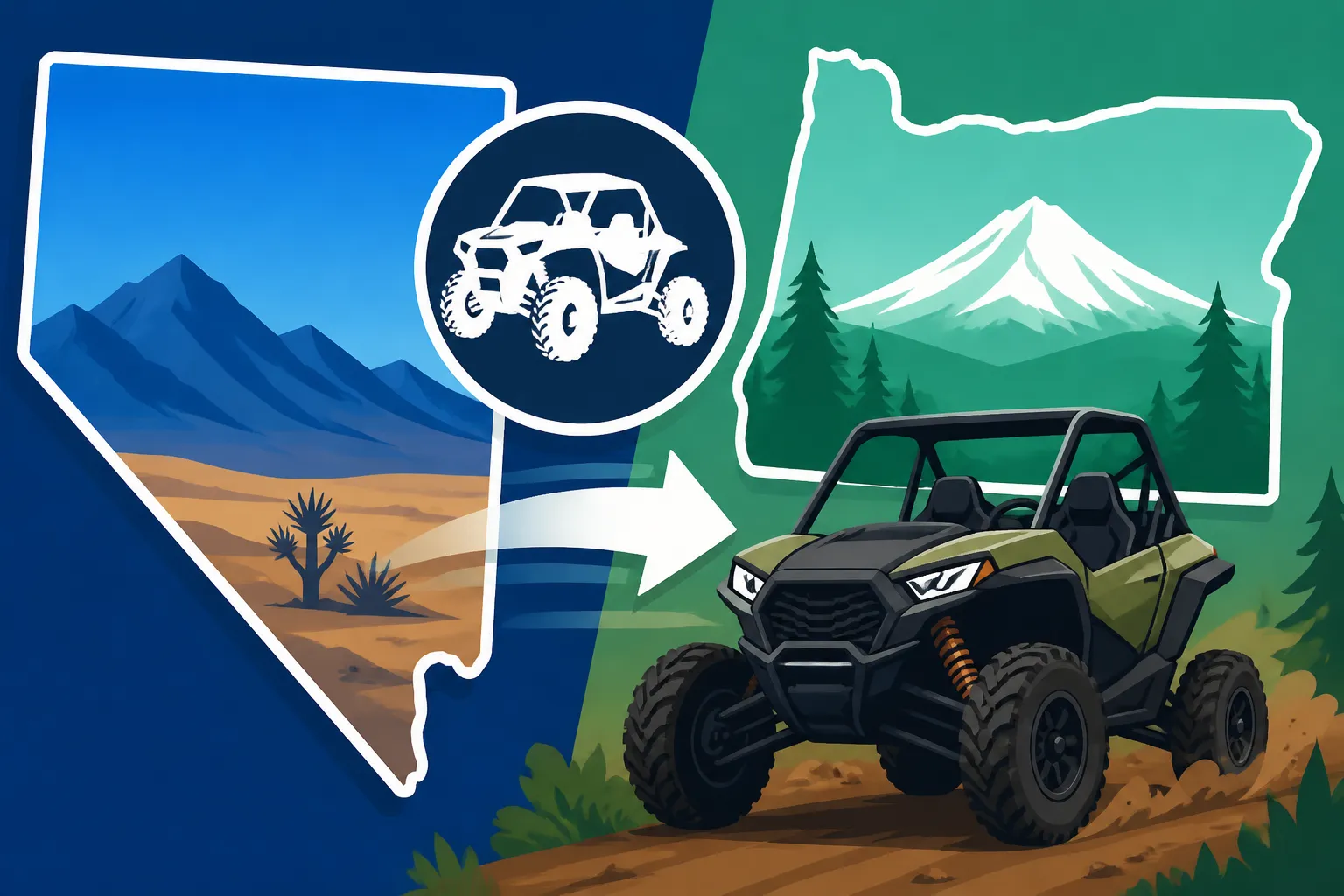
Oregon and Nevada have a reciprocity arrangement for qualifying off-highway vehicles. In general, that means a current Nevada OHV decal can meet Oregon’s permit requirement when you bring an eligible machine into Oregon for off-highway use. The Nevada decal is not simply a sticker that Oregon happens to accept: Nevada’s OHV registration system serves as the state’s off-road permit system, and reciprocity is what can make it useful across the border.
That does not mean a Nevada decal automatically covers every vehicle, location, or rider. Oregon’s requirements depend on the kind of machine and where it will be operated. A decal also does not replace rules about vehicle equipment, safety, land access, or carrying proof of registration.
Think of reciprocity as answering one narrow question: “Can my current Nevada OHV credential satisfy Oregon’s permit requirement for this machine?” It does not answer whether a route is open, whether the machine is allowed on that route, or whether the rider meets other requirements.
For context on how Nevada’s system works, see Nevada OHV Permits Explained and Nevada’s Registration Decal as Your Permit. Those details matter because the out-of-state permit Oregon recognizes needs to be current and associated with the machine you are taking. If the decal is expired, missing, damaged, or belongs to another vehicle, do not assume reciprocity will fix the problem.
| Situation | What to check before riding in Oregon |
|---|---|
| Current Nevada OHV decal on the machine | Confirm it is valid and clearly displayed |
| Decal expired or renewal pending | Do not rely on it as a current permit |
| Machine recently purchased | Confirm the ownership and registration paperwork is in order |
| Vehicle has no Nevada decal | Check whether it must obtain an Oregon permit before use |
| Riding on a specific trail or property | Confirm that the machine class and permit are accepted there |
| Road or street travel | Check road-use rules separately; OHV reciprocity does not make a machine street legal |
Because state rules and reciprocity arrangements can change, check Oregon’s official OHV information before leaving. If you are unsure whether your machine or Nevada credential qualifies, ask the relevant Oregon program or land manager and describe the exact vehicle and decal. A quick confirmation is much easier than finding out at a trailhead that your paperwork does not meet the requirement.
What to Check on Your Nevada Machine Before You Leave
A current decal is only useful if it is the right decal for the machine you are bringing. Before packing, check the decal’s expiration status, its placement, and whether the registration information matches the vehicle. Nevada’s decal and registration card are connected to the machine, not a general pass that can be moved from one ATV or UTV to another.
If you recently bought the machine, inherited it, or moved to Nevada, make sure the registration is complete rather than assuming a bill of sale or application receipt is a substitute. The paperwork process can differ depending on how you acquired the vehicle. The Nevada OHV Registration Paperwork Checklist can help you identify gaps, while Nevada OHV Registration and Proof of Ownership explains why proof of ownership and registration are related but separate issues.
Before departure, confirm these details:
- The decal is current. Check its expiration information and make sure you have completed any renewal required by Nevada. If it has expired, do not treat an application, payment receipt, or old decal as proof that the machine is currently permitted in Oregon.
- The decal is attached to the right machine. A decal for one vehicle does not authorize another vehicle, even if both are owned by the same person.
- The decal can be seen and read. Dirt, sun damage, peeling edges, or a worn number can make an otherwise valid decal difficult to verify. Review Reading a Nevada OHV Decal Number if you need help understanding the number and information shown.
- You have the registration card or other supporting paperwork. A decal is a visible indicator, but a card can help resolve questions about the machine and its registration. Keep documents where they will stay dry and accessible.
- The vehicle details are consistent. If there is a mismatch in the VIN, owner name, or other identifying information, resolve it before the trip if possible. Carrying paperwork that explains a recent transfer may help, but it does not guarantee that an incomplete registration will be accepted.
If your decal is missing or damaged, address that before traveling rather than hoping that an officer or trail manager will accept a photo. A clear image of your registration card can be useful backup, but it may not replace the actual decal or any original document required by the applicable rules. For a refresher on Nevada’s requirements, see What a Nevada OHV Decal Actually Proves.
Keep paperwork in a sealed document pouch, along with a phone photo for backup. An outdoor document pouch sold by retailers such as Amazon can help protect the card from dust, water, and mud; choose one that fits securely and does not interfere with safe access to the vehicle. Avoid leaving the only copy of important information loose in a cargo area.
It is also worth checking your VIN and ownership records before a long trip. That is particularly important if the machine was bought privately or came from out of state. A decal does not erase a title or ownership problem. If a question comes up, having consistent registration and ownership documents makes it easier to explain what the machine is and who is responsible for it.
Oregon Rules Still Apply After You Cross the Border
A Nevada decal does not let you ride wherever you want in Oregon. You still need to use routes and areas where your type of OHV is allowed, follow posted closures, and comply with the land manager’s requirements. Public land can include different jurisdictions and management rules, sometimes within a short distance of one another. A road or trail that appears open on a map may have restrictions that are not obvious on the ground.
Before choosing a route, verify the rules for the actual riding area. Check whether the route is open to motorized travel, whether your machine’s class is permitted, and whether the area has any additional requirements. A state permit and a local access rule are different things. If a site requires an additional pass or has special conditions, your Nevada decal may not satisfy those separate requirements.
Start with the route or recreation-area information and confirm it with the managing agency when details are unclear. Useful background includes Nevada Rules for Riding Federal Land and [Nevada Rules for Riding a Closed Route]. Those titles address Nevada, but the broader planning lesson also applies in Oregon: verify the controlling land rules rather than assuming the permit alone establishes access.
Pay close attention to:
- Vehicle class and dimensions. Some trails have restrictions based on machine width, type, or use. A route suitable for a small ATV may not be appropriate or open to a wider side-by-side.
- Seasonal and temporary closures. Fire restrictions, weather damage, wildlife protection, maintenance, or other local conditions can close a route even when it is normally available.
- Roads that connect trail systems. A road on a map is not necessarily open to OHVs. Do not assume that a Nevada decal gives permission to travel on public roads or paved highways in Oregon.
- Private property and boundaries. A route crossing private land may require permission, and a nearby public trail does not grant access across someone else’s property.
- Local passes and fees. A recreation site may have its own entry, camping, or use rules. Confirm whether a separate fee applies and what it covers.
- Camping and fire rules. Overnight use, camp locations, campfires, and fuel storage can be governed by rules separate from OHV registration.
If you plan to cross between different types of public land, check the map and posted signs at the transition. Boundaries can be hard to see from a vehicle, and relying on a navigation app alone can lead to riding onto a closed or unauthorized route. Download current maps before you lose cell service, and have a backup way to identify your location.
The same care applies to trailhead signs. Read them before unloading, even if you have ridden the area before or someone in your group says the trail is open. Signs may explain which vehicle classes are allowed, where a permit must be displayed, and whether a temporary restriction is in place. If the sign and an old online map appear to conflict, pause and confirm with the land manager rather than guessing.
Finally, keep OHV use separate from road legality. Reciprocity concerns an off-highway permit; it does not convert an ATV or UTV into a road-registered vehicle. A machine that is allowed on an Oregon OHV trail may still be prohibited on a nearby public street or highway. Trail-to-trail connections can require trailering rather than riding along the road.
Machine Class, Equipment, and Rider Requirements
Oregon may classify off-highway vehicles differently from the way a rider casually describes them. An ATV, a side-by-side, a dirt bike, and a youth machine can fall under different rules. That is why a general answer about “a Nevada decal” is not enough if the machine is unusual, heavily modified, or used by a young rider.
Before the trip, identify the machine’s type and check Oregon’s requirements for that category. Do not rely on the model name alone. Dimensions, seating, design, and intended use may matter. A UTV does not necessarily follow the same trail rules as a quad just because both are off-road machines. Similarly, a youth vehicle may have rules that differ from those for an adult-size ATV.
| Machine or rider situation | Practical check |
|---|---|
| Standard ATV or quad | Confirm that the trail accepts the machine’s class and width |
| Side-by-side or UTV | Check width restrictions, passenger rules, and route suitability |
| Dirt bike | Verify motorcycle-specific permit, equipment, and helmet rules |
| Youth machine | Check age, supervision, safety, and vehicle-size requirements |
| Modified or homebuilt vehicle | Confirm how the state classifies it and what documents it needs |
| Machine with a passenger | Confirm that the machine is designed for passengers and the trail allows them |
Equipment rules can also vary by machine class and operating area. Depending on the vehicle and route, requirements may concern helmets, lights, sound, spark arresters, or other safety equipment. Do not assume that equipment legal in Nevada automatically satisfies Oregon rules. Check the requirements that apply to the Oregon location and the vehicle class.
For a youth rider, confirm both the rider rules and the machine rules. A child’s ability to operate a vehicle safely does not by itself establish that the child can legally ride that machine in a particular location. Supervision, safety education, protective gear, and age or size limits may all be relevant. If any rider is a minor, check the current Oregon requirements before traveling rather than relying on a rule remembered from another state.
Passengers deserve a separate check, especially in a side-by-side. The vehicle must be designed to carry the people aboard, and everyone should use the vehicle’s restraint system as intended. A passenger rule for public roads may differ from a trail rule, so check the setting in which you will ride. Do not carry a person on a machine that lacks a designated seat or restraint arrangement simply because the trip is short.
If your vehicle uses an electric powertrain, confirm that the location’s rules include it. It may be treated as an OHV, but do not assume that every trail or permit category treats every power source identically. The Nevada Rules for an Electric UTV on Trails is a useful reminder to check both the vehicle category and the route rules rather than relying on a broad label.
For machines with alterations, an unfamiliar classification, or incomplete paperwork, contact the relevant Oregon office before the trip. Explain the machine’s make, model, type, and dimensions as accurately as possible. Ask specifically whether the Nevada decal is accepted for that category and whether any additional Oregon permit or equipment requirement applies. General answers may not cover a custom build or a machine that has been modified substantially.
A Simple Pre-Trip Process
Cross-border OHV planning is easiest when you treat the decal, machine, and route as three separate checks. Complete them in that order: confirm the credential, confirm the vehicle, and confirm the place where you plan to ride.
- Check the Nevada decal. Make sure it is current, attached to the correct vehicle, and legible. If it is missing or expired, resolve that before departure.
- Gather the supporting documents. Carry the Nevada registration card and relevant ownership paperwork. If the machine recently changed hands, make sure the records explain the transfer.
- Confirm the reciprocity rule. Review current Oregon OHV guidance or contact the relevant authority. Ask whether your specific Nevada decal and machine class meet Oregon’s permit requirement.
- Identify the route and land manager. Do not plan around a broad destination name alone. Identify the trail system, trailhead, or route and check its current access rules.
- Check machine and rider requirements. Verify restrictions for vehicle class, width, equipment, passengers, and any youth riders in your group.
- Check for separate site requirements. Find out whether the recreation area has its own pass, fee, reservation, camping rule, or temporary closure.
- Prepare for limited service. Download maps and keep paperwork protected. Do not depend on a live phone connection to look up basic rules once you are remote.
- Recheck shortly before departure. Closures and conditions can change. Review official notices close to the trip and read signs at the trailhead.
If Oregon’s current information is unclear, be precise when you ask for help. Instead of asking only, “Is my Nevada sticker good?” provide the vehicle type, whether the decal is current, the riding location, and whether you intend to stay off public roads. That makes it easier to get a useful answer and reduces the chance that you receive a response based on a different machine or kind of riding.
If you cannot confirm that the Nevada credential qualifies, ask whether you can obtain an Oregon permit for the trip. Do not buy a second permit based only on speculation, but do not assume you are covered simply because the decal is valid in Nevada. The decision should be based on the current Oregon rule and the specific machine. Keep any confirmation or permit documentation with your other vehicle papers.
Also plan for what happens if the decal or registration card is questioned. Keep the original paperwork protected, make a readable backup photo, and know where the physical documents are stored. A picture can help explain a situation, but it is not a substitute for a required original credential. If your decal is damaged or no longer readable, fix the issue before you travel.
Frequently Asked Questions
Can I ride in Oregon with a current Nevada OHV decal?
A current Nevada OHV decal may satisfy Oregon’s reciprocal permit requirement for an eligible off-highway vehicle. Confirm the current rule for your machine class and destination before riding.
Does a Nevada decal let me ride on Oregon roads?
No. OHV permit reciprocity does not make a machine street legal or authorize it to travel on public roads. Road access is a separate question with separate requirements.
Do I need to carry my Nevada registration card?
Carry it when possible. The decal is displayed on the machine, while the card can help verify the registration and vehicle details if questions arise.
Will my Nevada decal cover every trail or riding area in Oregon?
No. A state OHV permit does not guarantee access to every route or site. Check land-manager rules, vehicle restrictions, closures, and any separate recreation-area requirements.
What if my Nevada decal is expired or unreadable?
Do not assume Oregon will accept it. Renew or replace it through the appropriate Nevada process, and confirm Oregon’s current requirements before taking the machine there.
Disclaimer
This article is for general informational purposes only and does not constitute professional advice. Laws, prices and regulations vary by location and change over time. Consult a qualified professional for guidance on your specific situation.