Nevada Riders Crossing Into Arizona
A Nevada decal does not make every Arizona trail or road legal, and a route that looks open on a map may cross land with different rules. Before crossing into Arizona, check what your machine’s Nevada paperwork establishes, what Arizona requires, and whether each part of your route is open to OHVs.
What a Nevada decal does and does not cover
Nevada’s OHV decal is tied to Nevada’s registration system. It helps show that a machine is registered for use under Nevada’s rules, but it is not a universal permit for every state, road, trail or recreation area. Once you cross into Arizona, Arizona’s rules and the land manager’s access requirements matter.
That distinction is the main point to keep in mind: vehicle registration and permission to use a particular route are separate questions. You may have valid Nevada paperwork and still need to check Arizona’s rules for out-of-state machines, the route’s legal status, and any area-specific permit or fee.
Nevada and Arizona have reciprocity provisions for some out-of-state OHVs, but do not treat “reciprocity” as a blanket approval. The details can depend on the machine’s registration status, where it is operated, and the rule in effect for the particular area. For the Nevada side of the issue, see Nevada Reciprocity With Arizona. For the Arizona side, confirm directly with the appropriate Arizona agency or land manager before setting out.
| Question | What to check |
|---|---|
| Is the machine registered in Nevada? | Confirm that its Nevada registration is current and that the decal and registration document match the machine. |
| Does Arizona recognize its Nevada status? | Verify Arizona’s current treatment of Nevada-registered OHVs, including any nonresident exemption or decal requirement. |
| Is the route open to OHVs? | Check the current map or route information for the agency managing that road or trail. |
| Does the destination require another permit? | Look for area-specific passes, recreation permits, fees, closures or restrictions. |
| Will you ride on public roads? | Check the laws for the road’s jurisdiction and whether your machine is eligible for that use. |
A Nevada decal also does not turn an off-highway machine into a street-legal vehicle. If the route includes a public road, the machine must meet the rules for that road and be allowed to travel there. A route that is legal for an off-highway vehicle on one side of the state line may not be legal on a public road in the other state.
For background on what the Nevada credential establishes, see What a Nevada OHV Decal Actually Proves. If you are unsure whether your machine’s paperwork is complete, Nevada OHV Registration and Proof of Ownership explains why registration and proof of ownership should not be treated as interchangeable.
Check Arizona requirements before you cross
Before leaving Nevada, confirm the rules that apply to your specific machine in Arizona. Do not rely only on a decal, plate, bill of sale or registration card from home. The relevant question is whether Arizona recognizes that document for the kind of OHV you own and the use you plan to make of it.
This matters especially if your machine is an ATV or UTV that is not registered for ordinary highway use. A Nevada OHV decal identifies its Nevada registration status; it does not necessarily satisfy every Arizona requirement for operating out of state. A machine with a license plate may also have different paperwork from an OHV registered only for off-highway use. Confirm the rules for your machine’s actual status rather than assuming that a plate, decal or title answers every question.
Confirm how Arizona treats your machine
Before the trip, check with the relevant Arizona agency whether a Nevada-registered OHV qualifies for out-of-state treatment and whether any additional Arizona decal or paperwork is required. Ask about the kind of use you intend: riding on public land, using a state-managed area, crossing a road, or traveling on a road that permits OHVs. Those may not all have the same answer.
It is also worth asking what Arizona expects you to carry. Even if a Nevada credential is accepted, having the registration document available can help show that the decal belongs to your machine. If you have recently bought the ATV or UTV, make sure the paperwork is in the right name or otherwise supports your claim to the machine. A receipt or bill of sale may help document a purchase, but it should not be assumed to replace required registration.
For Nevada riders heading the other way, Riding Nevada on an Arizona Decal covers the related question of using an Arizona credential in Nevada. The rules are not automatically identical in both directions: acceptance by one state does not prove acceptance by the other.
Check for rules beyond vehicle registration
A state’s OHV decal or registration requirement is only one layer of access. The road or land you want to use may have its own conditions. Depending on the location, those can include a recreation permit, a day-use fee, an open-route restriction, a seasonal closure, or a rule limiting vehicle types.
Do not assume that all public land is open to cross-country riding. Land agencies commonly designate roads and trails for motorized use, and a route shown on a general map may be closed, restricted or outside the area where riding is allowed. Check the land manager’s current maps and notices, particularly if your planned route connects multiple recreation areas.
If your trip includes Nevada public land before you reach the border, Nevada Rules for Riding Federal Land and Nevada Rules for Riding State Trust Land explain why the landowner or agency can affect access separately from vehicle registration. Arizona has its own land managers and access rules, so apply the same careful approach on the other side.
Plan the crossing as a route, not a straight line
A state line on a map does not show whether an OHV route is legally connected across it. A trail may end at the boundary, turn into a road with different restrictions, cross private property, or enter land where motorized travel is limited. The practical task is to verify each segment, not merely confirm that a destination is near the border.
Start with a map from the agency that manages the land or route. If the route crosses multiple jurisdictions, check each one. A route could involve county roads, federal land, state land and private property during a single ride. The rules can change at each boundary, and a route that appears continuous in a commercial mapping app may not be an authorized OHV route.
Check the legal connection between areas
Trace the route from your Nevada staging area to your Arizona riding area. Look for the exact roads or trails you intend to use, and note where the route reaches a boundary or changes managing agency. If the map is unclear, contact the relevant office and ask whether the route is open to your machine type and whether the connection is legal for OHVs.
Pay particular attention to roads that cross or border public land. A road’s location on federal land does not by itself establish that OHVs may use it. See Riding a Road That Crosses BLM Land for the difference between riding on a route and simply being near land managed by the Bureau of Land Management.
If a route crosses private property, do not assume that an established track or visible tire marks mean the public has permission to use it. Confirm access or choose a route that is clearly designated for motorized travel. Nevada Rules for Crossing Private Land covers the same basic issue on the Nevada side: permission and route status matter even when the terrain looks passable.
A useful pre-ride checklist is:
- Identify the exact trailhead or staging location on each side of the border.
- Trace the route segment by segment, including any road crossings or connecting roads.
- Note each agency or landowner responsible for the route.
- Check current closures and restrictions for the date of your ride.
- Confirm that your machine type is allowed on every segment.
- Save an offline map and contact details for the relevant land office.
Treat roads as a separate legal question
Riding off-road and riding on a public road are not the same activity. A route may allow OHVs on designated dirt roads while prohibiting them on a nearby paved road. Even a short road connection can bring separate requirements for equipment, operator eligibility, registration, insurance or route designation.
Do not use an ordinary road just because it is the most direct way between two trail systems. Confirm that OHVs are legally allowed on that specific road, and check whether the permission applies to the whole road or only a signed segment. Rules can differ by jurisdiction, so a road open to OHVs in one county or recreation area does not establish that the next road is open too.
Crossings also need planning. If a route requires crossing a public highway, use a crossing that is permitted and safe; do not ride along the road or its shoulder unless the applicable rules allow it. Nevada Rules for Crossing a State Route explains the Nevada-side distinction between crossing and traveling along a road. In Arizona, confirm the corresponding rule with the agency responsible for that roadway.
If your planned route uses any road, make a separate list of road segments and verify them individually. That avoids the common mistake of treating a map’s continuous line as proof that every segment is legally open to an OHV.
Prepare the machine and documents
Before leaving, compare the paperwork on the machine with the machine itself. Check that the Nevada decal is current, readable and attached as required in Nevada. Carry the registration document and any ownership paperwork you may need to explain who owns the machine or why the registration is in a different name.
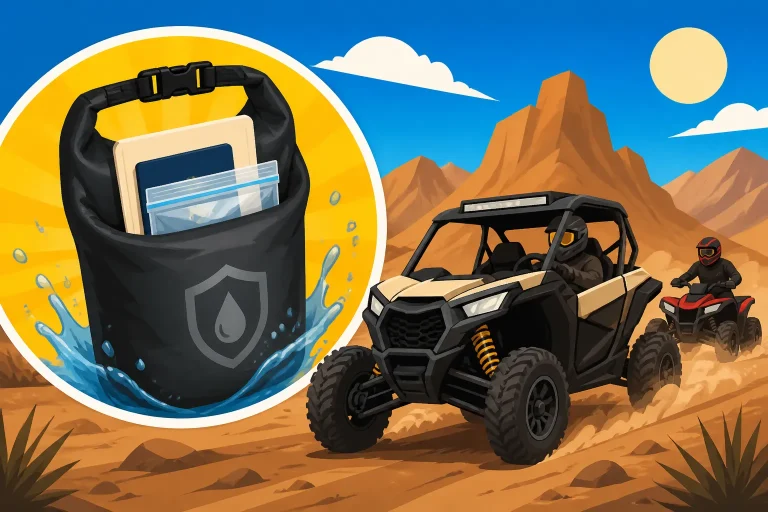
Keep documents protected from dust, water and damage. A basic waterproof document pouch, available from outdoor retailers or Amazon, can keep paper copies together; it does not replace the original documents or make an otherwise invalid registration acceptable. A photo of the paperwork on your phone is a useful backup, but do not rely on a phone image as the only proof unless the relevant authority confirms that it is accepted.
Before the ride, check:
- The registration card or other required registration document is with the machine.
- The decal is legible and associated with that machine.
- Ownership documents are available if the machine has just been purchased, inherited or transferred.
- Any road-use documents, insurance proof or permits required for the specific route are current.
- You have offline maps and a way to find the route boundaries without cell service.
Nevada registration does not establish that an ATV or UTV is equipped or approved for road use. If you plan to travel on public roads in either state, verify road eligibility and equipment separately. A machine that is legal for off-highway riding may not qualify for a road segment, even if it has a Nevada decal and all its documents are in order.
Check equipment and rider requirements
Equipment rules can depend on the activity and location. Before the trip, confirm requirements for helmets, passengers, lighting, sound, spark arresters and any other equipment that applies to your route or riding area. Do not assume that a rule you follow at home is sufficient for every Arizona destination.
If children or passengers are riding, check the relevant age, supervision and passenger rules for the route. A UTV’s seating capacity does not automatically settle whether a passenger is permitted in a particular situation. The safest approach is to follow the machine’s limits and the applicable rules, and to avoid carrying anyone in a position that is not designed for a passenger.
Protective equipment and emergency supplies are practical, too. Bring helmets and eye protection suitable for your ride, water, basic tools, a first-aid kit and a way to communicate if the group becomes separated. Desert routes can be remote, and cell service may be unreliable. Share your route and expected return time with someone who is not riding with you.
If the route includes long distances between services, plan fuel and water around the actual ride rather than the map’s straight-line distance. Keep the group together at junctions, turn around if route conditions or signs conflict with your plan, and do not continue onto a road or trail whose status you cannot verify.
What to expect at the border and on the ride
For an ordinary recreational ride, the state line is usually a legal boundary to plan around rather than a physical checkpoint. That does not mean you can ride across it at any point. You still need an authorized connection, and the rules for registration, land access and roads change with jurisdiction.
A well-planned crossing is often less about the line itself and more about the details surrounding it: where the route is open, which agency manages the next segment, whether a permit is required at the destination, and what documents you should carry. If you are unsure whether the exact route crosses into Arizona legally, stop before the boundary and confirm rather than riding on and hoping the trail continues.
If an officer or ranger checks your paperwork
Stay calm, stop safely and follow instructions. Be ready to show the documents you have and explain where you are headed. A Nevada decal may help establish the machine’s Nevada registration status, but it does not answer every question about Arizona’s requirements or the route you are using.
A roadside or trailhead check could focus on more than the decal. An officer or ranger may need to establish the machine’s identity, whether it is properly registered, whether the route is open, or whether the rider is complying with area rules. Keep paperwork accessible without placing it where it can blow away, get soaked or interfere with safe operation.
If you discover that a document is missing or a decal is unreadable, do not assume that a photo or verbal explanation will be accepted. Contact the relevant agency before riding if possible and ask what proof it accepts. For Nevada-specific guidance on keeping proof available, see Keeping Paperwork Dry in a Dusty Machine.
If your plans change
Riders sometimes need to change plans because of a closure, weather, a mechanical problem or a route that proves more difficult than expected. Do not improvise a shortcut across land that is not open to motorized travel, and do not use a road connection until you have checked that it is legal.
A sensible backup plan includes a second legal route, an identified place to turn around, and enough fuel and water to return to the staging area. If a route is closed, follow the posted direction and use an authorized alternative. A closure can protect people, wildlife, habitat or infrastructure; riding around a barrier can create safety and legal problems as well as damage the area.
The same caution applies to navigation apps. Use them to support your planning, not as proof of public access. Compare the route with current land-manager information, signs at the trailhead and any posted closure notices. If those sources conflict, pause and verify with the responsible office.
Frequently Asked Questions
Can I ride in Arizona with a Nevada OHV decal?
Possibly, but do not assume the Nevada decal alone is sufficient. Confirm Arizona’s current treatment of Nevada-registered machines and whether your destination has additional permits or access rules.
Does reciprocity mean I can ride anywhere in Arizona?
No. Reciprocity concerns how a state treats an out-of-state vehicle credential; it does not make every trail, road or parcel of land open to OHVs. Route access and land-use rules still apply.
Can I cross the state line anywhere along a trail?
Only where the route is legally open and connects across the boundary. A visible trail or track is not proof of public access. Check the route and land manager before riding across.
Is my Nevada OHV decal enough for a public road in Arizona?
Not necessarily. OHV registration and road-use eligibility are different questions. Verify the rules for the specific road and machine before using it.
What should I carry on the ride?
Carry the registration documents and ownership information relevant to your machine, along with any required permits or road-use proof. Keep paper documents protected and have offline route information as a backup.
Disclaimer
This article is for general informational purposes only and does not constitute professional advice. Laws, prices and regulations vary by location and change over time. Consult a qualified professional for guidance on your specific situation.