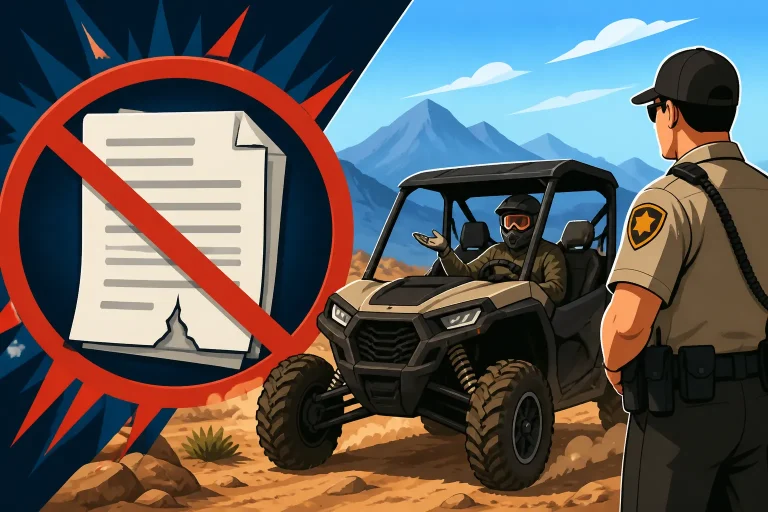
Nevada Permits for a Guided Tour Operator
A guided ATV or UTV tour in Nevada can cross public land, private property, and routes with different rules, so one permit may not cover the whole trip. Operators need to confirm who controls each part of the route, what authorization the business needs, and whether every machine and guide meets the applicable requirements. A little route and paperwork planning can prevent costly last-minute changes.
Start With the Route and the Land Manager
There is no single statewide permit that automatically authorizes every guided ATV or UTV tour in Nevada. Requirements depend on where the tour goes, whether the activity is commercial, how it is organized, and which agency or owner controls the land. A tour that stays on one private property may have a different approval path from a commercial ride on public land.
Start by mapping the full route, including the staging area, trail connections, rest stops, and any return route. Identify the land manager or owner for each segment. A trailhead may be on one kind of land while the trail itself crosses another. Nearby routes can also have different access rules, so do not treat a familiar area as one continuous permit zone.
Possible contacts include the relevant federal land office, state or local land agency, private landowner, or manager of a designated recreation area. Ask the agency or owner with authority over the route—not just the business that rents the machines or the person who maintains a trail map. If a tour crosses more than one jurisdiction, you may need to contact more than one office.
When you describe the business, be specific. Explain whether the tour is guided, whether customers use your machines or their own, whether you charge for the ride, how often tours run, how many machines travel together, and where the route begins and ends. Those details can affect the authorization required. A one-time group ride, a recurring commercial tour, and a rental business that sends customers out on their own are not necessarily treated alike.
A useful first question is: “Does this land manager require a commercial-use authorization for this activity on this route, and what application should I use?” Ask whether the proposed route is open to the type of vehicle you plan to use, whether commercial guiding is allowed, and whether there are limits on group size, season, staging, or route choice. Keep the response with your business records, but do not treat an informal answer as a substitute for a permit when the agency requires one.
| Tour situation | What to check first | Why it matters |
|---|---|---|
| Guided ride on federal public land | Whether commercial guiding requires a Special Recreation Permit or other authorization | Public access does not automatically authorize paid commercial use |
| Tour on private land | Written permission and any conditions set by the owner | Permission must cover the actual route and business activity |
| Tour in a managed recreation area | The site manager’s commercial-use and operating rules | A general land-use approval may not cover that location |
| Customers bring their own machines | Route authorization and the customers’ machine paperwork | The operator’s land authorization and each rider’s compliance are separate issues |
| Operator supplies the machines | Route authorization plus fleet registration and operating records | Commercial land use does not replace vehicle requirements |
For federal public land, commercial activities may require a Special Recreation Permit. The right authorization depends on the activity and the land manager’s rules, so verify the permit type rather than assuming that an event application or a general business license is enough. What a Special Recreation Permit Covers explains the basic role of this authorization; the agency responsible for your route should confirm what applies to your operation.
Confirm Commercial Authorization Before Advertising Tours
A permit for a guided tour is about the operator’s activity on the land. It is not the same thing as a rider’s OHV registration, and a customer’s valid decal does not necessarily authorize a business to conduct paid tours. The land manager may require an application describing the route, operating methods, safety procedures, expected use, and other details before granting permission.
An application may ask for information such as:
- The business and its responsible contact.
- The proposed route and staging locations.
- The types and number of machines.
- How often tours will operate and the expected group size.
- How guides will supervise customers and respond to incidents.
- Plans for avoiding closed routes, sensitive areas, and conflicts with other users.
- Proof of insurance or other supporting documents.
The precise requirements vary. A land manager may review whether the route is suitable for the proposed use, whether the activity can be managed safely, and whether the operation could affect other visitors or resources. The agency may also set operating conditions, such as approved routes, time periods, group limits, reporting obligations, or restrictions on where machines can stage. Treat conditions as part of the authorization, not optional suggestions.
A commercial authorization may also come with costs or administrative requirements. Those can depend on the issuing agency and the permit arrangement. Confirm current costs, submission instructions, payment methods, and renewal or reporting obligations directly with the relevant office. Do not build a tour budget around an old fee figure or assume that a permit remains valid indefinitely.
Give the land manager enough time to review a complete application. Processing time can vary with the office, the proposed activity, the route, and whether additional documents or review are needed. Ask about expected lead time before announcing dates or accepting bookings. Lead Times on a BLM Event Permit offers related planning context, but an event process is not automatically the process for a recurring guided tour. For an organized ride or special event, see Applying to the BLM for an Event Permit and ask the office which application fits the planned activity.
If the tour will cross several kinds of land, make a route-by-route authorization checklist. Record who approved each segment, the conditions attached to it, and who in the business is responsible for checking that the route remains open. A permit for one section should not be assumed to cover adjacent land, an alternate route, or a new staging area.
Before accepting reservations, make sure the approved activity matches the product being sold. A permit for one route, group size, or operating style may not cover a different tour itinerary. If you want to add a route, change the staging location, increase use, or run a special event, ask the land manager whether the change needs approval first.
Keep Machine Registration and Tour Authorization Separate
A guided-tour operator may have two distinct compliance jobs: securing permission for the commercial activity and ensuring that the machines used on the tour have the required paperwork. One does not substitute for the other. A land-use permit does not register a vehicle, while a valid registration decal does not grant permission to run a commercial tour on land where authorization is required.
For Nevada OHVs, check the requirements that apply to each machine and the places where it will be ridden. Nevada’s OHV registration decal serves an important registration and riding-permission role in the state, but the details can depend on the vehicle, the owner, and its circumstances. Nevada’s Registration Decal as Your Permit explains the connection. Do not assume that a customer’s out-of-state registration or decal is accepted for every Nevada trip; confirm the current reciprocity rules and any applicable exceptions with the responsible authority. The same check is sensible when your fleet or customers’ machines are registered outside Nevada.
If the business supplies machines, keep a clear inventory linking each machine to its identifying and registration records. Confirm that the paperwork matches the actual machine and is current before it is assigned to a tour. Establish a process for replacing a damaged or missing decal and for removing a machine from service if its status is unclear. Paperwork a Nevada Rental Machine Carries is also relevant when customers use an operator’s fleet, even if the business describes the activity as a tour rather than a rental.
If customers bring their own machines, explain before booking what paperwork they need to carry and what the tour operator will check. The operator can set reasonable participation requirements, but should not tell customers that a tour booking itself makes an otherwise noncompliant machine legal. Make the distinction plain in booking information: the operator handles the tour’s land authorization, while each rider remains responsible for the machine and documents they bring, unless the arrangement says otherwise.
Tour vehicles may be subject to additional rules depending on whether they are operated as OHVs, used on a road, or taken onto a particular managed area. Do not assume an off-road registration allows road use, or that a route advertised as a “trail” is open to every machine. If any part of the tour uses public roads or designated road routes, check the rules for that segment separately. The land manager’s approval for a trail ride does not grant permission to travel along a road that is closed to the vehicle.
For a mixed fleet, build a pre-ride check around the least familiar machine. Confirm that its paperwork, decal placement, and vehicle category match the intended use. Keep a record of inspections and maintenance, and make sure guides know which machines are approved for the route. This is especially useful when a tour uses customer machines alongside company machines.
Plan Insurance, Guides, and Customer Paperwork
Insurance deserves early attention because a commercial tour presents a different risk from a private ride. Ask an insurance professional who understands recreational vehicle operations to review the business model, the route, the machines, and the customer relationship. Be candid about whether the company owns the vehicles, guides customers on their own machines, transports machines, or offers more than one kind of service.
A land manager may require proof of insurance or specific policy language as part of its authorization. The exact limits and endorsements, if any, are set by the permit conditions and should be confirmed with the issuing office and your insurer. Do not assume that a personal auto policy, a customer’s policy, a general business policy, or a waiver satisfies the land manager’s requirement. Insurance a BLM Permit Requires provides related information, but confirm the current requirements for your own permit.
Consider how the policy addresses the actual activities customers will undertake. Questions to raise with your insurer include whether coverage applies to guided OHV tours, the types of machines used, passengers, employees and guides, accidents on the proposed land, and any vehicle transport or recovery work. Ask what the policy excludes and what steps the business must take to keep coverage in force. Keep written confirmation of the coverage that applies to the operation.
Customer forms are another part of a sound operating system, but a signed form is not a substitute for permission, training, safe supervision, or insurance. Have a qualified professional review customer agreements and waivers for the jurisdictions where you operate. Forms should accurately describe the activity, avoid promises about safety, and make responsibilities understandable before the ride begins.
Before a tour, explain the practical rules customers need to follow:
- Which machine they will use and whether passengers are permitted.
- Where the tour will travel and which areas are off limits.
- How to follow the guide and what to do if separated.
- The stop signal and procedure for mechanical trouble or an injury.
- What protective equipment is supplied and what riders should bring.
- What happens if a rider cannot safely operate the machine.
Guides need more than a route description. They should know the authorized route and its boundaries, how to count and supervise riders, what to do after a breakdown, and how to contact emergency services or the land manager when needed. Their training should match the terrain and the machines. Set a clear rule that a guide may stop or shorten a ride if weather, dust, vehicle problems, or a rider’s ability makes continuing unsafe.
Use a pre-ride briefing that covers the route, spacing, speed expectations, hand or radio signals, passing, stopping, and emergency actions. Keep instructions consistent across guides. A good briefing cannot eliminate risk, but it helps customers understand how the group operates and reduces confusion when the terrain or conditions change.
Use a Permit-First Operating Checklist
A repeatable process helps prevent a business from relying on assumptions made during an earlier tour. Keep the permit documents, route map, fleet records, insurance materials, and customer procedures together in a system that guides can access when needed. Review them before each season and whenever the route or service changes.
- Map the complete route. Include staging, trails, road crossings, stops, and alternate routes. Check who controls each segment.
- Ask each land manager about commercial use. Describe the actual guided activity, equipment, frequency, group size, and business model.
- Apply for the correct authorization. Follow the issuing office’s instructions and provide complete supporting documents.
- Review the issued conditions. Note approved routes, operating limits, reporting duties, insurance requirements, and expiration or renewal steps.
- Check machine paperwork. Verify each company machine and explain customer responsibilities when riders bring their own vehicles.
- Confirm insurance. Match the policy to the commercial activity and satisfy any permit-specific requirements.
- Prepare guides and customers. Train staff on the approved route and emergency procedures; brief customers before departure.
- Recheck conditions before each trip. Confirm the route is open and that no temporary closure, weather issue, fire restriction, or permit change affects the plan.
Build a change-control step into the process. If a trail closes, do not simply move the tour to a nearby route. Check whether the alternate route is open to the machines and whether the authorization covers it. If the operation adds a new land manager, changes the tour into an event, expands the fleet, or runs a materially different itinerary, ask whether revised approval is needed.
Keep records that show what the business was authorized to do and what it actually did. Useful records may include permits and conditions, correspondence with land managers, insurance documents, fleet registration information, guide training records, customer briefings, and trip logs. The issuing agency may require specific records or reports, so follow the permit rather than relying on a generic recordkeeping list.
Common mistakes are usually assumptions: believing public land is automatically open to commercial guiding, treating an event permit as a recurring-tour permit, assuming one agency’s approval covers the whole route, or expecting a decal to authorize the business. Another is advertising a route before the land manager has approved it. Confirming the route and permit path first is less disruptive than canceling bookings or moving customers after a restriction is discovered.
Frequently Asked Questions
Does a guided tour operator need a Nevada OHV permit?
The operator may need land-manager authorization for commercial guiding, while the machines may separately need valid registration or other required paperwork. The exact requirements depend on the route, land ownership, vehicle, and business arrangement.
Is a customer’s out-of-state decal enough for a Nevada tour?
Not automatically. Reciprocity and exemptions can depend on the circumstances. Confirm the current rule for the machine and rider with the responsible authority before the tour.
Does a BLM event permit cover regular guided tours?
Not necessarily. An event authorization and a permit for recurring commercial activity may follow different processes. Describe the planned operation to the relevant office and ask which authorization applies.
Can a tour operator use the same permit after changing routes?
Do not assume so. The permit may limit the operator to an approved route or operating area. Ask the issuing land manager before using an alternate route.
Disclaimer
This article is for general informational purposes only and does not constitute professional advice. Laws, prices and regulations vary by location and change over time. Consult a qualified professional for guidance on your specific situation.