Taking a Nevada Decal Into California
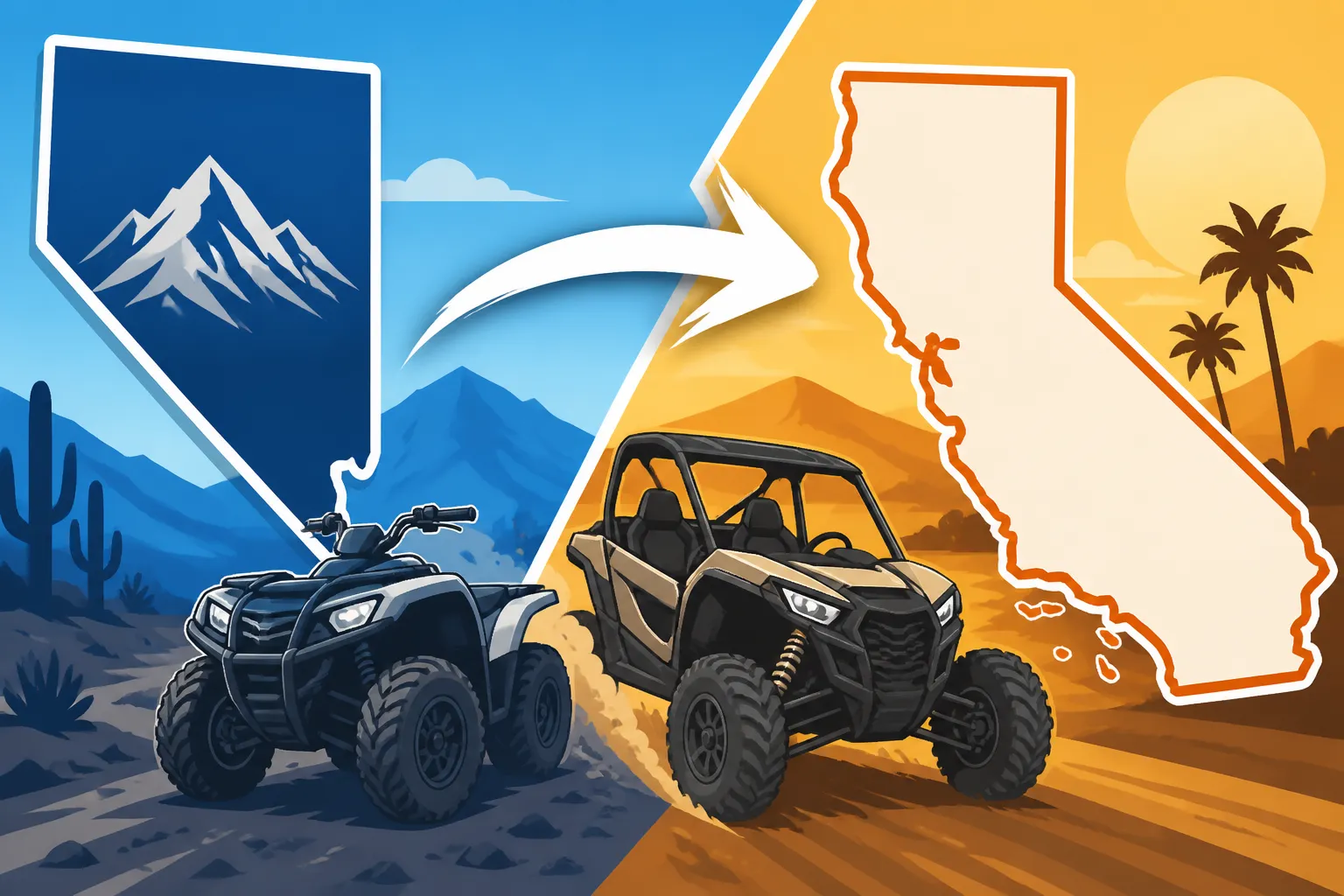
A Nevada OHV decal may let a Nevada-registered ATV or UTV ride in California as an out-of-state machine, but it is not a California Green or Red Sticker. The distinction matters: your home-state registration, residency, machine type and riding location can all affect what you need. Here’s how to prepare for a California trip and avoid assuming that one decal covers every rule.
What a Nevada decal does and does not cover in California
Nevada’s OHV decal is evidence that a machine is registered under Nevada’s off-highway vehicle system. Nevada uses a decal rather than a license plate for most OHVs, and the registration also serves as Nevada’s riding permit on applicable public lands. For more on that system, see Nevada’s Registration Decal as Your Permit.
California has its own OHV identification program, commonly associated with Green and Red Stickers. A Nevada decal does not turn into either California sticker, and it does not mean California has registered your machine. Instead, California’s rules for nonresident OHVs may allow a machine to ride on the strength of its valid home-state registration. Whether you can rely on that registration depends on your situation and the current rules.
The practical distinction is:
- A valid Nevada registration may establish that your machine is properly registered in its home state.
- It does not make the machine California-registered.
- It does not guarantee access to every California trail, park or riding area.
- It does not make an off-highway machine street legal.
California may also have separate requirements for a nonresident machine that is not registered in its home state. A California nonresident OHV permit can be relevant in that situation. Don’t assume it is required just because you have a Nevada decal, or assume it is unnecessary if your registration has expired, your machine is exempt in Nevada, or the decal does not apply to the vehicle you are bringing. Confirm the rule with California’s official OHV or DMV guidance before you travel.
A Nevada decal is not a California Green or Red Sticker
California’s Green and Red Sticker system is part of California’s own identification and emissions-related framework. The labels can affect where and when certain California-identified machines may be operated. A Nevada decal doesn’t change a machine’s California classification, and it does not override any applicable California riding restriction.
For an out-of-state visitor, the relevant question is usually not “Which California sticker does my Nevada decal equal?” It is “Does California recognize my current Nevada registration for this visit, and are there any other conditions that apply to my machine and destination?”
That’s also why comparing decals only by their appearance is unhelpful. Nevada’s decal is not a California sticker, even if both are displayed on the vehicle. Keep your Nevada registration card with the machine and be ready to show the registration is current and belongs to that vehicle. For context on the Nevada document itself, see What a Nevada OHV Decal Actually Proves.
Registration and trail access are separate questions
Even if your Nevada registration is accepted for a California visit, it does not grant access to every place where OHVs are allowed. The land manager may have its own operating rules, seasonal closures, route designations, safety requirements or local permit conditions. A trail open to some OHVs may not be open to your particular type of machine.
The same distinction applies if you plan to ride on roads. A Nevada OHV decal is not a road-use plate, and it does not make a quad or side-by-side legal for ordinary street travel in California. Road registration, equipment, insurance, licensing and route rules are separate matters. A machine that can ride off-highway under its Nevada registration may still be prohibited on a public road.
Who can usually rely on a Nevada registration
Your status as a nonresident is central. A visitor bringing a machine registered in Nevada is in a different position from someone who lives in California and keeps a machine there while relying on a Nevada decal. California’s treatment of nonresident vehicles should not be treated as a workaround for a resident’s own registration obligations.
If you live in Nevada and are taking your properly registered machine to California for a trip, check California’s current nonresident rules and carry proof of your Nevada registration. If you have moved to California, established residency there, or keep and regularly use the machine in California, contact California’s DMV or OHV program to find out what registration or identification is required. A decal from another state does not automatically settle the question of where the vehicle must be registered.
This is one reason to sort out the paperwork before loading the trailer. A move is not the same as a weekend visit, and an out-of-state registration that works for a visitor may not satisfy a resident’s obligations. If you are moving the machine to Nevada rather than taking it out of Nevada, Nevada Registration After You Move In covers the opposite direction.
Check that the decal and registration match the machine
Before leaving, compare the registration card with the vehicle. Make sure the identifying information is legible and matches the machine, especially the VIN. Check that the decal is still valid and displayed as required in Nevada. If you recently bought the ATV or UTV, don’t assume the seller’s paperwork or an old decal proves that registration has been transferred and remains current.
Take the registration card with you, not just a photograph of the decal. A clear photo of your paperwork can be a useful backup, but it may not replace the actual document if an officer or land manager asks to see it. Protect the card from dust, water and damage. A simple waterproof document pouch can help; if you order one through Amazon, choose a size that fits the card without folding it and keep the pouch secured rather than loose in a cargo area.
If the machine is exempt from Nevada registration, don’t presume that exemption will be treated as equivalent to a valid Nevada registration in California. Exemption rules can differ between states. Ask California’s OHV program whether your exact machine and circumstances require a nonresident permit or other proof. The details matter for small-displacement machines, older vehicles, government machines and vehicles used under a special exemption. Nevada’s own exemptions are discussed in Machines Nevada Exempts From Registration, but that does not decide how California will treat them.
Don’t confuse the operator’s home state with the machine’s paperwork
A rider’s driver’s license, the machine’s registration and the location where it is being ridden are separate parts of the situation. If a group includes riders from different states, the machine’s valid registration still matters, as do the rules for each person operating it. A friend’s California registration or permit does not cover your Nevada machine.
Likewise, borrowing a machine does not make its paperwork irrelevant. Confirm who owns it, that the registration is current and that the identifying details match. If you are travelling with a machine registered to someone else, carry any permission or ownership documents that help explain why you have it, especially if the registration card and rider’s name differ.
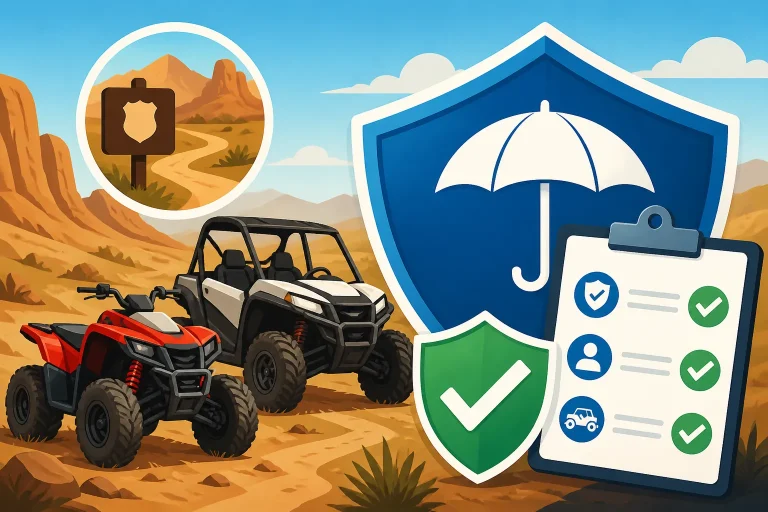
A checklist before riding in California
Rules can vary according to residency, vehicle status and destination, so use this checklist as a preparation tool rather than a substitute for confirming the current California requirements.
- Confirm your status. Are you a Nevada resident visiting temporarily, or do you live in California or keep the machine there? If your situation is more than a short visit, ask the California DMV or OHV program what applies.
- Confirm the machine is currently registered in Nevada. Check the expiration date and make sure the registration information matches the vehicle.
- Ask whether your exact machine qualifies for nonresident treatment. This is especially important if it is exempt from Nevada registration, has unusual paperwork or is not normally registered in its home state.
- Check whether California requires a nonresident OHV permit in your circumstances. Don’t infer the answer from the decal alone. Verify through California’s official guidance.
- Confirm the destination is open to your machine. Check the land manager’s current maps, closures and vehicle restrictions. A registration document does not substitute for that check.
- Pack the right documents. Bring the current registration card and any other paperwork relevant to ownership or an exemption. Keep a digital copy as backup, not as your only proof.
- Separate off-highway use from road use. If your route includes a public road, check the road-specific registration, equipment and operator requirements. An OHV decal alone does not authorize normal road travel.
For a visit in the other direction—bringing a California-identified machine into Nevada—the relevant rules are different. See Riding Nevada on a California Green Sticker and Nevada Reciprocity With California. Reciprocity is about how states treat qualifying out-of-state registration; it doesn’t mean the two systems are identical or that every machine qualifies automatically.
Keep paperwork easy to show
Put the registration card somewhere accessible and protected, not buried under tools or luggage. A sealed pouch in a secure compartment is often more practical than carrying a loose card in a pocket. If you use Amazon or another retailer to find a waterproof sleeve, prioritize a secure closure and a clear window over unnecessary extras.
A phone photo can make it easier to recover information if a document is misplaced, but don’t rely on a phone as your only record. Batteries fail, screens crack and service may be unavailable. A small power bank can help keep a phone usable for maps and emergency calls; if you buy one through Amazon, test it before the trip and pack the charging cable that fits your device. Keep digital navigation and registration images separate from your machine’s physical documents.
A paper map or printed route information is also useful if you’re travelling somewhere with unreliable cell coverage. A clear map sleeve—available from outdoor retailers and places such as Amazon—can protect a paper map from dust without making it difficult to read. None of these items changes the legal requirements, but keeping documents and route information in good condition can make a roadside or trailhead check less stressful.
How to confirm the rules for your trip
A quick check before departure is more dependable than relying on a friend’s experience from a previous ride. Rules can change, and a person’s circumstances may be different from yours. Confirm the status of your registration, any nonresident permit requirement and the conditions at the place you intend to ride.
Use California’s official DMV or OHV information for vehicle registration and nonresident requirements. Then check with the agency responsible for the specific trail, recreation area or public land. The DMV can help answer a registration question, but it may not know whether a particular trail is temporarily closed or restricted to certain vehicle types. Conversely, a trailhead sign or recreation-area page may describe access conditions but not fully resolve your registration status.
When you contact an agency, describe the details rather than asking only, “Can I ride with a Nevada sticker?” Explain that the machine is registered in Nevada, whether you are a Nevada resident, whether you are visiting temporarily, what kind of machine it is and where you intend to ride. If the vehicle is exempt from Nevada registration or has paperwork that differs from a standard registration card, mention that up front.
Keep a note of the guidance and where you confirmed it. If you receive an answer by phone, write down the office and date so you can follow up if needed. Don’t treat an informal answer from a social media group, dealer or riding partner as a substitute for the applicable state or land-manager requirements.
Check the destination, not just the state rule
California is large, and riding conditions are not uniform. A place may limit vehicle sizes, close routes seasonally or restrict access to protect land and wildlife. Some areas require a separate recreation pass or fee that has nothing to do with OHV registration. Others may not permit the kind of riding you have planned.
Before you leave, verify:
- Whether the route is open to your ATV or UTV.
- Whether there are seasonal or temporary closures.
- Whether the area has separate entrance, parking or recreation fees.
- Whether the route includes roads and, if so, whether your machine is authorized there.
- Whether the machine has any equipment required by the destination or route.
A Nevada decal does not cover those local checks. Think of it as one part of the paperwork—not a universal pass for California.
Common mistakes to avoid
The most common error is treating the Nevada decal as though it were a California Green Sticker. It isn’t. A valid Nevada registration may be relevant to a nonresident visitor, but it does not convert the vehicle into a California-registered machine or override local access restrictions.
Another mistake is assuming reciprocity means “no questions asked.” Reciprocity describes how one jurisdiction may recognize another jurisdiction’s registration. It does not erase differences between states, cover an expired decal or settle every question about residency and exemptions. If your registration is not current, the vehicle is exempt at home, or you have recently moved, get a direct answer before riding.
It is also easy to mix up off-highway access and road legality. A Nevada OHV decal is not a license plate and does not authorize riding an unplated machine along California streets or highways. If the plan involves riding between a trailer parking area and a trail on a public road, check whether that specific road is open to the vehicle and what legal equipment and documents are required. Don’t assume a short distance makes the trip lawful.
Finally, don’t leave the paperwork check until you arrive at the trailhead. A missing registration card, an expired decal or uncertainty about an exemption can turn a planned ride into a frustrating detour. Check the documents at home, confirm the destination’s rules and carry the information you need in a way that will stay readable.
Bottom line: A current Nevada OHV registration may be recognized for a Nevada visitor riding an OHV in California, but the decal is not a California Green or Red Sticker and does not grant unrestricted access. Confirm California’s current nonresident requirements for your circumstances, carry the Nevada registration card and check the rules for the specific place you plan to ride.
Disclaimer
This article is for general informational purposes only and does not constitute professional advice. Laws, prices and regulations vary by location and change over time. Consult a qualified professional for guidance on your specific situation.