Why Nevada Has No Separate Trail Permit
Nevada riders often expect to buy one sticker for state registration and another for trail access, then discover the paperwork does not work that way. Nevada uses its OHV registration decal as the state’s trail permit for many off-highway machines. This guide explains what that decal does, when separate fees or permissions still apply, and how visitors should think about reciprocity.
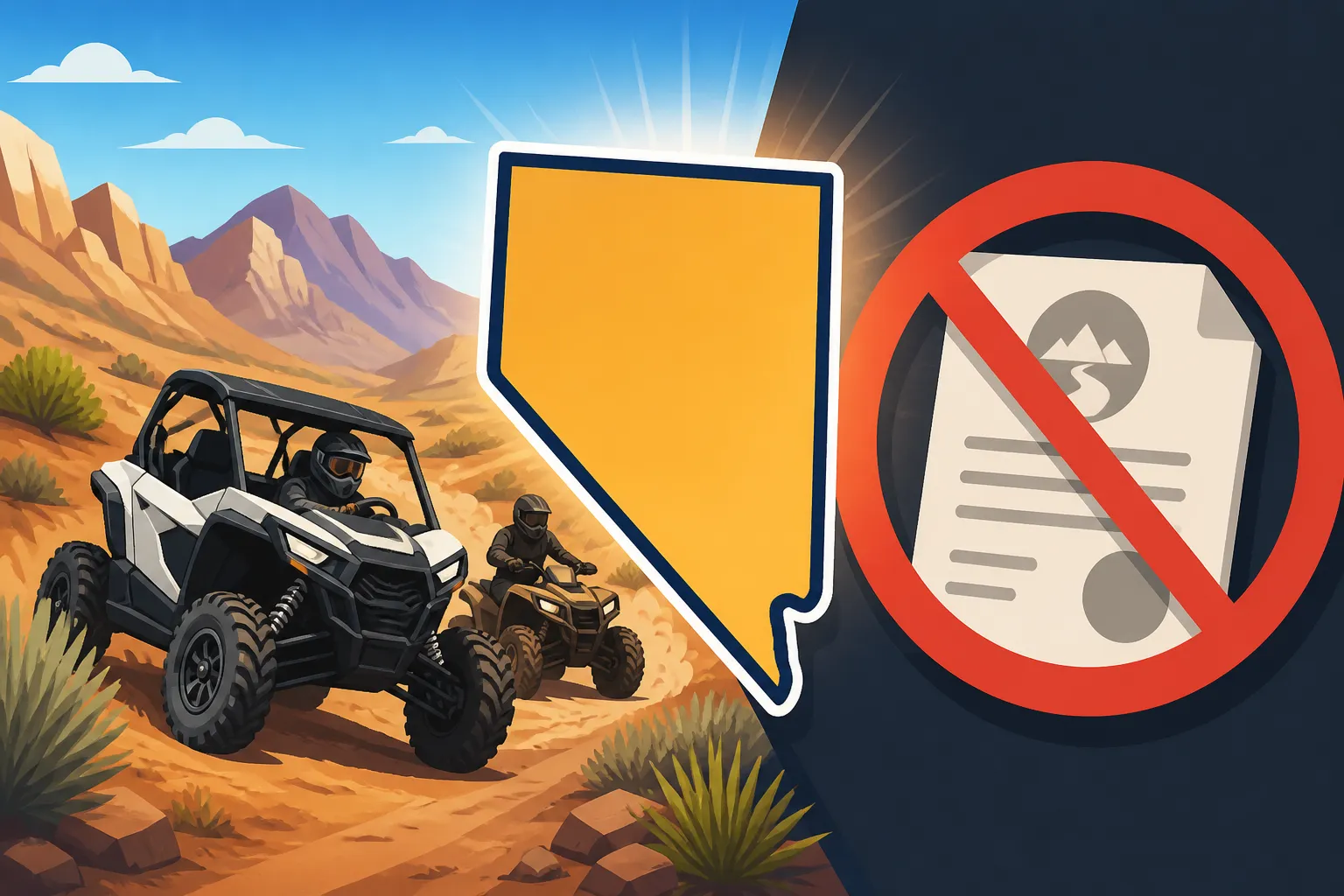
Why Nevada does not issue a separate trail permit
One decal serves two related purposes
Nevada combines off-highway vehicle registration and state trail-permit authority in one system. For an ATV, UTV, or other covered machine registered in Nevada, the OHV decal is the key visible proof that the machine has met the state’s registration requirement. It also serves as the state’s permit for riding on many public off-highway routes and areas where that requirement applies.
That arrangement avoids making an owner carry two separate state stickers for essentially the same machine and activity. A Nevada rider generally does not need to register the machine and then buy a second, statewide “trail permit” just to ride a trail. This is why the idea behind Nevada’s Registration Decal as Your Permit is central to understanding the system.
The decal is not a universal permission slip. It does not override a trail closure, authorize riding on private land, or replace a special permit required for a particular event or recreation area. Think of it as the state-level registration and permit credential, not as a guarantee that every road, trail, dune, or parcel is open to riding.
Why the sticker is displayed on the machine
A decal is easy to check at a trailhead or during a field contact. It lets an officer or ranger see that a machine carries the state credential without asking the rider to unfold paperwork in dust, wind, or traffic. The registration card and ownership records still matter, but the decal is the most visible part of the system.
The decal and the registration card do different practical jobs. The decal is attached to the machine and is meant to be seen. The card carries identifying details that help connect the machine to its registration. Riders should keep the card available, especially when the decal is dirty, damaged, hard to read, or questioned.
For example, a rider heading out from the Las Vegas area toward Nellis Dunes may pass through dusty conditions before reaching a riding area. A decal that is covered in mud or peeling at one edge can be harder to identify than one that is clean and secure. The underlying registration is still important, but making the decal legible can prevent an avoidable conversation at the trailhead.
What the Nevada OHV decal does and does not cover
State registration is not the same as open access
Nevada’s OHV decal addresses the state’s registration and permit framework. It does not decide whether a particular route is open. A route may be closed for habitat protection, maintenance, fire restrictions, private ownership, or another land-management reason, even when your machine has the right decal.
This difference matters in places where public-land routes cross different kinds of land or sit near sensitive areas. Near Logandale Trails, for instance, a rider needs to follow designated routes and posted restrictions rather than assume that a valid decal allows travel wherever the terrain looks rideable. Near Sand Mountain, protected dune habitat and seasonal restrictions can affect where machines may go.
A useful way to avoid confusion is to ask two separate questions before a ride: “Is my machine properly registered or covered by an applicable exemption?” and “Is this route open to my type of machine today?” The first question is about the state credential. The second depends on the land manager, route designation, and conditions. Nevada Rules for Riding Federal Land can help riders understand why a state decal does not replace land-use rules.
What a decal cannot replace
A Nevada decal does not substitute for permission to cross private property. It does not allow a rider to enter a closed area, ride through a wilderness boundary, or use a road that a local authority has closed to OHVs. Nor does the decal automatically meet the requirements for operating an OHV on a public road.
Road use is a separate legal question. A machine that is properly registered for off-highway use may still be prohibited from riding on a street or highway. Nevada has additional rules for certain large ATVs on qualifying roads, and those rules may involve a different decal and equipment requirements. A rider should not treat an ordinary OHV registration decal as a road-use authorization.
The same distinction applies to organized events. A normal riding decal does not automatically authorize a club poker run, competition, guided commercial tour, or other organized activity that may need separate approval from a land manager. The permit, if required, applies to that event or activity, not to every individual ride. For help separating these concepts, see Nevada OHV Permits Explained.
How Nevada registration and reciprocity work for visitors
Nevada residents and machines registered in Nevada
Nevada residents who own machines covered by the state’s OHV registration rules generally need to follow the Nevada registration process, unless the machine qualifies for an exemption. The route to the decal can depend on how the machine was acquired, whether it has a title, and whether its VIN needs inspection. A dealer purchase, private sale, move into Nevada, or homebuilt machine can each create different paperwork questions.
Owners should avoid assuming that a machine’s age, small engine, intended use, or location automatically makes it exempt. Nevada has specific exemptions, and the facts matter. A machine kept at a cabin or ridden only on a ranch can still raise registration questions if it is used in a way covered by state law. If you are sorting out a new purchase, Nevada OHV Registration Paperwork Checklist is a helpful companion topic.
Once the machine is registered, the decal is the state credential riders rely on for covered off-highway use. The owner should keep the registration card with the machine or readily accessible and make sure the decal remains attached and readable. This is especially useful when a machine is hauled between places such as Reno, Fallon, and a riding area farther away; the riding location does not change what the decal means, but the route and land rules may change.
Visitors riding machines registered elsewhere
Nevada generally recognizes certain out-of-state registrations under its reciprocity rules, but visitors should not assume every state’s sticker is accepted for every situation or for an unlimited stay. The rules can depend on the machine’s home-state registration and how long it is operated in Nevada. Nevada also has a limited visitor exemption described in Nevada’s Nonresident Exemption in NRS 490.082.
Before hauling a machine from California, Arizona, Utah, Idaho, or Oregon, check the specific reciprocity rule that applies to that state and the machine. A green sticker, registration card, or permit from another jurisdiction may be relevant, but the precise conditions matter. A visitor should carry the home-state paperwork and make sure the identifying information matches the machine.
If a visit is extended, or the owner moves to Nevada, the visitor’s situation can become different from a short recreational trip. Do not treat a temporary visitor allowance as a permanent substitute for Nevada registration. Riders bringing a machine from another state can review Riding Nevada With an Out-of-State Registration and What a Visitor Does After 15 Days in Nevada to understand the questions to resolve before a longer stay.
| Rider situation | State credential to check | Separate access questions |
|---|---|---|
| Nevada resident with a covered machine | Nevada OHV registration decal and card, unless an exemption applies | Is the route open, and does the land manager require anything else? |
| Visitor with an out-of-state registration | Home-state registration and Nevada reciprocity or visitor rules | Does the visitor’s status meet Nevada’s conditions for this trip? |
| Rider attending an organized event | Machine registration plus any event-specific approval | Has the organizer secured required land-manager permits? |
| Rider visiting a fee-area or managed recreation site | Required state credential or valid reciprocity | Does the site charge a separate use fee or require a pass? |
| Rider considering a public road | OHV registration alone may not be enough | Does the machine and route qualify under road-use rules? |
When a separate fee or permit may still apply
Recreation-area charges are not a second statewide permit
Some places may charge for access, camping, or day use even when the rider already has the required state credential. Those charges serve a different purpose from Nevada OHV registration. They can support the management of a particular recreation area, provide access to a site, or apply to an activity such as camping.
Sand Mountain near Fallon is a useful example of why riders sometimes think Nevada has a separate trail permit. The area may have its own recreation-fee structure, while the Nevada OHV decal remains the statewide credential. Paying a site fee does not replace registration, and having a decal does not necessarily waive the site fee.
The same principle applies when riders camp, use facilities, or access a managed location with its own rules. Read the site’s fee and access information before leaving home, because the details can differ from one area to another. If you are preparing for a Sand Mountain trip, Nevada’s Only Pay-to-Ride Dune explains why site-specific charges should not be confused with a statewide trail permit.
Events and commercial activities can have their own requirements
A casual ride with family or friends is not the same as organizing a large group event. A club ride, race, fundraiser, commercial tour, or film shoot may require approval from the land manager, depending on the activity and location. The permit is connected to the organized use of the land, not to the ordinary state registration of every participant’s machine.
That distinction can catch organizers by surprise. A group may have registered machines and still need to deal with event logistics, insurance requirements, route limits, participant numbers, or timing. It is best to contact the relevant land-management office early rather than assume that the group can ride simply because each machine displays a decal.
For an individual rider, the practical takeaway is straightforward: do not buy or apply for a vague “Nevada trail permit” when what you really need is to confirm your machine’s registration, the destination’s access rules, and whether your activity is organized or commercial. Permits for an Organized Nevada Group Ride is relevant when a normal weekend ride grows into a planned event.
How to prepare before riding in Nevada
Check the machine’s paperwork before loading it
A little paperwork checking at home is much easier than trying to resolve a mismatch at a dusty trailhead. Compare the VIN on the machine with the VIN on the registration card and title or ownership documents. Confirm that the decal belongs to that machine, is current where applicable, and is displayed where Nevada requires it to be.
If you bought the machine recently, make sure you know whether the seller provided the documents needed to complete a transfer or registration. A private sale with missing paperwork can take more effort than a dealer purchase. If the VIN is obscured, altered, or difficult to locate, do not wait until the morning of a ride to investigate. Nevada’s inspection process has specific limits on who can verify a VIN, so consult Who Can Do a VIN Inspection in Nevada when that issue comes up.
Keep the registration card protected from water, dust, and loss. A small document pouch or dry bag can keep paperwork from becoming unreadable after a day in the desert. Some riders look for this kind of basic gear through Amazon, but whichever source you choose, use a pouch that closes securely and can be reached without unpacking the whole machine.
Confirm the route and site rules close to your trip
Choose a destination, then check the land manager’s route information and any local restrictions. A decal does not tell you whether a trail is temporarily closed, whether a boundary has changed, or whether a road is open to the machine you plan to bring. Confirm that the route suits your vehicle and your experience, not just that it appears on a map.
This is particularly important in Nevada’s desert. A route that looks like an easy shortcut on a screen may cross a wash, a closed area, or terrain where the surface changes quickly. Around Sand Mountain, sensitive habitat protections affect where riders may travel. Near Logandale, designated routes and nearby land boundaries matter. Near Nellis Dunes, parking and riding-area arrangements are separate from the state registration question.
Save or print useful information before leaving cell coverage. A phone photo of the registration card can be a backup reference, but it should not be treated as a guaranteed substitute for the original document if an officer or ranger asks for proof. A waterproof pouch for the paper card can be useful on a long ride; riders who use Amazon to find one should still check that it is durable, sealable, and sized for the documents they carry.
Common misunderstandings about Nevada’s trail permit system
“My decal lets me ride anywhere”
This is the most consequential misunderstanding. The decal shows that the machine has a state registration credential, but it does not open every piece of land to OHV use. Federal, state, county, and private land can each have different access rules. Even public land can contain closed routes, restricted habitat, or boundaries where cross-country travel is not allowed.
A rider heading toward a familiar area can still encounter a change in conditions. Fire restrictions, storm damage, maintenance, or habitat protections may affect access. When a route is closed, a valid decal does not make it legal to ride around the barrier or cut across open-looking terrain.
Plan to follow the route, not merely the destination. Read signs, stay on routes designated for motorized travel, and turn around when a closure or boundary makes the route unclear. [Nevada Rules for Riding a Closed Route] is a useful reminder that registration and access are separate questions.
“A site fee is the same as the state permit”
A fee collected at a recreation area is not automatically the same thing as an OHV registration permit. One may apply to a specific location or facility; the other is part of the state’s registration framework. A rider may need one, the other, or both depending on the machine, the destination, and the activity.
For instance, paying for camping or day use at a recreation area does not necessarily register a machine. In the opposite direction, displaying the Nevada decal does not necessarily cover camping or a site’s own access fee. Keep the receipts and permits relevant to your trip, but do not confuse them with the machine’s state registration card.
The same clarity helps when comparing Nevada with other states. A neighbor may call its credential a permit, sticker, tag, or registration. The label alone does not show whether it covers registration, trail access, a fee area, or a limited visitor exemption. Check what the credential actually authorizes rather than relying on familiar terminology.
“An out-of-state sticker always works the same way”
Reciprocity is useful, but it is not a blanket promise that every out-of-state credential works in every circumstance. The machine’s home registration, the rider’s residency, and the duration and purpose of the Nevada visit can all matter. A visitor who regularly rides in Nevada should know the rule that applies rather than rely on what worked during a previous trip.
If you are uncertain, carry current home-state documentation and check Nevada’s visitor rules before departure. This is especially sensible for riders crossing from nearby states for a weekend at Sand Mountain, Logandale, or a route near Mesquite. A quick check can prevent the frustration of discovering at the trailhead that the credential does not fit the trip as assumed.
Moving to Nevada changes the question again. A machine that was properly registered in another state may need Nevada paperwork after the move. Review Nevada OHV Registration After Moving to the State rather than assuming visitor reciprocity will cover a permanent Nevada residence.
A practical decision process for riders
Start with the machine and the rider
First identify the machine: ATV, UTV, youth machine, electric vehicle, or another off-highway vehicle. Then establish who owns it and where that person lives. Those details help determine whether Nevada registration, an exemption, or an out-of-state reciprocity rule is the starting point.
Next, gather the paperwork. Look for the title or other ownership evidence, bill of sale if applicable, registration card, and VIN. If the machine was purchased privately or inherited, the paperwork path may be different from a new dealer sale. Resolve title or VIN questions before planning around a particular ride date.
Finally, verify the decal itself. Check that it is for the correct machine, visible, and in usable condition. If it is damaged or missing, deal with replacement procedures before the trip rather than hoping that an old photograph or verbal explanation will settle the issue. Keep documents protected from the weather, and consider a secure pouch from a retailer such as Amazon if your current storage method leaves papers exposed to dust or moisture.
Then check the destination and the activity
Once the machine’s status is clear, check where you intend to ride. Identify the managing agency or landowner and confirm the route is open to your class of machine. Check whether the destination has a site-use or camping fee, and whether there are fire, seasonal, habitat, or vehicle restrictions.
Then ask whether the ride is ordinary recreation or an organized activity. A family day ride may raise fewer permit questions than a commercial tour, race, or large club event. If you are organizing something beyond a casual ride, contact the land manager before advertising the event or inviting participants.
Before departing, carry your registration information, follow the posted route, and make sure each rider understands the rules for the area. If you are traveling with visitors, explain that the Nevada decal is a state credential, not a guarantee of access and not necessarily a replacement for their home-state paperwork. This short conversation can prevent different assumptions among riders from becoming a problem on the trail.
Disclaimer
This article is for general informational purposes only and does not constitute professional advice. Laws, prices and regulations vary by location and change over time. Consult a qualified professional for guidance on your specific situation.