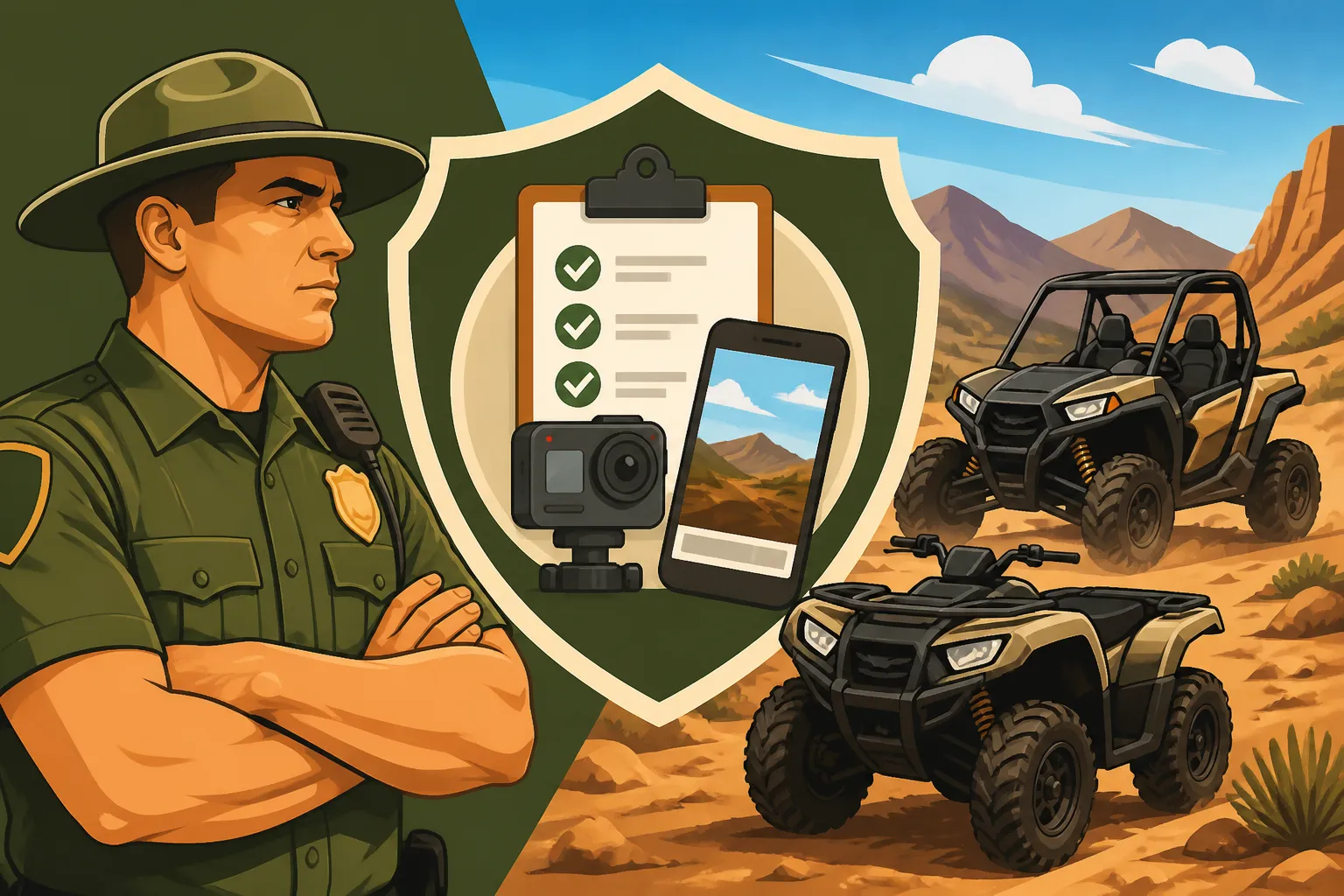
What Rangers Accept as Proof
A ranger asks for paperwork, dust is blowing, and the registration card is buried somewhere in your gear. For Nevada ATV and UTV riders, the safest answer is to carry both the machine’s visible decal and its registration documents. Here’s what to have ready, what a phone photo can and cannot do, and how the answer changes for visitors and rentals.
The proof to keep with your machine
For a Nevada-registered off-highway vehicle, the clearest proof is a valid OHV decal displayed on the machine, together with the registration card issued for it. The decal is the visible sign that the vehicle is registered; the card connects that decal and machine to the registration record. Carrying both makes it easier to answer questions if a ranger or other officer wants to verify the paperwork.
Nevada’s OHV decal also serves as the state’s permit for riding where that registration is required. It is not the same thing as a road-use plate, and it does not make every road or trail open to your machine. For the distinction between the decal and other permits, see Nevada’s Registration Decal as Your Permit and What a Nevada OHV Decal Actually Proves.
A practical proof packet looks like this:
| What to carry | What it helps show | What it does not prove by itself |
|---|---|---|
| Current Nevada OHV decal attached to the machine | The vehicle displays its registration decal | That the route is open or that the rider has permission to cross private land |
| Registration card for that machine | Registration details associated with the vehicle | Ownership in every situation, or authorization to ride a closed route |
| Valid out-of-state registration, where applicable | The machine’s current registration in another jurisdiction | That every out-of-state vehicle is exempt from Nevada requirements |
| Rental agreement or documents supplied by the rental company | That the machine is rented and what paperwork the operator provided | That the rider may leave the permitted area or ignore contract limits |
| Identification and any road-use documents needed for the trip | Information relevant to the rider and, on some roads, legal operation | A substitute for the machine’s registration or route access |
Keep the card accessible, not just somewhere in a trailer at the staging area. A ranger may ask about the machine while you are riding, away from your vehicle or camp. A compact document pouch or dry bag helps keep paperwork readable in dust, water, and rough travel. If you need one, a basic waterproof pouch from a retailer such as Amazon is one option; the important part is keeping the documents protected and easy to reach.
The visible decal matters, too. A registration card does not make up for a missing or unreadable decal when the decal is required to be displayed. Check that it is attached where Nevada requires and that the number is legible. If it has peeled, faded, or become damaged, review Nevada OHV Decal Placement Rules and the process for getting a replacement before you ride.
What a ranger may ask to see
A roadside or trailhead check is usually easier when you can show the decal and matching registration card without searching through a vehicle full of gear. Be ready to identify which machine the paperwork belongs to, especially if your group has several similar ATVs or UTVs.
The card and decal should make sense together. If you recently bought the machine, changed ownership, or replaced a decal, make sure you understand which documents are current and what remains to be completed. A bill of sale, title, or purchase receipt can help explain an unusual situation, but those papers are not automatically a replacement for current registration. Registration and ownership are related but separate issues; Nevada OHV Registration and Proof of Ownership explains why.
A useful pre-ride check is to compare the machine’s identifying details with the registration documents. If you are not sure what paperwork belongs in the packet, use Nevada OHV Registration Paperwork Checklist as a prompt. Keep the original card clean and legible, and avoid writing on it or laminating it unless the issuing authority says that is acceptable.
Phone photos are backup, not the whole plan
A clear photo of the registration card can be valuable if the paper copy is lost, damaged, or difficult to reach. Save images of both sides if the card has information on both sides, and make sure the text is readable. Keep the file available offline; a remote riding area may have little or no cell service.
But do not assume that a photo will always be accepted in place of the original card. Acceptance can depend on the document, the circumstances, and the officer checking it. A screenshot may help confirm details or speed up a conversation, but carrying the actual card is the safer choice when one has been issued.
If your registration card goes missing, arrange a replacement rather than treating the phone image as a permanent fix. See What Happens If You Lose the Registration Card for the next steps. Until you resolve the problem, carry whatever official records or duplicate documentation you can obtain, and do not rely on an informal note from a seller or a screenshot of an old registration.
It also helps to keep a photo of the decal number and the machine’s identifying information separately from the registration card. That can make it easier to explain a mismatch or start a replacement request. These images are useful records, not a replacement for the decal or any required official paperwork.
Visitors, rentals, and unusual paperwork
The right proof depends on how the vehicle is registered. A Nevada resident’s machine, a visitor’s machine registered in another state, and a rented UTV may not have the same documents. Before riding, identify which situation applies and confirm the current rule for that machine.
Out-of-state vehicles
Visitors should carry the machine’s valid home-state registration or other official registration evidence, along with any Nevada decal or permit required for their circumstances. Nevada has rules addressing out-of-state machines and reciprocity, but an out-of-state sticker does not automatically answer every question. Residency, the machine’s registration status, and how long it has been in Nevada can matter.
The short-term exemption for some nonresident machines has conditions. Do not assume that a home-state decal alone settles the issue, especially on a longer stay. Review Nevada Reciprocity With California if your vehicle is registered there, and Riding Nevada With an Out-of-State Registration for the broader issue. Check official Nevada information before a trip if your situation is close to an exemption limit or involves a machine that is not currently registered at home.
Carry the registration document itself where possible, not just a photo of the state decal. If a ranger asks how the machine qualifies to ride, you will be better prepared to show the actual registration and explain the vehicle’s status.
Rental machines
When you rent, ask the rental company what paperwork the machine carries and what you should keep with you. The company may handle registration, but that does not necessarily mean the renter should leave every document behind. Confirm whether the machine has its required decal and whether the company provides a registration card, rental paperwork, or other proof for the ride.
Keep the rental agreement accessible, especially if it identifies the machine or sets boundaries on where it may be operated. It can help establish that you are the renter and clarify the company’s instructions. It does not grant access to restricted land, override a closure, or replace any registration proof required for the vehicle. See Paperwork a Nevada Rental Machine Carries and What a Rental Agreement Covers before heading out.
If a guide or rental company tells you that the paperwork is stored with a support vehicle, ask what you should do if you are separated from the group. Knowing where the documents are and who can retrieve them is better than discovering the gap during a check.
Recently purchased or inherited machines
A sales receipt or bill of sale can explain why the name on a document differs from the person riding, but it may not complete a transfer or establish current registration. Keep purchase and transfer documents with the registration card while you work through any remaining steps. If there is no title or the seller cannot find one, do not assume that a bill of sale alone is enough; review When a Seller Cannot Find the Title and confirm what applies to the machine.
For a recently purchased Nevada machine, check that the registration and decal requirements have been handled within the applicable deadline. Keep copies of your application or transaction records, but distinguish them from final proof of registration. An application receipt can show that you started the process; it may not establish that registration is complete.
Proof of registration is not permission to ride anywhere
Even complete paperwork does not prove that a particular route is open. Nevada riders may travel on public land, but access depends on land manager rules, designated routes, closures, private property, and other local restrictions. A valid decal is not a general pass to cross a closed route, enter a wilderness boundary, or ride on private land without permission.
Before a trip, check the route and riding-area rules as well as the machine’s registration. A ranger may be checking more than one issue: whether the vehicle is registered, whether the decal is displayed, whether the route is open, and whether the rider is following applicable operating rules. Having documents ready helps with the registration question, but it cannot resolve a route-access problem.
Use this simple routine before leaving the staging area:
- Confirm that the decal is current, attached, and readable.
- Put the registration card in a secure, accessible place on the machine or with the rider.
- Save clear photos of the paperwork for backup, but do not rely on them instead of required originals.
- For an out-of-state or rented machine, carry the relevant home-state documents or rental paperwork and check any special conditions.
- Check current land and route restrictions separately from registration.
That routine covers the most common paperwork gap: a rider has a decal, but cannot produce the document that explains it, or has documents but assumes they authorize access everywhere. Keep both sides of the question in view. Carry the evidence tied to the machine, then verify that your planned route is open to it.
Disclaimer
This article is for general informational purposes only and does not constitute professional advice. Laws, prices and regulations vary by location and change over time. Consult a qualified professional for guidance on your specific situation.