Nevada Rules for Riding Near Livestock
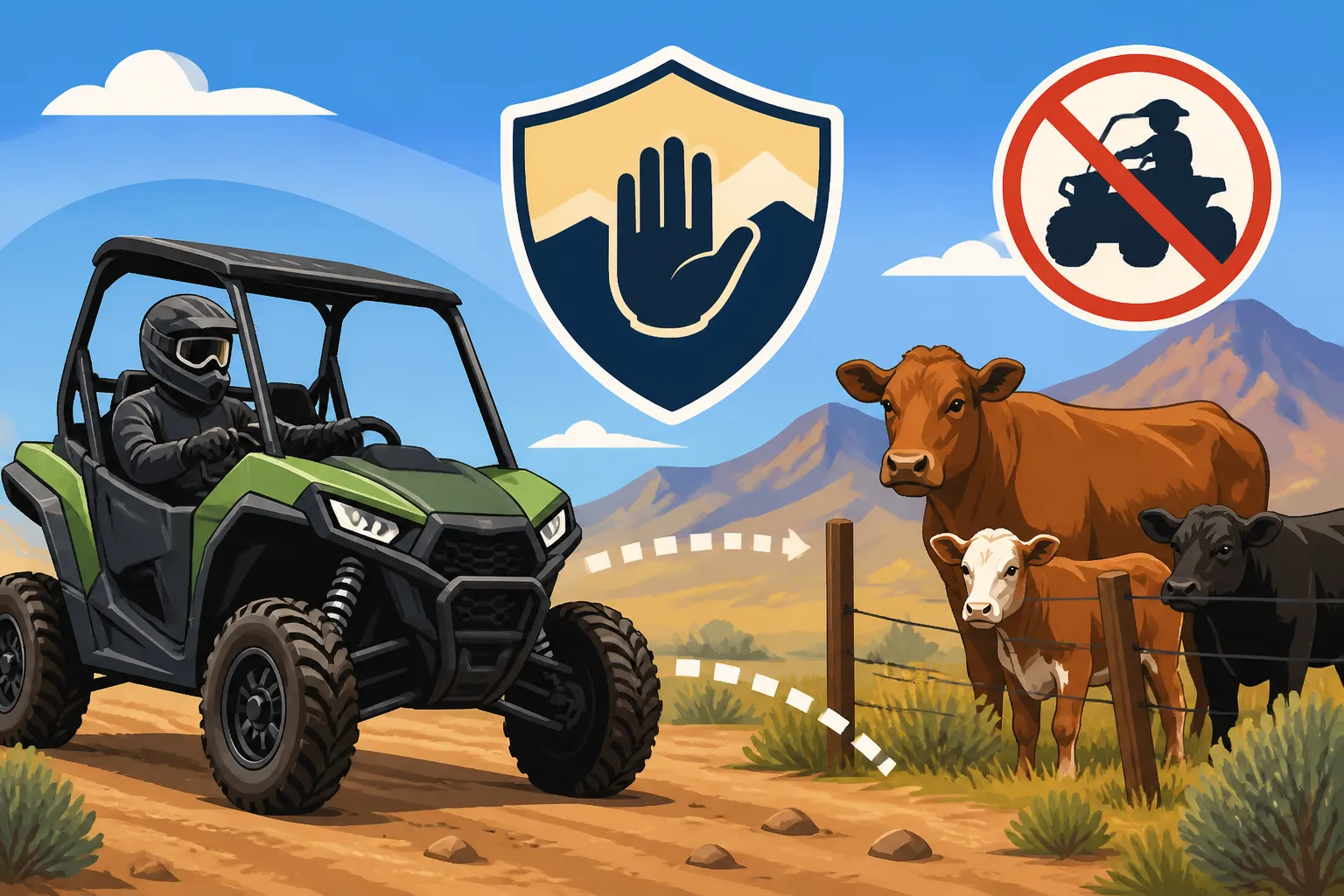
Cattle, horses, sheep, and other livestock may be grazing near Nevada trails, ranch roads, or public-land routes. A close encounter can frighten an animal, injure a rider, or create trouble with a landowner. The safest approach is to slow down, give animals plenty of room, stay on authorized routes, and avoid pushing a herd toward fences or traffic.
Why livestock encounters need extra care
Livestock are not trail obstacles that will reliably move out of your way. A startled cow or horse may bolt, bunch together, turn toward a machine, or break through a fence. A rider who accelerates, revs the engine, or tries to squeeze past can make an unpredictable situation worse. Even animals that appear calm can react suddenly to noise, movement, or a dog.
Nevada riders may encounter livestock on private ranch land, along roads, or on public land where grazing is allowed. Seeing animals beside a route does not automatically mean the route is closed, but it also does not give you permission to leave the route, cross a fence, or enter private property. Land-management rules and access rights still apply. For public-land riding basics, see Nevada Rules for Riding Federal Land and Nevada Rules for Riding State Trust Land.
A useful rule is to treat a herd as a moving hazard and a ranch operation as someone else’s workplace. The animals may be moving between pastures, watering areas, or handling facilities. A gate may be part of that operation, and a ranch road may not be open for public riding simply because it is visible on a map.
There is no sensible one-size-fits-all distance to promise for every encounter. The space a herd needs depends on terrain, animal behavior, visibility, and whether calves or young animals are present. Give the group as much room as the route allows, and do not force a close pass just to keep your planned pace.
| Situation | Safer response | Avoid |
|---|---|---|
| Animals are ahead on the route | Slow early and stop at a distance where you can wait calmly | Accelerating toward them or sounding the horn |
| A herd is crossing | Stop and let the animals finish moving | Driving through a gap or splitting the group |
| Animals are beside the trail | Pass slowly only if there is ample room and no need to leave the route | Cutting close to the herd or riding between animals and their young |
| An animal blocks a narrow route | Wait for a clear path or turn back if safe | Pressuring it forward, circling it, or entering a fenced area |
| You see a gate | Follow posted directions and leave it as you found it | Assuming it should be open or closed without checking |
| An animal appears injured or trapped | Keep your distance and contact the land manager or responsible authority | Trying to handle, move, or feed it |
Livestock may be marked with ear tags, brands, or other identification, but those marks do not tell a rider who to contact or whether an animal is in distress. Do not approach to inspect them. If a situation appears urgent, note the location and contact the appropriate land manager or local authorities rather than attempting a rescue yourself.
What to do when livestock are on or near your route
The safest encounter is usually a quiet one. Reduce speed before reaching the animals, keep your machine pointed in a safe direction, and avoid sudden movements. If you are riding in a group, signal the riders behind you to slow or stop before they come up close. A line of machines arriving at once can be more alarming than one rider waiting patiently.
Use this sequence when you meet livestock:
- Slow down early. Ease off the throttle before you reach the herd. Avoid sharp acceleration, revving, or unnecessary engine noise.
- Stop where you have room. Leave enough space for the animals to move without feeling crowded. Do not stop so close that they have to push past your machine.
- Wait quietly. Give the animals time to move on their own. Keep people and pets with the group, and do not walk toward the herd to encourage it to move.
- Watch the whole group. If some animals have crossed but others are still moving, wait until the route is clear. Avoid driving through the middle or separating young animals from adults.
- Pass only when there is a clear, safe opening. Keep to the authorized route and proceed slowly. If the available space is too tight, wait longer or turn around where it is safe to do so.
- Leave if the situation is not settling. If the animals are agitated, the route is blocked, or passing would require riding off-route, retreat rather than forcing a way through.
Do not chase, herd, feed, touch, or throw objects at livestock. Do not use a machine to push animals away from the trail. Even a rider who means to help can accidentally drive the herd toward a road, fence, wash, or other hazard. Keep dogs under control; a dog running toward cattle or horses can trigger a fast reaction.
Be especially patient around calves, foals, lambs, and other young animals. Adults may turn back or move defensively if they perceive a threat. A small opening between animals is not an invitation to pass. Wait until the group has moved far enough that no animal is likely to turn into your path.
A narrow trail creates a judgment call. If there is room to wait, waiting is generally the better choice. If the animals are moving toward you, do not try to race past them. Back away slowly if you can do so without putting yourself or others at risk. If backing up is unsafe, stop and allow the animals to choose their direction.
Avoid using a horn, loud exhaust, or shouting to make livestock move. Noise may startle rather than guide them. If another rider is already attempting to pass, do not crowd the scene by joining in. Wait until the herd and the first rider are well clear.
If you are riding with children or inexperienced riders, explain the plan before the trip: stop when the lead rider stops, do not ride up alongside the animals, and do not leave the group. A passenger should also stay seated and avoid sudden movement. For broader group-safety considerations, see Nevada Rules for Riding With a Passenger Off-Road.
Routes, fences, gates, and private property
A route can pass through grazing country without granting permission to roam across the surrounding land. Stay on roads and trails open to your vehicle, and do not leave the route to go around a herd unless the detour is clearly authorized. Riding around animals may take you across private property, damage vegetation, or put you on a closed route.
Before heading out, check the route’s access status and any seasonal or temporary closures. A line on a map does not always show whether a road is open to public OHV use, and a track made by another rider is not proof of legal access. These checks matter especially where public routes cross or border ranch property. See Nevada Rules for Crossing Private Land and Nevada Rules for Riding a Ranch Road You Do Not Own when access is uncertain.
Gates deserve particular attention. Some mark a boundary; others control livestock movement between pastures. Follow posted instructions and any guidance from the land manager or property owner. If you are authorized to pass through a gate, leave it in the condition you found it unless you have clear instructions to do otherwise. Do not guess based on what seems convenient for the ride. A gate left open can let livestock wander; a gate closed when it was meant to remain open can interfere with access or operations. For more on this issue, see Nevada Rules for Opening and Closing Gates.
Never climb a fence or drive through a gap to get around animals. Do not cut or move fencing, and do not open a gate to make a shortcut. If the herd is blocking your route and there is no safe, authorized way through, turn back or contact the responsible land manager for direction.
Ranch roads can look like public roads, particularly in remote areas. A road’s appearance, condition, or connection to a trail does not establish that the public may use it. When you cannot confirm access, choose a route you know is open rather than relying on a guess. The same caution applies to roads that cross public and private parcels: permission to ride one section may not mean permission to continue across the next.
Plan your route with room for a change of direction. In remote terrain, a narrow canyon, steep bank, or fence line can make it difficult to turn around after a herd appears. If the route is unfamiliar, identify alternatives before setting out and keep enough fuel and daylight to retreat. Guidance on route status and map use is available in Reading a BLM Travel Management Map and Nevada Trail Closures to Check Before You Go.
Do not leave trash, food, or other items where animals can reach them. Feeding livestock can change their behavior and may create health or management problems. Keep food and waste secured, and pack out anything you bring.
Special situations and practical trip planning
Some encounters call for more caution than others. A single animal standing well off the route is different from a large herd moving across a narrow trail. Visibility, noise, terrain, and the presence of young animals all affect what a safe pass looks like. If you cannot see where the herd is moving, do not ride into the blind area hoping it will clear.
Dust can also hide animals. Reduce speed in dusty conditions and leave enough room to stop within the distance you can see. At night, livestock may be harder to detect and more difficult to judge. A route that seems manageable in daylight can become unsafe after dark, so avoid riding into a livestock area when visibility is poor. See [Nevada Rules for Riding After Dark] for other night-riding considerations.
After rain or during seasonal changes, livestock may use different routes or gather near water. Do not assume that a familiar trail will be empty because it was clear on a previous visit. Check local access information before leaving, and adjust your plan if conditions have changed. If a route is closed or posted against entry, do not ride it simply because the animals are not visible.
If livestock are loose near a public road or appear injured, trapped, or in immediate danger, do not try to catch or move them. Record your location as accurately as you can, including a nearby road, trail junction, or landmark, and contact the relevant land manager or local authority. Keep your group out of the animals’ path while you make the call. Do not post private contact information or identifying details about a ranch operation online.
A quick pre-ride check can reduce the chance of being surprised:
- Confirm that your planned roads and trails are open to your type of machine.
- Look for posted closures, gate instructions, and temporary notices.
- Carry a map or offline route information in case the planned route is blocked.
- Tell riders in your group to stop when the lead rider stops.
- Keep pets controlled and food secured.
- Allow enough time and fuel to turn back rather than forcing a pass.
- Carry a charged phone or another way to contact help where service is available.
The main practical test is straightforward: can you pass without crowding the animals, leaving an authorized route, or disrupting a gate or ranch operation? If not, wait, retreat, or choose another route. A delayed ride is a small cost compared with a collision, damaged fence, injured animal, or conflict with a landowner.
Disclaimer
This article is for general informational purposes only and does not constitute professional advice. Laws, prices and regulations vary by location and change over time. Consult a qualified professional for guidance on your specific situation.