Machines Nevada Exempts From Registration
Navigating the world of off-highway vehicle (OHV) registration in Nevada can feel like trying to find your way through a dust storm without a map. Many riders, especially those new to the Silver State or buying a machine for a specific purpose, get genuinely confused by all the rules and requirements. You might be wondering if that old quad sitting in the barn needs paperwork, or if your kid's mini-ATV requires a trip to the DMV. This comprehensive guide is here to clear up that confusion, explaining exactly which machines Nevada exempts from registration, so you can ride with peace of mind and avoid any unexpected fines.
Understanding Nevada's OHV Registration Basics
Before we dive into what doesn't need to be registered, it's really helpful to understand the general lay of the land for what does. Nevada, like many states, wants to know about the off-road vehicles tearing up its amazing public lands. This isn't just about collecting fees; it's about funding trails, managing resources, and ensuring accountability on our shared landscapes. If you've ever had to deal with the regular process, you know it can feel a bit like a maze, but there's a good reason for it.
Why Nevada Requires Registration in the First Place
Imagine hundreds of thousands of ATVs, UTVs, dirt bikes, and sand rails all hitting the desert trails and dunes without any form of tracking or regulation. It would be chaos, right? Nevada's registration system, while sometimes a bit of a headache for the individual, serves several crucial purposes for the larger OHV community and the environment. First off, the money collected from registration fees is earmarked for the very trails and facilities we all enjoy. This includes things like maintaining existing routes, building new trailheads, and installing vault toilets at popular spots like Logandale Trails or Sand Mountain. Without these funds, our riding areas would quickly degrade, becoming less enjoyable and potentially unsafe.
Beyond funding, registration also helps with identification and accountability. If a machine is involved in an accident or is ridden in an unauthorized area, the decal links it back to an owner. This is important for promoting responsible riding and ensuring that everyone follows the rules designed to protect both riders and the delicate desert ecosystems. Plus, it aids law enforcement and land management agencies in monitoring OHV use and addressing issues like illegal dumping or habitat damage. It's really about ensuring the longevity and quality of our riding experiences for everyone who loves hitting the dirt.
The Standard OHV Decal: What It Signifies
When you successfully register an OHV in Nevada, you don't get a traditional license plate like you would for a car or truck. Instead, you receive a colorful, sticky decal – typically orange, yellow, or green, depending on the year – that you affix to the left side or rear of your machine. This decal, along with your registration card, is your official proof that your OHV is good to go for riding on public lands in Nevada. It's what rangers and deputies look for when you're out exploring. [What a Nevada OHV Decal Actually Proves] is that you've paid your dues and your machine is accounted for.
The decal itself is surprisingly informative, containing a unique registration number, the expiration date, and the year it was issued. This quick visual check helps enforcement officers determine at a glance if your machine is legally registered. Without it, you could face a citation or even have your riding day cut short. So, when you see those vibrant stickers on other riders' machines, know that they represent a commitment to responsible riding and support for our incredible trail systems. It's not just a sticker; it's your passport to Nevada's vast off-road playground.
The Core Exemptions: Machines That Don't Need a Decal
Alright, let's get to the good stuff – the machines that actually get a pass on the registration requirement. Nevada recognizes that not every off-road vehicle fits the mold of a typical trail machine or is used in a way that necessitates full registration. These exemptions are in place for logical reasons, often related to the size, age, or specific use of the machine. Understanding these can save you a trip to the DMV and a few dollars.
Small Engines Under 70cc: The Youth Machine Exemption
This is probably one of the most common exemptions, and it makes a lot of sense, especially for families with young riders. Nevada law specifically states that off-highway vehicles with an engine displacement of 70 cubic centimeters (cc) or less are exempt from registration. This primarily covers many youth-model ATVs and dirt bikes, often designed for beginners and smaller children. The idea here is that these machines are typically ridden in more controlled environments, like private property or designated youth riding areas, and pose less of a general impact on public lands compared to larger, more powerful machines.
Think about that tiny Suzuki QuadSport 50 your five-year-old might be learning on, or a pint-sized Yamaha PW50 dirt bike. These are exactly the types of machines that fall under this 70cc rule. It's a huge relief for parents, as it removes one hurdle from introducing their kids to the joys of off-road riding. However, it's crucial to remember that while the machine itself might be exempt, all other safety rules still apply, such as helmet requirements and supervision for young riders. Just because it doesn't need a decal doesn't mean you can throw caution to the wind! For more detail, check out [Machines Under 70cc and Why They Skip Registration].
Pre-1976 Machines: A Nod to History
Nevada also offers an exemption for vintage machines, specifically those manufactured before January 1, 1976. This is a really cool exemption that acknowledges the historical aspect of our sport and the fact that many of these older machines are often collector's items, project bikes, or simply used less frequently than modern OHVs. Back in the day, the regulations surrounding off-road vehicles were quite different, and the state wisely decided not to retroactively apply registration requirements to these historical pieces of equipment.
So, if you've got a classic Honda ATC 90, an early Polaris Sno-Traveler, or a rugged old Toyota Land Cruiser that you've converted into a trail rig (and it still qualifies as an OHV), as long as its original manufacture date predates 1976, you're likely in the clear for registration. Proving this exemption often involves having a clear title or other documentation that shows the year of manufacture. You might need to carry a copy of that documentation with you when you ride, just in case a ranger inquires. This exemption is a great way to preserve and enjoy the roots of off-road exploration without getting bogged down in modern paperwork. For specifics, see [Pre-1976 Machines on Nevada's Exempt List].
Agricultural and Industrial Use Exemptions
Beyond the age and size of a machine, Nevada also recognizes that some off-highway vehicles are simply tools for work, not primarily for recreation. When an ATV or UTV is integral to a farming operation, ranching, or certain industrial tasks, the state provides exemptions from recreational OHV registration. This is about practicality, ensuring that essential work can be done without unnecessary bureaucratic hurdles.
The Husbandry Exemption: Quads on the Ranch
This exemption is a lifesaver for ranchers and farmers across Nevada's vast rural landscapes. If you use your ATV or UTV exclusively for agricultural purposes, such as herding livestock, checking fences, hauling feed, or maintaining irrigation systems on land dedicated to agriculture, it's exempt from recreational OHV registration. This is often referred to as the "husbandry exemption." It makes perfect sense when you think about it: a rancher in Elko County relies on their quad as a workhorse, often traversing their own private property and occasionally crossing public land to move from one section of their ranch to another. Registering it as a recreational vehicle would be a misplaced burden.
To qualify for this, the machine must genuinely be used solely for the stated agricultural purposes. If you use it to run errands in town on a county road or take it out for a joyride at Sand Mountain on the weekend, then the exemption probably doesn't apply, and you'd need to register it. Proving husbandry use typically means having documentation related to your agricultural operation, and sometimes, a little common sense goes a long way – a quad covered in mud, carrying tools, and being ridden between pastures looks a lot different than a gleaming sport machine at a dune recreation area. This exemption is a testament to Nevada's recognition of its vital agricultural industry. You can learn more about it in [The Husbandry Exemption for Nevada Ranches].
Machines Used for Commercial or Government Operations
Similar to agricultural use, off-highway vehicles that are primarily employed for commercial or governmental functions are also often exempt from standard recreational registration. This covers a wide array of uses, from utility companies using UTVs to access remote power lines, to survey crews navigating rugged terrain, or state and federal agencies like the Bureau of Land Management (BLM) and the Forest Service using ATVs for land management, fire suppression, or search and rescue operations.
These machines are essential tools for specific jobs and are not being used for recreational purposes by the general public. For instance, a Polaris Ranger owned by an internet provider to reach cell towers in the mountains, or a Can-Am Defender used by a park ranger at Valley of Fire State Park, would fall under this category. The vehicles are typically clearly marked as belonging to the entity, and their use is directly tied to their official duties. This exemption prevents additional red tape for organizations that are often working to provide essential services or manage the very lands we recreate on. It's another example of how Nevada's registration laws are designed with practical applications in mind, ensuring that necessary work can proceed efficiently.
Machines Operating Exclusively on Private Land
One of the most frequently asked questions about OHV registration revolves around private property. Many people assume that if a machine never leaves private land, it's automatically exempt. While this is largely true, there are critical nuances that every rider needs to understand, especially concerning access and crossing public ways. The line between private and public land can sometimes feel blurry, and misinterpreting it can lead to trouble.
When Your Property Is Your Playground
If your off-highway vehicle, whether it's an ATV, UTV, or dirt bike, is never ridden on public roads, public trails, or any other public land, then Nevada does not require it to be registered. This is a straightforward exemption: if your sprawling ranch in northern Nevada or your custom-built desert compound near Pahrump is your machine's exclusive domain, you don't need a decal. Your private property is your playground, and the state isn't generally concerned with how you operate your vehicles within those boundaries.
This means you can buy an ATV, keep it on your property, ride it around your acreage, and teach your kids to ride without ever having to visit the DMV. This is a common scenario for many rural homeowners or those with large plots of land who simply enjoy riding on their own turf. The key here is exclusively. The moment that tire touches a publicly accessible trail, road, or open BLM land, the rules change, and that exemption can vanish faster than dust in a crosswind. So, while it's fantastic to have your own riding paradise, be absolutely certain your machine stays within those private confines if you're relying on this exemption. You can get more information on this topic in [A Nevada Machine That Only Rides Private Land].
The Nuances of Crossing Public Land to Reach Private Property
Here's where it gets a little tricky, and it's a common misunderstanding. What if your private land isn't directly accessible from a paved road, and you have to cross a short stretch of public dirt road or open BLM land to get there? Or what if you own two parcels of private land, separated by a public easement or a designated OHV trail? In these situations, your machine generally will need to be registered, even if its ultimate destination and primary use are private.
The moment your wheels hit that public surface, even for a few yards, you are operating on land that falls under Nevada's OHV registration laws. Law enforcement, whether it's a local sheriff's deputy or a BLM ranger, can stop you and check for a valid decal. It doesn't matter if your journey on public land is brief; the intent of the law is to cover any machine being operated on public recreational areas. This is why it's so important to be clear about your access routes. If there's any public land between your garage and your private riding spot, plan on getting that decal. This might mean registering a machine that only rides private land because of how you get to the private land itself. It's a subtle but critical distinction that many riders overlook, often leading to unexpected citations.
Reciprocity and Out-of-State Visitors
Nevada is a fantastic destination for off-road enthusiasts from all over the country. Our vast open spaces, incredible dunes, and extensive trail systems draw riders seeking adventure. Recognizing this, Nevada has provisions for out-of-state visitors, allowing them to ride here without having to jump through all the hoops of full Nevada registration – but only for a limited time and under specific conditions. This is called reciprocity, and it's a common practice among states that share borders and popular riding areas.
The Nevada Welcome Mat for Registered OHVs
If you're visiting Nevada from another state and your off-highway vehicle is currently registered and displaying a valid decal or sticker from your home state, Nevada extends a reciprocal courtesy. This means you generally don't need to get a separate Nevada registration. For example, if you're coming from California with a current Green Sticker, or from Utah with their OHV registration, you can ride on Nevada's public lands without needing a Nevada decal. This is a huge convenience for travelers, making it easier to plan multi-state riding trips.
The key here is "currently registered and displaying a valid decal or sticker" from your home state. Nevada wants to see that you've already met a similar requirement elsewhere. This reciprocity is designed to encourage tourism and allow riders to enjoy our state without excessive duplicate paperwork. However, it's always a good idea to carry your home state's registration card with you, as well as your driver's license, in case you're stopped by law enforcement. It just makes the interaction smoother and helps you prove your compliance quickly. You can find more specific details on [Registering an Out-of-State Machine in Nevada].
How Long a Visitor Can Ride Unregistered
While Nevada is welcoming to out-of-state visitors, that welcome mat does have a time limit if your machine isn't registered in your home state, or if you plan on becoming a resident. Generally, a nonresident's OHV can operate in Nevada for up to 15 days without a Nevada decal, if the machine isn't registered in any other state. This short window is really for visitors who might be passing through or participating in a short event and don't have a formal registration from their own state. It's not a loophole for long-term unregistered use.
If you plan on staying longer than 15 days, or if you're moving to Nevada, that exemption evaporates. Once you establish residency in Nevada, you are expected to register your OHV in the state. The clock usually starts ticking from the moment you bring the machine into Nevada with the intent to operate it here. Similarly, if your home state does have an OHV registration requirement but you haven't complied with it, you won't benefit from Nevada's reciprocity. This 15-day rule is a pretty tight window, so if you're planning an extended stay or a permanent move, factor Nevada registration into your to-do list early on. For more information about these deadlines, refer to [How Long a Visitor Can Ride Nevada Unregistered].
Other Less Common Exemptions and Special Cases
Beyond the mainstream exemptions, there are a few other scenarios where an OHV might not require standard registration in Nevada. These situations are less common for the average recreational rider but are important to acknowledge for those who might find themselves in these unique circumstances. It highlights the state's attempt to cover a broad spectrum of vehicle types and uses.
Homebuilt Buggies and Unique Creations
What about that awesome custom buggy you built in your garage from the ground up, or that unique electric OHV you've been tinkering with? This can be a tricky area because the definition of an "off-highway vehicle" can sometimes feel a bit broad. Generally, if your homebuilt machine meets the criteria of an OHV – designed for off-road use, not street-legal, and capable of sustained travel off pavement – it would typically fall under the registration requirements unless it fits one of the other exemptions (like being under 70cc).
However, there can be unique situations. If your "buggy" is more akin to a specialized piece of equipment that is never used on public OHV trails but, say, for specific tasks on private land or a closed course, you might argue for an exemption. The state's OHV section at the DMV is the best place to get definitive answers for truly unique builds. You might be asked to prove its primary purpose and operational limits. For most recreational homebuilt machines, though, especially those intended for public trail riding, assume registration is required unless you can clearly fit it into an existing exemption category. It's always safer to err on the side of caution and inquire.
Dealer Inventory and Rental Fleets
Another important exemption applies to licensed OHV dealers and rental companies. When a new ATV or UTV is sitting on a dealership showroom floor in Las Vegas or Reno, waiting to be sold, it's considered part of the dealer's inventory and does not need to be individually registered as a recreational OHV. The same applies to rental machines when they are part of a commercial fleet. Companies like SunBuggy or Polaris Adventures, which offer guided tours and rentals, register their fleets under commercial provisions, not as individual recreational machines for each trip.
This makes perfect sense from a business standpoint. Imagine the paperwork if every new machine a dealer received had to be registered, only to be transferred to a new owner a few weeks later. Similarly, rental companies have their own specific licensing and compliance requirements that cover their operation. When you rent an ATV in Nevada, the rental company handles the necessary commercial registrations, so you, as the renter, don't need to worry about obtaining a personal OHV decal for that specific machine. You'll sign waivers and agree to their terms, but the state's recreational decal isn't your responsibility for a rental. This exemption keeps commerce flowing and allows businesses to operate efficiently.
Proving Your Exemption: Documentation and Best Practices
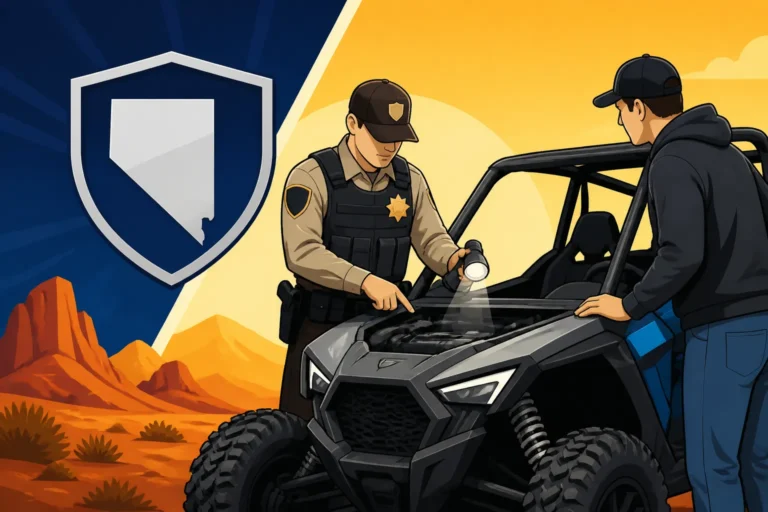
So, you believe your machine falls under an exemption. That's great! But simply believing it isn't enough when a Nevada State Trooper, a BLM ranger, or a county sheriff's deputy pulls you over for a spot check. You need to be able to prove your exemption. This often comes down to documentation and how you carry yourself during an interaction with law enforcement. Being prepared can save you a lot of hassle, potential fines, and a ruined riding day.
Gathering Evidence for Exempt Machines
For any machine you believe is exempt from registration, the golden rule is: have your proof ready. What kind of proof? It depends on the exemption:
- Under 70cc: While a physical document might not explicitly state "under 70cc," you should have the manufacturer's statement of origin (MSO) or title that clearly lists the engine displacement. Even better, have a photo of the engine case showing the displacement stamped on it, or a copy of the owner's manual page with specifications.
- Pre-1976: A title or registration document from any state that shows the year of manufacture is crucial. If you don't have a title, an MSO, or even a bill of sale that clearly identifies the make, model, and year can work. For very old machines, historical documentation or even a signed affidavit stating the year of manufacture might be necessary if other documents are unavailable.
- Husbandry Exemption: This is tougher to prove with a single document. You'd ideally have proof of your agricultural business, perhaps a business license, ranch branding documents, or property tax records showing agricultural zoning. If you're on a ranch, it helps to be known in the community. A signed statement from the property owner if you're an employee, confirming the machine's exclusive use for husbandry, can also be beneficial.
- Private Land Use: The simplest proof here is to only ride on your private land and never venture onto public ways. If you're questioned while riding on what appears to be private land, having your property deed or a map showing your parcel boundaries can be helpful. But remember, the moment you touch public land, this exemption is likely voided for that ride.
No matter the exemption, keep copies of these documents in a waterproof bag on your machine, or even better, have clear photos of them stored on your phone. [Keeping Paperwork Dry in a Dusty Machine] is crucial in the desert environment. Being able to quickly show verifiable proof is key.
What to Do If Questioned by Law Enforcement
When a law enforcement officer or ranger stops you and asks about your OHV's registration, the best approach is always to be polite, cooperative, and provide the information they request promptly. Here’s a quick guide:
- Stay Calm and Courteous: A positive attitude can go a long way.
- State Your Exemption Clearly: "Officer, this machine is exempt because it's under 70cc, and here's the manufacturer's info." or "This is a 1972 model, manufactured before 1976, and I have the title right here."
- Provide Documentation: Hand over your driver's license, and then your proof of exemption. If it's on your phone, offer to show it to them.
- Explain Your Use (if applicable): If it's for husbandry, briefly explain its role on the ranch. If it's strictly private land, clearly state that and point to any visible property lines or maps if you have them.
- Listen to the Officer: They might have questions or need further clarification. Answer truthfully and to the best of your ability.
Remember, officers are doing their job. Being prepared with your documentation makes their job easier and makes your case clearer. Arguing or being uncooperative can escalate a simple stop into a more negative experience. While it's rare to be specifically targeted for an exemption check, random stops at trailheads or on county roads do happen, so being ready is your best defense. [What a Nevada Trooper Looks For on a County Road] often includes current registration.
Potential Pitfalls and Misconceptions
Even with a clear understanding of the exemptions, riders sometimes fall into traps due to common misconceptions or by trying to bend the rules. The desert is a vast place, but it's not a lawless one, and enforcement officers are well-versed in the various ways people try to get around regulations. Avoiding these pitfalls is just as important as knowing the legitimate exemptions.
"Just 2 Miles" and Other Road-Use Myths
One of the biggest areas of confusion, and a frequent cause of citations, revolves around riding OHVs on paved or maintained public roads, even for short distances. Many riders mistakenly believe that if they're "just going a couple of miles" to get to a trail, or crossing a paved road to reach another dirt section, they are somehow exempt from either standard OHV registration or, more critically, from specific street-legal requirements. This is a myth that can cost you.
Nevada law is quite clear: operating a standard OHV on a paved public highway is generally prohibited, with very specific exceptions like [Nevada's 2-Mile Limit on Paved Highway] for certain large ATVs/UTVs that meet additional equipment requirements and have a special decal. A typical quad or dirt bike, even if fully registered with a Nevada OHV decal, is not street legal for paved roads. If you're riding your unregistered (and therefore un-decaled) ATV on a public road, even a dirt one, you're looking at potential citations for both lack of registration and illegal road use. Don't fall for the "just a short hop" trap; if you need to access trails via a public road, trailer your machine or ensure it meets the strict requirements for a large ATV decal.
The Risks of Relying on Outdated Information
Laws and regulations can change, even if slowly, and relying on what your buddy "heard" years ago or what you read on an old forum post can lead you astray. This is particularly true for nuanced topics like exemptions. What might have been true five or ten years ago, or in another state, might not apply in Nevada today. For example, some states have different engine displacement cutoffs for youth machines, or varying reciprocity agreements.
Always seek the most current and official information. The Nevada Department of Motor Vehicles (DMV) OHV Section website is your primary source for up-to-date regulations. While online forums and social media groups can offer insights and shared experiences, treat them as starting points, not definitive legal advice. Cross-reference any information with official sources. The penalties for riding an unregistered machine can include fines and potentially impoundment, which are experiences no one wants. Investing a little time to ensure your information is current and accurate will save you a lot of potential headaches and ensure your desert adventures remain stress-free. If you're ever in doubt, a quick call or email to the Nevada DMV's OHV section is always the safest bet. Even better, consult official resources like those you might find through LawDepot for templates or guidance on legal documents that could support your claims, such as bills of sale for older machines or affidavits of ownership.
Table of Common Nevada OHV Registration Exemptions
To make things a bit clearer, here's a handy table summarizing the common exemptions we've discussed:
| Exemption Category | Key Criteria | Example Machines/Scenarios | Required Documentation (Recommended) |
|---|---|---|---|
| Engine Displacement | Under 70cc engine displacement | Youth ATVs (e.g., Polaris Outlaw 50, Yamaha Raptor 90), small dirt bikes | MSO/Title showing CC, owner's manual page, photo of engine stamping |
| Manufacture Date | Manufactured before January 1, 1976 | Vintage Honda ATC 90, early Kawasaki three-wheelers | Title, MSO, bill of sale, or historical document showing year |
| Agricultural Use | Used exclusively for husbandry/agriculture | Quad used for herding cattle, UTV for hauling feed on a ranch | Proof of agricultural business (e.g., business license, tax docs) |
| Commercial/Government | Used for official commercial or government work | Utility company UTV, BLM ranger's ATV | Entity identification, proof of official use |
| Private Land Use | Operated exclusively on private property | ATV ridden only on a large private acreage or closed track | Property deed/map (if challenged near boundaries) |
| Out-of-State Reciprocity | Validly registered in home state | California Green Sticker ATV, Utah-registered UTV | Out-of-state registration card/decal, driver's license |
| Visitor (Unregistered) | Nonresident, machine unregistered in home state, < 15 days in NV | Visitor passing through for a short trip, no home state registration | Driver's license, proof of nonresident status |
| Dealer/Rental Fleet | Part of licensed dealer inventory or commercial rental fleet | New ATV on showroom floor, UTV from a rental agency | Dealer/rental business license (covered by business, not rider) |
Remember, "recommended documentation" means having these items readily available will make any interaction with law enforcement much smoother. It's about being prepared and proving your case.
Conclusion
Understanding Nevada's OHV registration exemptions is a crucial part of being a responsible and informed off-road enthusiast. While the general rule is that most machines used on public land require a decal, there are clear and logical exceptions for smaller youth machines, historical vehicles, those used for essential work, or those that never leave private property. For our out-of-state visitors, Nevada extends a friendly hand with reciprocity, making it easier to enjoy our incredible landscapes.
The key takeaway is always to be prepared. If you believe your machine is exempt, gather the necessary documentation and carry it with you. Avoid common pitfalls like the "just 2 miles" myth, and always seek the most current information from official sources. By knowing the rules, you can ensure your adventures across Nevada's dunes, trails, and open deserts are always about the thrill of the ride, not the worry of a fine. Now get out there and explore!
Disclaimer
This article is for general informational purposes only and does not constitute professional advice. Laws, prices and regulations vary by location and change over time. Consult a qualified professional for guidance on your specific situation.