Nevada Rules for a Youth Machine on Public Land
A youth ATV or UTV ride on Nevada public land involves more than choosing a small machine. You need to know whether it needs a Nevada decal, what supervision and protective gear apply, and whether the route is open to that type of riding. These checks help you avoid a preventable stop or a ride that puts a young operator in over their head.
Start with the rider, the machine, and the land
There is no single answer to “Can a child ride here?” The practical answer depends on the rider’s ability, the machine’s size and design, Nevada’s youth-related requirements, and the land manager’s rules. A small youth quad and a full-size side-by-side are not interchangeable, and a route open to one type of OHV may not suit another.
Before a trip, work through three questions:
- Can the rider control this machine? The rider should be able to reach the controls, operate the brakes and throttle, steer, and stop without help. Follow the manufacturer’s age and size guidance. An age recommendation is not a substitute for an honest assessment of the child’s strength, judgment, and experience.
- What rules apply to the rider and machine? Check Nevada’s requirements for helmets, supervision, and registration. A parent or other responsible adult should be prepared to stay close enough to intervene, even where a rule does not spell out a precise distance.
- Is this particular route open and appropriate? Public land is not automatically open to unrestricted OHV travel. A trail, road, dune, or staging area may have route restrictions, closures, or conditions that make it unsuitable for a young beginner.
For a first ride, choose a familiar, low-risk area rather than a steep, fast, or heavily trafficked route. Keep the first outing short. A youth rider who becomes tired, cold, overheated, or overwhelmed is more likely to make a poor decision.
A child’s machine is still an OHV
A machine marketed for youth use does not necessarily have a blanket exemption from every Nevada rule. Its engine size may affect registration, but it does not by itself establish that the machine can be used anywhere, that the child may ride without supervision, or that safety equipment is optional.
Likewise, the vehicle’s name can be misleading. A youth quad, mini bike, and small utility-style vehicle may have different controls and handling characteristics. Check the owner’s manual and the land manager’s restrictions for the specific machine, not just the rider’s age.
The topics in Nevada Minimum Age to Ride Off-Road and Nevada Supervision Rules for Young Riders can help clarify the youth-specific questions. Treat supervision as a core part of the plan: an adult should be able to monitor the rider, recognize trouble early, and stop the ride if the child is no longer comfortable or in control.
Public land has its own access rules
Nevada public land includes areas managed by different agencies, and access can vary by location. Some routes are designated for OHVs; others may be closed, limited to certain vehicle types, or subject to temporary restrictions. Stay on routes that are open to your machine and do not assume that an unmarked track is legal to ride.
Check the local map and current notices before setting out. Nevada Rules for Riding Federal Land explains the broader public-land distinction, while Nevada Trail Closures to Check Before You Go is useful when conditions or seasonal restrictions might affect your route. If the route is unclear, contact the local land office rather than relying on a map app or tracks shared by another rider.
Check safety, supervision, and training
Nevada’s youth riding rules are only one part of a safe outing. The adult responsible for the child should plan for the rider’s actual skill level and the day’s conditions, not just the machine’s advertised capability.
Fit and protective gear matter
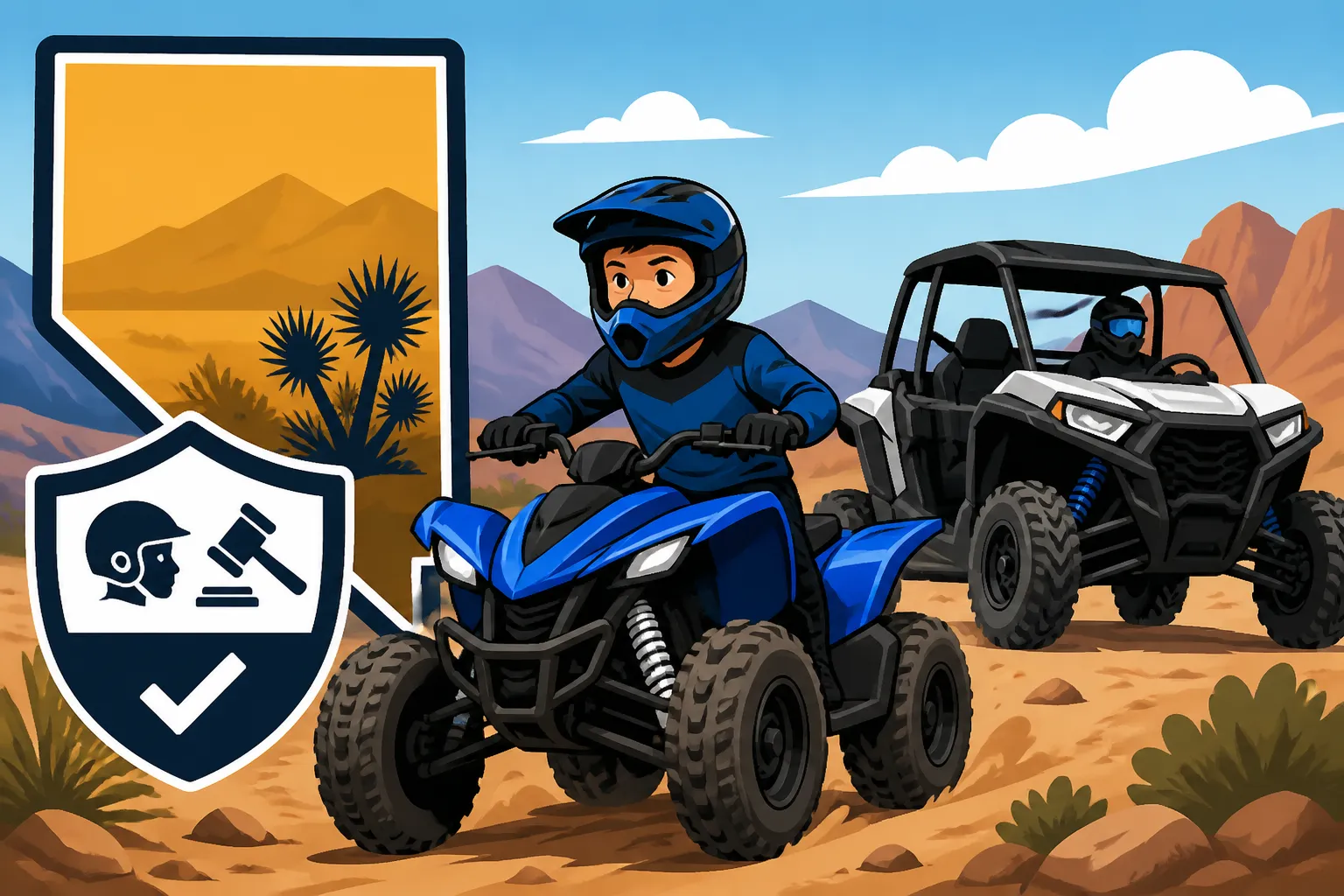
A helmet should fit securely and be made for the type of riding. A helmet that shifts, blocks vision, or is too large is not a safe fit. The rider also needs eye protection, gloves, sturdy clothing, long pants, and over-the-ankle footwear suitable for the terrain. Check that protective gear does not prevent the child from seeing clearly or operating controls.
Nevada has a helmet requirement for young OHV operators. Confirm the current rule and any applicable details before riding, and make wearing a properly fitted helmet non-negotiable regardless. A helmet is not a substitute for keeping speed appropriate or choosing a route within the child’s ability.
For a side-by-side, check that the youth passenger is seated and restrained as the manufacturer requires. Do not assume a child can safely ride in a cargo area or in a seat that does not fit. The vehicle’s occupant limits and restraint instructions matter even when the ride is off-road.
Keep supervision practical
An adult who is supervising should be able to see or promptly reach the rider. Following far behind in another vehicle, leaving a child to ride alone, or relying on a phone call from the trailhead is not a sound supervision plan.
On a group ride, do not let a young rider disappear between faster adults. Put a capable adult where the child can follow, and have another adult watch the back of the group if possible. Agree on simple instructions before starting: where to stop, what to do if separated, and how the child should signal trouble.
Keep the route and pace predictable. Avoid letting a novice follow experienced riders into dunes, steep climbs, deep ruts, loose rock, or traffic-heavy areas. A child may be able to ride a machine on a flat practice area but still lack the judgment or control for changing terrain.
Training is useful even when it is not required
Nevada does not make a safety course a universal prerequisite for every young OHV rider. That does not mean training is unnecessary. A structured course or hands-on instruction can teach basic controls, safe stopping, terrain awareness, and riding etiquette before a child encounters those situations on public land.
Review Nevada ATV Safety Certificate for Minors for information about training and certificates. An adult can also practice with the child in a controlled area before a public-land trip. Start with mounting and dismounting, starting and stopping, turning, and safely shutting down the machine. Move on only when the rider can repeat each task calmly and consistently.
A brief pre-ride talk is not enough by itself. Check the machine’s brakes, tires, throttle return, controls, and fuel or battery condition. Make sure the child knows not to ride beyond the agreed route or attempt a feature just because another rider does.
Confirm whether the youth machine needs registration
Nevada registration requirements depend in part on the machine. A youth model may fall below the state’s engine-size threshold, but do not assume that “youth” or “mini” means exempt. Check the engine displacement and the machine’s classification against the current rules.
Nevada has an exemption for certain machines under 70cc. The exact cutoff matters: a machine at 70cc is not the same as one under 70cc. If the machine qualifies for an exemption, keep enough documentation to support its engine size and identity, particularly if it may be questioned during a ride or at a trailhead. See Why Nevada’s 70cc Cutoff Decides Registration for the registration distinction.
| Situation | What to check before riding |
|---|---|
| Nevada machine under 70cc | Confirm the engine size and that the machine fits the exemption; do not assume other safety or land-use rules are waived |
| Nevada machine at or above the cutoff | Check whether Nevada OHV registration and a decal are required |
| Machine registered in another state | Confirm Nevada reciprocity and any time limit that applies to the visit |
| Machine with uncertain ownership or paperwork | Resolve the ownership and registration questions before taking it onto public land |
For a machine that requires registration, make sure the paperwork matches the machine and that the decal is current and displayed as required. Nevada OHV Registration Paperwork Checklist can help identify what to gather. Nevada’s registration decal generally serves as the OHV permit, rather than being a road-use plate; see Nevada’s Registration Decal as Your Permit.
A registration exemption is not permission to ignore land-manager rules. It also does not make a machine street legal or authorize travel on a public road. The registration status of the vehicle and the legality of the route are separate questions.
Out-of-state machines and visitors
If the youth machine is registered in another state, do not assume that its home-state sticker automatically covers every Nevada trip. Nevada’s reciprocity rules and visitor exemptions may depend on where the machine is registered, how long it remains in the state, and other details. Verify the current requirements before travel, especially for a longer stay.
The rider’s age does not change which state’s registration applies to the machine. A parent may own or transport the vehicle, but the machine still needs whatever paperwork is required for its use in Nevada. Keep registration documents accessible and protect them from dust and water.
If the machine is exempt because of its size, or the out-of-state status is complicated, ask the relevant state or land office before relying on an assumption. That is easier than trying to explain the machine’s status during a roadside check.
Plan a route a young rider can manage
A legal route is not automatically a suitable route for a child. Terrain, weather, visibility, traffic, and distance all affect how demanding a ride becomes. Choose a route that matches the least experienced rider in the group.
Look beyond the map
Use a current travel-management map or information from the land manager. Check whether the route is open to the machine’s type and size, whether any sections are restricted, and whether a closure affects the planned area. Riding Open BLM Land Versus Marked Trail explains why open land and open routes are not always the same thing.
For a youth ride, marked routes are usually easier to plan around than open-ended cross-country travel. They provide clearer boundaries and make it easier to estimate distance and return time. Avoid areas where fast vehicles, steep slopes, deep sand, or narrow trails are likely to overwhelm the child.
Confirm how you will reach the riding area and where the group will park or unload. Do not let a youth rider use a road or shoulder as a shortcut unless that road is specifically legal for the vehicle and rider. Off-road registration does not grant permission to ride on ordinary streets.
Prepare for desert conditions
Nevada’s desert conditions can change the difficulty of a ride quickly. Heat, dust, wind, cold mornings, and uneven ground may tire a child sooner than expected. Bring enough drinking water for the group, sun protection, a basic first-aid kit, and a way to communicate if the group separates or a machine breaks down.
Before starting, set a turnaround point and a time to head back. Leave room for slower travel, rest stops, and minor delays. If the child is getting tired, losing focus, or struggling with control, end the ride early. Finishing the planned route is never more important than getting everyone back safely.
A practical pre-ride checklist:
- Confirm the rider can comfortably reach and operate the controls.
- Check the helmet fit and the rest of the protective gear.
- Inspect brakes, tires, throttle, fuel or battery, and the machine’s basic condition.
- Verify registration or the specific exemption, and carry supporting paperwork.
- Check current route access, closures, and machine restrictions.
- Choose a short route with a clear return plan.
- Brief the child on stopping, regrouping, and what to do if separated.
- Carry water, communication equipment, and basic emergency supplies.
The best youth ride is one the child can complete without being pushed beyond their ability. Keep the machine, route, pace, and duration conservative, and be ready to change the plan when conditions or the rider’s confidence change.
Disclaimer
This article is for general informational purposes only and does not constitute professional advice. Laws, prices and regulations vary by location and change over time. Consult a qualified professional for guidance on your specific situation.