Nevada Rules for an Electric UTV on Trails
An electric UTV can be quieter and easier to use than a gas model, but its power source does not automatically change Nevada’s trail rules. The key questions are whether the machine needs Nevada OHV registration, whether its paperwork is recognized, and whether the route is open to it. Check all three before unloading.
Does an electric UTV need Nevada OHV registration?
Nevada’s OHV requirements are based on the machine and where it is operated, not simply on whether it has a gasoline engine. An electric motor does not, by itself, exempt a UTV from registration. If your vehicle fits Nevada’s off-highway vehicle rules and you plan to ride it in places where OHV registration is required, expect to need the appropriate Nevada decal or qualifying out-of-state registration.
The decal serves as Nevada’s OHV registration credential and trail permit; it is not a license plate or permission to drive on public roads. Details about what it covers are explained in Nevada’s Registration Decal as Your Permit. A decal also does not authorize travel on every public trail or road. The route still has to be open to your vehicle.
The exact classification can matter for an unusual electric model, a home-built vehicle, or a machine whose paperwork does not clearly identify it as an OHV. Check the vehicle’s title or manufacturer documents, VIN, and Nevada’s current registration requirements before assuming it falls into a particular category. If its status is unclear, ask the Nevada OHV registration authority rather than relying on a dealer description or a sales listing. Nevada OHV Registration for an Electric UTV covers the registration question in more detail.
| Situation | What to check |
|---|---|
| Nevada resident riding a qualifying electric UTV on public OHV routes | Whether Nevada registration and a decal are required, and what ownership documents to submit |
| Visitor bringing an electric UTV from another state | Whether its existing registration or permit qualifies under Nevada reciprocity, and how long the exemption applies |
| Electric UTV ridden only on private property | Whether a registration exemption applies to the specific machine and use |
| Electric UTV on a BLM route or trail | Whether the route is open to the machine and whether any local closure or land-use restriction applies |
| Electric UTV driven on a public road | Separate road-use requirements; an OHV decal alone does not make it street legal |
Some machines or uses may qualify for an exemption, but do not assume an electric UTV does. Nevada has specific exemptions, and eligibility depends on the facts—not just on having electric drive or riding infrequently. If the machine will only be used on private property, verify whether that use qualifies before taking it onto public land. A change in use can change the answer.
Registration paperwork can also depend on how you acquired the UTV and whether it has a Nevada title or an out-of-state title. Keep the title, bill of sale, and any registration documents together, and sort out missing ownership paperwork before planning a public-land ride.
Can visitors ride an electric UTV on an out-of-state registration?
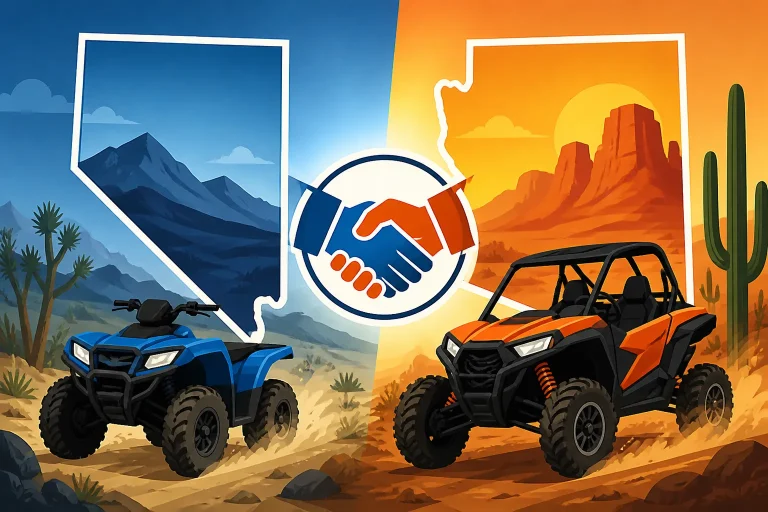
Visitors should check Nevada’s reciprocity rules before traveling. A registration or permit from another state may allow a qualifying machine to be operated in Nevada for a limited period, but the visitor exemption has conditions. Do not assume that any sticker from another state counts, or that a registration issued for a different kind of vehicle is accepted as OHV registration.
The details can depend on the machine’s home-state status, the rider’s residency, and the time the machine spends in Nevada. Nevada’s rules for visitors are covered in Nevada OHV Reciprocity With Other States and Nevada’s Nonresident Exemption in NRS 490.082. Confirm the current terms before setting out, especially if you are staying for an extended trip or your machine is not registered in its home state.
A practical visitor checklist:
- Confirm what the out-of-state document represents. Check that it is a current OHV registration or permit for the machine, rather than a road registration that does not cover off-highway use.
- Check that the machine is eligible. Make sure the document applies to this specific electric UTV and that its identification details match.
- Verify the Nevada time limit and other conditions. Do not rely on a friend’s experience or a rule summary that may not cover your situation.
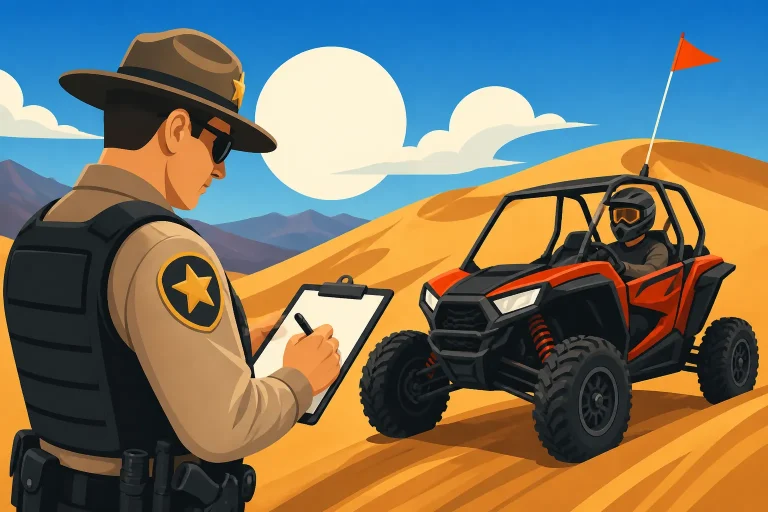
- Carry proof while riding. Keep registration and ownership documents protected from dust and water, and make them accessible if an officer or ranger asks to see them.
- Ask before crossing jurisdictions. Nevada registration rules and land-manager rules are separate; meeting one does not guarantee access everywhere.
If your machine does not have a valid registration or permit from another state, check whether you must register it in Nevada before riding public OHV routes. A short visit is not a reason to guess at the exemption. And if you ride beyond the applicable visitor period, investigate what registration is required before continuing to use the machine in Nevada.
An out-of-state sticker also does not override a route closure, a land manager’s restrictions, or requirements for a particular recreation area. For a ride on federal land, start with Nevada Rules for Riding Federal Land and check the relevant route information before you unload.
Where can an electric UTV ride in Nevada?
The electric motor does not create a separate category of trail access. You still need to confirm that the route is open to off-highway vehicles and suitable for your machine. A trail can be restricted by land ownership, local rules, vehicle size, season, maintenance, fire conditions, or a temporary closure. A map that shows a road or trail is not enough on its own to prove that riding is allowed.
On BLM land, follow the travel-management rules for the specific area. Some routes are open to motorized vehicles, some are limited to certain types of use, and others are closed. Stay on routes designated for motorized travel unless the land manager explicitly allows a different type of riding. Riding Open BLM Land Versus Marked Trail explains why open-looking terrain is not necessarily open to cross-country travel.
Before each trip:
- Check the land manager’s current route map and notices for the area.
- Look for seasonal, fire-related, habitat, or emergency closures.
- Confirm whether the route allows your vehicle type and width.
- Check whether a recreation site has its own operating rules, fee, or permit.
- Be prepared to turn around if signs or current local information show a closure.
Nevada’s OHV decal is not a substitute for a site-specific pass or other access requirement. Some areas may charge a separate use fee, while others may not. Confirm requirements for your destination directly, especially before a holiday or a long drive. Nevada Trail Closures to Check Before You Go is useful when planning around temporary restrictions.
The same approach applies to state and locally managed recreation areas: check the authority responsible for the route, not just the statewide registration rules. A route might be open to OHVs generally but unsuitable for a wide side-by-side, or have restrictions that apply to all motor vehicles. Electric power does not waive those limits.
Also keep trail access separate from road legality. A standard OHV decal does not make an electric UTV street legal, and it does not authorize a rider to use a public road to connect two trail sections. If your trip involves a road, check the specific road-use rules and the vehicle’s legal equipment and status before riding there.
What is different about riding an electric UTV?
The basic registration and access questions are largely the same as for a gas-powered UTV, but electric power changes trip planning. Battery range can vary substantially with terrain, speed, payload, temperature, tire choice, and how much climbing or soft sand the route involves. The range shown in a brochure or display is not a safe basis for planning a remote ride.
Plan around charging and recovery
Work out the whole route before leaving, including the return distance, detours, and a reserve for slow or difficult sections. If the trailhead has no confirmed charging option, plan to arrive with enough charge for the full ride and a reasonable margin. Do not count on charging at a recreation site unless the operator confirms that charging is available and allowed.
A depleted battery can leave a heavy UTV stranded far from help. Carry the recovery equipment appropriate to your vehicle and route, and make sure someone in your group knows how to use it. Tell a reliable person where you are going and when you expect to return. In areas with limited cell coverage, a phone alone may not be a dependable way to call for help.
Heat, cold, sand, and steep climbs can affect both range and vehicle performance. Follow the manufacturer’s operating instructions for battery temperature, charging, water exposure, and recovery. Do not assume that a battery enclosure is designed for deep water crossings or that a particular charger can be used in dusty outdoor conditions.
Quiet does not mean unrestricted
An electric UTV may produce less engine noise, but quieter operation does not grant extra access, permit travel on closed routes, or remove requirements that apply to the machine. Respect posted rules and other trail users, and slow down where visibility is limited. Other riders, hikers, or wildlife may not hear an approaching electric vehicle as readily as a gas model.
Because an electric machine has no conventional exhaust system, some equipment questions may not apply in the same way as they do to a gas UTV. That does not mean every equipment rule is irrelevant. Follow the vehicle-specific requirements for the route and ask the responsible authority if a rule is unclear. Fire restrictions, closures, and land-use rules remain important regardless of the powertrain.
Carry proof and keep the machine identifiable
Bring the registration or qualifying out-of-state permit, proof of ownership, and any site-specific pass required for the trip. Store paper documents in a sealed pouch or keep a readable digital copy as backup. Do not treat a photo on your phone as a guaranteed replacement for required documents; carry the originals or other accepted proof when the rules call for them.
Before leaving, check that the VIN and registration details correspond to the electric UTV. If you have modified the vehicle or its documents do not clearly match, resolve the discrepancy before riding public routes. For a step-by-step overview of the permit question, see Nevada OHV Permits Explained.
The practical rule is straightforward: treat an electric UTV as an OHV unless Nevada’s current rules clearly say otherwise for your machine and use. Confirm its registration status, verify any visitor reciprocity, and check that each route is open. A quiet motor and a full battery make a ride more convenient; neither replaces the paperwork or access checks.
Disclaimer
This article is for general informational purposes only and does not constitute professional advice. Laws, prices and regulations vary by location and change over time. Consult a qualified professional for guidance on your specific situation.