Nevada Minimum Age to Ride Off-Road
Nevada does not set one simple minimum age that makes every ATV or UTV appropriate for a child. The practical rules depend on the rider’s age, adult supervision, the machine and where it will be used. Here’s how to tell what a young rider may do, what adults need to check and why a legal ride can still be a poor fit.
Nevada’s age rule and adult supervision
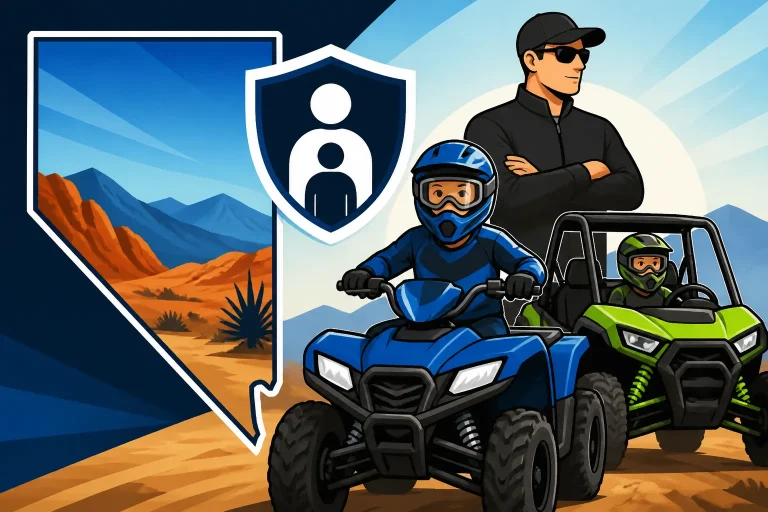
For off-road riding, Nevada’s key age distinction is whether the operator is under 16. A rider under 16 must be accompanied and directly supervised by someone who is at least 18. That is not the same as having an adult somewhere at the staging area: the adult should be able to watch the rider and step in if a situation becomes unsafe.
At 16, the state’s under-16 supervision requirement no longer applies. That does not mean every 16-year-old is ready for every vehicle, trail or riding condition. A young person still needs to follow equipment requirements, registration rules, land-use restrictions and any conditions set by a rental company or property owner.
| Rider’s age | Main off-road consideration | What the adult should check |
|---|---|---|
| Under 16 | Must ride with direct supervision from someone at least 18 | Supervision, helmet, machine fit, passenger limits and route |
| 16 or 17 | The under-16 supervision rule no longer applies | Protective gear, skill level, machine controls and local rules |
| 18 or older | No minor-specific supervision rule | Registration, land access, machine limits and general safety rules |
Age is only one part of the decision. A child might meet the age and supervision requirements but still be unable to reach the controls, operate the brakes confidently or handle the machine’s weight. A UTV may have a steering wheel and seat belts, but it is not automatically simple or safe for a young driver. A powerful machine, steep terrain, soft sand or a crowded trail can overwhelm a rider of any age.
Nevada’s rule is about operating off-road. Riding on a public road is a separate question, with additional requirements that can involve the machine, route, license and supervision. Do not assume that permission to ride on a trail also permits a young person to operate the machine on a road. For the road-specific rules, see Nevada Rules for Riders Under 16 on Roads.
The supervision requirement also does not replace the responsibility to keep the ride within the young rider’s ability. Adults should choose a route where they can maintain visual contact, communicate easily and stop without putting the child in the path of other riders. If the adult cannot supervise closely because of speed, distance or terrain, the group should change the plan.
Choose a machine the young rider can control
A manufacturer’s minimum age recommendation is an important starting point, not a challenge to work around. Check the owner’s manual and safety labels for the specific make and model. Youth machines vary considerably, and the fact that a machine is called an ATV or UTV does not tell you whether it suits a particular child.
Before riding, check whether the young person can:
- Sit in a stable position with feet supported as designed.
- Reach and operate the controls without stretching or shifting awkwardly.
- Use the throttle and brakes smoothly.
- Turn and stop the machine reliably.
- Understand how to shut it off and what to do if it stalls.
- Follow instructions and keep enough distance from other riders.
If the machine is too heavy or powerful for the rider to manage, adult supervision cannot make it a good match. Nor does an adult passenger necessarily make a machine suitable for a child to drive. A passenger can change how a vehicle handles, and some machines are not designed to carry one at all.
For UTVs, verify that the intended seating position is designed for the passenger and that the rider can use the available restraints as intended. Never let a child ride in a cargo bed or in a position not designed for passengers. For ATVs, do not add a passenger unless the machine is designed for two and the manufacturer permits it. The relevant safety considerations are covered in Nevada Rules for Riding With a Passenger Off-Road.
A helmet and other protective gear matter at every age
Nevada requires minors riding off-road to wear a helmet. Check current state requirements and the helmet’s safety certification before setting out. Fit matters: a helmet that is loose, sits incorrectly or shifts when the rider moves may not protect as intended. Goggles, gloves, long sleeves, long pants and over-the-ankle footwear can also help protect against dust, branches, hot parts and falls.
If you order gear online, including through Amazon, confirm that the helmet is intended for the activity, carries the appropriate safety marking and fits the rider securely. A product description or a child’s age range is not a substitute for checking fit and certification. For a growing child, reassess fit regularly rather than assuming last season’s helmet still works.
A helmet is not a solution to poor machine fit or risky riding. It is one part of a layered approach that also includes instruction, appropriate speed, protective clothing, a suitable route and an adult who is paying attention.
Prepare the ride, not just the paperwork
Nevada does not generally require an ATV safety certificate simply because a rider is a minor. A course can still be useful, especially for a new operator. It gives young riders structured practice with starting, stopping, turning, terrain and basic decision-making before they join a busy ride. See Nevada Has No Mandatory Safety Course for how the state requirement differs from the value of training, and Nevada ATV Safety Certificate for Minors for more on youth training.
A practical pre-ride routine can prevent avoidable problems:
- Review the rules for the location. Confirm that OHV riding is allowed on the route and that it is open to the type of machine you plan to use. Public land can include closed routes, restricted areas and changing conditions. A trail map is useful, but check for current closures as well.
- Inspect the machine. Check the brakes, throttle, tires, steering, lights where needed, fuel, and any required safety equipment. Make sure the controls work as expected and that the machine is appropriate for the rider.
- Set expectations before starting. Explain where the young rider may go, how to stop, what signal to use and what to do if separated. Agree on a pace that lets the supervising adult stay close.
- Start with easy terrain. Give the rider a chance to practice in a clear, low-traffic area before attempting hills, sand, rocks or narrow paths.
- Keep the group together. Do not let an under-16 rider disappear around a bend or continue beyond the adult’s ability to supervise directly. Stop and regroup before visibility or communication becomes unreliable.
- Stop when conditions change. Dust, heat, fatigue, a mechanical problem or a more difficult trail can turn a manageable ride into an unsafe one. A young rider may not recognize when to quit, so adults need to make that call.
Registration and access are separate from age. A youth-sized machine may still need the required Nevada OHV registration, and registration does not establish that a child is qualified to operate it. Check the vehicle’s paperwork and decal requirements using Nevada Rules for a Youth Machine on Public Land and Nevada OHV Registration Paperwork Checklist.
Also confirm who is allowed to use the land. A ride on private property depends on the owner’s permission and any applicable rules; public-land routes may have different restrictions. Do not treat an open-looking dirt road as permission to ride it. Confirm that the route is legally open to OHVs and appropriate for your vehicle.
Rentals, public land and common age-rule mistakes
Rental companies can set stricter age limits than Nevada’s general off-road supervision rule. They may also limit which machines a young person can drive, require a licensed adult to operate the rental or restrict where the vehicle may go. Those are rental conditions, not proof that state law sets the same age for every machine.
Before booking, ask the company directly:
- What is the minimum age to drive the specific machine?
- Can a minor drive with an adult present, or must the adult drive?
- Does the company require a driver’s license or other documentation?
- Are there height, weight or experience requirements?
- Which areas and routes are permitted?
- What protective gear is supplied, and what should the family bring?
Get the answers for the exact machine and activity. A guided tour may have different rules from a self-drive rental, and permission to ride as a passenger does not mean a minor may drive. The details in Nevada Rules for Renting to a Teenager can help you prepare questions, but the rental operator’s current contract and instructions control its own service.
One frequent mistake is interpreting “no under-16 supervision rule” as “no restrictions for older teens.” Riders who are 16 or 17 still need appropriate gear, a suitable machine, legal access and compliance with any location or rental rules. Another is assuming adult supervision excuses a child from the machine maker’s age recommendation. State law, manufacturer guidance and land or rental rules address different issues; satisfying one does not cancel the others.
It is also easy to confuse off-road riding with road use. A child who may operate an OHV off-road under the applicable rules may not meet the requirements to ride on a county road or other public roadway. Those rules can involve licensing, equipment, route restrictions and adult supervision. Check the specific road rules before using any paved or public route.
For a family ride, the soundest decision is usually more conservative than the legal minimum: follow the machine’s age guidance, provide close supervision, choose easy terrain and stop before the young rider becomes tired or distracted. If the child cannot confidently control the machine in a practice area, wait rather than trying to make the trail ride work.
Disclaimer
This article is for general informational purposes only and does not constitute professional advice. Laws, prices and regulations vary by location and change over time. Consult a qualified professional for guidance on your specific situation.