Nevada Rules for Packing Out Game by UTV
Packing out a harvested animal by UTV can save a difficult carry, but it does not make every route or recovery method legal. The key is to separate hunting rules from vehicle-access rules, tag and handle the animal correctly, and confirm that your planned route is open to motorized travel.
What a UTV can and cannot do during a hunt
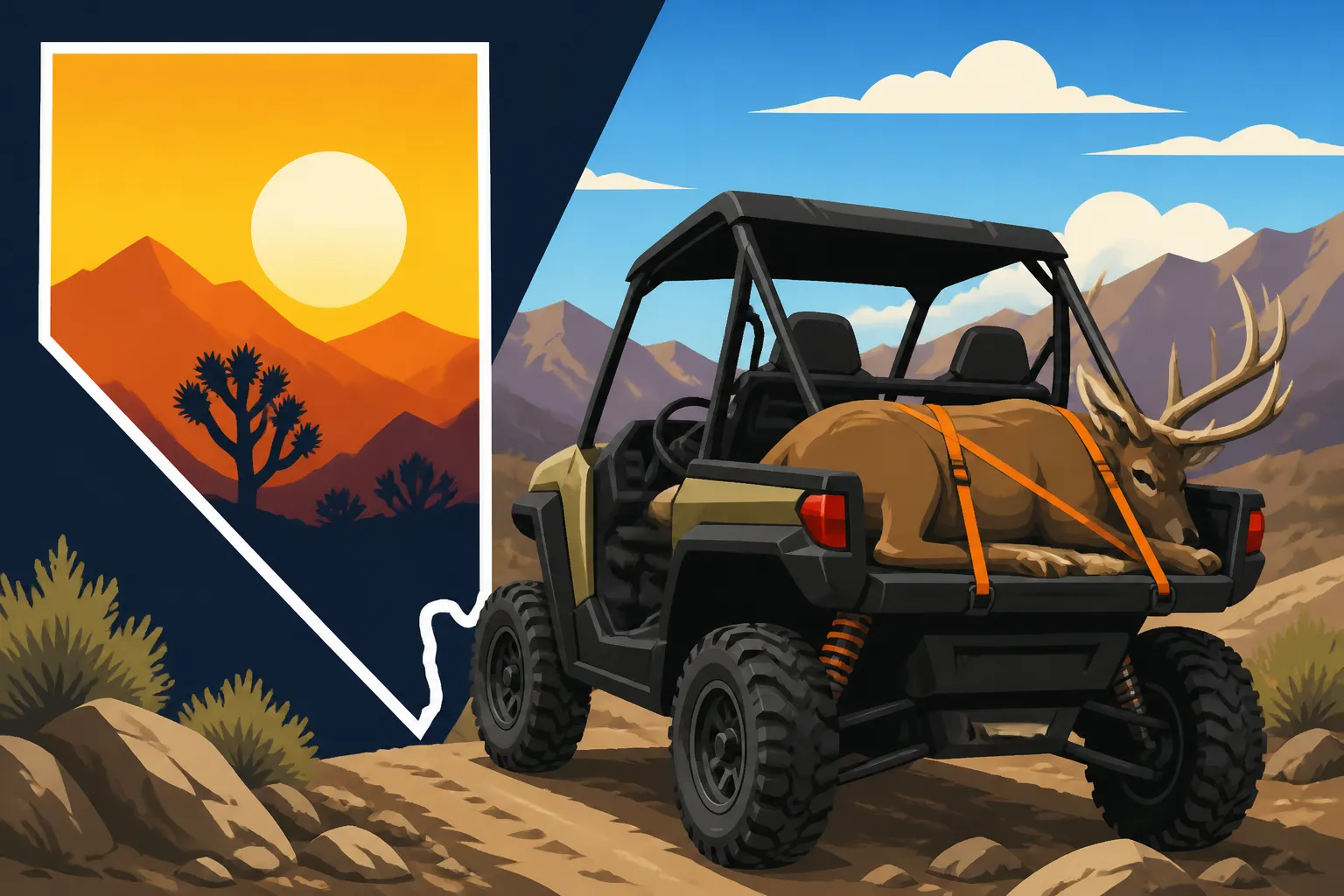
A UTV can be useful for carrying people and equipment to an authorized hunting area and transporting a legally harvested animal back out. It is not permission to hunt from the vehicle, chase or harass wildlife, or drive wherever the carcass lies.
Keep the distinction clear: hunting rules govern how you take game; land and travel rules govern where your UTV can go. A legal harvest does not automatically create an exception to a closed route, an off-road restriction, a seasonal closure, or a private-property boundary.
Nevada hunting regulations can prohibit hunting or pursuing game from or with a motor vehicle. Do not shoot from a UTV, use it to run an animal down, or use it to push wildlife toward another hunter. A vehicle may also be restricted from being used to locate or pursue animals, even if the actual shot is taken on foot. Check the current regulations for the species and hunt before setting out, including any exceptions that apply to a particular hunt or permit. For more on the hunting-versus-vehicle distinction, see Nevada Rules for Hunting From an ATV.
| Situation | What to check before proceeding |
|---|---|
| Driving to a hunting area | Whether the road or trail is open to motorized travel and whether your machine meets applicable registration requirements |
| Riding off an established route | Whether the land manager specifically allows that travel; a harvested animal does not create a general off-road exception |
| Retrieving a harvested animal | Tagging and evidence requirements, access restrictions, and any species-specific retrieval rules |
| Crossing private land | The landowner’s permission and any conditions on the route |
| Traveling with an out-of-state decal | Whether Nevada’s reciprocity rules apply to your machine and circumstances |
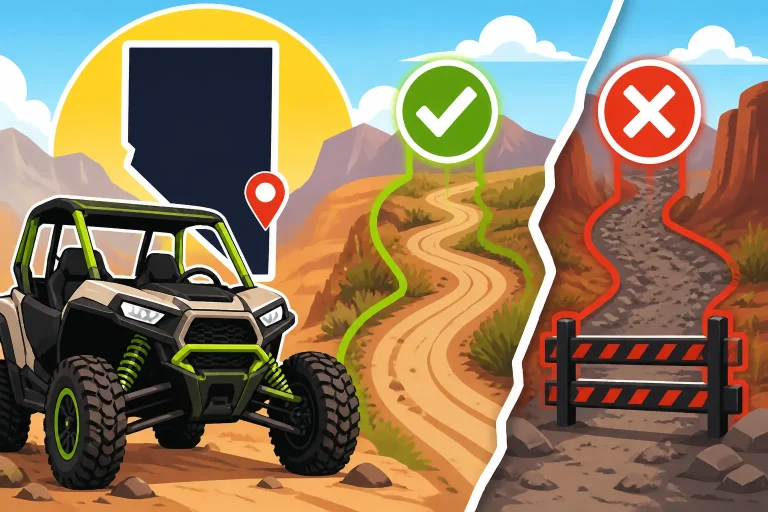
Before the hunt, identify the permitted routes on the relevant land-management map and check for temporary closures. Federal land, state-managed areas, and private property may have different access rules. A road that appears on a map, has tire tracks, or has been used by other riders is not necessarily open to your UTV. The basics are covered in Nevada Rules for Riding Federal Land and Nevada Rules for Riding a Closed Route.
Your Nevada OHV registration or another state’s valid registration can address a registration requirement, but it does not grant access to a route or hunting area. Visitors should check whether their out-of-state registration qualifies under Nevada’s rules; Nevada OHV Reciprocity With Other States explains that separate issue.
If a hunt has a specific vehicle-access condition, follow the hunt materials as well as the general regulations. When the rules are unclear about using a UTV to retrieve an animal in a particular area, check with the land manager or wildlife agency before the hunt. Do not assume that “retrieval only” is allowed everywhere simply because the animal has already been taken legally.
Confirm the route before you recover the animal
The most important access question is often not whether you own a UTV, but whether the route to the animal is open to motorized vehicles. Some areas allow travel only on designated roads or trails. Others have seasonal restrictions, habitat protections, route-specific rules, or limits on vehicle use. Those limits can apply even when the trip is short and the purpose is to retrieve game.
Plan a route before the hunt, not after an animal is down. Check the current map or travel guidance for the exact area, and note where the route ends. If the vehicle cannot legally reach the animal, plan to carry the meat to an authorized road or trail. A difficult pack-out does not change the access boundary.
Public land and route limits
On public land, follow the rules of the agency responsible for that specific area. Do not rely only on a general map or a phone navigation app: neither necessarily shows current closures or whether a route is open to motorized use. Where motorized travel is limited to designated routes, stay on them. Do not cut across vegetation, a wash, or a hillside to shorten the distance to a carcass unless the applicable rules clearly allow it.
These limits also matter when a road crosses several kinds of land. A route may be open through one section and closed after a boundary, or it may pass near a protected area where travel is restricted. Nevada Rules for Crossing Private Land is useful when a planned route approaches or crosses property you do not own. Permission to cross private land should be explicit; an open-looking gate or an established track is not a substitute.
If a gate is part of the route, follow posted instructions and leave it as you found it. See Nevada Rules for Opening and Closing Gates. Avoid driving through livestock, disturbing animals, or blocking a ranch road. A route that is technically accessible may still be subject to conditions meant to protect livestock, wildlife, or other land users.
Roads, shoulders, and travel between areas
A UTV’s ability to travel on public roads depends on the applicable vehicle and road rules. Do not assume that an OHV decal makes a machine road-legal, or that a road leading toward a hunting area is open to UTVs. If your plan includes a road connection, confirm the road’s status and the machine’s legal requirements before riding it. When access is not clearly permitted, trailer the UTV to an authorized staging point instead.
Conditions can change after weather, fire activity, maintenance, or wildlife management decisions. Recheck closures close to your trip and again at the trailhead if notices are posted. A route that was open on an earlier visit may not be open now.
Tag and handle the animal before loading it
Before moving the carcass, complete the required tag steps for that species and hunt. Nevada’s rules and tag instructions determine when and how a tag must be validated and attached. Do this promptly and follow the instructions that came with the tag; do not leave the carcass at the recovery site with the paperwork incomplete while you make multiple trips.
Keep the tag with the animal as required, and retain any paperwork or electronic documentation the hunt rules call for. Species-specific regulations may also require evidence such as proof of sex or other identifying parts to remain with the carcass during transport. Check those requirements before the season rather than relying on memory in the field.
If more than one person is helping, make sure everyone understands which animal the tag belongs to and who is responsible for it. Do not put a tag on an animal until you have confirmed that the tag is valid for that hunter, species, hunt, and location. If a tag is damaged, lost, or difficult to attach, contact the appropriate wildlife authority for direction rather than improvising in a way that could make the animal’s status unclear.
Take care of meat and required evidence
Follow the current species regulations on salvage and possession. Requirements may specify which edible portions must be recovered and what evidence must remain with the meat. Do not assume that a carcass can be discarded because it is inconvenient to move, and do not remove required evidence before you have confirmed that the rules allow it.
Plan the breakdown and loading process so the meat can be kept as clean and cool as conditions allow. Use clean game bags or other suitable coverings, keep meat away from fuel, oil, dirt, and exhaust, and avoid sealing warm meat in a way that prevents cooling. In hot weather, time matters: prepare the UTV and recovery gear beforehand so the animal is not left exposed while you search for straps or clear cargo space.
Keep the load secure and within the machine’s capacity. A carcass or heavy game bags can shift on uneven ground, affect steering and braking, and make a UTV less stable on slopes. Balance the load, secure it with suitable straps, and avoid stacking gear where it can block the driver’s view or interfere with the controls. If the animal is too large for one trip, make a plan that keeps the meat attended and protected while you return for additional loads.
Do not let a heavy load tempt you into taking a shortcut across closed ground. If the permitted route is too rough for a safe loaded trip, consider carrying the meat to a suitable point by hand or using another lawful recovery method. The route restriction still applies after the UTV is loaded.
A practical pack-out plan
A straightforward plan reduces both legal and safety problems. Before leaving for the hunt, confirm the machine’s status, access route, tag requirements, and recovery equipment. Then use this sequence after a harvest:
- Confirm the harvest and location. Make sure the animal was taken lawfully and identify the land and route restrictions that apply to the recovery.
- Complete the tag steps. Validate and attach the tag as directed for that hunt before moving the animal.
- Check required evidence. Follow the species-specific rules on proof of sex, edible portions, and any other evidence that must accompany the carcass.
- Choose an authorized route. Use only roads or trails open to your UTV. If the animal is beyond the legal motorized route, do not drive cross-country to reach it.
- Prepare a safe load. Keep meat clean, distribute weight sensibly, and secure it so it cannot shift during travel.
- Carry documentation. Keep the tag details and required hunting documents accessible during transport. Store paper documents where dust, moisture, and damage are less likely.
- Recheck access on the return. Watch for gates, signs, closures, livestock, and other users. A route can require careful travel even when it is open.
If the animal is on the other side of a fence or property boundary, do not assume that a harvest gives you the right to cross. Get permission before entering private land, and ask how the owner wants the recovery handled. If the animal is near a closed route, a boundary, or a sensitive area, contact the appropriate land manager or wildlife agency for instructions rather than making a difficult call on the spot.
For a hunt involving an out-of-state machine, check registration and reciprocity before travel, but keep those requirements separate from land access. For a hunt involving public land, check the managing agency’s route rules. For a hunt involving private land, get clear permission for both the hunting activity and the vehicle route. These are separate questions, and satisfying one does not automatically satisfy the others.
A useful rule of thumb is: tag the animal correctly, recover only what the regulations require, and keep the UTV on routes where motorized travel is allowed. When the route or a species-specific requirement is uncertain, verify it before the hunt rather than treating the recovery trip as an exception.
Disclaimer
This article is for general informational purposes only and does not constitute professional advice. Laws, prices and regulations vary by location and change over time. Consult a qualified professional for guidance on your specific situation.