Nevada Reciprocity With Idaho
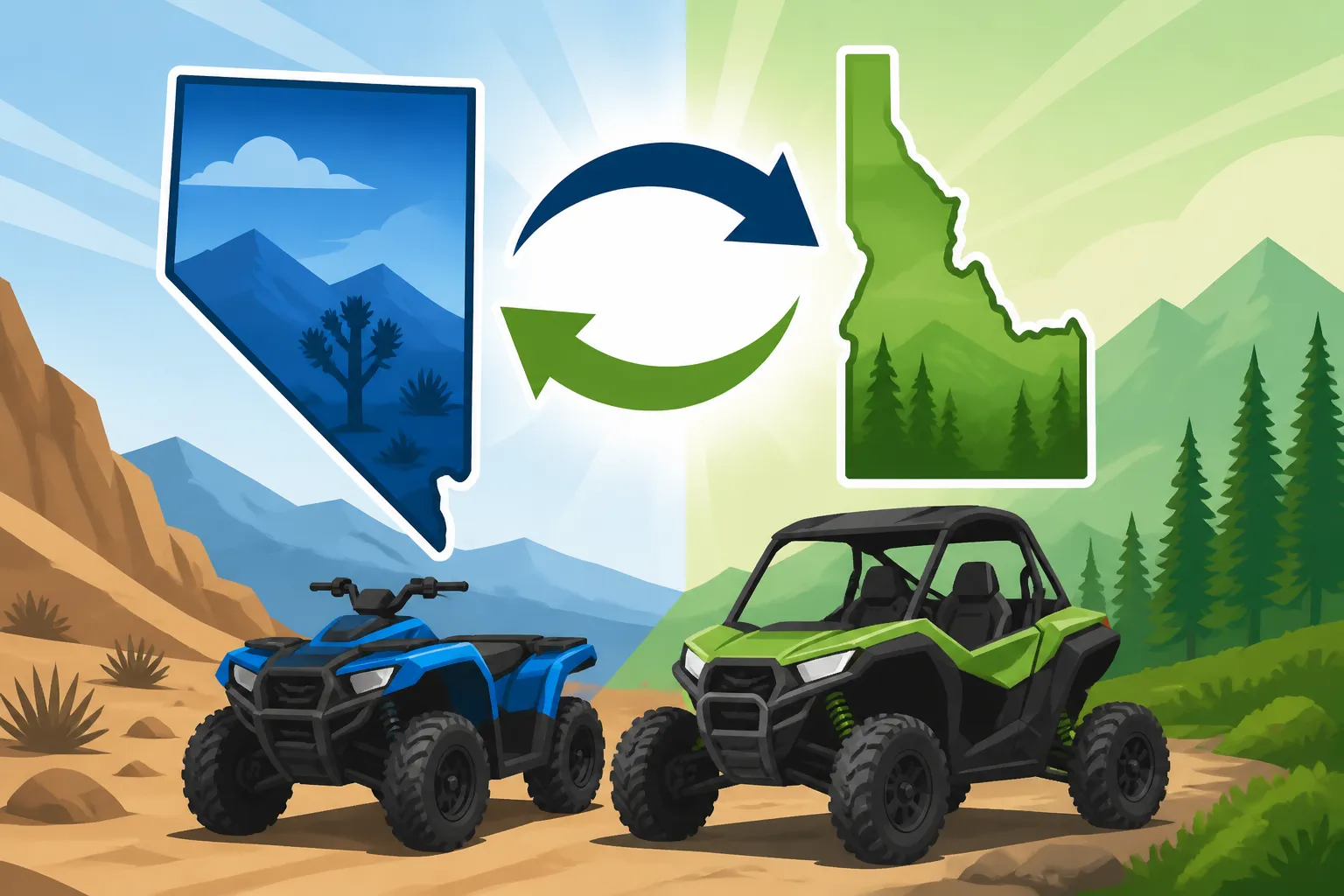
An Idaho OHV decal may let you ride in Nevada without immediately buying a Nevada decal, but only if your machine and visit meet the state’s reciprocity rules. The key is to distinguish a valid Idaho registration from ownership papers or a road plate, and to understand that reciprocity does not authorize road riding or override local route restrictions.
When Idaho registration is accepted in Nevada
Nevada generally allows a nonresident to operate an OHV registered in another state for a limited visit without obtaining a Nevada OHV decal. For Idaho riders, that means a current Idaho OHV registration can qualify the machine for Nevada’s visitor exemption. Nevada’s short-term allowance is commonly described as up to 15 days.
That is a limited exception, not a transfer of registration between states. Your Idaho registration remains an Idaho registration, and you need to comply with Nevada’s rules while riding there. The exemption also does not mean every Idaho document or sticker is enough. The machine must be properly registered in Idaho, and the registration must still be valid.
The Idaho decal or certificate should correspond to the machine you bring. A title proves ownership; it does not necessarily prove that the OHV has current registration. Likewise, a bill of sale or an expired Idaho sticker is not a safe substitute for valid registration. If you are unsure whether your Idaho paperwork counts, confirm it with the Nevada OHV Section before traveling.
Nevada’s allowance is for a nonresident visiting with an out-of-state-registered machine. It is not a way for a Nevada resident to avoid Nevada registration by keeping an Idaho sticker on the vehicle. If you move to Nevada, or become a Nevada resident and keep riding the machine here, review the requirements for Nevada OHV Registration After Moving to the State.
The 15-day limit deserves particular attention. Do not assume that leaving Nevada briefly restarts the clock, or that repeated visits automatically qualify as separate short stays. Confirm how the state counts the days for your circumstances. If you expect to remain or ride beyond the exemption, arrange Nevada registration rather than waiting until the limit has passed. More detail on the time limit is covered in Nevada’s 15-Day Window for Out-of-State Machines.
| Situation | What it means in Nevada |
|---|---|
| Idaho resident visiting with a currently registered OHV | The machine may qualify for Nevada’s limited nonresident exemption |
| Idaho title, but no current OHV registration | Ownership alone does not establish current registration |
| Expired Idaho registration | Do not assume the machine qualifies for reciprocity |
| Nevada resident riding on an Idaho registration | The visitor exemption generally is not intended for Nevada residents |
| Visitor staying or riding beyond the permitted period | Check Nevada requirements and obtain the required Nevada registration |
| Idaho registration used for public-road travel | Reciprocity does not make the machine legal on Nevada roads |
For a broader explanation of how other states’ paperwork is treated, see Nevada OHV Reciprocity With Other States. If you are comparing Idaho’s sticker with Nevada’s own registration decal, Riding Nevada on an Idaho Sticker focuses on that situation.
What to bring and check before the trip
Before loading the OHV, check that the Idaho registration is current for the dates you plan to ride. Confirm that the registration belongs to that particular machine and that any required Idaho decal is displayed as instructed. Keep the registration certificate or other official proof with you; a clear phone photo can be useful as a backup, but do not rely on a photo instead of required documents.
It also helps to carry identification showing that you are visiting from outside Nevada. That does not replace registration, but it can help clarify why you are relying on the nonresident exemption. Keep paperwork protected from dust, water and damage. A small waterproof document pouch, available from outdoor retailers such as Amazon, can keep papers together in a vehicle or riding pack.
Use this quick check before departure:
- Confirm the machine is an OHV covered by Idaho registration. Do not assume that a title, sales receipt or ordinary vehicle plate is equivalent to an Idaho OHV registration.
- Check the registration dates and machine details. Make sure the registration is current and matches the machine’s identifying information.
- Display the Idaho decal as required. A decal carried loose in a glove box may not satisfy the display rules that apply to your Idaho registration.
- Plan within Nevada’s visitor time limit. If the trip may exceed the short-term allowance, contact the Nevada OHV Section and ask what registration steps apply.
- Check the riding area and routes separately. A valid registration does not make a closed route open or grant permission to cross private land.
- Carry your documents. Keep registration proof accessible, protected and separate from items that could be lost during a ride.
If the Idaho registration is missing, damaged or about to expire, resolve that with the appropriate Idaho agency before the trip if possible. If you cannot confirm that the machine has current registration, ask Nevada whether it can be registered there and what documentation is required. The Nevada OHV Registration Paperwork Checklist can help you identify the records typically needed for a Nevada application.
Some situations need more care than an ordinary vacation visit. A machine recently purchased in Idaho may not yet have a completed registration. A machine owned by someone else may have paperwork that does not identify you as the operator or owner. A machine you inherited, bought without paperwork or brought after a move may need a different process. In those cases, do not treat the visitor exemption as a substitute for resolving the ownership or registration issue.
What reciprocity does not allow
An Idaho registration is not a Nevada road-use permit. It does not authorize you to ride an ATV or UTV along an ordinary Nevada street, highway or shoulder. Nevada’s OHV registration system and its rules for road use are separate questions.
Some larger machines may qualify for a separate Nevada large ATV decal for certain county roads, subject to applicable equipment, licensing, insurance and route rules. Idaho registration alone does not satisfy those Nevada requirements. Before planning to ride between a town and a trailhead, check Street Legal ATVs in Nevada: The Short Answer and the specific county route rules.
The visitor exemption also does not replace:
- Permission to ride on private property.
- Land-management rules for public land.
- Posted closures, seasonal restrictions or habitat protections.
- Any site-specific fee or pass required at a riding area.
- Safety and equipment rules that apply to the machine or the place you ride.
For example, an OHV may be registered and still be prohibited from a particular road, trail or protected area. Check current travel maps and notices for the actual riding location, and make sure the route is open to your type of machine. If you are relying on a Nevada decal instead, remember that the decal is evidence of registration, not a blanket authorization to ride anywhere. See Nevada’s Registration Decal as Your Permit for how registration and riding access differ.
Likewise, a site’s day-use or recreation fee is separate from state registration. Reciprocity does not include a riding-area pass, camping fee or other site charge. Check the rules for the area before you arrive so that an accepted Idaho registration is not mistaken for the only permission you need.
If your visit will last longer than the exemption
If you expect to ride in Nevada beyond the visitor allowance, contact the Nevada OHV Section before the trip or early in your stay. Ask whether the machine qualifies for Nevada registration, what ownership and registration documents are needed, and whether a VIN inspection or additional paperwork applies. Requirements can depend on the machine’s history and the documents you have.
Do not wait until the Idaho registration expires or the Nevada visit has already gone beyond the allowed period. A valid Idaho registration may support the short-term exemption, but it does not automatically convert into Nevada registration. If Nevada registration is needed, follow the current application process and keep proof of the application or completed registration with the machine as directed.
If you have recently moved to Nevada, approach the issue as a resident registration question rather than as a visitor relying on reciprocity. If you are still an Idaho resident but making several trips, ask how Nevada counts the time and whether your pattern of use changes the answer. Getting that clarification in advance is easier than trying to resolve a paperwork issue at the trailhead.
The practical rule is simple: bring a machine with current Idaho OHV registration, keep the registration proof available, stay within Nevada’s limited visitor period, and check the rules for every road and riding area separately. When any part of that checklist is uncertain, verify it with the Nevada OHV Section before riding.
Disclaimer
This article is for general informational purposes only and does not constitute professional advice. Laws, prices and regulations vary by location and change over time. Consult a qualified professional for guidance on your specific situation.