Teaching a Child to Ride Legally
Teaching a child to ride an ATV or UTV in Nevada raises two separate questions: what state law allows and what makes a first ride manageable. Nevada has no minimum age or driver’s license requirement for off-highway operation, but that is not a reason to skip supervision, suitable gear, or a careful choice of riding area.
What Nevada law says about children riding off-highway
According to Off Road Nevada, Nevada has no minimum age or driver’s license requirement for operating an OHV off-highway. That rule answers only the age-and-license question. It does not mean every child is ready to ride, that every machine fits every rider, or that every place is open to every OHV.
Keep the setting clear: this article is about off-highway riding, not taking an ATV or UTV onto public roads. Road use has different rules. If your plan includes a road or roadway crossing, check the specific requirements before the ride rather than assuming the off-highway rule applies. Nevada Minimum Age to Ride Off-Road covers the age question, while Nevada Rules for a Youth Machine on Public Land is a useful next stop when public land is part of the plan.
A riding area may also have access rules, closures, or restrictions that are separate from state registration. Check with the land manager before unloading, and make sure the route is open to your type of machine. Nevada Trail Finder is a resource for off-road trail maps throughout the state, according to the Nevada Off-Highway Vehicles Program; a map is a planning aid, not a substitute for confirming current access. Where to Ride an ATV in Nevada can help with the broader location question.
A safety course is another separate issue. According to Off Road Nevada, Nevada does not require a driver’s license for off-highway operation, but that does not establish that a child has the skills to handle a machine. Treat instruction as a practical safety decision, not as something made unnecessary by the absence of a license requirement. Does Nevada Require an ATV Safety Course? and Nevada ATV Safety Certificate for Minors address the course and certificate questions.
The simplest way to think about the law is to separate four things:
| Question | What it means for a family |
|---|---|
| Is there a minimum age for off-highway operation? | Off Road Nevada says Nevada has no minimum age requirement for OHVs operated off-highway. |
| Does the child need a driver’s license? | Off Road Nevada says no driver’s license is required for off-highway OHV operation. |
| Is the machine registered? | Check the machine’s registration status and whether an exception applies; the child’s age does not answer this question. |
| Is the intended route open? | Confirm access and restrictions with the land manager before riding. |
A child’s readiness still deserves a more demanding test than “the state allows it.” Consider whether the rider can understand and follow directions, control the machine’s speed, stop when asked, and stay within a route chosen for their ability. If those skills are not dependable in a quiet, controlled setting, postpone the trail ride.
Set up a first ride around the child, not the machine
Choose a machine the child can control comfortably. The child should be able to reach the controls and operate them without stretching, twisting awkwardly, or losing a stable position. If the machine feels heavy or difficult to manage while stationary, it is unlikely to become easier once it is moving.
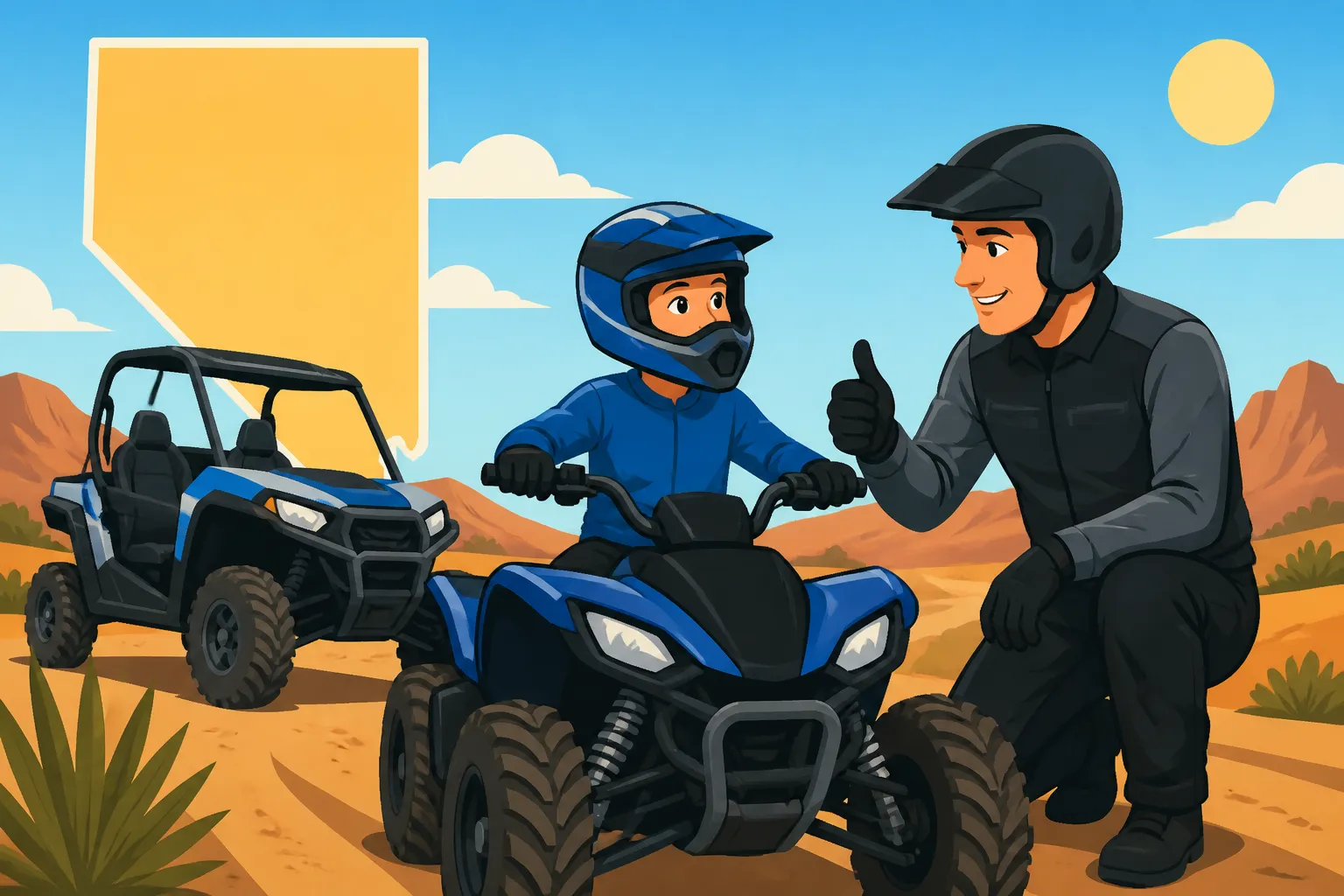
Before riding, explain the controls and agree on simple signals for stop, slow down, and get help. Demonstrate each one at walking pace in a clear area. Give the child time to practice starting, stopping, steering, and turning without pressure to keep up with a group. Keep the first outing short enough that fatigue does not become the deciding factor.
A useful progression is:
- Check the fit. Confirm that the child can sit securely, reach the controls, and move their body without losing balance.
- Explain the boundaries. Point out where the practice area ends and where the child must not go.
- Demonstrate the controls. Show how to start, accelerate gently, brake, and stop before the child takes a turn.
- Practice one skill at a time. Begin on easy, open ground; add turns and uneven terrain only when the child is comfortable and in control.
- Stop when attention fades. End the session if the child is tired, upset, distracted, or struggling to follow directions.
For protective gear, prioritize a properly fitted helmet and clothing that covers exposed skin, along with eye protection, gloves, and sturdy footwear. Check fit before heading out: loose gear can interfere with controls, while gear that shifts can distract the rider. Do not rely on a product description alone to decide whether an item fits a child or suits the planned ride. If shopping through Amazon, compare the item’s sizing information and intended use carefully, then check the fit in person before riding.
The Nevada Off-Highway Vehicles Program promotes safe and responsible use of off-road recreation opportunities, according to the State of Nevada Department of Conservation and Natural Resources. That goal is a good standard for a family ride: the child should be able to follow instructions, the adult should be able to supervise without distraction, and the route should match the rider’s current ability.
Keep supervision active. Ride close enough to see and communicate with the child, choose a route where you can stop safely, and avoid splitting the group across terrain where the child disappears from view. Do not let speed, peer pressure, or a more experienced rider set the pace. A child who is comfortable on a flat practice area may still need more time before handling sand, rocks, slopes, or changing trail conditions.
Choose a manageable place and make a simple ride plan
A low-pressure location is often a better teaching environment than a popular, busy riding area. Look for open space, predictable ground, good visibility, and room to stop without blocking other riders. Avoid routes that demand difficult climbs, tight maneuvering, or fast decisions before the child has developed basic control.
Trail difficulty is not just about the surface. Traffic, dust, noise, visibility, weather, and the distance from help can change how challenging a route feels to a young rider. Start with the easiest suitable option available, and be ready to turn around. Nevada Trail Difficulty for Beginners can help you think through route selection; still confirm that the specific route is open and appropriate for your machine.
Before leaving, tell someone where you plan to ride and when you expect to return. Bring water, a first-aid kit, communication equipment that suits the area, and the supplies needed to deal with a minor breakdown. Keep the route and the day’s plan modest; a family ride is not a good time to test how far a child can go before becoming tired.
Nevada’s desert environment also calls for attention to wildlife and the trail surface. According to OFF-ROAD Nevada, desert tortoises are protected as a threatened species under the federal Endangered Species Act, and it is illegal to harass, harm, pursue, hunt, shoot, wound, kill, trap, capture, or collect a wild desert tortoise. OFF-ROAD Nevada advises OHV users to look underneath their tires for desert tortoises before moving their vehicle. Make that a deliberate part of the stop-and-start routine, especially when parked in habitat where wildlife may be difficult to see.
Stay on designated routes and trails to help limit the spread of weeds, as OFF-ROAD Nevada advises. The same source recommends washing the undercarriage and brushing dirt and mud from tires before entering and leaving a recreation site, and cleaning boots and other gear that can carry dirt and seeds. These habits help protect the areas where families ride and are easy to model for a child.
If the child is riding as a passenger rather than operating the machine, do not assume that passenger rules are the same as rules for an operator. Check the machine’s instructions and the applicable restrictions for the riding location before carrying a child. Nevada Rules for Riding a Passenger Off-Road is relevant if your plan involves a passenger.
Check the machine’s paperwork before the ride
A child’s readiness and a machine’s registration are separate matters. According to Off Road Nevada, Nevada OHV registration is annual and costs $20.00 as of November 2026. Off Road Nevada also says an OHV must be registered within 30 days of purchase from a dealer or private party. These requirements concern the machine and its owner, not whether the child has a driver’s license.
There is a visitor exception: according to Off Road Nevada, registration is not required if the OHV is registered or certified in another state and is located in Nevada for not more than 15 days. If that exception may apply, check the machine’s documentation and the official rules before relying on it. Do not assume that an out-of-state registration removes other restrictions or means the vehicle can be used on any route.
Registration and title are also different paperwork questions. Off Road Nevada says every owner of an OHV purchased on or after July 1, 2012, must obtain a certificate of title, and the owner must obtain the title within 30 days of purchase. For a used machine, ask the seller for the ownership paperwork and verify that the information matches the vehicle before you buy. Nevada OHV Registration and Proof of Ownership and Nevada OHV Registration Paperwork Checklist can help you identify what to check.
If you are buying a machine for a child, handle the paperwork before the first outing rather than treating it as an afterthought. According to Off Road Nevada, the fine for failing to register an OHV is $100 as of November 2026. Registration also supports the state’s OHV grant program: the Nevada Department of Motor Vehicles says funding for the program relies on revenue generated by the DMV’s Off-Highway Vehicle Registration Program. Nevada Fines for Riding Without Registration explains the registration-enforcement issue in more detail.
Registration is not a substitute for insurance on a road, and it does not grant permission to ride on a closed route. According to the Nevada Department of Motor Vehicles, Nevada law does not require liability insurance for OHVs because they may not be used on public roads and highways. Keep the distinction clear: this is a statement about OHV use under the rules described by the DMV, not a recommendation to go without insurance in every circumstance. Check the rules that apply if your planned use differs.
Before each outing, check that the decal and registration information are current and that you have the paperwork you need. If you are uncertain about a title, registration, or exception, contact the DMV OHV Unit for registration information; the Nevada Off-Highway Vehicles Program lists its phone number as 775.684.4381. Questions about access to a particular route should go to the land manager, since registration alone does not determine whether that route is open.
The practical bottom line is straightforward: Nevada does not set a minimum age or require a driver’s license for off-highway OHV operation, according to Off Road Nevada. A safe ride still depends on an appropriately fitted machine, a child who can follow directions, active adult supervision, suitable gear, current paperwork, and a route that matches the rider’s ability. Start small, keep the plan flexible, and stop before the child’s attention or control begins to slip.
Sources
- Off Road Nevada — Frequently asked questions about off-highway vehicle registration in Nevada | Off Road Nevada (checked November 3, 2026)
- Nevada Department of Motor Vehicles — Nevada DMV Off Highway Vehicle (checked November 3, 2026)
- Nevada Off-Highway Vehicles Program — Off-Road Nevada | OFF-ROAD Nevada (checked November 3, 2026)
- State of Nevada Department of Conservation and Natural Resources — About us | Off Road Nevada (checked November 3, 2026)
- Department of Motor Vehicles — Register your Off-Highway Vehicle | Off Road Nevada (checked November 3, 2026)
- OFF-ROAD Nevada — Tortoise & Invasive Species Awareness | OFF-ROAD Nevada (checked November 3, 2026)
- Nevada Commission on Off-Highway Vehicles — Nevada Commission on Off-Highway Vehicles | OFF-ROAD Nevada | Off Road Nevada (checked November 3, 2026)
Disclaimer
This article is for general informational purposes only and does not constitute professional advice. Laws, prices and regulations vary by location and change over time. Consult a qualified professional for guidance on your specific situation.