The Voluntary Nevada Offroad Course
A voluntary Nevada offroad course can help you feel more prepared before taking an ATV or UTV onto public land, especially if you are new to riding or teaching a young rider. The key is knowing what the course can teach, what it cannot certify, and how it fits alongside Nevada registration, land-access rules, and supervision requirements.
What a voluntary Nevada offroad course does
A rider education course is a structured way to learn safe operating habits before a ride. Depending on the provider, it may be online, in person, or a mix of classroom instruction and hands-on practice. The course may cover basic controls, protective equipment, hazard awareness, riding etiquette, and what to do when a machine breaks down or someone is hurt.
“Voluntary” matters. Nevada does not generally require an off-road safety course certificate simply to operate an ATV or UTV off-road. A course is an educational choice, not a substitute for a registration decal, permission to use a route, or compliance with land-management rules. For the legal distinction, see Nevada Has No Mandatory Safety Course.
Course formats and lesson details vary. An online class can be a convenient way to learn terminology and think through decisions, but it cannot show whether you can safely control a particular machine on uneven ground. An instructor-led session may give you a chance to practice, but the amount of riding time and the skills covered depend on the provider.
Before enrolling, check what the course actually includes. A title such as “ATV safety” does not automatically mean the course covers UTV operation, Nevada-specific rules, or hands-on skills. If you ride more than one type of machine, make sure the lessons apply to each one.
A course can be useful even if you have ridden for years. Familiarity is not the same as current knowledge: you may have picked up habits that work on familiar terrain but fail in sand, loose rock, steep grades, or an unfamiliar group ride. Training can also give parents and riding partners a shared vocabulary for discussing speed, spacing, hand signals, and when to stop.
It helps to separate three things that are often confused:
- Education: A course teaches safe decisions and operating skills.
- Registration: Nevada’s OHV decal addresses the machine’s registration obligations and serves as the riding permit in applicable settings. See Nevada’s Registration Decal as Your Permit.
- Access: The fact that a machine is registered does not mean every road, trail, or parcel is open to riding.
A course may improve your preparation, but it does not turn a closed route into an open one or make an unregistered machine compliant. Treat it as one part of responsible ride planning.
Who benefits from taking a course
New riders are the obvious candidates, but they are not the only ones. A course can help anyone who wants to replace guesswork with a repeatable approach to basic riding decisions.
First-time ATV and UTV riders
A first ride can feel simple in a parking area and become challenging quickly once the terrain changes. A rider needs to understand how steering, throttle, braking, body position, and momentum affect the machine. A course can introduce those ideas before the rider has to manage them while navigating rocks, soft sand, ruts, or traffic.
ATVs and UTVs also handle differently. An ATV is generally operated by a rider who steers with handlebars and shifts body weight. A UTV has a steering wheel and seats, but its size, weight, and passenger arrangement create different considerations. Training for one machine should not be assumed to cover the other in equal depth.
Parents and young riders
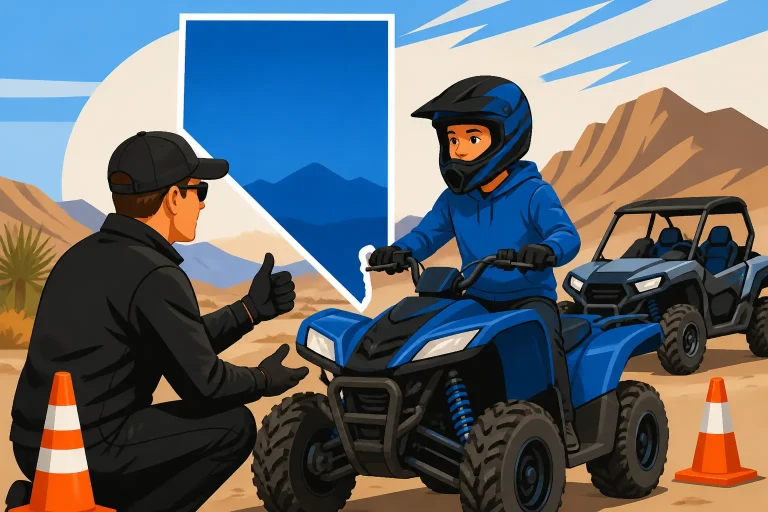
For a young rider, training can establish the idea that safe riding is a set of decisions, not just a matter of courage or speed. A child may benefit from learning when to slow down, how to scan for hazards, how to stop safely, and why it is important to stay within the rider’s ability.
A course does not replace an adult’s responsibility to select an appropriate machine, supervise the ride, and choose suitable terrain. Nevada rules for youth operation and supervision still apply. Review [Nevada Minimum Age to Ride Off-Road] and Nevada Rules for a Youth Machine on Public Land before taking a young rider out. For a more practical look at instruction beyond an online class, see Hands-On Training for Riders Under 16.
Parents should also consider whether the course matches the machine the child will ride. A rider who has completed a general ATV lesson may still need instruction and close practice before using a different size or style of ATV. A UTV passenger, meanwhile, needs to understand passenger safety even if they are not driving.
Experienced riders and group leaders
Experience helps, but it can also encourage overconfidence. Riders who have spent years on one familiar trail may not have had to make decisions around new terrain, unfamiliar machines, or a group with mixed experience. A refresher can help identify risky habits and reinforce practical routines.
Group leaders can benefit from training because they are often responsible for more than their own riding. They may need to set a pace, give clear pre-ride instructions, keep the group together, and respond calmly when someone has a mechanical problem or injury. A safety course does not make someone a professional guide, but it can help a leader recognize what needs attention before a ride begins.
Riders visiting Nevada
Visitors may be familiar with another state’s course or registration system. That experience can help, but it does not answer every Nevada question. A safety certificate is not the same as a Nevada OHV decal, and a visitor should separately check registration, reciprocity, and route restrictions.
For example, riders arriving with another state’s decal can review Nevada OHV Reciprocity With California or the page for their own state. The broader overview, Nevada OHV Permits Explained, helps distinguish a riding permit from other requirements. When planning a Nevada trip, check these details even if you have completed a course elsewhere.
What to look for when choosing a course
Because training is voluntary, the important question is not simply whether a course exists. It is whether the course suits your rider, machine, and intended use.
Start by identifying the format. An online course may work well for learning concepts at home and completing lessons at a convenient pace. In-person instruction can provide a chance to ask questions and, in some cases, practice skills. Some programs combine both. Confirm the format before enrolling rather than assuming that a course advertised as rider education includes time on a machine.
Next, check the scope. Look for clear information about:
- Whether the course is designed for ATV riders, UTV drivers, or both
- The age and experience level it is intended for
- Whether it discusses protective equipment and pre-ride checks
- Whether it covers riding in groups and responding to emergencies
- Whether it addresses the terrain or conditions you expect to encounter
- Whether there is a practical component, and what that component involves
- What proof of completion the provider issues, if any
A completion card can be useful as a record of training, but do not assume it is an official Nevada credential or that every organization will accept it for every purpose. If a club, rental company, employer, organized event, or other program asks for training, ask that organization which courses it accepts. The provider can explain its own certificate; the requesting organization decides whether that certificate meets its requirements.
Online learning versus hands-on practice
| Course format | What it can do well | What it may not provide |
|---|---|---|
| Online course | Introduce safety concepts, legal awareness, and decision-making at a flexible pace | Feedback on riding posture, braking, turning, or machine control |
| In-person classroom | Allow questions and discussion with an instructor | Practical riding unless the course specifically includes it |
| Hands-on instruction | Let riders practice skills and receive feedback in a controlled setting | A guarantee that the rider is ready for every trail or condition |
| Combined course | Pair knowledge with practical instruction when both are included | A replacement for continued practice and careful route selection |
An online course is a starting point, not proof that someone can safely handle a machine. After classroom or online learning, practice basic controls in a legal, low-risk area before attempting a challenging route. Keep the practice session focused: stopping, starting, turning, controlling speed, and responding to surface changes are more valuable than trying to cover difficult terrain quickly.
A hands-on course also has limits. A controlled practice area is not the same as a busy trail system, a steep dune, or a remote route with little support. Use instruction to build fundamentals, then continue to make conservative choices in the field.
Verify Nevada-specific information
Some courses are national in scope and may not explain Nevada’s rules in detail. That does not make them useless, but it means you should supplement them with current state and land-manager information. Check the rules that apply to your machine and destination rather than relying on a general course to answer every local question.
The Nevada Offroad Association is one organization riders may encounter while looking for education and off-road information. Its role is separate from the state’s registration process; see The Nevada Offroad Association’s Role. Before relying on a course or certificate, confirm who provides it and what the provider says it covers.
How to get practical value from the training
The strongest benefit comes when lessons turn into habits. A course is easier to remember if you connect each topic to a specific action before, during, and after a ride.
Before leaving
Use the course as a reason to make a repeatable pre-ride routine. Check the machine’s controls, tires, fuel, lights, and other safety-related components. Carry the documents you need and make sure your route is open to your type of machine. Do not assume that a trail shown on a map remains open or that a route is suitable for a new rider.
Choose a ride that fits the least experienced person in the group. If a course teaches riders to assess risk, apply that principle to the day’s terrain, weather, distance, and available communication. A route that is manageable for an experienced driver may be a poor choice for a beginner or a young rider.
Tell someone who is not riding where the group plans to go and when it expects to return. In remote areas, a small delay can become serious if the machine breaks down, a rider is injured, or weather changes. Bring enough water and essential supplies for the route, and do not treat a safety course as a substitute for preparation.
During the ride
Course concepts should show up in how the group rides. Keep speeds appropriate to visibility and terrain. Leave space between machines so a sudden stop or a dust cloud does not create a collision. Stop in a safe place when riders need to regroup or discuss a route choice.
Riders should not feel pressured to follow a faster machine into terrain they cannot handle. A sensible group agrees on a pace and a way to regroup before entering a narrow or confusing section. A new rider should be able to ask for a break, turn around, or take an easier route without embarrassment.
A course can also help riders recognize the difference between a challenge and a hazard. Loose surfaces, blind rises, steep side slopes, water, unstable ground, and hidden obstacles require more than confidence. If the rider is unsure whether the machine can safely proceed, stopping and reassessing is a better skill than pushing on.
After the ride
Review what went well and what felt difficult while the experience is fresh. Did the route match the group’s ability? Did riders keep enough distance? Were instructions clear? Did anyone struggle with controls or become tired? Those answers can shape the next practice session or help you decide whether more instruction would be useful.
A certificate, if the provider issues one, is only a record of course completion. It does not measure every skill a rider may need later. Continue to build ability gradually, especially when changing machines or moving to more demanding terrain.
What the course does not replace
A voluntary course is not a pass that covers legal or practical requirements. It is important to keep the boundaries clear, especially when planning a ride in Nevada.
Registration and permits
Training does not register a machine. It does not provide the Nevada decal, satisfy ownership paperwork, or resolve a registration problem. Riders should confirm what applies to their machine and situation separately. The state’s OHV registration rules are covered in Nevada OHV Permits Explained, including the distinction between registration and riding access.
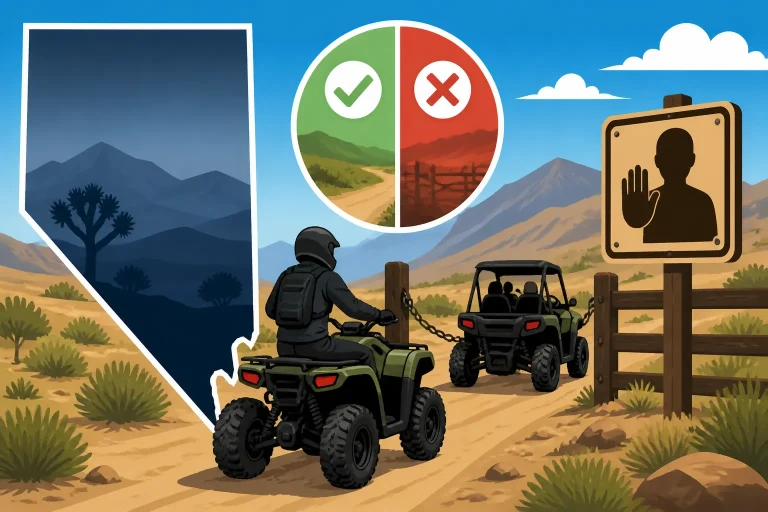
A decal also does not authorize riding everywhere. Public land may have designated routes, seasonal closures, vehicle restrictions, or boundaries that riders must respect. Private land requires permission. A machine that is properly registered can still be ridden unlawfully if it is taken onto a closed route or private property without authorization.
Supervision and machine suitability
A course does not remove supervision requirements that apply to young riders, nor does it make an oversized or unsuitable machine appropriate for a child. Adults should match the machine to the rider’s size, judgment, and demonstrated control. They should also supervise closely enough to intervene before a small mistake becomes a serious one.
Do not treat course completion as a reason to reduce oversight. Children may understand safety concepts and still lack the judgment or coordination needed to manage a fast-changing situation. Review the applicable age and supervision rules before riding, then set limits based on the individual rider rather than the certificate.
Trail and road rules
A safety course does not make an off-road machine street legal or authorize it to travel on a road. Road use has separate rules, equipment requirements, and restrictions. If you plan to ride on a road, check the requirements for that kind of use rather than assuming that off-road training covers them.
Likewise, a general course may not address the rules for a particular recreation area. Before heading out, confirm current closures, permitted routes, and local restrictions with the relevant land manager. Conditions and access can change, so a course taken earlier is not a current trail-status update.
Rental, event, and employer requirements
A rental company, organized event, club, or employer may set its own training or experience conditions. A voluntary course may help you prepare, but it may not meet that organization’s specific requirement. Ask the organization what it accepts before booking or arriving.
If a provider or event asks for a certificate, confirm the course name, format, and acceptable proof directly with them. Do not assume that a course completion card from one program transfers automatically to another. The relevant organization’s rules control participation, while Nevada’s laws and land-use rules continue to apply separately.
Frequently Asked Questions
Is a Nevada offroad course required to ride an ATV or UTV?
A safety course is generally voluntary for off-road riding in Nevada. That does not remove registration, supervision, or land-access requirements. Check the rules for your machine and the location where you plan to ride.
Does an online course qualify as hands-on training?
No. An online course can teach concepts, but it does not provide physical practice or instructor feedback on machine control. Check the course description to see whether it includes in-person instruction.
Will a course certificate replace an OHV decal?
No. A course certificate is not a registration decal or riding permit. Check registration requirements separately, including any rules that apply to visitors or machines registered elsewhere.
Should a young rider take a course?
A course can help a young rider learn safer habits, but it does not replace adult supervision or the need to choose an appropriate machine and route. Review Nevada’s youth-riding rules and consider hands-on instruction.
Does taking a course make every trail suitable?
No. Training can improve judgment, but riders still need to assess their skills, machine, terrain, weather, and route conditions. Choose rides that match the least experienced person in the group.
Disclaimer
This article is for general informational purposes only and does not constitute professional advice. Laws, prices and regulations vary by location and change over time. Consult a qualified professional for guidance on your specific situation.