Nevada Fees That Fund Trail Work
Nevada riders often see an OHV decal, a recreation-site pass and other fees as one pot of money. They are not. Knowing which charges support statewide trail work—and which pay for a particular site or event—helps explain where the money goes and what your payment does not guarantee.
How Nevada OHV decal revenue supports trail work
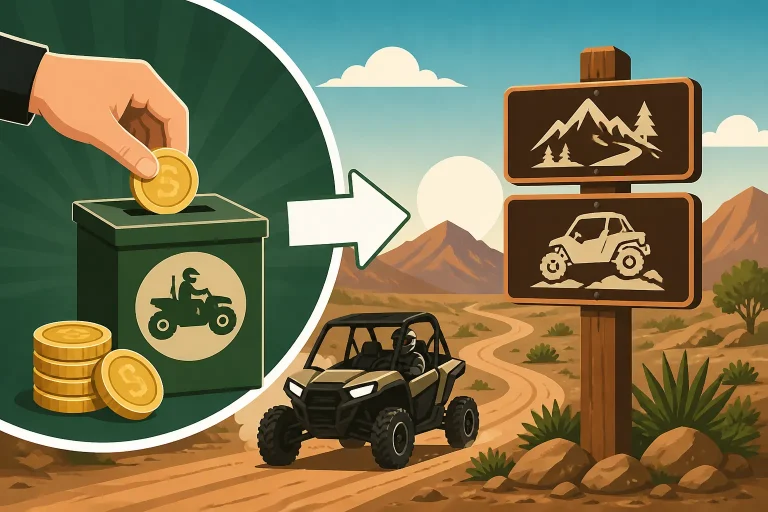
Nevada’s OHV registration decal is more than proof that a machine has been registered. Revenue from the state’s OHV program supports projects and services intended to improve off-highway riding opportunities. The Nevada Commission on Off-Highway Vehicles helps direct that support through a grant program, while the DMV handles registration administration.
That arrangement matters: buying a decal does not mean your payment is reserved for the trail you ride most, or that a particular site receives an automatic share. The money supports a statewide program, and projects must fit the program’s rules and priorities. A grant may help fund work at one location while another area receives support in a different year—or not at all.
The decal also serves as Nevada’s OHV permit. Nevada does not generally sell a separate statewide trail sticker alongside registration. See Nevada’s Registration Decal as Your Permit for how that role works, and Nevada OHV Grant Program Explained for more on the grant process.
Projects supported by OHV program funding may address practical needs such as trail planning, route signs, maintenance, facilities, rider education or other eligible work. The exact activities depend on the program’s current requirements and the approved project. “Trail work” can mean more than grading a route: clear maps and signs, safe staging areas and basic facilities can all help riders use an area responsibly.
| Type of charge | What it generally supports | What it does not necessarily mean |
|---|---|---|
| Nevada OHV registration decal | The statewide OHV program, including eligible projects and services | Your favorite trail receives your individual payment |
| Recreation-site pass or fee | Management and services at a particular fee site | The fee replaces Nevada OHV registration |
| Event or organized-ride permit | Review and conditions for a specific organized activity | The permit pays for routine work across Nevada |
| Optional purchase or service | The item or service provided by that seller | It is a state trail-maintenance contribution |
The state program is not a promise that every route will be maintained to a particular standard. Public lands may have different managers, budgets and travel rules. Some routes are remote, informal or subject to closures, and the agency responsible for a site may not be the same entity that administers Nevada OHV registration.
For a closer look at how registration revenue and administrative responsibilities fit together, read Why the Commission Spends What the DMV Collects and What Trail Money Comes Out of a Decal Sale. Those distinctions help explain why a registration fee can contribute to trail opportunities without functioning like a personal maintenance subscription.
How fees become projects on the ground
The path from a rider’s decal purchase to a sign, restroom or maintained route is not usually a direct transaction. Registration revenue enters a statewide funding process. Eligible applicants propose work, the program reviews projects, and approved funding is used according to the award’s conditions. The work may involve planning, construction, maintenance or other activities that fit the program.
This process has a useful purpose: it allows funding to support projects that serve riders and public land management needs, rather than tying each purchase to one location. A project might improve wayfinding in a popular riding area, address a safety or access issue, or provide facilities that help keep activity organized. Funding priorities and eligible costs can change, so applicants and riders should check current program information rather than assume a particular expense qualifies.
Grants also take time. A proposal may need planning, land-manager coordination, environmental review or other approvals before work begins. Even after a project is approved, weather, access, contracting and seasonal restrictions can affect when improvements appear. A decal payment should therefore be understood as support for a larger system, not a guarantee that a visible improvement will happen immediately.
It is also worth separating project funding from day-to-day management. A grant may help pay for a defined improvement, but it does not necessarily cover every future maintenance need at that location. Site managers may rely on other budgets, partners or fee revenue for ongoing operations. A new sign or facility is easy to notice; less visible work, such as route planning or coordination, can also be important.
The state OHV program and the land manager have different roles. Nevada registration supports the OHV funding system, but a federal or local land manager may decide which routes are open and how a particular area is managed. Decal ownership does not give permission to ride a closed route, cross private land or ignore a seasonal restriction. Before a trip, check the relevant manager’s current maps and notices as well as your machine’s registration status.
For fees tied to registration itself, Nevada OHV Registration Fee for One Year and Nevada OHV Registration Fee for Three Years explain the difference between the registration options. The current amount and requirements should be confirmed with the official Nevada OHV registration information, since fees and procedures can change.
Why a site pass or event permit is a different fee
Some Nevada riding areas charge a separate recreation fee. That payment is tied to a particular site or experience; it is not the same charge as the statewide OHV decal. Paying a site fee does not automatically register an unregistered machine, and having a decal does not necessarily cover a separate fee that a recreation area requires.
Sand Mountain is a familiar example of a pay-to-ride dune area. Its site pass is separate from Nevada OHV registration and is associated with access and management at that recreation area. The state decal and the site pass serve different purposes: one is part of Nevada’s OHV registration system, while the other applies to a specific place. Check current site rules, pass options and payment instructions before traveling. See Nevada’s Only Pay-to-Ride Dune and Sand Mountain’s $40 Weekly Pass for related details, and Why Sand Mountain Charges and Logandale Does Not for context on why nearby riding areas can have different fee arrangements.
Other areas may not charge a day-use fee, but that does not mean they have no operating costs or receive no support. An area’s budget can involve land-manager funding, grants, partnerships or other sources. Likewise, a fee at one site should not be assumed to pay for work at every Nevada OHV area.
Organized group rides, competitions and commercial activities can involve yet another kind of permission. A land manager may require an event permit to review the activity, location, timing, group size or effects on public land. That permit is about conducting the proposed activity under specified conditions. It is not a substitute for individual registration or any site pass that applies. Requirements depend on the event and the managing agency; organizers should contact the land manager early and confirm the current process.
A few common situations make the distinction clearer:
- A registered Nevada machine at a fee recreation site: The decal covers the state OHV registration requirement, but the site may still require a separate pass.
- A registered machine at a no-fee riding area: There may be no site payment, but registration, route restrictions and other applicable rules still matter.
- An organized ride on public land: Registration for each machine does not necessarily authorize the event; organizers may need separate approval.
- A visitor riding with an out-of-state registration: Reciprocity rules may apply, but they do not automatically eliminate a separate recreation-site fee or an event permit requirement.
For visitor rules, Nevada OHV Reciprocity With Other States explains why a state registration question is separate from a fee charged at a specific riding area. For event requirements, review Permits for an Organized Nevada Group Ride before advertising or scheduling a large ride.
How to check where a fee goes before you pay
Start by identifying the charge. Is it for registering a machine, entering a recreation site, participating in an event, or buying a service? A checkout page or receipt should make the payment’s purpose reasonably clear. If it does not, ask the agency or provider what the fee covers before relying on it.
Then confirm the responsible organization. Nevada OHV registration questions belong with the state’s OHV registration channels. Recreation-area fees should be checked with the land manager or site operator. Event permits should be confirmed with the agency that manages the land where the activity will take place. A retailer, tour operator or event organizer may collect money, but that does not mean every charge they collect is a state OHV fee.
When reviewing an explanation of program spending, look for the difference between a source of money and an approved use. Registration revenue may help fund eligible projects, but it does not mean all revenue is spent on one category or one trail. A grant award may cover specific work, and the award’s conditions determine how the funding can be used. If you want to understand a project at a particular area, check the grant or project details and ask the relevant land manager what was funded.
Before riding, use this simple checklist:
- Confirm that the machine has the registration or valid out-of-state status required for the trip.
- Check whether the destination charges a separate recreation fee or requires a pass.
- If you are organizing an event, ask the land manager whether a permit or advance approval is needed.
- Check current route maps, closures and site notices; a fee payment does not open a closed route.
- Keep proof of registration and any separate pass or permit available during the ride.
This approach prevents a common mix-up: assuming that one payment covers everything. Nevada OHV decal revenue supports a statewide system, while site fees and event permits address separate needs. Each payment can play a role in keeping riding areas usable, but none should be treated as a blanket right to ride wherever or whenever you choose.
Disclaimer
This article is for general informational purposes only and does not constitute professional advice. Laws, prices and regulations vary by location and change over time. Consult a qualified professional for guidance on your specific situation.