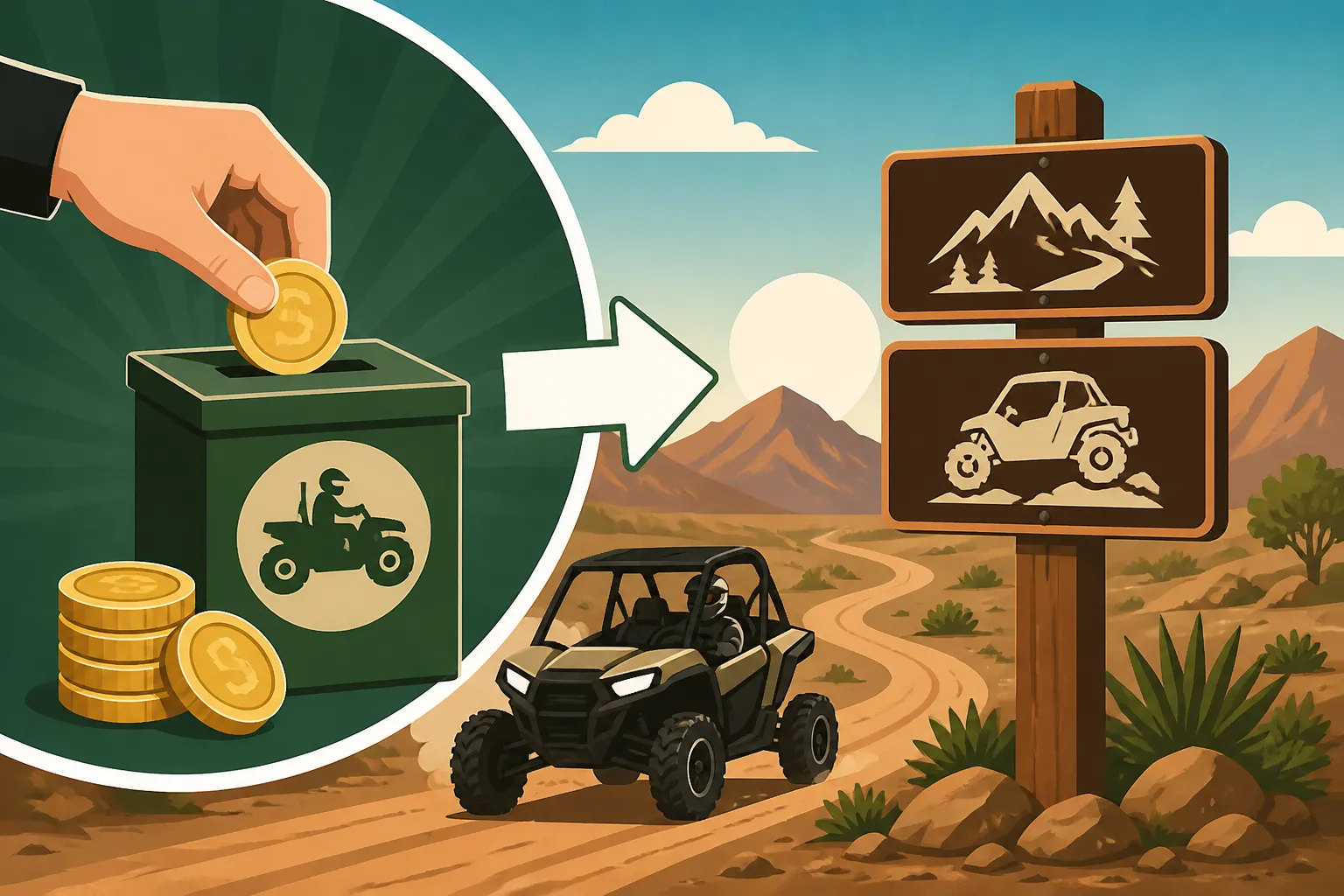
Where Fees Fund Trail Signs
Nevada OHV registration fees help support trail signs, but they do not flow straight from an individual decal to a specific sign. The money feeds a grant program, where eligible groups and public agencies can seek funding for maps, signs and other recreation projects. Understanding that process helps riders see what registration revenue can support—and what it cannot promise.
How registration revenue reaches trail signs
Nevada’s off-highway vehicle registration program generates revenue that helps fund the state’s OHV grant program. The Department of Motor Vehicles says funding for the grant program relies on revenue from its OHV Registration Program. The Nevada Off-Highway Vehicles Grant Program describes the broader purpose: investing registration dollars in trails, public lands and recreation infrastructure.
That does not mean a particular portion of every registration payment is automatically set aside for signs, or that a rider can trace their own fee to a particular trailhead. Rather, registration revenue supports a grant program that can award money to eligible projects. Signs are one possible use, alongside trail work, planning, facilities, restoration, training and enforcement.
According to Off Road Nevada, an annual OHV registration costs $20.00 as of November 2026. The fee applies to the registration program; the facts available about the grant program do not specify what share of revenue goes to signs or how much any one project receives. For a fuller explanation of the program’s funding role, see Where Nevada OHV Registration Money Goes and Nevada OHV Grant Program Explained.
The grants are not limited to trail signs. Eligible work can include developing plans, studies and environmental assessments; creating or improving trails and trailheads; maintaining existing facilities; restoring areas damaged by OHV use; and supporting safe, responsible riding. Grants can also fund maps and signs for OHV trails and facilities. A sign project therefore sits within a broader effort to make recreation areas usable, understandable and better managed.
This distinction matters when riders ask, “Where did my registration fee go?” The careful answer is that registration revenue helps support a grant program, and that program can fund sign projects when they are proposed and selected. It would be misleading to say every decal purchase pays directly for a particular sign, or that every trail sign in Nevada was funded through this program.
Nevada’s registration decal also serves a separate purpose for riders. For more on that role, read Nevada’s Registration Decal as Your Permit. The grant program is about funding OHV-related projects; the decal is part of the state’s registration system.
What trail-sign grants can support
Trail signs do more than point toward a route. They can help riders understand where travel is allowed, find a staging area, follow a route through a recreation site, and recognize places where they should not ride. Grant funding can support the creation and installation of maps and signs for OHV trails and facilities, but a useful sign project is often part of a larger site plan.
For example, a route may need signs at a trailhead as well as at turns, junctions or boundaries. A map at the staging area can give visitors an overview, while smaller signs along the route can help them stay oriented. If the project also includes a parking area or other facility, signs may help direct traffic and reduce confusion around the site. The program allows grants for trailheads, parking areas and supporting infrastructure, so applicants may be able to propose related improvements together.
Signage can also help protect natural and cultural resources. If a route passes near sensitive habitat or a restricted area, clear directions can steer riders toward designated routes and away from places where travel is not appropriate. That complements basic responsible-riding habits: stay on designated routes, avoid disturbing wildlife, and clean dirt and seeds from vehicles and gear before moving between recreation areas.
Signs are not a substitute for checking current route information. A sign can be damaged, obscured or out of date, and conditions can change. Use Nevada Trail Maps Worth Downloading to prepare before leaving, then follow posted directions on site. Nevada Trail Finder is also a resource for off-road trail maps throughout the state, according to the Nevada Off-Highway Vehicles Program.
A sign project may focus on different needs depending on the location. One proposal might emphasize route directions and maps; another could address staging-area access, safety information or boundaries. The grant program can support maps and signs, but project details depend on the applicant’s plan and the grant award. Riders should not assume that a specific trail has received funding simply because the program supports signage in general.
The same principle applies to maintenance. A new sign installation may help, but signs still need to remain legible and useful. Grant-funded improvements can maintain or enhance existing OHV trails and facilities, which may include work connected to existing infrastructure. The program facts do not promise a particular maintenance schedule for each sign or location, so riders should report unclear or damaged signage to the responsible land manager or agency rather than relying on a grant description as proof that it has been repaired.
Who can seek funding and what projects look like
The grant program is open to eligible applicants such as off-road clubs, nonprofit organizations, law enforcement agencies and government entities, according to Off Road Nevada. That creates a route for groups with local knowledge to propose improvements, while allowing public agencies to put forward projects tied to trail access, safety, education or management.
Applicants access grant applications through the Nevada Infrastructure Finance System. Off Road Nevada says applicants must notify the program after creating an account in the system. In practical terms, a project idea needs to be developed into an application through the program’s process; the existence of a need does not itself guarantee funding.
Examples from Off Road Nevada show how varied the program’s projects can be. BigHorn Outback Explorers Phase II includes installing OHV staging-area signage modeled on signage at Goldfield and Tonopah. The Nevada Offroad Association project includes statewide education, outreach, OHV access support and infrastructure improvements for the Johnson Lane Staging Area. The City of Fernley is developing an OHV trail plan for an open-space parcel intended for passive recreation and OHV trail use.
Other examples are not sign installations, but illustrate the range of needs the grant program can address. The Ward Mountain Off-Road Naturalist Trail project will create a virtual interpretive trail along the existing Ward Mountain Adventure Loop, with points of interest. The Humboldt County Sheriff’s Office project includes rider safety training, while the Storey County Sheriff’s Office is funding OHV enforcement, education and outreach. Together, these projects show that registration-supported grants can work on access, interpretation, safety and compliance as well as physical trail features.
For riders, the useful takeaway is not that every grant project will change the trail they ride most often. It is that the program provides a funding path for qualified organizations and agencies to propose OHV-related improvements. Some projects are visible on the ground, such as staging-area signs; others may be planning, education or restoration work that is less obvious during a ride.
To understand a particular project, look for its stated location, scope and implementing organization in the program’s project information. A proposal to create signs is not the same thing as a completed installation, and a statewide education project is not necessarily a trail-maintenance project. When a local club or agency is involved, it may also be able to explain what the work is intended to accomplish and how riders can support it.
What riders can do with this information
Riders can make better use of trail signs by treating them as one part of trip planning, not the whole plan. Before heading out, check a current map, confirm where the route begins and understand that conditions or access rules may differ by area. On the trail, follow posted signs and stay on designated routes. These habits support the purpose of signage and reduce avoidable damage to land and habitat.
If a sign is missing, hard to read or confusing, note where it is and what information is needed. A clear report is more useful than a general complaint: identify the trail or staging area, describe the problem, and, when practical, provide a photo or location details. Contact the land manager or the organization responsible for the site. The grant program can fund eligible improvements, but it is not an instant repair service, and not every issue will be addressed through a grant.
Riders can also ask local OHV clubs or public agencies whether they are developing projects or seeking community input. Clubs and nonprofit organizations are among the eligible applicant types, and local groups may know which routes need better wayfinding or where a staging area could benefit from clearer information. A project proposal still has to fit grant requirements and go through the application process, but rider observations can help identify practical needs.
Good signage works best when riders help keep the trail usable. Stay on marked routes, avoid disturbing wildlife, and clean mud, dirt and seeds from tires, undercarriages, boots and gear before moving to another recreation site. Those steps reduce avoidable impacts and make route information more meaningful for the next visitor. For practical riding habits, see Nevada Trail Etiquette on Shared Dunes.
The central point is simple: Nevada OHV registration revenue supports a grant program that can fund maps and signs, along with many other trail and recreation projects. Grants are awarded for eligible proposals, so the fee does not guarantee a sign at a particular location. But when an organization identifies a need, develops a suitable project and secures funding, registration-supported grants can help turn a signage plan into a real improvement for riders.
Sources
- Off Road Nevada — Frequently asked questions about off-highway vehicle registration in Nevada | Off Road Nevada (checked November 3, 2026)
- Nevada Off-Highway Vehicles Program — Off-Road Nevada | OFF-ROAD Nevada (checked November 3, 2026)
- Off Road Nevada — grants | Off Road Nevada (checked November 3, 2026)
Disclaimer
This article is for general informational purposes only and does not constitute professional advice. Laws, prices and regulations vary by location and change over time. Consult a qualified professional for guidance on your specific situation.