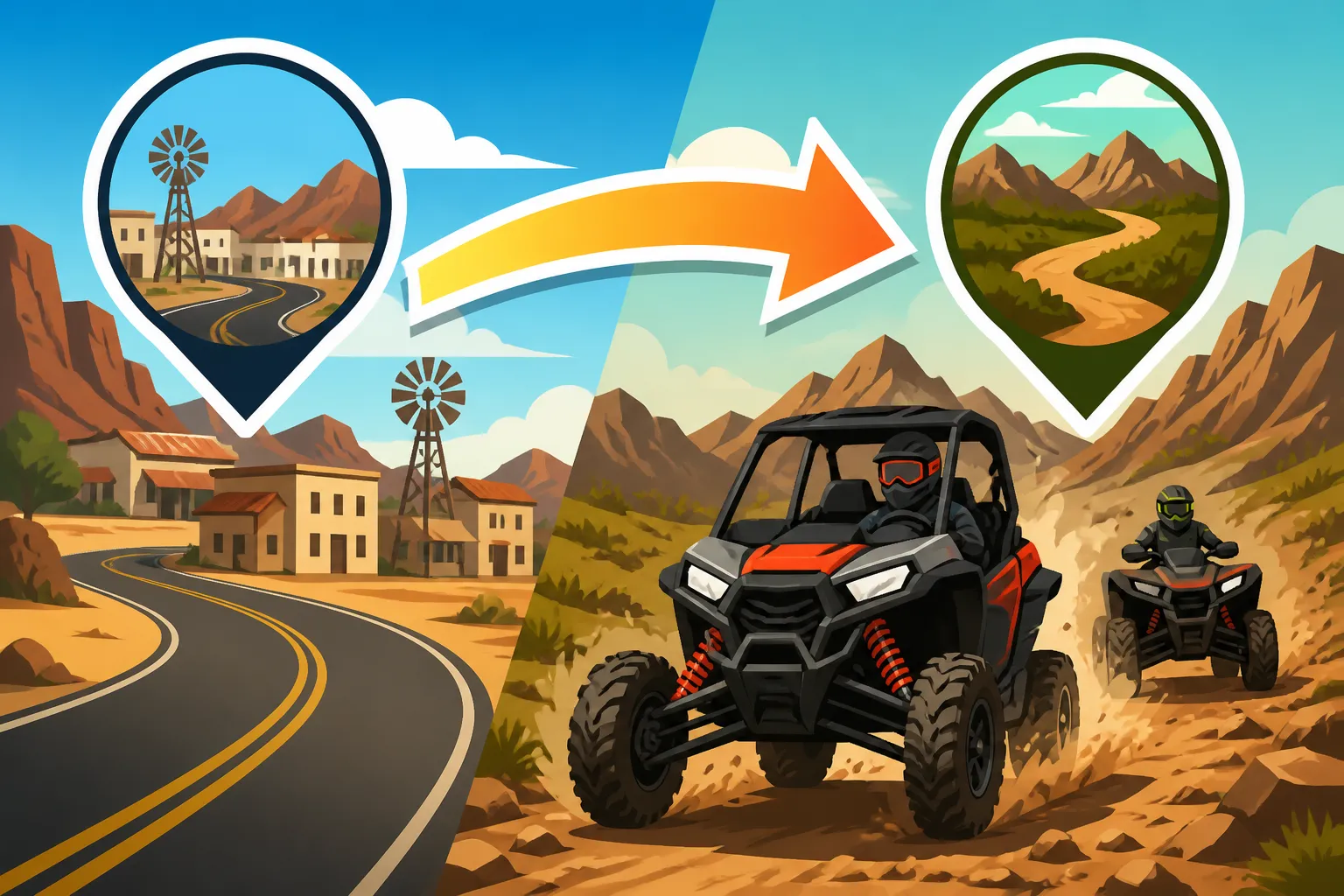
Getting From Logandale Town to the Trailhead
It’s a truly frustrating experience for many off-highway vehicle (OHV) enthusiasts: you pull into a beautiful, trail-adjacent town like Logandale, Nevada, ready for adventure, and the first question that hits you is, "Can I actually ride my quad or side-by-side from my campsite or hotel directly to the trailhead?" It seems like such a simple, logical thing to do, yet the rules around street legality for ATVs and UTVs in Nevada can feel like a tangled desert bush, making you second-guess every turn. This guide is here to untangle those rules, specifically focusing on how to get your machine from Logandale town to the incredible Logandale Trails system without running afoul of the law.
The Frustration of Getting to the Trailhead
Anyone who's ever trailered an ATV or UTV knows the drill: load it up, strap it down, drive to the staging area, unload, and then you can finally ride. It's a significant part of the ritual, but when you're staying just a stone's throw from some of the best trails Nevada has to offer, like those around Logandale, the thought of just hopping on and riding out of town is incredibly appealing.
The Allure of a Direct Ride
Imagine it: you wake up, grab a coffee, and instead of wrestling with tie-downs and ramps, you simply fire up your UTV and cruise a few blocks down a paved road, turn onto a dirt path, and you're immediately immersed in the stunning landscape of Logandale Trails. The convenience is unmatched, the sense of freedom immediate. It's the dream scenario for many riders, especially when a town feels so integrated with its surrounding outdoor recreation areas. This desire to minimize the "transport" part of the adventure and maximize the "riding" part is totally understandable. After all, your machine is built for the rugged outdoors, not for sitting on a trailer.
The Reality of Road Restrictions
Unfortunately, the reality often clashes with this idyllic vision. Public roads, even in small, rural towns, are generally governed by a different set of rules than open desert trails. What’s perfectly legal off-road – like riding without a windshield, having knobby tires, or lacking turn signals – can suddenly become a traffic infraction the moment your tires touch pavement. The state of Nevada, like many others, has specific statutes regarding the operation of off-highway vehicles on paved surfaces, and while there are exceptions, they’re not always straightforward or universally applied. This patchwork of rules can leave riders confused and concerned about inadvertently breaking the law or incurring a costly fine before their adventure even truly begins.
Nevada's General Rules for OHVs on Paved Roads
Before we dive into Logandale specifically, it's crucial to understand the foundational rules Nevada has in place for OHVs on public roads. Generally speaking, your typical ATV or UTV is not considered "street legal" in the same way a car or motorcycle is. Nevada Revised Statute (NRS) 490.060 specifically prohibits the operation of an OHV on a highway, with some very particular exceptions.
For many years, this meant riders had to trailer their machines to designated trailheads or face potential fines. However, Nevada has evolved some of its laws to better accommodate the growing popularity of OHVs, especially larger side-by-sides. These changes aim to balance rider access with public safety, creating a complex but navigable set of regulations.
The "Large ATV" Exception: A Ray of Hope?
One of the most significant changes came with the introduction of the "large all-terrain vehicle" designation, outlined in NRS 490.043. This is where the possibility of street-legal riding often begins for UTV owners. To qualify as a "large ATV," your machine must meet specific criteria, which typically include:
- Being designed by the manufacturer primarily for recreational use off highways.
- Having a width of 50 inches or more.
- Weighing 2,500 pounds or less.
- Having a non-straddle seat.
- Being designed to travel on four or more wheels.
Crucially, it also must have a truck bed or a seating capacity for at least two people, side-by-side. This last point is key: it generally excludes most traditional two-seat sport quads, as they don't have side-by-side seating or a truck bed. If your machine meets these criteria, it might be eligible for a special "Large ATV" decal, which allows it to be operated on certain public roads. You can find more details on [What Nevada's NRS 490.043 Counts as a Large ATV].
But here's the catch: even with a Large ATV decal, you can't just ride anywhere. The state allows counties to permit the use of these machines on "minor county roads" or "general county roads" through local ordinances. Without such an ordinance, the Large ATV decal doesn't grant you carte blanche to ride on paved roads. This means that rules can differ wildly from one county to the next, even within the same state.
The Two-Mile Crossing Rule
Even if your machine doesn't qualify as a "large ATV" or you're in a county without a specific ordinance for them, there's a limited exception for crossing paved roads. Nevada law generally allows an OHV to cross a highway, street, or road if it's done at approximately a 90-degree angle to the roadway and at a location where the operation is otherwise lawful. This crossing must be done safely and without undue interference with other traffic.
Furthermore, there's a provision that allows you to ride on the paved portion of a highway for up to two miles to connect to an unpaved road or trail. This is often referred to as the "2-mile rule" or "connector rule." It's not for cruising into town for groceries, but specifically for reaching an off-road area when a direct dirt path isn't available. This is a critical point for places like Logandale, where trail access might involve a short stretch of pavement. Remember, this still means you must adhere to all other applicable traffic laws, yield to conventional vehicles, and have the required equipment if you're venturing beyond just a simple perpendicular crossing. Always check for specific local variations to this rule. More information on [How Far You Can Ride Pavement in Nevada] is really helpful here.
The Power of Local Ordinances
This is where things get truly granular and location-specific. While Nevada state law provides the framework, individual counties, and sometimes even incorporated cities, have the authority to enact ordinances that either open up or further restrict OHV access on their roads. For example, some counties have fully embraced the "Large ATV" designation and have passed ordinances allowing properly equipped machines on most minor county roads, sometimes with speed limits or time-of-day restrictions. Other counties, often those with denser populations or specific concerns, might choose to prohibit OHVs entirely from their paved roads, or only allow them on very specific, designated routes.
It’s not enough to simply know the state law; you absolutely must check the local ordinances for the specific area you plan to ride. A quick call to the county sheriff's department or checking the county's official website can save you a lot of headache. This local control is why what's perfectly fine in rural Elko County might get you a ticket in parts of Washoe County. The key takeaway here is that "street legal" for an OHV is often less about state law alone and more about a combination of state law and local ordinance.
Navigating Logandale: What the Locals Know
Now, let's bring it back to Logandale. This community is nestled in Clark County, a vast and diverse region that includes both the bustling Las Vegas metropolitan area and expansive rural landscapes like Logandale. Understanding Clark County's specific ordinances is paramount for anyone hoping to ride their OHV from town to the Logandale Trails.
Understanding Clark County's Approach
Clark County has indeed adopted ordinances that allow for the operation of "Large ATVs" (as defined by NRS 490.043) on certain county roads. This is great news for UTV owners whose machines meet the state's criteria. However, it's not a free-for-all. Typically, these ordinances specify that such machines can be operated on "general county roads" or "minor county roads," and often explicitly exclude major arterial roads, state highways (like SR 169 that runs through Logandale), and incorporated city streets (though Logandale itself is unincorporated). The primary intent is to facilitate access to public lands and trail systems, not to allow full integration into urban traffic.
This means that while you might be able to ride a properly equipped UTV on some of the smaller, residential roads within Logandale to reach the boundary of the Logandale Trails area, you generally cannot ride on state routes or through other major developed areas without specific designation. The goal is often to connect a rider from their staging point (like a home or campground) directly to the unpaved trail system, avoiding the need for a trailer for short distances. Always look for signage; designated OHV routes, where they exist, are often clearly marked. Ignoring these local nuances is a common pitfall for even experienced riders.
Designated Routes and Unpaved Connectors in Logandale
Logandale is unique because it's a small community deeply intertwined with the Logandale Trails system, which is a massive 45,000-acre network of trails managed by the Bureau of Land Management (BLM). The community itself has a more relaxed, rural feel, and local authorities often understand the importance of OHV tourism to the area.
You'll find that many of the residential roads on the outskirts of Logandale transition pretty seamlessly into the BLM access roads and unpaved sections of the Logandale Trails. For properly equipped "Large ATVs," these unpaved county roads often serve as the bridge from the residential areas to the heart of the trail system. It's not uncommon to see UTVs on these roads, especially on weekends. However, always exercise caution and respect posted speed limits, as these are still shared roads with cars and local residents. The key is to know exactly where the paved county roads end and the designated unpaved routes begin, and to ensure your machine and your driving behavior comply with all regulations on the paved sections. This is where understanding [Riding from Logandale Town to the Trailhead] becomes specifically relevant.
Essential Equipment for Road-Legal Transit
If your machine qualifies as a "Large ATV" and you're in an area that permits its use on specific roads, you're not just ready to roll. Your OHV must be equipped with certain safety features to operate legally on any paved road, even for short distances. This isn't just about avoiding a ticket; it's about making your machine visible and controllable in a mixed-traffic environment.
Here’s a checklist of common requirements:
- Headlights: Must be on, day or night, and visible from at least 500 feet.
- Taillights: Must be on, visible from at least 500 feet to the rear.
- Stop Lamps (Brake Lights): Must illuminate when the brakes are applied.
- Reflectors: Often required on the sides and rear, though a functioning taillight can sometimes substitute for rear reflectors.
- Mirrors: At least one rearview mirror, typically on the left side, but often two (one on each side) are recommended for better visibility, especially with side-by-sides. Reputable aftermarket brands like SuperATV offer a range of robust and adjustable mirrors that are perfect for meeting these requirements.
- Horn: A functional horn that can be heard from a reasonable distance. Again, SuperATV has horn kits that are easy to install and meet these specifications.
- Spark Arrester: A U.S. Forest Service-approved spark arrester is usually required both on-road and off-road to prevent wildfires.
- Muffler: Must be in good working order to prevent excessive noise.
- Seat Belts: If your machine has seats and is designed for passengers, seat belts are mandatory for all occupants on roads.
- Windshield: While not always explicitly required for all OHVs, many "Large ATVs" designed for road use will have some form of windshield for safety and comfort.
Failing to have any of these can negate your "street legal" status for that particular ride and could result in a citation. It’s always best to err on the side of caution and ensure your machine is fully equipped. Think of it this way: if you're going to share the road with cars, your machine needs to be seen and heard just like them.
Practical Considerations and Safe Practices
Even when you've done your homework and your machine is fully compliant, there are still practical considerations and safety practices that should guide your decision to ride your OHV on paved roads in Logandale or anywhere else in Nevada.
Driver and Insurance Requirements for Road Use
Just like any other vehicle on a public road, the operator of a "Large ATV" must meet certain qualifications.
- Driver's License: You must possess a valid driver's license. This isn't a situation where an OHV safety course certificate alone will suffice; it's a motor vehicle on a public road, so a regular driver's license is essential. [Nevada Driver's License Rules for UTV Road Use] outlines this clearly.
- Insurance: Nevada requires liability insurance for any motor vehicle operated on its public roads. For a "Large ATV" that's going to spend any time on pavement, even just to reach the trail, you absolutely must have proof of liability insurance. This protects you and others in case of an accident. Your existing auto insurance policy might extend to your OHV, or you might need a separate OHV-specific policy. Always check with your insurance provider to ensure you have adequate coverage for road use. [Insurance and Nevada OHV Registration] gives more context on this.
- Age Limits: While Nevada's general OHV rules have age restrictions for off-road riding, when operating on a public road, the driver must meet the age requirements for holding a valid driver's license, typically 16 years old with certain provisional restrictions, or 18 for an unrestricted license. Supervising a rider under 16 on county roads is a whole other set of rules to contend with, typically not applicable for street-legal transit to a trailhead.
- Carrying Documents: Always carry your driver's license, proof of insurance, and your OHV registration (which includes the Large ATV decal if applicable) with you. Keep them in a waterproof bag or pouch; the desert environment can be harsh on paper.
Ensuring you meet all these personal requirements is just as important as having the right equipment on your machine. Ignoring these can lead to fines, citations, or even more serious legal trouble in the event of an incident. Many riders also enhance their UTV's safety beyond the minimum legal requirements, adding things like a full SuperATV windshield or a sturdy cage to further protect occupants when navigating mixed terrain.
When Trailering is Still Your Best Bet
Despite the possibilities for limited road use, there are still many scenarios where trailering your OHV remains the safest, most convenient, or even only legal option.
Consider these points:
- Longer Distances: If your lodging is more than a couple of miles from the main Logandale Trails access points, or if you need to cross a major highway, trailering is likely the smarter choice. The 2-mile rule is a connector, not an invitation for extended road trips.
- Uncertainty About Local Ordinances: If you're unsure about the specific ordinances in Logandale or Clark County, or if you're visiting from out of state and find the rules confusing, trailering eliminates the guesswork. It’s better to be safe than sorry, especially when a ticket could put a damper on your entire trip.
- Weather Conditions: Heavy rain, high winds, or low visibility can make riding an OHV on paved roads significantly more dangerous, even for short distances. Trailering provides a much safer mode of transport in adverse conditions.
- Machine Not a "Large ATV": If your quad or UTV doesn't meet Nevada's "Large ATV" definition, or if it lacks the necessary road-legal equipment, then trailering is your only legal option for getting it to the trails. Don't risk a ticket just for convenience.
- Passenger Comfort and Safety: While UTVs are designed to carry passengers, road vibration, exhaust fumes, and general discomfort can make short road trips unpleasant, especially for children. Trailering keeps everyone more comfortable until you hit the dirt.
Using a trailer also means you can carry more gear, fuel, and water, which is particularly important for longer rides into the Logandale Trails where amenities are scarce. While the idea of riding directly from your lodging to the trailhead is appealing, sometimes the traditional method is still the best.
| Requirement Category | General Nevada OHV Rule | "Large ATV" Street Legal Rule (if permitted by county) | Relevant for Logandale Transit |
|---|---|---|---|
| Registration/Decal | Required for public land use | Required (specific Large ATV decal) | Yes |
| Driver's License | Not required off-road (age/supervision rules apply) | Required (valid state DL) | Yes |
| Liability Insurance | Not required off-road | Required | Yes |
| Headlights | Required for night riding | Required (on during operation) | Yes |
| Taillights | Required for night riding | Required (on during operation) | Yes |
| Brake Lights | Not always required off-road | Required | Yes |
| Mirrors | Not required off-road | At least one rearview (left side), two recommended | Yes |
| Horn | Not required off-road | Required | Yes |
| Spark Arrester | Required (USFS approved) | Required (USFS approved) | Yes |
| Muffler | Required | Required (noise limits apply) | Yes |
| Seatbelts | OEM for UTVs | Required for all occupants | Yes |
| Road Access | Limited to 2-mile crossing | Limited to minor/general county roads (by ordinance) | Yes |
Getting from Logandale town to the Logandale Trails system on your ATV or UTV is possible, but it requires diligent preparation and a clear understanding of Nevada's complex, layered regulations. For UTV owners with "Large ATV" compliant machines, Clark County's ordinances offer a pathway to limited road use. However, ensuring your machine is properly equipped, you're legally licensed and insured, and you stick to designated routes is paramount. Always prioritize safety and local compliance, and when in doubt, the good old-fashioned trailer remains a reliable choice. The adventure on the trails is incredible, and getting there legally and safely is the first step to enjoying it fully.
Disclaimer
This article is for general informational purposes only and does not constitute professional advice. Laws, prices and regulations vary by location and change over time. Consult a qualified professional for guidance on your specific situation.