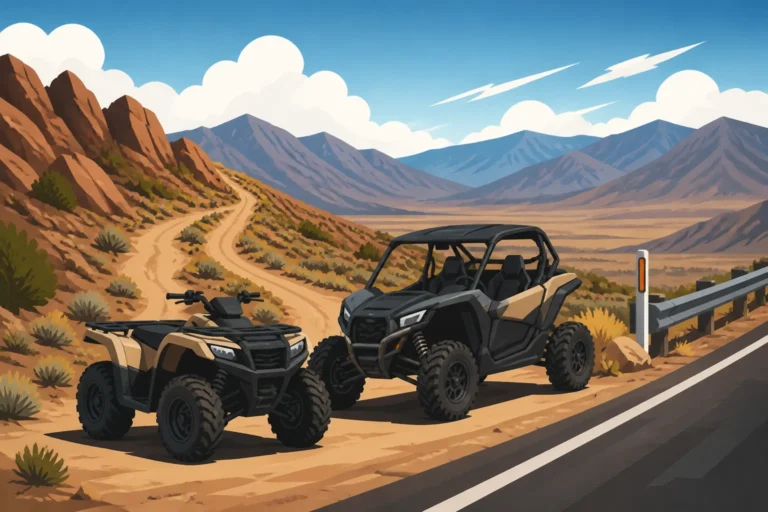
Breaking Down Far From the Trailhead
A breakdown miles from a Nevada trailhead can turn a fun ride into a long, hot wait, especially when cell service disappears and the route back is harder to follow than it looked on the map. This guide covers what to do first, how to signal for help, and what to carry so a mechanical problem or injury does not become a larger emergency.
What to do when your ATV or UTV breaks down
Stop, assess, and make the machine safe
When a machine quits, the first instinct is often to keep trying to restart it or push it toward the trailhead. Pause before doing either. Get yourself and any passengers away from traffic, steep edges, loose sand, and other immediate hazards. If you are on a narrow trail, move the machine only if it is safe to do so; a disabled UTV can block the route for other riders.
Check for obvious dangers such as smoke, leaking fuel, a hot engine, or damaged wiring. If you suspect a fuel or electrical problem, do not keep turning the ignition on. Shut the machine down, keep flames and smoking materials away, and give hot components time to cool. A small repair is not worth risking burns or a fire.
Take a moment to assess the people as well as the vehicle. Look for injuries, overheating, confusion, or signs that someone is becoming unwell. In Nevada’s dry climate, a rider may be dehydrated or overheated even if they do not feel especially sweaty. If someone is injured or seriously ill, treat that as the priority. Do not make a difficult recovery attempt just because the machine is inconveniently located.
Decide whether to troubleshoot or call for help
A quick check can solve some minor problems, but only if the machine is in a safe place and you know what you are doing. Check for a loose battery connection, a kill switch left in the wrong position, a dislodged belt guard, a blocked air intake, or a tire that has lost pressure. Follow the owner’s manual for troubleshooting, and do not reach near moving parts or work under a machine supported only by a jack.
Avoid repeatedly cranking the engine, especially if it is hot or making an unfamiliar sound. Stop if you smell fuel, see fluid leaking, hear a metallic knock, or suspect a damaged belt or drivetrain. Continuing to run a machine with a serious fault can turn a repairable issue into a more dangerous one.
If the problem is beyond a basic roadside check, contact your riding group or emergency services as appropriate. A tow or recovery may require a capable vehicle, a winch, and someone who understands the terrain. A steep dune face, unstable slope, or deep wash is not a safe place to improvise a pull. For broader preparation, review Breaking Down Far From the Trailhead and Satellite Messengers for Desert Riding before heading out.
Get your location and communication plan in order
Share a precise location, not just a trail name
A message saying “we’re near Sand Mountain” or “somewhere outside Logandale” may not give rescuers or riding partners enough to find you. Before you ride, save the route and trailhead location, and note how your navigation app identifies the area. If you have a GPS device or phone with location services, record coordinates when you stop. Include the nearest named road, trail junction, wash, or landmark if you can identify it safely.
A detailed message can be simple: how many people are with you, whether anyone is injured, what type of machine is disabled, the best coordinates you have, and whether you can stay where you are. If you are calling emergency services, answer their questions clearly and follow their instructions. Do not leave an injured person alone to walk for help unless remaining in place presents a greater immediate danger.
A mapping tool such as onX Offroad can help you review routes and save maps for offline use before losing cell service. But an app is not a rescue service, and its route information should not be treated as proof that a road or trail is open. Download what you need before leaving coverage, carry a backup navigation method, and tell someone outside the riding group where you plan to go and when you expect to return. For route planning, see Nevada Trail Maps Worth Downloading and Using the Nevada Trail Finder.
Use the right communication tool for the situation
Cell coverage can be inconsistent across Nevada riding areas. A phone may work at a highway pullout but lose service once you drop into a canyon, cross a broad desert basin, or travel behind terrain. Do not count on being able to call for help from every point on a route.
A satellite messenger or satellite communication device can provide a way to send an emergency message when cellular service is unavailable, depending on the device, subscription, sky visibility, and conditions. Learn how it works before your trip. Charge it, register emergency contacts, test the non-emergency functions as directed, and keep it accessible rather than buried in a packed bag.
| Communication option | Useful for | Important limitation |
|---|---|---|
| Mobile phone | Calls, texts, maps, and location sharing where service is available | Coverage may disappear away from towns and roads |
| Satellite messenger | Sending an SOS or preset messages beyond cellular coverage | Must be charged, configured, and used with a clear view of the sky when required |
| Two-way radio | Communicating with members of your riding group nearby | Usually does not connect you directly to emergency services |
| Paper map and compass | Basic navigation when electronics fail | Require familiarity and do not provide automatic location sharing |
Bring more than one method if the route is remote. A phone with a dead battery is not a useful backup, and a radio only helps if the rest of your group is within range. A prearranged check-in time also matters: tell a reliable person when to expect your message and what action to take if they do not hear from you.
Prepare your machine and gear before leaving
Carry a repair kit suited to your machine
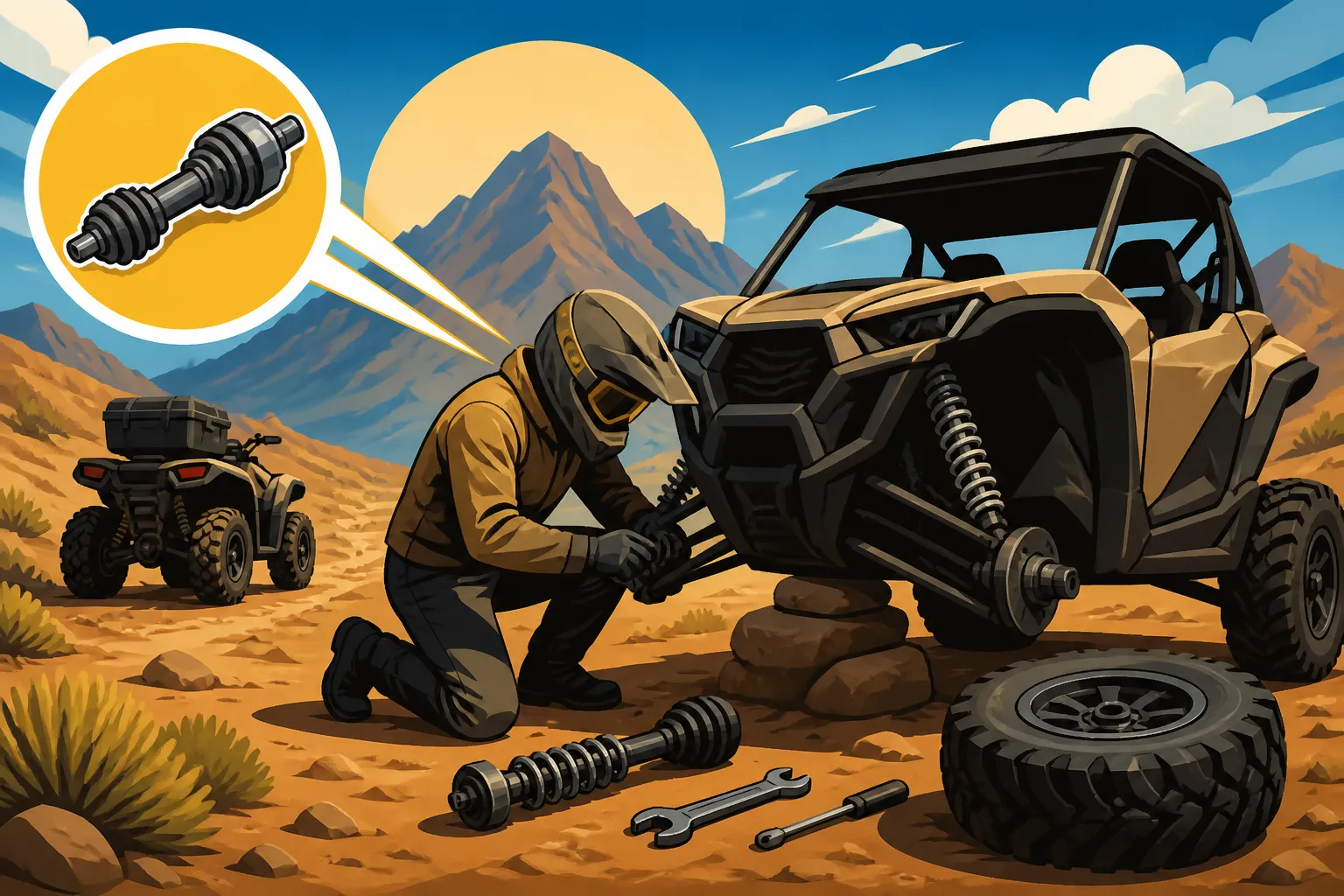
The best kit is not the largest one; it is the one that matches your vehicle and that you know how to use. Before a ride, check the owner’s manual and identify the basic items required for your machine. Depending on the vehicle, that may include a tire repair kit, tire inflator, spare fuses, basic hand tools, a belt or belt-specific tools, electrical tape, zip ties, and gloves.
Inspect the machine at home, not at the trailhead after the group is ready to leave. Check tires, wheels, battery connections, fuel level, fluids, lights, and any parts that have recently been repaired. On a UTV, confirm that the winch and recovery points are in working order if you plan to rely on them. A winch with a damaged cable or an unsuitable anchor point can create a serious hazard.
Keep your tools and supplies secured so they do not become projectiles in a rollover or disappear in dust. Store small items in a labeled pouch and make sure another rider knows where it is. If you are riding with a group, coordinate shared gear rather than assuming someone else has the right tool.
Carry enough water, shade, and essential supplies
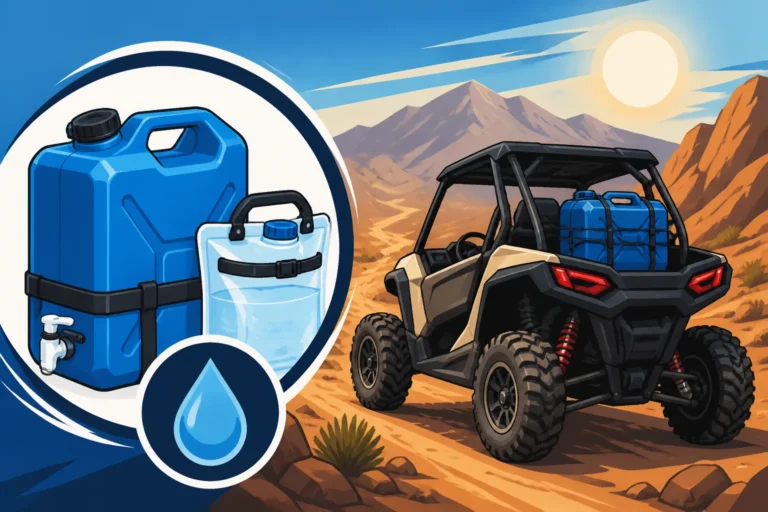
A breakdown can stretch a short ride into hours outdoors. Bring more water than you expect to drink during a normal trip, and keep it where you can reach it without unloading the machine. Add food, sun protection, a first-aid kit, and a way to create shade. In hot weather, pace activity carefully: walking in direct sun to find help may be more dangerous than waiting in a safe, shaded location.
A practical kit can include:
- Drinking water for every rider, plus an emergency reserve
- First-aid supplies and any personal medication
- Hat, sunglasses, sunscreen, and clothing that protects skin from sun
- Headlamp or flashlight with spare batteries
- Warm layers for cold evenings or changing weather
- High-visibility clothing or a signal panel
- Emergency blanket or lightweight shade tarp
- Paper map, compass, and a charged power bank
- Basic repair tools and a tire inflation option
Consider the specific area and season. Nevada desert heat can be severe, while higher elevations and winter conditions can bring cold, wind, or snow. Check Nevada Desert Riding in Summer Heat, Water and Fuel Planning in Nevada, and Carrying Water for a Desert Ride when adjusting your supplies for the route.
Choose whether to wait, walk, or move the machine
Stay put when it is safer than traveling
If you have shared your location and the machine is in a safe spot, staying nearby is often the most sensible choice. This is especially true when someone is injured, the route is unfamiliar, visibility is poor, or the group lacks enough water for a long walk. Moving away from the vehicle can make you harder to locate and leave you without shelter, supplies, or a place to rest.
Make the waiting area visible without creating a new hazard. Keep people clear of the trail where other machines may pass. Use a bright item to mark your location, but do not stand in the path or climb onto unstable terrain to attract attention. Conserve phone battery by dimming the screen, closing unnecessary apps, and using brief messages rather than repeatedly trying calls that cannot connect.
If weather or terrain makes the current spot unsafe, move only as far as needed to reach a safer location and keep the group together. Watch for flash-flood risk in washes, unstable slopes, and exposed areas during lightning or high winds. A dry-looking wash can change quickly during a storm, so do not wait in a channel if rain is approaching. See Flash Flood Season in the Desert and Riding a Desert Wash Safely for additional planning considerations.
Walk out only with a clear plan
Walking to seek help may be necessary, but it should be a considered decision rather than a frustrated reaction. Before anyone leaves, identify a known destination, confirm the route as best you can, and decide who will stay with an injured rider or the disabled machine. Do not split up casually. If the group must separate, leave one capable adult with anyone who needs assistance, and make sure the person walking has water, navigation, sun protection, and a working communication device.
Do not assume the nearest road is easy to reach. A short distance on a map can involve deep sand, steep terrain, loose rock, or a wash that is difficult to cross. In unfamiliar country, walking without a reliable location fix can make it harder for others to find you. If you are uncertain, use your communication device to ask for guidance rather than setting off in a direction based on guesswork.
Before your next ride, make a simple trip plan: route, expected return time, group size, emergency contacts, and what you will do if a machine fails. Check access conditions and route closures, and carry maps that work offline. OnX Offroad can be one part of that preparation, alongside a paper backup, adequate supplies, and a communication plan. Reviewing Nevada Trail Closures to Check Before You Go and Nevada Cell Coverage on Trails can help you plan around the limits of a route rather than discovering them after a breakdown.
Disclaimer
This article is for general informational purposes only and does not constitute professional advice. Laws, prices and regulations vary by location and change over time. Consult a qualified professional for guidance on your specific situation.