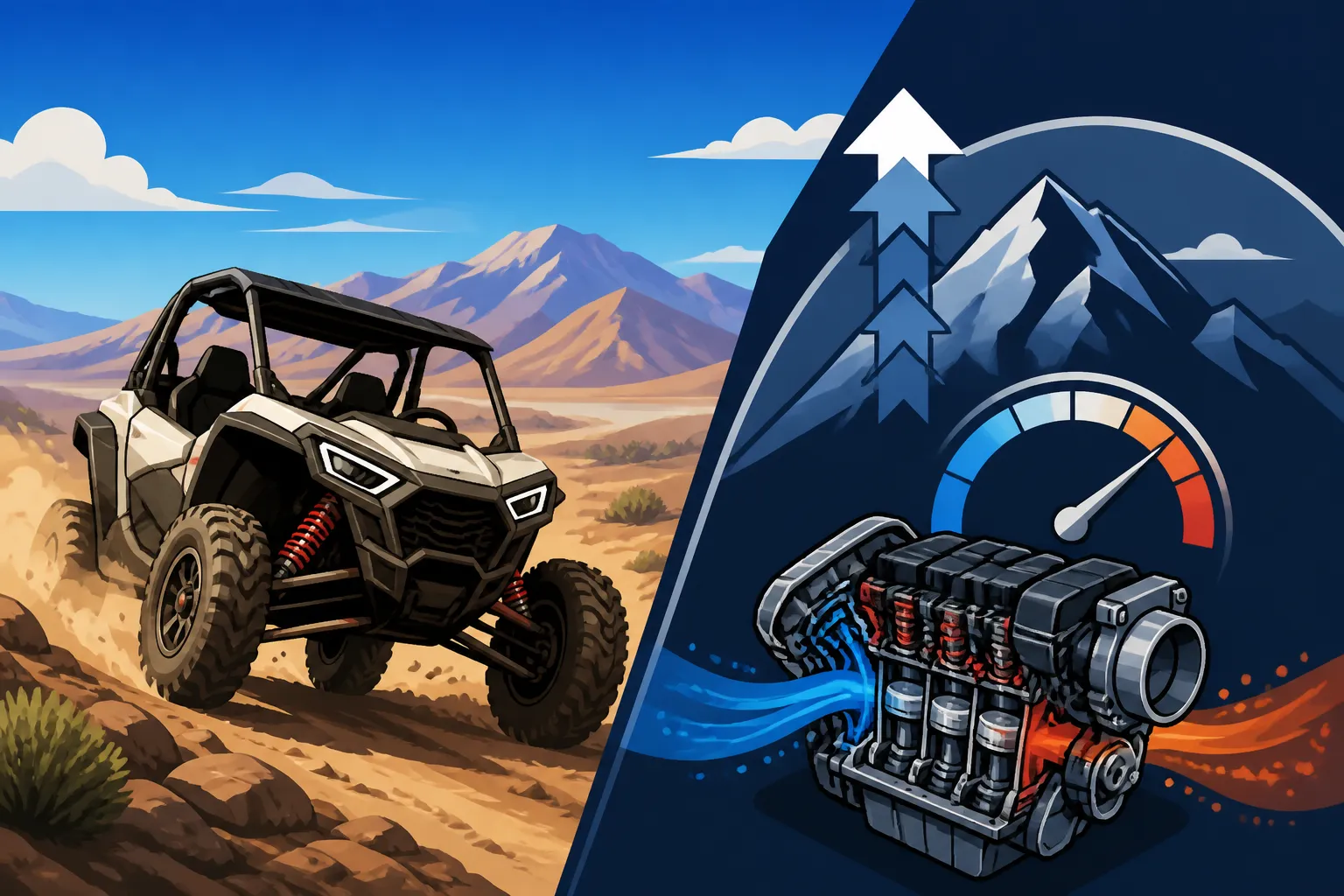
Nevada’s High Desert Elevation and Your Engine
Nevada rides can begin near Las Vegas and climb into high country where the air is thinner, the weather changes quickly, and your ATV or UTV may feel noticeably different. That can mean less power on a long climb, different engine response, and more planning around heat and dust. This guide explains what elevation changes, how to prepare, and what to watch for on the trail.
Why Nevada Elevation Changes Engine Performance
Nevada is not one long, flat desert. A ride near Las Vegas may start around 2,000 feet above sea level, while areas around Ely and Tonopah sit much higher. Even familiar riding areas can include climbs, plateaus, and valleys that place different demands on a machine over the course of one trip.
The main change at elevation is thinner air. There is less oxygen in a given volume of air, which affects combustion in a gasoline engine. Elevation can also affect cooling, throttle response, and how hard a machine works on a climb. How noticeable those changes are depends on the vehicle, its engine, its condition, the weather, and the terrain.
Thinner air means less oxygen for combustion
A naturally aspirated gasoline engine draws air in without a turbocharger or supercharger. As elevation rises, the air becomes less dense, so each intake stroke brings in less oxygen than it would at a lower elevation. With less oxygen available, the engine cannot burn the same amount of fuel as effectively while producing the same power.
That loss may be subtle on an easy, level road. It tends to become obvious when you ask for power: accelerating up a sandy incline, carrying passengers and gear, or climbing a rocky trail. A machine that feels lively near Las Vegas may feel slower and less responsive on a high-country ride near Ely, particularly if you are trying to keep pace with a group.
A commonly used rule of thumb is that a naturally aspirated engine can lose roughly three percent of its power for every 1,000 feet of elevation gain. Treat that as a broad estimate, not a promise about your specific ATV or UTV. Engine design, engine management, temperature, and maintenance all affect the result. A turbocharged engine may compensate for thinner air differently, but that does not make it immune to changing conditions or overheating.
Fuel-injected and carbureted machines respond differently
Most modern fuel-injected machines use sensors and engine controls to adjust fuel delivery as conditions change. That can help the engine maintain a suitable air-fuel mixture across a range of elevations. Still, electronic adjustment does not restore all the oxygen that thinner air takes away, so a fuel-injected machine can lose power even when it runs smoothly.
A carbureted machine may need more attention when riding at a substantially different elevation than the one where it was set up. If the mixture is poorly suited to the conditions, the engine may run unevenly, hesitate, or feel sluggish. Adjustments depend on the machine and the manufacturer’s guidance; changing jets or tuning by guesswork can cause new problems. If you are unsure, consult the owner’s manual or a qualified mechanic before a major elevation change.
Before a trip, note how the engine behaves at home: how it starts, idles, accelerates, and responds under load. That gives you a useful reference point. If the machine begins running unusually rough, losing power abruptly, or showing a warning light during the ride, do not assume elevation is the only cause. A clogged air filter, fuel problem, overheating, or mechanical fault can produce similar symptoms.
Elevation is only one part of the ride
A high-elevation route can combine thinner air with steep grades, loose sand, rocks, and a heavy load. Each factor asks the engine to work harder. A four-seat UTV full of passengers and camping gear, for example, may struggle more on a long climb than a lightly loaded two-seat machine—even if both have similar engine designs.
The terrain also affects how you use the throttle. Spinning tires in sand or repeatedly charging up a steep grade creates heat and wastes momentum. Smooth, steady inputs are usually easier on the machine than abrupt acceleration followed by hard braking. Choose a line you can ride at a controlled pace, and leave room to turn around if the climb becomes too demanding.
If you are planning a trip across a broad elevation range, map the route before leaving. [Nevada's High Desert Elevation and Your Engine] is one part of that planning, while [Nevada Trail Difficulty for Beginners] can help you think about whether the terrain matches your group’s experience and equipment.
What Riders May Notice on Nevada Trails
The first sign of elevation-related performance change is often not a warning light. It may be a machine that needs more throttle to maintain speed or takes longer to accelerate. Those changes can feel frustrating if you are accustomed to riding at lower elevations, but they are not automatically a sign that something is broken.
Pay attention to changes over time and compare them with the conditions. A mild, predictable reduction in power as you climb is different from a sudden loss of power, unusual knocking, smoke, a warning light, or a rising temperature reading. Knowing that distinction can help you decide whether to adapt your riding or stop and investigate.
Acceleration and climbing can feel different
When the air is thinner, an engine may produce less power, and that can be especially noticeable when climbing. A machine that normally pulls up a hill in a higher gear may need a lower gear, a slower approach, or a more gradual climb. On a UTV, extra passengers or cargo can make the change more pronounced.
A practical example: imagine leaving a lower-elevation trailhead with a machine that feels responsive, then climbing toward a higher plateau. If the route becomes steeper and the engine takes longer to build speed, forcing the throttle harder may not solve the problem. Reduce speed, select an appropriate gear if your machine has one, and give the engine a steady workload rather than repeatedly accelerating and backing off.
Avoid treating a group ride like a race. If one machine has less power at elevation, let that rider choose a manageable pace and avoid pressuring them into a climb that feels unsafe. A sensible turnaround point is part of good trip planning, not a failure.
Throttle response and engine sound may change
Some riders notice that the throttle feels less immediate at elevation. The engine may sound different under load, and the machine may not respond as briskly when accelerating out of a turn. These sensations can be normal, but they should be judged alongside other signs such as temperature, warning indicators, and whether the engine is running smoothly.
A sudden change deserves more caution than a gradual one. If the machine was running well and then begins to stumble, stall, or lose power sharply, stop somewhere safe and check for obvious issues. Look for a loose intake connection, an obstructed air intake, or a warning light, but avoid reaching near hot or moving parts. If the cause is not clear, arrange help rather than continuing into remote terrain.
It can help to make a quick note of the location, elevation, weather, and symptoms. That information is useful if you need to describe the problem to a mechanic later. It can also help you distinguish a repeatable elevation-related change from an intermittent issue that may be linked to fuel, dust, or heat.
Your load and riding style matter
Passenger count, cargo, tires, and riding pace all influence how hard the engine works. A side-by-side loaded with water, tools, spare parts, and camping supplies has more weight to move than the same machine on a short day ride. On a steep or sandy climb, that extra load can make a modest power reduction feel much larger.
Before heading out, check that your load is secure and within the machine’s limits. Keep heavy items low and balanced, and do not carry unnecessary gear simply because there is room for it. A family trip may call for more supplies, but packing thoughtfully can reduce strain and help preserve handling.
Riding smoothly matters too. Avoid prolonged wheelspin, repeated full-throttle bursts, and stopping halfway up a steep grade if you can safely maintain momentum. That does not mean charging into a hill faster than conditions allow. It means choosing a safe line and pace before the climb, then avoiding unnecessary throttle changes once you are committed.
Preparing Your ATV or UTV for a High-Elevation Ride
A little preparation can prevent a small performance difference from becoming a bigger problem far from the trailhead. Start with the machine itself, then consider the route, expected weather, and the people riding with you. A short inspection at home is easier than troubleshooting in dust, heat, or a remote canyon.
Preparation is especially important when your machine is usually ridden at a very different elevation. If you live near Reno and are planning a route much higher or lower, or you are visiting from out of state, give yourself time to notice how the machine behaves before tackling demanding terrain.
Check the owner’s manual and maintenance basics
The owner’s manual is the best starting point for elevation-related setup questions. It may explain whether the machine’s fuel system adjusts automatically, whether specific maintenance or tuning is recommended for certain conditions, and what warning indicators require you to stop. Follow the manufacturer’s procedures rather than relying on a generic adjustment suggested for a different model.
Before leaving, check the air filter, engine oil, coolant where applicable, tires, belts, and battery condition. A dirty or damaged air filter can restrict airflow, while a loose intake connection may let dust reach places it should not. On a belt-driven UTV, a worn or damaged belt can become a trip-ending problem under demanding conditions. Do not wait until the evening before a long trip to discover that a service item needs attention.
Carry only the tools and spare parts you know how to use safely. For a group ride, agree on what basic tools, recovery equipment, and communication devices will be carried, and who is responsible for them. A machine that has been properly serviced is not guaranteed to avoid trouble, but maintenance reduces preventable surprises.
Inspect the intake and protect against dust
Nevada’s dry riding areas can produce fine dust that coats clothing, gear, and machine parts. The air filter is particularly important because dust entering the intake can contribute to engine wear. Inspect it according to the manual, and do not ride with a missing, damaged, poorly seated, or excessively dirty filter.
If you are riding in a group, increase spacing when dust reduces visibility. Following closely can send a steady cloud into your own intake and make it difficult to see ruts, rocks, and other riders. Consider taking turns at the front or allowing dust to settle when conditions permit. A short pause can be safer than pressing ahead with limited visibility.
Keep the intake area clear of loose gear and debris, and make sure any pre-filter or accessories are installed as intended. Avoid improvising changes that could block airflow or allow water and dust into the system. For routes with exposed, dusty sections, checking the filter during the trip may be sensible, especially if conditions are worse than expected.
Plan for temperature as well as elevation
High elevation does not guarantee cool riding. Nevada weather can bring hot, dry conditions, and a slow technical section may provide less airflow through a radiator than a faster open trail. Dust, mud, blocked vents, and an overloaded machine can also contribute to rising temperatures. Check the temperature display if your machine has one, and learn what its warnings mean before the ride.
Watch for signs that the machine is getting too hot: a temperature warning, steam, unusual smells, reduced performance, or coolant leaking from the system. Stop in a safe place and follow the manual’s instructions. Do not open a hot cooling system; pressurized coolant can cause serious burns. Give the machine time to cool and investigate only when it is safe.
Plan a route with realistic rest points and an option to shorten or turn back. If the group includes several machines or less experienced riders, avoid a schedule that depends on maintaining a fast pace. [Nevada Desert Riding in Summer Heat] and [Nevada Riding After a Winter Storm] offer useful context for how weather and seasonal conditions can change the demands of a Nevada ride.
Choosing and Managing a Nevada Route
A route that looks simple on a map may feel very different when you add elevation, surface, heat, and machine load. Before setting out, look at the full route rather than just the destination. Identify the steepest sections, likely turnaround points, fuel options, and places where you can stop safely if a machine needs attention.
Use more than one source when planning. A map can show roads and terrain, but it may not tell you whether a route is open, suitable for your vehicle, or affected by a closure. onX Offroad can help riders review mapped routes and terrain before departure; pair that planning with current local land-management information and conditions on the ground.
Match the route to your machine and group
Consider the least powerful or least experienced rider when choosing a route. A challenging climb that is manageable for one machine may be uncomfortable for another, especially when there is a difference in engine size, tire setup, passenger load, or rider skill. If your group includes mixed machines, choose a pace and route that allow everyone to ride within their ability.
Look at the combination of distance, elevation gain, surface, and escape options. A short, steep route may place more demand on an engine than a longer, gradual one. Sand can require sustained throttle, while rocky climbs may demand careful control at low speeds. Neither is automatically unsuitable; the important question is whether your machine, setup, and experience fit the conditions.
For a first ride in an unfamiliar area, plan conservatively. A route that leaves time for breaks and a return before dark is more forgiving than a packed itinerary. [Nevada Trail Maps Worth Downloading] can be useful when preparing offline navigation, and [Planning a Ride With Trail Finder] can help structure the route research before you leave.
Understand how elevation, weather, and surface combine
Elevation alone does not determine how difficult a route will feel. A high plateau with a smooth surface may be easier on the engine than a lower, steep sandy hill. Likewise, cool air may help with some operating conditions, but it does not eliminate the effects of thin air on naturally aspirated engine power.
Weather can change the surface and your options. Recent rain may leave washes soft or routes muddy, while a winter storm can bring snow or ice at higher elevations. Heat can make long, slow climbs more demanding for both riders and machines. Check the forecast and local advisories, then be willing to revise your plan when conditions do not match expectations.
Use route apps as planning tools, not as permission to ride anywhere a line appears on a screen. Verify access, closures, and land boundaries before departing. onX Offroad can help you study mapped routes and terrain, but riders still need to confirm that the route is open and legal. [Calling a BLM Field Office Before a Ride] is a practical step when access or conditions are unclear.
Plan for fuel, water, and communication
A machine working harder on a demanding route may use fuel differently than it does on an easy local ride. Do not plan fuel stops based only on your usual consumption on flat ground. Allow a margin for detours, soft surfaces, slow climbs, and time spent looking for a route or helping another rider.
Carry enough water for the people in your group, not just the machine. Nevada’s dry air and sun can leave riders feeling depleted before they realize how much fluid they have lost. Set a habit of drinking during stops rather than waiting until someone feels thirsty, and make sure everyone knows where the group’s supplies are stored.
Cell coverage can be limited away from towns and highways. Tell someone your route and expected return time, and carry a suitable backup communication device for remote trips. Keep navigation available offline if you rely on a phone or mapping app, and bring a paper backup or another device when the route warrants it. [Cell Coverage on Nevada Trails] and [Water and Fuel Planning in Nevada] can help round out that preparation.
Troubleshooting Changes in Engine Performance
Not every loss of power is caused by elevation. A machine that struggles may have an intake, fuel, cooling, electrical, or mechanical problem. The safest approach is to compare the symptoms with how the machine normally behaves, make basic checks only when conditions are safe, and avoid pushing a machine that is signaling trouble.
It is also useful to distinguish gradual changes from sudden ones. A steady reduction in acceleration as elevation increases may be expected, particularly with a naturally aspirated engine. An abrupt loss of power, a persistent warning light, abnormal engine noise, or overheating deserves more attention.
Use a simple stop-and-check process
If performance changes, first move to a safe place away from traffic and other riders. Let the engine idle only if the machine is operating normally and the manual does not advise shutting it down; if a serious warning or overheating is present, stop and follow the manufacturer’s instructions. Keep the group together and make sure the machine is stable before inspecting it.
Check the information you can safely access: warning lights, visible leaks, loose connectors, obstructed vents, obvious damage, and the condition of the intake area. Do not touch hot exhaust components or open a hot radiator cap. If the issue is not obvious, avoid repeated attempts to climb or accelerate hard. Continuing to test the machine can turn a manageable problem into a more serious failure.
If the machine needs repair, decide whether it can safely return under its own power or whether it needs assistance. Do not ask an already struggling engine to pull a heavy load over a difficult route just to avoid turning back. A cautious return or recovery plan is often preferable to being stranded farther from help.
Know when to stop riding
Stop riding if the engine overheats, a critical warning appears, the machine makes new severe noises, smoke is present, or power drops suddenly enough to affect safe control. A gradual change in performance at elevation may be manageable; a symptom that threatens control or could damage the engine is not something to ride through.
Do not remove safety equipment or bypass a warning system to keep moving. Avoid making roadside tuning changes unless you understand the procedure and have the correct tools and instructions. If the machine is under warranty or uses a system you are unfamiliar with, improvised adjustments may complicate diagnosis or cause additional damage.
A sensible trip plan includes the possibility of turning back. Tell your group beforehand that anyone can call for a stop if a machine feels unsafe. That agreement reduces the pressure to keep going when a rider notices an unfamiliar sound, smell, or response.
Learn from the ride before the next one
After the trip, note where the performance changed, how high the route climbed, the approximate load, and the weather. Include whether the engine was fuel-injected or carbureted, what warning indicators appeared, and whether the issue continued after descending. These details can help a mechanic diagnose a genuine problem and help you plan a better-matched route next time.
Inspect the air filter and other service items after a dusty ride, and record any maintenance that is due. If the machine behaved differently at elevation but otherwise ran smoothly, review the owner’s manual before changing anything. A planned setup adjustment may be appropriate for some machines and conditions, but it should be based on the manufacturer’s guidance and the machine’s actual symptoms.
For your next outing, use what you learned to adjust the route, load, pace, or departure time. Bring a less experienced group to a gentler area first, or choose a route with easier exits if the machine is unfamiliar at elevation. Nevada’s range of terrain makes it possible to tailor a ride; the best route is one that leaves enough margin for both the machine and the people riding it.
Disclaimer
This article is for general informational purposes only and does not constitute professional advice. Laws, prices and regulations vary by location and change over time. Consult a qualified professional for guidance on your specific situation.