Nevada Dispersed Camping Rules for Riders
A Nevada ride can go sideways when a campsite looks open on the map but sits inside a restricted area, beside a closed route, or beyond a land manager’s camping limit. This guide explains how to check where you may camp, ride in and out legally, manage stay limits and fire rules, and prepare for remote desert conditions.
Check who manages the land before choosing a camp
Public land is not one set of rules
Nevada has vast stretches of public land, but “public” does not mean every spot is open to camping or off-road travel. The Bureau of Land Management manages many areas, while other places may fall under the Forest Service, a state agency, a county, or private ownership. Each land manager can set different rules for camping, fires, vehicles, and seasonal closures.
That matters when you’re planning a ride near places such as Sand Mountain, Logandale, or the Winnemucca Dunes. One area may have developed facilities, designated campsites, or a day-use boundary; another may allow dispersed camping only under certain conditions. Don’t assume a rule you followed on one trip applies at the next trailhead.
Before you settle on a spot, identify the land manager and check its current rules for the specific area. Start with [Riding BLM Land in Nevada] and [Nevada Rules for Camping Beside Your Machine] to understand how camping and riding access can intersect. For popular recreation areas, check whether the site has special rules or fees rather than treating it like open, undeveloped BLM land.
Confirm the campsite and the route to reach it
A campsite can be legal while the route to it is not. Conversely, you may be able to ride on an open route but not camp beside it. Look for designated campsites, seasonal closures, wilderness boundaries, private parcels, and travel restrictions before planning to drive or ride your ATV or UTV to a dispersed spot.
A mapping app such as onX Offroad can help you orient yourself, review route information, and see land boundaries while planning. Use it as a planning aid, not as the final authority: map layers can be incomplete, and a line on a screen does not override a posted closure, a land-manager order, or an official travel map. Compare what you see in onX Offroad with current information from the agency responsible for the land.
For a more careful route check, review [Reading a BLM Travel Management Map] and [Riding Open BLM Land Versus Marked Trail]. A route that appears physically rideable may still be closed to motor vehicles. Keep your plan flexible in case you arrive and find a gate, sign, habitat closure, or muddy section that makes travel inappropriate.
Plan a campsite that is legal and low-impact
Stay limits apply even when you move your camp
Dispersed camping usually means camping outside a developed campground, not camping without limits. On many BLM-managed lands, a 14-day limit applies within a 28-day period, but details and enforcement can vary by location. Some areas may have additional restrictions, so check the applicable land manager’s rules before relying on a general limit.
A stay limit is not a reason to shift your tent or trailer a short distance and assume the clock has reset. Some rules require campers to move a substantial distance after reaching the limit, and the restriction may apply to the area rather than just one exact campsite. For the relevant local details, see [The 14-Day Camping Limit on Nevada BLM Ground]. If you are staying for several days, confirm how the limit works in that specific district and keep track of your arrival date.
This is especially easy to overlook on a longer ride trip. For example, a group might camp near one trail system, move a few miles to another pullout, and believe they have started a new stay. If the land manager considers both spots part of the same restricted area, that move may not satisfy the rule. When the answer is unclear, ask the local office before extending your stay.
Camp on durable ground and leave room for others
Choose an established disturbed area when one is available, and avoid creating a new turnout or widening a campsite with your vehicle. Keep tents, trailers, and parked machines away from fragile vegetation, wet ground, stream edges, cultural sites, and marked habitat areas. In desert environments, a shortcut across the crust or plants can leave damage that lasts well beyond your visit.
Keep your camp compact. Park in a way that leaves the route open, allows emergency access, and does not block another site or a gate. If your group brings several machines, trailers, and support vehicles, think about the footprint before arriving; a spot that works for one truck may not safely or responsibly hold a large convoy.
Pack out trash and food scraps, and do not assume that a remote area has toilets, water, or refuse services. Bring a plan for human waste that follows the land manager’s requirements. At a developed recreation area, use the facilities provided and follow posted directions rather than treating the surrounding open ground as an extension of the campground.
Follow separate rules for riding, fires, and camp routines
Camping permission does not grant permission to ride anywhere
A common source of trouble is treating a campsite as permission to ride in every direction from it. Camping rules and motorized travel rules are separate. You may need to stay on designated or otherwise open routes, and some areas prohibit cross-country travel or close routes for habitat protection, restoration, or public safety.
Before unloading, determine which roads and trails are open to your type of machine. Read signs at the access point and watch for closures along the route. Use [Nevada Rules for Riding Federal Land] and [Nevada Trail Closures to Check Before You Go] as starting points, then verify the current map or notice for your destination. A route shown on an older map or a third-party app may have changed.
Do not ride through a closed gate, around a barricade, or across a restricted area to reach a more convenient campsite. If a route is muddy, heavily rutted, or likely to cause damage, turn around rather than making it worse. When traveling with a group, make sure everyone understands the route plan; one rider’s detour can create problems for the whole party.
| Before you camp or ride | What to check | Why it matters |
|---|---|---|
| Land ownership | Which agency or owner manages the spot | Rules and closures differ by land manager |
| Campsite access | Whether the approach route is open to motor vehicles | A legal campsite may still have restricted access |
| Stay limit | Local maximum stay and any required move | General limits may not cover every area |
| Fire rules | Current restrictions, permitted equipment, and safe conditions | Restrictions can change with weather and risk |
| Ride routes | Official map, signs, closures, and allowed vehicle use | Camping does not make nearby routes open |
| Facilities | Water, toilets, trash service, and fuel availability | Remote sites may have none of these |
Fire rules can change with conditions
Fire permission is not something to guess at from the landscape. Restrictions can change with weather, drought, wind, and local risk. A campfire, charcoal grill, or even certain portable equipment may be restricted in some places or during particular conditions. Check current orders from the land manager before your trip and follow posted directions at the site.
If fires are allowed, use an established fire ring where available, keep the fire small, and never leave it unattended. Avoid lighting a fire on a windy day or near dry brush, and make sure it is fully extinguished before leaving or going to sleep. If restrictions prohibit fires, use an allowed alternative only if the rules permit it; don’t treat a stove as automatically exempt.
Nevada’s dry conditions can make a small mistake consequential. Keep a shovel and water available when appropriate, and do not park a hot vehicle or operate equipment in dry vegetation. Check for [Nevada Rules for Riding During Fire Season] if your trip overlaps with fire restrictions, and be prepared to change plans if an order closes an area.
Prepare for remote Nevada conditions
Carry enough water, fuel, and backup supplies
Dispersed campsites may be far from services, and a route that looks short on a screen can take longer than expected over sand, rock, or washboard. Carry water for riding, cooking, and basic cleanup, with extra capacity for heat, delays, or a machine problem. Do not count on finding potable water at an undeveloped campsite.
Fuel planning deserves the same attention. Estimate the round trip, include detours and low-speed riding, and identify a realistic refueling option before leaving paved roads. A fuel stop in a nearby town does not guarantee that fuel will be available at the trailhead or camp. [Water and Fuel Planning in Nevada] is useful preparation for trips where the nearest service is far away.
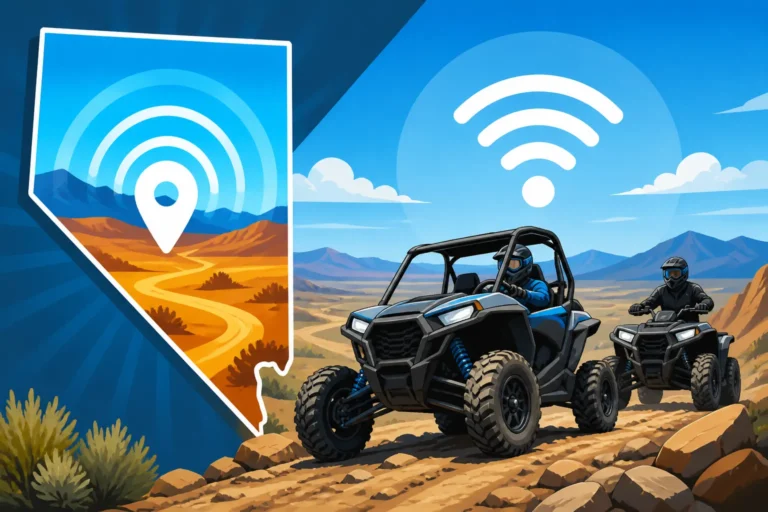
Bring basic recovery and repair gear suited to your machine, plus a first-aid kit and a way to communicate if cell service disappears. Tell someone where you plan to go and when you expect to return. For a remote ride, consider downloading offline maps in advance; onX Offroad can be one tool for keeping route information available when you lose coverage, but save official maps and key contact details as well.
Account for heat, terrain, and changing access
A campsite that feels comfortable in the morning may be punishing by midday. Plan riding hours around the conditions, take breaks, and pay attention to signs of heat illness in yourself and your group. Desert heat also affects machines: slow travel, soft sand, and extended idling can add strain, so keep an eye on temperature warnings and avoid pushing a machine that is overheating.
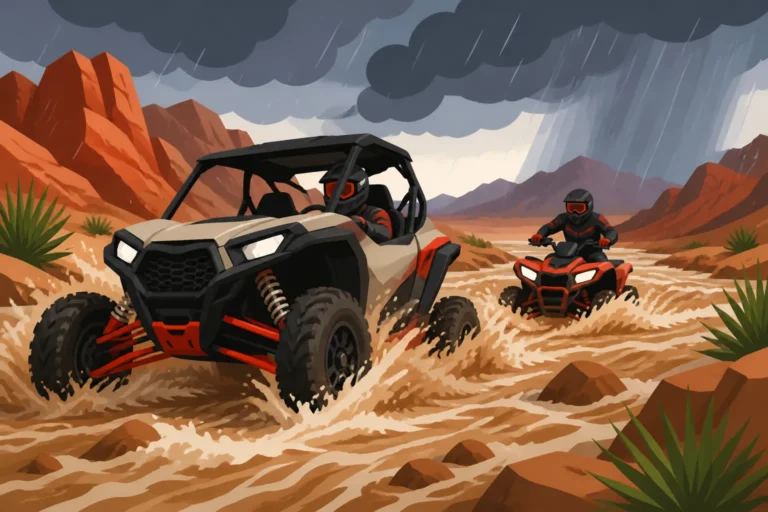
Weather can change access quickly. A dry wash may become dangerous after rain, and a route that was firm when you arrived may turn soft or muddy. Check the forecast for the broader area, not just the nearest town, and do not camp in a wash or other drainage where water could collect. Be ready to stay put or leave by a safer route rather than crossing floodwater.
Use a current map alongside on-the-ground signs, and set a turnaround point before the group starts riding. If one rider is tired, a machine is acting up, or the weather is changing, shorten the route. A good dispersed-camping trip is not measured by how far you push from camp; it is measured by whether everyone returns safely and the place looks undisturbed when you leave.
Disclaimer
This article is for general informational purposes only and does not constitute professional advice. Laws, prices and regulations vary by location and change over time. Consult a qualified professional for guidance on your specific situation.