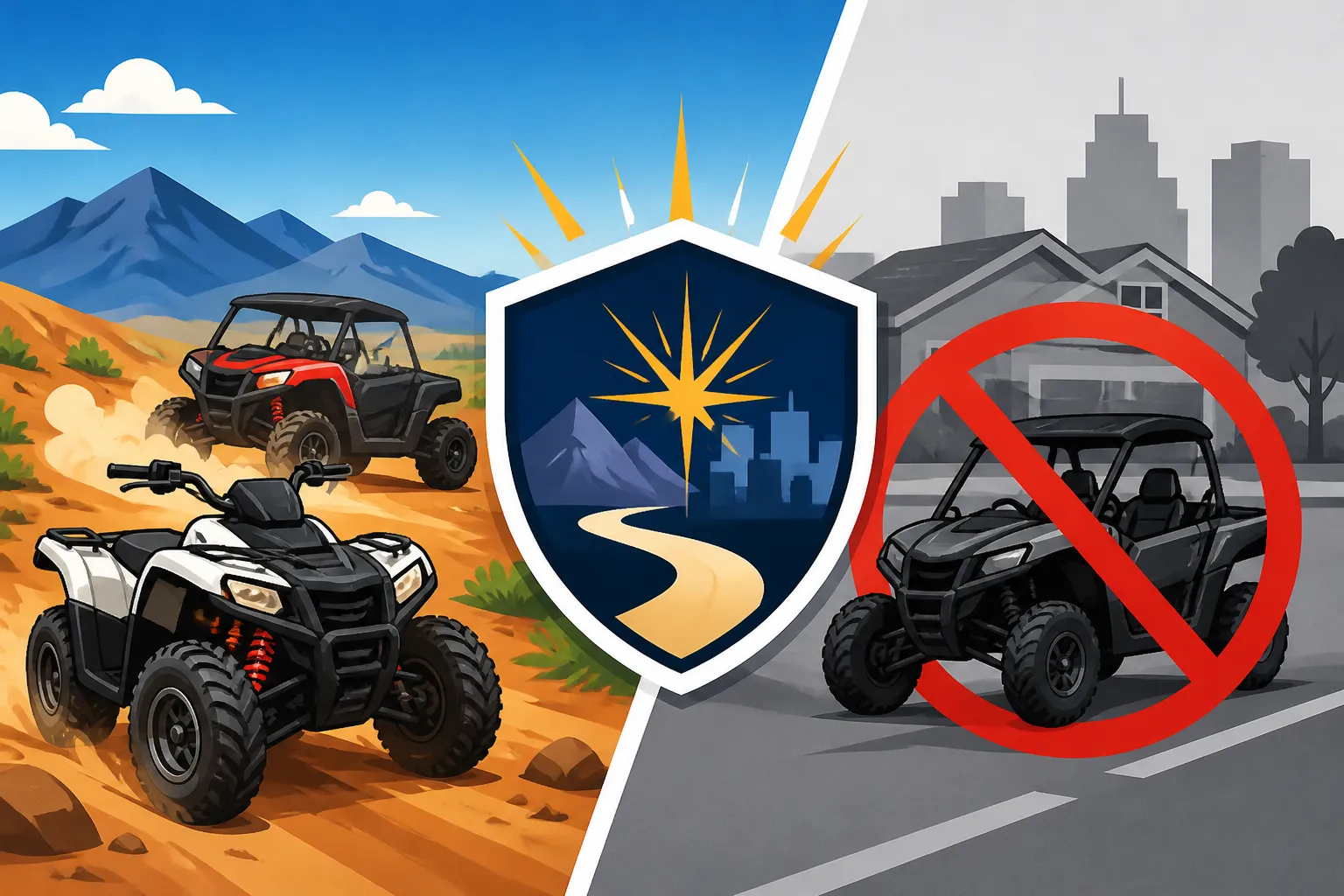
Sparks Streets and OHV Restrictions
It's incredibly frustrating when you're itching to hit the trails, but navigating the rules about riding your ATV or UTV on city streets feels like trying to read a map written in ancient hieroglyphs. Many off-road enthusiasts assume that if a machine is registered, it's fair game everywhere, only to find themselves facing a stern conversation with local law enforcement. This guide is here to untangle the specific rules governing off-highway vehicle (OHV) use on the streets of Sparks, Nevada, helping you understand where you can and absolutely cannot ride.
Understanding Sparks' Unique OHV Landscape
When you picture riding your ATV or UTV, you probably imagine wide-open desert, dusty trails, or maybe some challenging rock crawls. What most riders don't envision are paved city streets, bustling intersections, and residential neighborhoods. And for good reason: the rules change dramatically once you leave the vast expanse of public lands and enter the structured environment of a municipality like Sparks.
Why City Limits Are Different from Open Desert
The fundamental difference between riding in the open desert and riding within city limits boils down to jurisdiction, population density, and public safety. On Bureau of Land Management (BLM) land or in designated recreation areas, the primary concerns are environmental impact, trail etiquette, and general safety. These areas are designed for recreational use, often with extensive trail systems that cater specifically to OHVs.
However, a city like Sparks has a different set of priorities. Its streets are primarily designed for conventional vehicular traffic – cars, trucks, motorcycles – and pedestrians. Introducing OHVs, which often have different handling characteristics, lower top speeds, and a distinct sound profile, can create significant safety hazards and noise disturbances for residents. Local governments, therefore, have the authority to establish their own rules that often supersede the more general state laws when it comes to riding within their defined boundaries. This is why what might be permissible on a dirt road outside of town isn't necessarily okay on Main Street in Sparks.
The Role of Washoe County Ordinance 1507
Sparks falls within Washoe County, and this is where Washoe County Ordinance 1507 comes into play for OHV riders. While Nevada state law does make provisions for certain "large ATVs" (primarily UTVs or side-by-sides) to operate on specific county roads, local ordinances like Washoe County's can add layers of restriction or outright prohibit OHVs from designated areas. This is a critical point that many riders overlook, thinking that state registration automatically grants them carte blanche on all public roads.
Washoe County Ordinance 1507, which governs the operation of OHVs on county roads, often has the effect of limiting where these machines can legally travel within the more urbanized areas, including Sparks. The ordinance seeks to balance recreational opportunities with public safety and quality of life for residents. It's not uncommon for these local laws to designate very specific routes, if any, where OHVs might be allowed to operate, and these are usually far from what you'd consider general street use. So, even if your UTV is decked out with all the necessary equipment for state-level "street legal" status, a local ordinance could still prevent you from riding it down a residential street in Sparks. Understanding [Which Nevada County Roads Qualify for ORVs] is crucial, but remember that city limits can be even stricter.
Nevada State Law vs. Local Sparks Rules
It's easy to get confused when you're trying to figure out where you can ride your OHV. Nevada state law has certain provisions, but then individual cities and counties add their own layers of regulations. It's like trying to play a game with two different rulebooks at the same time! For anyone riding in or around Sparks, understanding this distinction is absolutely key to staying out of trouble.
What Nevada Law Says About "Large ATVs" on Roads
Nevada Revised Statutes (NRS) provide a framework for the operation of certain Off-Highway Vehicles on public roads. Specifically, Nevada has a category for what it calls "large ATVs." These are generally UTVs or side-by-sides that meet specific criteria: they must be wider than 50 inches, weigh more than 900 pounds, and have four wheels. If your machine fits this description, Nevada law allows for specific, limited road use under certain conditions.
To legally ride a large ATV on a qualifying Nevada road, you'd need:
- A valid driver's license.
- Liability insurance, similar to what's required for a car.
- A special "large ATV" decal from the Nevada DMV, which is different from a standard OHV decal.
- Required equipment, including headlights, taillights, a stop lamp, reflectors, a horn, a muffler, a spark arrester, and often mirrors. For machines that might meet this definition, SuperATV offers a wide range of accessories, from turn signal kits to mirrors, that can help equip your vehicle for any potential road use.
Even with all these boxes checked, the state law imposes strict limitations. For instance, you generally cannot ride on Interstate highways or state routes, and you are limited to a maximum of [Nevada's 2-Mile Limit on Paved Highway] when crossing or traveling along certain paved roads to connect to trails. The entire purpose of this state provision is to allow large ATVs to move safely from a staging area to a trail, not for general transportation or cruising around town. It's important to understand [What Nevada's NRS 490.043 Counts as a Large ATV] to see if your machine even qualifies for this state-level consideration.
How Sparks and Washoe County Restrict Even State-Legal Machines
Here's where the rubber meets the road, or more accurately, where the dirt road ends and the city pavement begins: even if your OHV technically qualifies as a "large ATV" under Nevada state law and you've got all the required decals and equipment, Sparks and Washoe County have the authority to impose stricter rules. Many cities and counties in Nevada exercise their right to opt out of or further restrict OHV use on roads within their jurisdiction, often through local ordinances.
For Sparks, the general rule of thumb is that off-highway vehicles are not permitted on city streets, sidewalks, or other public property not specifically designated for OHV use. This means that even a fully equipped, state-registered "large ATV" cannot simply drive through a residential neighborhood, run errands, or commute to a trailhead within Sparks city limits. The intention of [Washoe County Ordinance 1507], which applies to Sparks, is to keep OHV traffic off the main arteries and residential areas for safety and noise reduction.
While some county roads outside of Sparks' immediate urban core might allow limited OHV travel under the state's large ATV provisions, the city of Sparks itself, much like its neighbor Reno, has chosen to maintain a highly restrictive stance. Designated routes for OHV travel within Sparks are exceedingly rare, if they exist at all, for general connectivity. So, while you might find a high-quality SuperATV street legal kit for your UTV, hoping to use it for city cruising in Sparks will likely lead to disappointment and possibly a citation. The reality is that the safety and traffic flow of a busy city environment take precedence over recreational OHV use on its streets.
Practical Implications for OHV Riders in Sparks
So, what does all this mean for you, the rider, living in or visiting Sparks with your OHV? It means you need to be realistic about where and how you can enjoy your machine. The dream of hopping on your quad or side-by-side and riding from your driveway straight to the desert trails is, for the most part, just that – a dream within Sparks city limits.
Riding to the Trailhead: Is It Possible?
This is perhaps the most common question and the biggest source of frustration for many OHV owners in urban areas. The convenience of simply riding your machine from your garage to a nearby trail system is incredibly appealing. Unfortunately, for most residents of Sparks, this simply isn't a legal option.
As we've discussed, the city's ordinances, supported by Washoe County's regulations, generally prohibit OHVs from operating on city streets. This means that even if a trail entrance is just a mile or two down the road from your house, you cannot legally ride your ATV or UTV there on public pavement. The idea of [Riding to the Trailhead, Not to the Store] is certainly the spirit of the state's "large ATV" rules, but local ordinances in places like Sparks often create a barrier to even this limited use. You'll find that designated routes for OHVs within Sparks that would allow for such connectivity are practically non-existent.
What does this translate to? Trailering your machine becomes the default and necessary method for getting your OHV to legitimate riding areas. You'll need a truck or an SUV capable of towing, and a suitable trailer to transport your ATV or UTV safely out of city limits to areas where riding is permitted, such as designated BLM lands or established trail systems further afield. This adds an extra layer of planning and equipment, but it's the only way to ensure you're riding legally and responsibly when starting from a Sparks residence.
Avoiding Citations and Fines
The consequences of ignoring local OHV restrictions can be significant and costly. Local law enforcement in Sparks and Washoe County are well-versed in these ordinances and are prepared to enforce them. A quick ride around the block or a shortcut across a residential street could easily lead to a citation, and nobody wants their fun day cut short by a costly ticket.
Fines for illegal OHV operation on city streets can vary, but they are generally not trivial. Beyond the financial penalty, you could face other consequences, such as your machine being impounded, which adds further costs for towing and storage. Imagine the headache of retrieving your ATV or UTV from an impound lot, all because you took a chance on a quick street ride. It simply isn't worth the risk. Always consult the official city and county ordinances directly, or visit the Washoe County Sheriff's Office or Sparks Police Department's website for the most current information. Familiarize yourself with warnings about [Nevada Tickets for Riding Where You Should Not] and the potential for [Nevada Fines for No Large ATV Decal] if you're caught without the correct paperwork, even if your machine isn't legally allowed on those particular streets anyway. Being informed is your best defense against unwanted legal trouble.
Alternatives and Best Practices for Sparks Riders
Given the strict regulations within Sparks city limits, what's a dedicated OHV enthusiast to do? The good news is that Nevada is a vast state with incredible riding opportunities. The key is knowing how to access them legally and safely, which often means changing your approach to getting your machine from point A to point B.
Trailering Your Machine: The Safest Bet
For most OHV riders starting from or residing in Sparks, trailering your machine to designated riding areas is not just an alternative, it's the safest and most reliable best practice. This method ensures you avoid any potential legal issues with city ordinances and allows you to reach a much wider array of trails and open lands.
Consider areas outside the immediate urban sprawl, such as the vast BLM lands around Pyramid Lake, the expansive [Winnemucca Dunes] to the north, or even further destinations like [Sand Mountain: Nevada's Great Basin Dune] or [Logandale Trails Outside Las Vegas] if you're planning a longer trip. These locations are specifically designed for OHV recreation and offer thousands of acres of legal riding terrain. Investing in a sturdy trailer and understanding how to secure your machine properly for transport is a small price to pay for peace of mind and hassle-free riding. It allows you to explore incredible landscapes without the constant worry of an unexpected stop from law enforcement. When you think about [Trailering Versus Riding the Road There], the benefits of trailering for riders in Sparks become clear.
Equipping Your Machine for Any Legal Road Use (Outside Sparks)
While general street use within Sparks is out, if you plan to venture to other Nevada counties or areas where limited road use for "large ATVs" is permitted, ensuring your machine is properly equipped is paramount. Many riders like to customize their UTVs for various scenarios, and having the right gear is crucial for safety and compliance.
This might include adding a horn, turn signals, mirrors, a properly working stop lamp, and ensuring your headlights and taillights are visible from the required distances. Many aftermarket companies specialize in these types of upgrades. For instance, SuperATV offers a comprehensive selection of aftermarket parts that can help make your UTV compliant with state-level "large ATV" requirements in areas where it's allowed. From full wiring harnesses for turn signals to robust mirrors designed for off-road conditions, SuperATV has options to enhance both safety and functionality. Remember, these upgrades are about preparing for legal road crossings or travel in other jurisdictions, not about enabling general street riding in Sparks. Even for those moments when you might need to cross a paved county road to get to another section of trail, having your machine properly outfitted, perhaps with components from SuperATV, will give you confidence. It’s always good to be prepared, and knowing your machine meets the [Nevada Equipment List for Road-Legal UTVs] provides that readiness for permitted areas.
Here’s a quick comparison of the general OHV road rules in Sparks versus broader Nevada state allowances:
| Feature/Requirement | Sparks/Washoe County City Streets | Nevada State Law (for "Large ATVs" on designated County Roads) |
|---|---|---|
| General Street Travel | Generally Prohibited | Prohibited on Interstates/State Routes; Limited on County Roads |
| Designated Routes | Very rare, if any, for general use | Some County Roads may be designated or implicitly allowed for connection |
| Driver's License Required | N/A (as generally prohibited) | Yes |
| Liability Insurance | N/A (as generally prohibited) | Yes |
| Special Decal | N/A (as generally prohibited) | Yes (Large ATV Decal) |
| Equipment (Lights, Horn, Mirrors) | N/A (as generally prohibited) | Yes (Specific requirements for visibility, signaling, etc.) |
| Purpose of Road Use | Not permitted | Primarily for connecting trails, not general transportation |
| Common Practice | Trailer your OHV | Trailer or ride on designated county roads within limits |
Disclaimer
This article is for general informational purposes only and does not constitute professional advice. Laws, prices and regulations vary by location and change over time. Consult a qualified professional for guidance on your specific situation.