Nevada Rules on Riding to a Restaurant
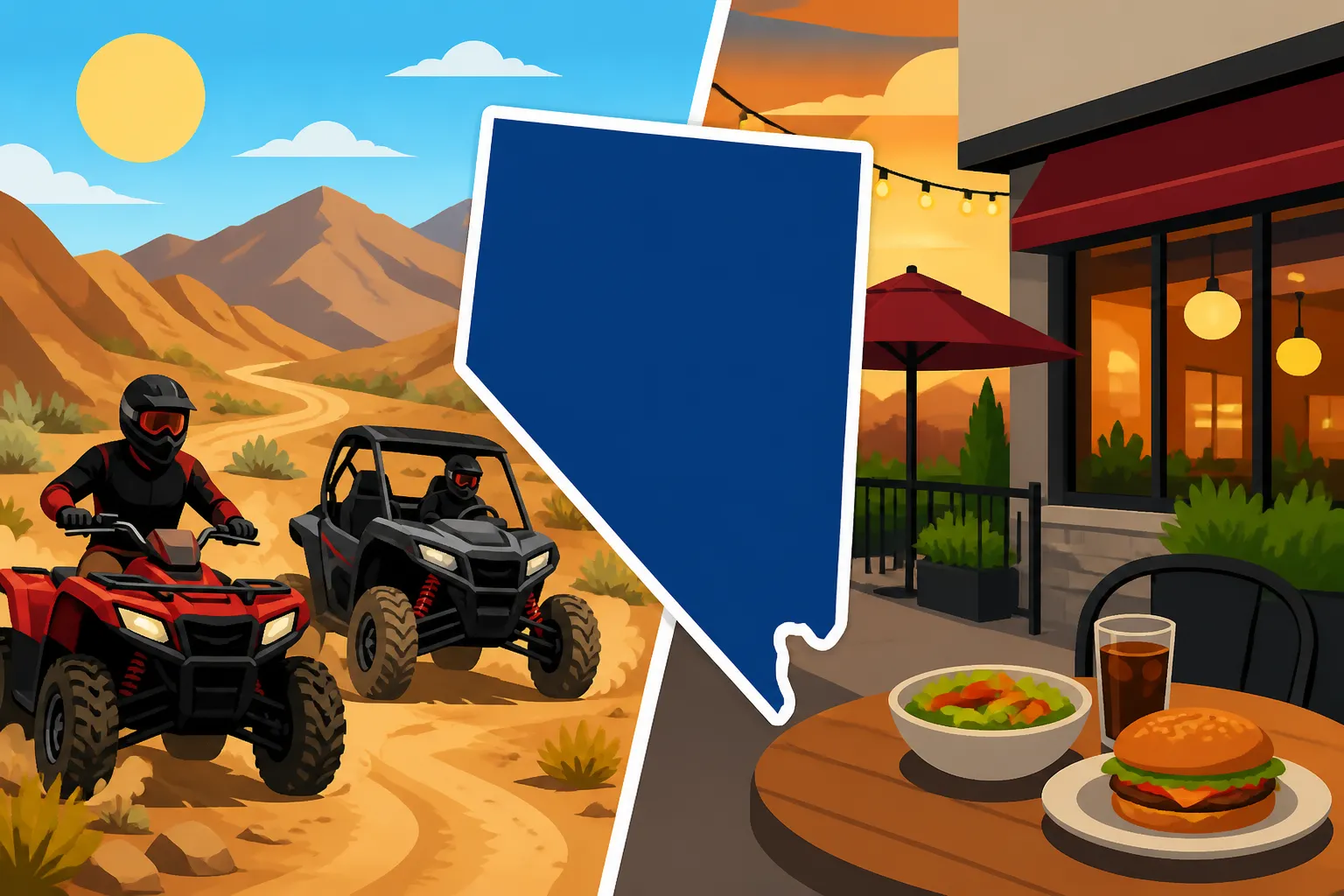
There's nothing quite like the freedom of riding your off-highway vehicle (OHV) through Nevada's incredible landscapes. You’ve just finished an epic ride on some dusty trails, the sun is setting, and a craving for a burger and a cold drink hits. Your machine is right there, ready to go. So, the question naturally pops into your head: can I just hop on my ATV or side-by-side and cruise directly to that restaurant in town? It's a common desire, and the reality, as many riders find, is a mix of possibility and significant legal hurdles. This guide will walk you through Nevada's specific regulations, equipment requirements, and local nuances to help you understand when (and if) riding your OHV to a restaurant is truly an option.
The Core Question: Can You Really Ride Your OHV to a Nevada Restaurant?
It’s tempting, isn’t it? The thought of pulling up to your favorite diner, covered in a fine layer of desert dust, with your trusty off-road machine parked outside. Many riders dream of this seamless transition from trail to town. However, Nevada's laws surrounding OHVs on public roads are quite strict and designed primarily for accessing trailheads or crossing short distances, not for general street use or leisure cruising. While there are some allowances, the idea of casually riding your ATV or UTV to a restaurant is often more complicated than it appears.
Understanding Nevada's "Street Legal" Limitations
First and foremost, we need to clarify what "street legal" actually means in Nevada for an OHV. It's not the same as registering a car, truck, or even a motorcycle. Nevada generally does not allow ATVs or UTVs to be fully registered as on-highway vehicles, which means you won't be getting a traditional license plate for your quad or side-by-side. Instead, for larger OHVs, the state offers what's called a [Nevada's Large All-Terrain Vehicle Decal]. This special decal is primarily intended for machines that meet a certain size and seating criteria (typically four seats or a truck bed), and it grants very limited road access under specific conditions.
Think of it this way: your OHV is designed for dirt, rocks, and dunes, not asphalt. Even a tricked-out side-by-side that looks robust enough for the road is still legally categorized as an off-highway vehicle. The special decal acknowledges that some larger UTVs might need to use short stretches of public road to connect trails or access services, but it emphatically does not transform your machine into a street-legal car. This distinction is crucial because it immediately places limitations on how far and where you can ride on pavement, especially when your destination is a restaurant in the middle of a populated area.
The "Two-Mile Rule" and Designated Routes
One of the most significant restrictions you'll encounter when considering riding to a restaurant is Nevada's infamous "2-mile limit on paved highway." This rule is a core component of OHV road access. It essentially states that even with the proper decal and equipment, you're generally limited to traveling a maximum of two miles on a paved highway or road to get to an OHV trail or to access services like fuel, food, or lodging. It's designed for practical, short-distance utility, not extended travel.
Imagine you're at a trailhead, and there's a small gas station or a roadside diner just a mile and a half down the paved county road. In this specific scenario, and provided you meet all other requirements, the two-mile rule might allow you to make that quick trip. However, if that restaurant is three miles away, or if it requires navigating through a city's main thoroughfares, you're already outside the bounds of this rule. Furthermore, this "two-mile" window can be further restricted by local ordinances. Some [Nevada Cities That Require Designated OHV Routes] may only allow OHVs on specific, clearly marked roads, or they might ban them entirely from all city streets. This means that even if a restaurant is within two miles, if it's on a road not designated for OHVs, or within a city that has an outright ban, your dinner plans on four wheels are out of luck.
Equipment You'll Need (and Why Most OHVs Don't Qualify for Long Rides)
So, let's say you've found a restaurant that's within that magical two-mile limit on a road that isn't expressly forbidden by local ordinance. Great! But before you even think about firing up the engine, your OHV needs to be equipped to meet very specific state requirements for limited road use. Most machines, right off the dealership floor, don't have everything needed to legally touch pavement. This can be a substantial barrier, requiring modifications and investments.
The Mandatory Equipment Checklist
To qualify for limited road use, especially with the [Nevada Street Legal UTV Requirements] decal for larger machines, your OHV needs a specific set of safety and visibility features. This isn't just a suggestion; it's the law, and deputies and rangers will be looking for it. Here’s a breakdown of what you'll typically need:
- Headlights: Your machine must have headlights that are visible from at least 500 feet, day or night. This isn't just for you to see; it's for other drivers to see you. Many aftermarket options are available, and companies like SuperATV offer a range of robust lighting solutions that go beyond basic off-road illumination to meet these requirements.
- Taillights: Similar to headlights, you need taillights visible from 500 feet to the rear.
- Stop Lamps (Brake Lights): These are crucial for signaling to vehicles behind you when you're slowing down or stopping.
- Reflectors: Additional reflectors may be required, especially if your taillights don't encompass all the necessary visibility angles. Often, a combination of working taillights and dedicated reflectors will satisfy this.
- Horn: A working horn is mandatory for signaling other drivers or pedestrians.
- Mirrors: You must have at least one rearview mirror, typically on the left side, but many riders opt for both left and right side mirrors for better visibility, and some even add a center rearview mirror. SuperATV, for instance, has a wide selection of robust mirrors designed for OHV use that can help meet this mandate.
- Spark Arresters: While primarily an off-road requirement to prevent wildfires, a properly functioning spark arrester is also part of road-legal compliance to ensure your exhaust isn't spewing sparks onto pavement or dry vegetation.
- Muffler: Your machine needs a muffler to keep noise levels within legal limits. Aftermarket exhausts that are overly loud will not be compliant for road use.
- Seat Belts: If your OHV is a UTV designed with seating for passengers, all occupants must be properly restrained with seat belts. This is a critical safety measure, especially on roads.
- DOT-Approved Tires: This is often a sticking point. Many off-road tires are not rated for highway speeds or conditions. For any road use, even limited, your tires must be Department of Transportation (DOT) approved. This means they've met certain safety standards for on-road use. If you're considering limited road access, upgrading to DOT-rated tires is usually a necessity, and SuperATV offers tire options that can provide this compliance while still performing well off-road.
As you can see, simply having an OHV isn't enough. Many riders find that the cost and effort of adding all these components to an off-road-specific machine can be considerable, making casual road trips to dinner less appealing or practical.
Beyond the Equipment: Driver's License, Insurance, and Age
Even with a fully equipped and decaled OHV, you’re not quite ready for the road without considering the human element. Nevada has clear rules about who can operate these machines on public roads.
First, the operator must possess a valid [Nevada Driver's License Rules for UTV Road Use]. This isn't just for cars; if you're driving an OHV on a public road, you need a legitimate driver's license. A simple off-road safety certificate isn't sufficient for this type of operation.
Second, [Does Nevada Require ATV Insurance on Roads?] The answer is a resounding yes. While off-road insurance might be optional in many scenarios, if you're taking your OHV onto public roads, even for short distances, you must carry liability insurance that meets the state's minimum requirements, just like a regular vehicle. This is critical for protecting yourself and others in case of an accident. Deputies conducting roadside stops will absolutely ask for proof of insurance.
Finally, age restrictions apply. There's a [Nevada Minimum Age to Ride on a County Road] when operating an OHV with road access. Generally, this means the driver must be at least 16 years old and possess a valid driver's license. Furthermore, there are specific [Nevada Rules for Riders Under 16 on Roads], and usually, this means they cannot operate the OHV on public roads at all, even with supervision. This can significantly impact family outings where younger members might want to drive.
Navigating the Local Landscape: County and City Ordinances
Nevada is a vast state with diverse local governance, and what's permissible in one county or town might be strictly forbidden in another. This patchwork of rules means that even if you meet all state-level requirements for limited road use, you absolutely cannot assume you can ride your OHV to just any restaurant. Local ordinances can and often do trump or further restrict state allowances, adding another layer of complexity to your "dinner by OHV" dreams.
The County's Power to Opt Out or Designate Routes
Nevada Revised Statute (NRS) 490.060 explicitly allows counties and cities to enact ordinances that restrict or prohibit the operation of OHVs on certain roads within their jurisdiction. This means a county can essentially "opt out" of the state's limited road use allowances or specify very particular routes. Understanding [How a Nevada County Opts Out by Ordinance] is crucial because a fine from a local deputy will quickly erase any enjoyment you hoped to get from your meal.
For example, [Washoe County Ordinance 1507] has specific regulations that largely keep OHVs off county roads, especially in populated areas around Reno and Sparks. You certainly couldn't just ride into downtown Reno for dinner. On the flip side, you might find some very rural counties, particularly those with vast swaths of public land, to be more lenient, or they might have designated routes that cater to OHV users. However, even in these areas, you must check local signage and published ordinances. Meanwhile, [Lincoln County Highways Closed to OHV Travel] exist, meaning even if you’re out exploring the Extraterrestrial Highway, you can’t just turn off onto every paved road with your UTV.
Then there's the special case of places like [Mesquite and Its Reputation for Open Streets]. Mesquite, a popular spot for OHV enthusiasts, is known for being more OHV-friendly, with certain designated routes that allow for travel within city limits, often connecting directly to trails or services. But even in Mesquite, there are rules and designated paths. It’s not a free-for-all, and riders still need to be aware of the "two-mile rule" and other local specifics. The bottom line is: before you plan to ride your OHV to a restaurant, always, always check the specific city and county ordinances for that location. A quick call to the local sheriff's department or city hall can save you a significant headache and a costly ticket.
Crossing Highways and Riding Shoulders
Another common scenario involves crossing a state highway or briefly using a highway shoulder to navigate around an obstacle or connect to another county road. Nevada law does allow for [Nevada Rules for Crossing a State Route], but this is strictly for crossing directly and safely at an intersection, not for traveling along the highway for any significant distance. The moment you begin to travel along a state highway, you're likely in violation of the law. And don't even think about the [Nevada's Ban on Interstate Riding]; OHVs are absolutely forbidden on interstates.
As for [Riding a Nevada Highway Shoulder], this is generally only permitted under very specific circumstances, such as to pass an obstacle on a county road or to move to a designated crossing point. It is not intended as a way to extend your travel distance on paved roads to reach a restaurant. Many riders have been ticketed for trying to use shoulders as a bypass, mistakenly believing it offers a loophole to the two-mile rule or city restrictions. The emphasis here is on minimal, necessary use, not convenience. A deputy will not see "I was riding the shoulder to get to the sushi place" as a valid excuse.
The Reality of "Riding to Dinner" in Nevada
After breaking down all the rules and requirements, the dream of an impromptu ride to a restaurant might seem a bit dim. The truth is, while technically possible in very specific circumstances, it's rarely as simple or straightforward as it sounds. The legal and logistical hurdles often outweigh the convenience.
When Riding to a Restaurant is Actually Feasible
So, when could this actually work? Picture this: you're camping or staying at a vacation rental that backs right up to public land. The closest establishment – perhaps a small, local diner or a gas station with a deli counter – is literally less than two miles down a county road that has no local prohibitions. Your machine is fully equipped with all the necessary lights, mirrors, DOT tires (perhaps thanks to an upgrade with parts from SuperATV), and you have your driver's license and insurance card ready. In this very specific, almost perfect storm of compliance, you might be able to legally ride to that restaurant.
These scenarios usually involve small, rural towns where the trail system essentially merges with the edge of the community, and the services are incredibly close. The intention here is usually [Riding to the Trailhead, Not to the Store] or, in this case, the restaurant, as a practical necessity rather than a leisurely cruise. It’s about utility, not recreation on pavement. However, these situations are more the exception than the rule, and even then, discretion is often key. You might find some locals tolerate a short trip, but a law enforcement officer is equally within their rights to enforce the letter of the law.
The Easier, Safer Alternative: Trailer Your Machine
For the vast majority of riders, the easiest, safest, and most legally sound way to get your OHV to a restaurant or any other amenity in town is to trailer it. It might not have the same "cool factor" as riding directly, but it eliminates almost all the legal headaches and safety concerns discussed above.
Consider the benefits:
- No Equipment Worries: You don't have to stress about whether your headlights are bright enough, if you have DOT tires, or if your mirrors are compliant. Your OHV simply rides on the trailer.
- No Ordinance Research: You won't need to spend hours poring over county and city ordinances for every place you visit. You can drive your truck and trailer anywhere a regular vehicle is allowed.
- Beyond the Two-Mile Limit: The restrictions on paved road travel vanish. You can go to any restaurant, no matter how far or how deep into an urban area it is.
- Safety: Roads are for cars, and while OHVs are rugged, they're not designed for the speed, weight, and traffic dynamics of highway travel. Trailering reduces your risk of an accident with on-road vehicles.
- Flexibility: You can choose any restaurant you like, not just the one that happens to be within a two-mile legal riding window. This includes places where you might want to enjoy an alcoholic beverage without worrying about [Nevada DUI Rules for ATV Riders].
While it's fun to dream of riding your machine from the dunes directly to dinner, the reality in Nevada is that it's often a complex, restricted, and potentially costly endeavor. For most off-road adventures, enjoy your ride on the dirt, and then load up your machine on the trailer when it's time to head to town for that well-deserved meal.
| Feature | General Off-Road Use (Nevada Decal) | Limited On-Road Use (Large ATV Decal & Requirements) |
|---|---|---|
| Primary Purpose | Trail riding, recreation | Accessing trails, fuel, food, lodging (utility) |
| Distance Limit | N/A (off-road) | Max 2 miles on paved public road |
| Required Decal | Standard OHV Decal | Large ATV Decal (OHV-002, specific criteria) |
| Driver's License | Not always required off-road | Mandatory valid driver's license |
| Liability Insurance | Optional for off-road | Mandatory for on-road use |
| Headlights/Taillights | Often required for night riding | Mandatory, visible 500 ft, working stop lamps |
| Mirrors | Optional | At least one rearview mirror (left side) |
| Horn | Optional | Mandatory |
| DOT Tires | Not typically required | Mandatory for on-road use |
| Spark Arrester | Mandatory | Mandatory |
| Muffler | Mandatory | Mandatory (sound limits apply) |
| Seat Belts (UTV) | Highly recommended | Mandatory for all occupants |
| Local Ordinances | Primarily apply to designated areas | Can prohibit or further restrict road use |
| Crossing Highways | Permitted at designated points | Permitted at intersections, direct crossing only |
| Interstate Travel | Banned | Banned |
| Primary Advice | Enjoy the trails! | Trailer for town access for convenience & legality |
Disclaimer
This article is for general informational purposes only and does not constitute professional advice. Laws, prices and regulations vary by location and change over time. Consult a qualified professional for guidance on your specific situation.