Nevada Tickets for Riding Where You Should Not
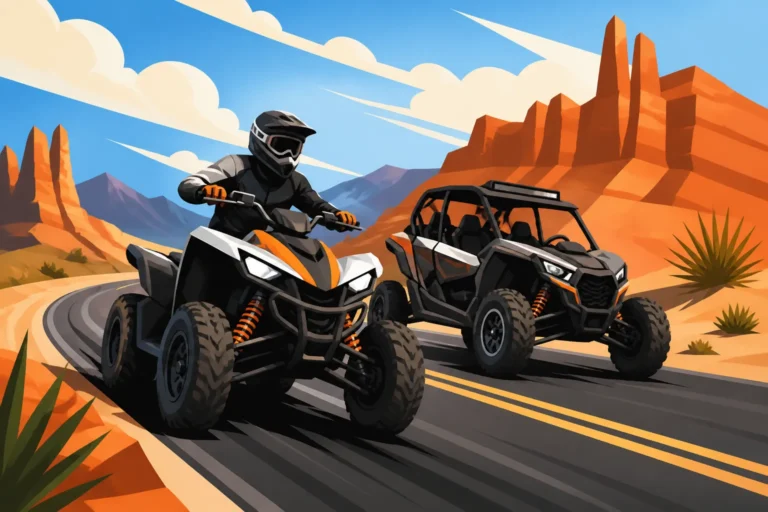
It's a beautiful day out in the Nevada desert, and you're just itching to get your ATV or UTV out on the trails. You've heard stories, though, or maybe even seen friends get pulled over, and the last thing you want is a hefty fine or your pride and joy impounded for simply not knowing where you can and cannot ride. That feeling of uncertainty, the worry of breaking an unknown rule, can really take the fun out of planning your next adventure. This guide is all about cutting through that confusion, helping you understand the specific places in Nevada where riding your off-highway vehicle (OHV) can lead to a ticket, and more importantly, how to avoid those frustrating encounters so you can enjoy the vast Nevada landscape worry-free.
Understanding the "Where Not To Ride" Basics in Nevada
Let's face it, when you invest in an ATV or UTV, the dream is wide-open spaces, dusty trails, and epic views. The reality, however, is that Nevada has specific rules about where those machines can legally operate, and ignoring them can lead to a quick end to your day – and a lighter wallet. It's not always intuitive, and what might seem like a harmless shortcut through town could land you in hot water.
Cities and Populated Areas: A No-Go Zone for Most OHVs
This is perhaps the biggest misconception for many riders. While Nevada embraces off-highway vehicle recreation, cities and densely populated areas are generally off-limits for ATVs and UTVs. You might see a buddy zip down a street for a short distance and think it's fine, but that's often where the problems begin. These rules are in place for safety, noise, and to minimize disruptions to residential areas.
Think about places like Las Vegas, Reno, Henderson, or Sparks. Cruising down a paved city street, or even using a bike path or sidewalk, is typically a direct route to a citation. These municipalities have their own ordinances that often prohibit OHVs on their streets, sidewalks, and any publicly maintained pavement unless it's a very specific, designated route. For example, [Las Vegas City Limits and OHV Routes] are very clearly defined, and veering off them can have consequences. Trying to ride your side-by-side from your hotel in Mesquite to a restaurant can also quickly lead to trouble, even if you feel like you're just trying to get around. Some cities are more lenient, like Mesquite with its reputation for open streets, but even there, understanding the nuances of [Mesquite Riders and the 2-Mile Rule] is crucial. It’s not just about what feels right; it’s about what the local law actually states.
State and Federal Highways: Tread Carefully, or Not At All
Nevada's vast network of state routes and federal highways (like US 95 or US 50) are generally not for your ATV or UTV. These are high-speed thoroughfares designed for conventional vehicles. The risks associated with an OHV on these roads are immense, both for you and for other drivers. Imagine pulling out onto US 93, the speed limit often 70 mph, on your UTV. It’s a recipe for disaster and certainly illegal.
There's a critical distinction here with Nevada law, which allows for brief crossings or traveling on the far right shoulder for a maximum of two miles to connect designated trails or access services. This isn't a free pass to cruise down the highway. This "2-mile limit" is often misunderstood. It's strictly for connecting segments of trails or getting to a fuel station, not for joyriding or commuting. You’ll definitely want to understand [Nevada's 2-Mile Limit on Paved Highway] before you even think about putting tires on major asphalt. And remember, this doesn't apply to interstates at all—[Nevada's Ban on Interstate Riding] is absolute. Even if you're just trying to get from one section of trail to another, using a prohibited highway section for longer than allowed, or without the proper "Large ATV" designation, is a surefire way to catch a deputy's attention.
Private Land and Restricted Areas: Respect the Boundaries
It might seem obvious, but riding on private property without explicit permission is a major no-no. Whether it's a ranch, a construction site, or even a vacant lot in a rural area, if it's not public land designated for OHV use, you need permission. Trespassing laws are taken seriously, and a landowner is well within their rights to have you cited or even arrested. Many times, these properties aren't clearly marked, leading to accidental trespass. It's your responsibility to know whose land you're on.
Beyond private land, there are also restricted public areas. Wilderness areas, for example, strictly prohibit motorized vehicles. Environmentally sensitive areas, like parts of Sand Mountain critical for the Kearney Buckwheat or the Sand Mountain blue butterfly, have specific closures. [How the Sand Mountain Blue Butterfly Closes Dune Areas] is a prime example of how conservation efforts dictate where and when you can ride. Always check maps from the Bureau of Land Management (BLM) or local authorities to ensure you're riding on open, legal routes. Riding on closed routes, even unintentionally, can result in a ticket and damage to fragile ecosystems.
The Consequences: What Happens When You Get a Ticket?
So, you've accidentally, or perhaps knowingly, ridden where you shouldn't have. What happens next? It's usually more than just a slap on the wrist. Nevada's law enforcement, from local sheriff's deputies to BLM rangers, are well-versed in OHV regulations and don't hesitate to enforce them for public safety and resource protection.
Fines and Penalties: The Cost of Misjudgment
The most immediate consequence is, of course, a fine. These aren't usually cheap. Riding an unregistered machine where registration is required can lead to a significant financial penalty, sometimes with an additional late fee if your decal was expired. [Nevada Fines for No Large ATV Decal] are specific, and if you were on a paved road without that special designation, you're looking at a separate set of penalties. These fines are designed to deter illegal riding and help fund trail maintenance and education programs.
Consider a scenario: you decide to take a shortcut through a subdivision in Elko to get to some trails you know are nearby. A resident calls the sheriff about noise. When the deputy arrives, not only might you get a ticket for riding in a prohibited area, but if your machine isn't registered or lacks the proper equipment for any road use (even permitted county roads), you could face additional citations. These can quickly add up, turning a fun outing into a very expensive lesson.
Impoundment and Other Legal Troubles: A Real Headache
In more severe cases, or for repeat offenders, law enforcement has the authority to impound your ATV or UTV. Imagine having your machine towed away right in the middle of your ride. The process to get it back is often costly, time-consuming, and can involve storage fees, towing fees, and proving ownership. It’s a major inconvenience that can completely ruin your plans and your budget.
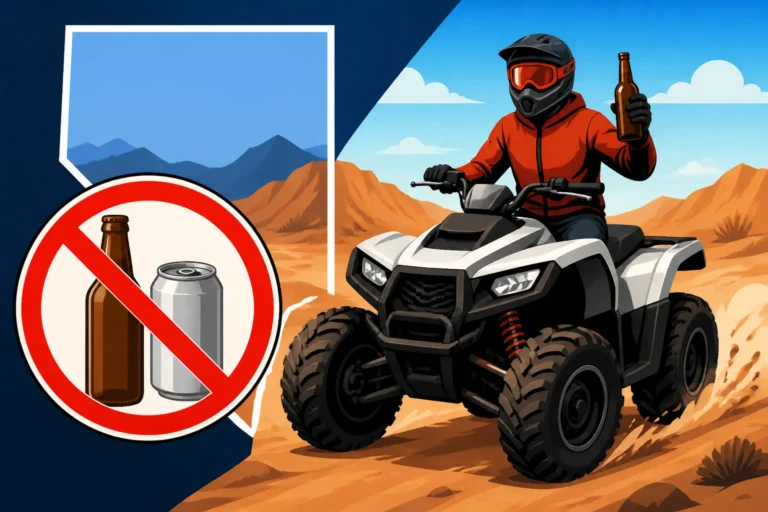
Beyond impoundment, depending on the severity of the offense (e.g., reckless driving, significant property damage, or riding under the influence), you could face more serious legal charges, potentially including court appearances, community service, or even jail time. [Nevada DUI Rules for ATV Riders] are just as serious off-road as on public highways. It's not just about the monetary fine; it's about the stress, the time lost, and the potential impact on your legal record.
License Points and Insurance Implications
While most OHV infractions won't directly impact your driver's license points for typical street driving, certain violations, especially those involving operating a "Large ATV" on a paved road without proper licensing or insurance, could potentially carry points or affect your driving record. It’s vital to distinguish between off-road rules and limited on-road rules. Additionally, if you're involved in an accident while riding illegally, your insurance coverage might be denied, leaving you personally liable for damages or injuries. This is a huge risk that many riders overlook. Always ensure you understand [Insurance and Nevada OHV Registration] requirements, especially if you plan any legal road use.
The "Large ATV" Designation: Limited Road Access Explained
Nevada does offer a specific pathway for some larger OHVs to legally use certain public roads, but it’s a far cry from being "street legal" in the traditional sense. This is a common point of confusion, and understanding it is key to avoiding tickets when you're trying to connect trails or access services.
What Qualifies as a "Large ATV"
Not all ATVs and UTVs qualify for this special designation. Nevada law is quite specific in [What Nevada's NRS 490.043 Counts as a Large ATV]. Generally, it refers to machines that are wider, heavier, or have multiple seats, often akin to a side-by-side. The law specifically looks for characteristics like an engine size over 70cc (most UTVs and larger ATVs easily meet this), and the presence of a steering wheel, roll-over protection, and an occupant restraint system. Crucially, it considers the number of seats or whether it has a cargo bed. For instance, [Why a Defender's Truck Bed Meets Nevada's Definition] is because the law accounts for utility-focused machines. On the other hand, [Why a Two-Seat Sport Quad Fails Nevada's Test] is because it lacks many of the features Nevada requires for limited road use.
If your machine fits this "Large ATV" definition, you can apply for a special decal that permits limited road travel. This is a completely separate process from standard OHV registration and comes with its own set of rules and required equipment.
Specific Road Use Rules for Large ATVs
Even with a Large ATV decal, you can't just drive anywhere. The rules are strict:
- Designated County Roads: You are generally restricted to "minor county roads" or "general county roads" that are not state or federal highways. [Which Nevada County Roads Qualify for ORVs] depends on the county. Many counties, like Washoe, have specific ordinances, so understanding [Washoe County Ordinance 1507] is critical if you ride there. Some counties might also specifically ban OHVs on their roads.
- Cities with Ordinances: In cities with populations over 100,000 (like Las Vegas, Henderson, Reno, Sparks), you can only ride a Large ATV on specifically designated OHV routes. You can't just drive on any city street. [Nevada Cities That Require Designated OHV Routes] outlines where this applies.
- The 2-Mile Rule: This rule still applies. Even on permitted county roads, you can only travel up to two miles on a paved section of a state or federal highway (unless it's a designated OHV route within a city) to connect trails or access services.
- Crossing Highways: You can cross a state or federal highway, but only at an intersection and only if the crossing doesn't prohibit it. [Nevada Rules for Crossing a State Route] clearly lays this out. It's a quick, direct crossing, not riding along it.
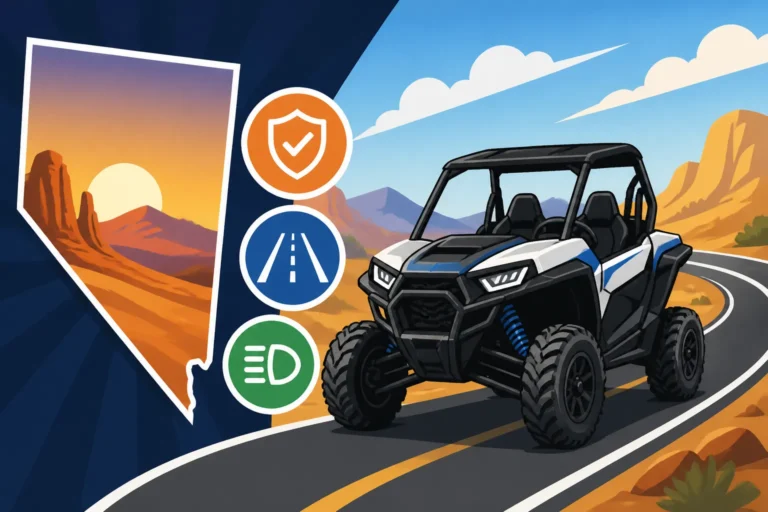
- Equipment Requirements: A Large ATV on these roads must have specific safety equipment, many of which can be found through aftermarket retailers. This includes:
- Headlights and taillights visible from 500 feet [Nevada Headlight Requirements for Road Use].
- A stop lamp [Nevada Stop Lamp Requirement for UTVs].
- At least one mirror providing a view 200 feet to the rear.
- A horn.
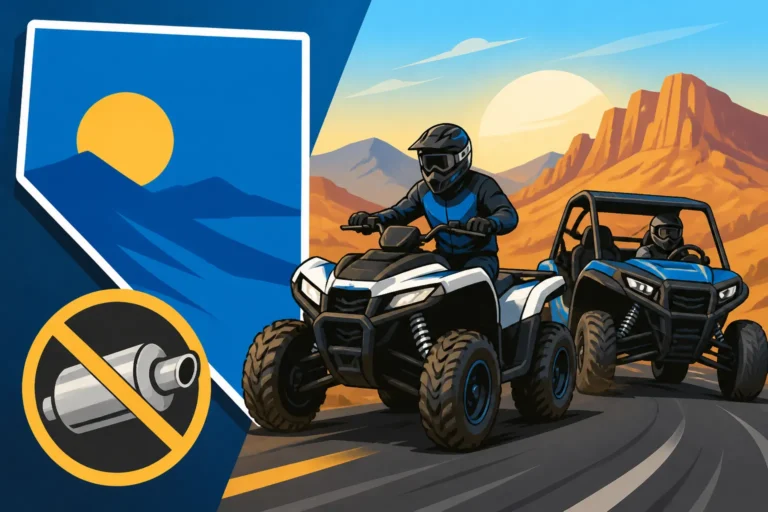
- A muffler and spark arrester [Nevada Spark Arrester Requirement].
- Seat belts (if equipped) must be worn.
- A windshield is optional but recommended by many, and products from companies like SuperATV offer a range of durable, scratch-resistant windshields, as well as robust mirrors and horns, to help you meet these requirements. Many riders turn to aftermarket suppliers like SuperATV for their robust mirrors and signal kits to ensure compliance.
- Driver's License and Insurance: You must possess a valid driver's license and carry proof of liability insurance. [Nevada Driver's License Rules for UTV Road Use] and [Liability Insurance Nevada Requires Under NRS 485.185] are non-negotiable.
Failing to meet any of these specific requirements, even if you have the Large ATV decal, can still result in a ticket. It's a limited privilege, not a blanket approval for street use.
How to Ride Smart and Avoid Tickets in Nevada
The goal is always to have a fantastic time riding your OHV, not to spend your hard-earned money on avoidable fines. With a little preparation and awareness, you can significantly reduce your chances of getting a ticket.
Know Your Local Ordinances and Trail Rules
Before you even load up your machine, do your homework. This is perhaps the single most important step.
- Check City and County Websites: If you plan to ride anywhere near a town or on county roads, visit the city or county's official website. Look for specific ordinances regarding OHV use. For example, knowing [Washoe County Roads and Large ATVs] rules can save you a lot of grief.
- Consult the BLM: Much of Nevada's riding is on Bureau of Land Management (BLM) land. Their district offices (like BLM Carson City or Las Vegas) have maps and information on designated trails, open areas, and any temporary closures. The [Nevada Trail Finder] is an excellent resource for planning your routes. Always verify you're riding on open BLM land versus a marked trail, and pay attention to wilderness boundaries you cannot cross.
- Read the Signs: Trailheads and access points often have signage detailing local rules, restrictions, and permit requirements. Pay attention to these signs, as they often contain critical, up-to-date information specific to that riding area.
- Understand Reciprocity: If you're visiting from out of state, know [Nevada OHV Reciprocity With Other States]. While Nevada offers a 15-day exemption for registered out-of-state machines, after that, you'll need to register here. [How Long an Out-of-State ATV Can Stay in Nevada] is a common question, and getting it wrong can lead to a ticket.
Equip Your Machine Properly
Whether you're sticking purely to trails or have a Large ATV decal for limited road use, proper equipment is essential.
- Nevada OHV Decal: For any OHV used off-highway (unless exempt), you must have a current Nevada OHV registration decal. [What a Nevada OHV Decal Actually Proves] is that you've paid your dues and are contributing to trail maintenance. Riding without it, or with an expired one, is an easy ticket. [Nevada Citations for an Expired Decal] are common.
- Safety Gear: Helmets are mandatory for riders under 18 off-road, and for all riders and passengers on paved roads if riding a Large ATV. Eye protection is highly recommended for everyone.
- Road-Specific Equipment: If you're using a Large ATV on permitted roads, ensure you have all the required items: working headlights, taillights, a stop lamp, horn, and at least one rearview mirror. Products from SuperATV, for instance, are well-regarded for providing robust aftermarket solutions that meet these compliance needs, whether it's a durable windshield or integrated turn signal kits to help you meet the full list of road-legal equipment.
Carry the Right Paperwork
Always have your essential documents with you when you ride.
- Registration Card: Your Nevada OHV registration card (or valid out-of-state registration).
- Driver's License & Insurance: If operating a Large ATV on a road, or even just crossing a paved road, your valid driver's license and proof of liability insurance are crucial. [Carrying a License on a County Road Ride] is paramount.
- Proof of Ownership: While not always required by law to carry, having your title or bill of sale handy can help resolve any questions about ownership.
- Keep it Dry and Safe: Dust, water, and vibration can quickly destroy paper documents. Invest in a waterproof and dustproof document holder or a small dry bag to keep your paperwork protected. [Keeping Paperwork Dry in a Dusty Machine] is a small but important detail. Some riders even keep photos of their documents on their phones as a backup, though physical documents are usually preferred by enforcement officers.
Ride Responsibly and Respectfully
This might seem like common sense, but a respectful attitude goes a long way.
- Stay on Marked Trails: Don't create new trails, and don't go around obstacles unless a designated bypass exists. This protects the environment and keeps you out of restricted areas.
- Control Your Speed and Noise: Excessive speed and loud exhaust systems attract unwanted attention from both residents and law enforcement. Be mindful of others enjoying the outdoors, including hikers, equestrians, and campers. [Sound Limits and Aftermarket Exhaust] are real concerns, especially near populated areas.
- Pack It In, Pack It Out: Leave no trace. Littering is not only disrespectful but also illegal and subject to fines.
- Avoid Private Roads: If you see a "Private Road" or "No Trespassing" sign, take it seriously. Even if it looks like a shortcut, it's not worth the risk. [Nevada Trespass Rules for Riders] are clear.
Following these guidelines will not only help you avoid tickets but will also ensure that OHV enthusiasts continue to have access to Nevada's incredible riding areas for years to come. Ride safe, ride smart, and enjoy the ride!
| Where You CAN Ride (Legally) | Where You CANNOT Ride (Legally) |
|---|---|
| Designated OHV Trails (BLM, Forest Service) | Paved City Streets (unless designated route) |
| Open BLM Land (where cross-country travel is permitted) | Sidewalks or Bike Paths |
| Minor County Roads (with Large ATV decal & equipment) | State Highways (except for 2-mile connection/crossing) |
| Designated OHV Routes within large cities (with Large ATV decal & equipment) | Interstate Highways (absolute ban) |
| Private Land (with express permission) | Private Land (without permission) |
| Sand Mountain Recreation Area (with specific permit/fee) | Wilderness Areas |
| Logandale Trails Recreation Area | Environmentally Protected Areas (e.g., Kearney Buckwheat habitat) |
Disclaimer
This article is for general informational purposes only and does not constitute professional advice. Laws, prices and regulations vary by location and change over time. Consult a qualified professional for guidance on your specific situation.