How Far You Can Ride Pavement in Nevada
It's incredibly frustrating, isn't it? You've got your ATV or UTV all prepped for an epic day out in the vast Nevada desert, but then you hit a snag: how do you get from your camp or the staging area to the actual dirt trails without breaking the law? Paved roads are often a necessary evil, a short bridge between your truck and trailer and the open desert. This guide is going to meticulously break down exactly how far you can legally ride your off-highway vehicle (OHV) on pavement in Nevada, so you can focus on the ride, not the potential ticket.
Nevada's 2-Mile Pavement Limit: The Golden Rule
Let's cut right to the chase with the most important rule of thumb: Nevada law generally restricts off-highway vehicles, like your ATV or UTV, to a maximum of two miles of paved highway travel. This isn't some arbitrary number designed to annoy you; it's a carefully considered allowance meant to bridge the gap between staging areas, fuel stops, and the vast network of unpaved trails. The spirit of the law is clear: OHVs are for off-highway travel, and pavement is for necessary transitions.
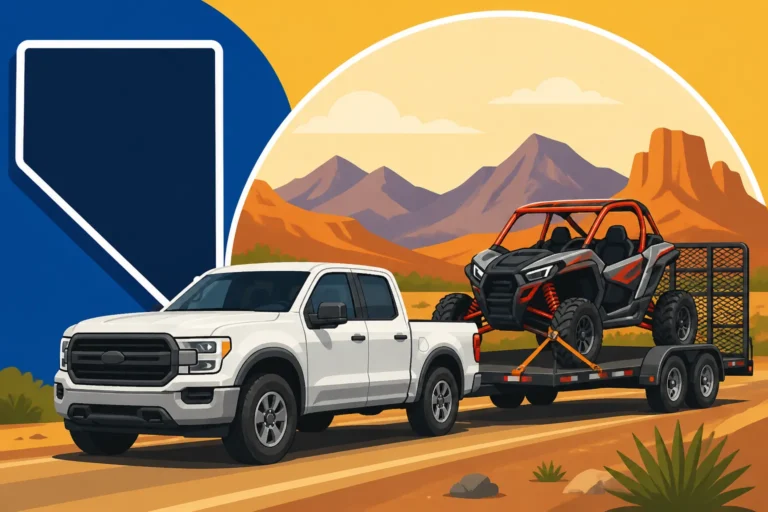
Imagine you've just unloaded your side-by-side at a BLM staging area, and the closest dirt trail entrance is just a short hop down a county-maintained paved road. Under this 2-mile rule, you're usually good to go. The idea is to provide a practical solution for riders who need to connect segments of trail, or access a small town for gas, food, or maybe a quick repair. It's not intended for you to take your quad to the grocery store across town, or for an extended cruise down a scenic highway. If you find yourself needing to travel further than two miles on pavement, it's a huge red flag that you might be operating outside the legal boundaries. Always err on the side of caution and consider trailering your machine if the paved distance is substantial. [Nevada's 2-Mile Limit on Paved Highway] covers this in more detail.
Why This Limit Exists
The primary reason for the 2-mile limit is safety and practicality. OHVs are designed differently than street-legal vehicles. They often lack the turn signals, mirrors, specific lighting, and tires required for safe highway speeds and traffic conditions. Their suspension systems are built for absorbing bumps and jumps, not for smooth, high-speed cornering on asphalt. Allowing unlimited pavement travel would put OHV riders, as well as other motorists, at undue risk.
Think about it: a knobby ATV tire that performs brilliantly in sand and dirt can be squirrely and wear out quickly on hot asphalt. The noise levels, the lack of robust crumple zones, and the differing visibility profiles all contribute to why these machines aren't meant for extended road use. The state wants you to enjoy the trails, and the 2-mile buffer is a pragmatic compromise, acknowledging that sometimes pavement is unavoidable to reach those trails. It helps prevent unnecessary wear and tear on your machine, too, which is a bonus.
Real-World Examples of the 2-Mile Rule in Action
Let's paint a picture of how this rule plays out. You're camped at the Logandale Trails, a fantastic OHV area with a mix of technical trails and scenic washes. You realize you forgot some crucial supplies back in the small town of Logandale, which is just over a mile away on a paved county road. This short trip, to grab a cooler or some extra water, would typically fall within the 2-mile allowance. You're using the pavement as a brief access point to services, not as your primary travel route.
Another common scenario is connecting two distinct trail systems separated by a minor paved road. Perhaps you've completed one loop and the next leg of your adventure requires crossing a state route that has a designated OHV crossing, and then a short paved county road section to get to the next dirt trail. As long as that paved section remains under two miles, you're likely in the clear. However, if that paved section stretches for three, four, or even five miles, you'll need to re-evaluate. That's when you should consider packing up and trailering to the next staging point. This kind of planning prevents unwanted encounters with law enforcement.
Beyond the 2-Mile Limit: Designated Routes and Special Cases
While the 2-mile rule is the general standard, Nevada isn't entirely black and white. There are specific exceptions and designations that can allow for longer paved travel under certain circumstances. These usually involve local county or city ordinances, or specific machine classifications.
Local Ordinances and Designated OHV Routes
Some local governments in Nevada have taken proactive steps to create designated OHV routes within their jurisdictions. These routes allow for more extensive paved travel than the standard 2-mile limit, specifically to connect riders with trailheads, services, or even to allow limited in-town travel. [Nevada Cities That Require Designated OHV Routes] delves into this. It's crucial to understand that these routes are usually clearly marked and are exceptions to the general rule, not the norm. You can't assume that because one town has them, another will.
Mesquite, for example, has developed a reputation for being relatively OHV-friendly, with specific routes designated for off-highway vehicles to access amenities or connect to nearby trail systems. This means you might be able to ride from your hotel in Mesquite directly to a trail system, or to a restaurant, along these marked paths, exceeding the 2-mile limit. However, always check local ordinances before riding, as these can change, and what's permitted in Mesquite might be strictly prohibited in a neighboring community like Bunkerville or out near Caliente. Some [Nevada Counties That Ban OHVs on County Roads] exist, so research is key.
Understanding "Minor County Roads"
Nevada law also makes distinctions between different types of paved roads. While major state highways and interstates are almost universally off-limits for OHVs (beyond permitted crossings), minor county roads might fall into a grey area or be subject to different local rules. The definition of a "minor county road" often refers to less-traveled, local paved roads maintained by the county, usually without high speed limits or significant traffic volume.
However, even on a "minor county road," the 2-mile rule still generally applies unless a specific local ordinance overrides it. It's not a blanket pass to ride indefinitely. These roads are typically where you'll find those short connecting stretches between dirt trails. Always assume the 2-mile limit unless you've confirmed a specific, marked designated route or a local ordinance that explicitly allows otherwise. Trying to argue the definition of "minor" with a county deputy on the side of the road is rarely a successful strategy.
The "Large All-Terrain Vehicle" Decal
Nevada offers a special "Large All-Terrain Vehicle" decal for certain UTVs that meet specific criteria. This decal isn't about making your machine street legal in the traditional sense, but rather about allowing limited use on designated county roads, again, typically those "minor county roads." [What Nevada's NRS 490.043 Counts as a Large ATV] explains what kind of machine this decal is for.
Generally, to qualify for a Large ATV decal, your UTV needs to meet specific requirements, such as having four seats or a cargo bed capable of carrying a significant load (think utility side-by-sides like a Can-Am Defender or a Polaris Ranger, not typically a two-seat sport quad like an RZR XP 1000). Even with this decal, the intent is for access, not general transportation. You still need proper lighting, mirrors, a horn, and other safety equipment. While this decal can allow for travel beyond the 2-mile limit on specific, designated minor county roads, it doesn't open up all paved roads or highways. It's another layer of complexity that requires you to know your local laws and the specific roads you plan to ride. If you're outfitting your UTV to meet these criteria, companies like SuperATV offer a wide range of accessories, from mirrors to turn signal kits, that can help you meet the equipment requirements for these specific limited road-use scenarios.
Practical Considerations and Compliance
Riding on any paved surface, even within the legal limits, comes with a host of responsibilities. You need to be aware of your machine's capabilities, the local laws, and how to stay safe and compliant.
Required Equipment for Limited Road Use
Even for short stints on pavement, Nevada law requires certain equipment on your OHV to ensure basic safety and visibility. This isn't just a suggestion; it's a legal mandate that deputies will check. Expect to have:
- Headlights and Taillights: These must be visible from a certain distance, especially if you're riding at dusk or in low light.
- Stop Lamp (Brake Light): Essential for signaling your deceleration to other vehicles.
- Reflectors: Often integrated into lights or separately mounted, to enhance visibility from the sides and rear.
- Spark Arrester: Required on all OHVs riding on public land, regardless of pavement, to prevent wildfires.
- Muffler: To keep noise levels within acceptable limits.
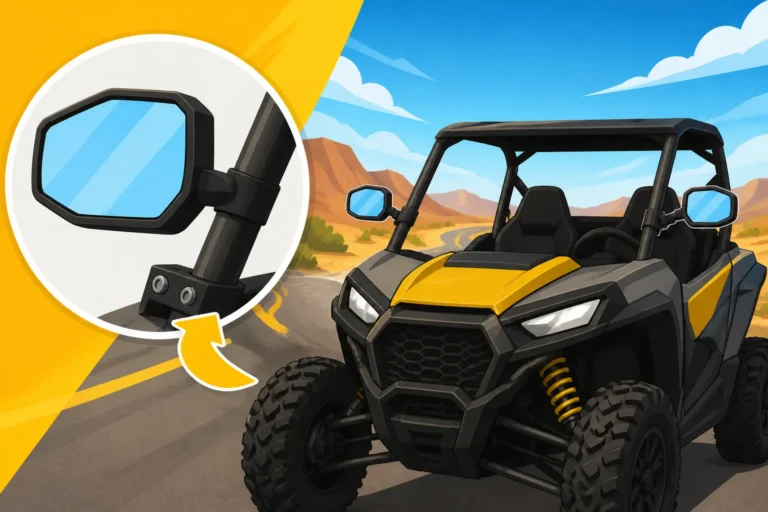
- Mirrors: At least one rearview mirror is often required for road travel.
- Horn: A working horn is necessary to alert others.
- Seatbelts: For UTVs designed with them, they must be worn by all occupants.
Many riders turn to aftermarket suppliers like SuperATV to get their machines up to snuff for these limited road-use requirements, purchasing things like side mirrors, complete turn signal kits, or more robust lighting solutions.
Driver's License and Insurance
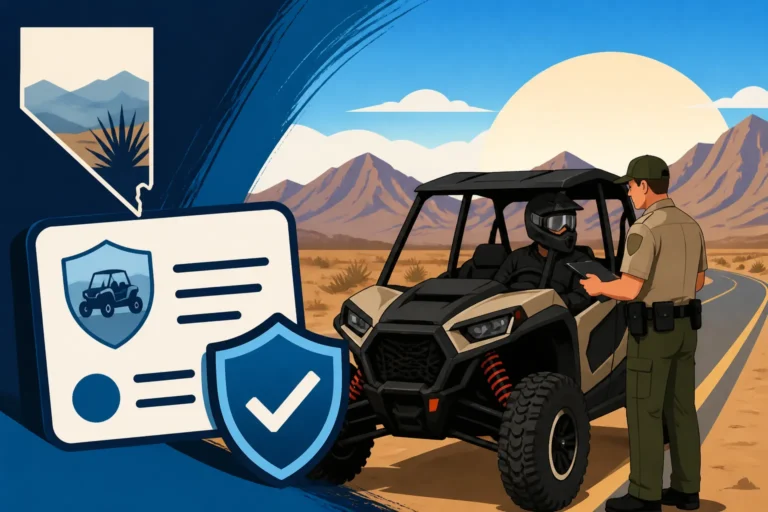
If you're operating an OHV on any paved public road in Nevada, even for just a mile, you absolutely need a valid driver's license. This isn't optional. Think of it as operating any other motor vehicle on a public roadway – the same rules apply to the operator. [Nevada Driver's License Rules for UTV Road Use] provides more context.
While liability insurance isn't typically required for off-road riding in Nevada, if you're venturing onto any public paved road, even if it's just a county road, liability insurance becomes mandatory. This protects you in case of an accident involving another vehicle or property. Always carry proof of insurance, your driver's license, and your OHV registration card with you. A dry bag or a secure compartment on your machine is a great place to keep these documents protected from dust and the elements.
Supervision for Minors and Helmet Rules
For riders under 18, specific supervision rules apply, especially on paved roads. Generally, a rider under 16 cannot operate an OHV on a paved county road unless directly supervised by someone at least 18 years old who also holds a valid driver's license. And let's not forget helmets. While helmets are always a good idea off-road, [Nevada Helmet Law for Road Riding] makes it clear: if you're riding an OHV on a public paved road, helmets are mandatory for everyone, regardless of age. No exceptions.
Consequences of Non-Compliance
Ignoring these rules can lead to serious consequences. Law enforcement officers, whether state troopers, county deputies, or BLM rangers, are well-versed in Nevada's OHV laws. Riding on prohibited roads, exceeding the 2-mile limit without proper designation, or lacking the required equipment can result in fines, citations, and potentially having your machine impounded. [Nevada Fines for No Large ATV Decal] can be steep, and a citation for an unregistered or improperly operated OHV can quickly put a damper on your ride. It's simply not worth the risk.
Navigating Common Scenarios
Let's break down some everyday situations where you might encounter pavement and how to handle them legally and safely.
Riding to the Trailhead, Not to the Store
This is perhaps the most common reason OHV riders find themselves on pavement. You've trailered your machine to a campsite or a staging area, and the actual dirt trails are a short distance away on a paved access road. This scenario perfectly illustrates the intent behind the 2-mile rule. It's about getting to the trail, not using the OHV as a substitute for your truck or car for general errands. [Riding to the Trailhead, Not to the Store] highlights this key distinction. Stick to the most direct route, keep your speed appropriate for the road, and be highly visible to other traffic.
Crossing a Major Highway
Sometimes, the only way to get from one section of an OHV trail to another is to cross a major paved highway. Nevada law allows for this, but with strict rules. You cannot ride along the highway; you must cross it at a ninety-degree angle at a safe, visible location. You're essentially treating it like a pedestrian crosswalk, but with a motor vehicle. Stop, look both ways, and proceed only when it's safe. There are specific restrictions on how and where this can be done, so always exercise extreme caution. [Crossing a Highway on an ATV in Nevada] for details. Never attempt to cross if visibility is poor or traffic is heavy.
Fueling Up or Grabbing a Bite in a Small Town
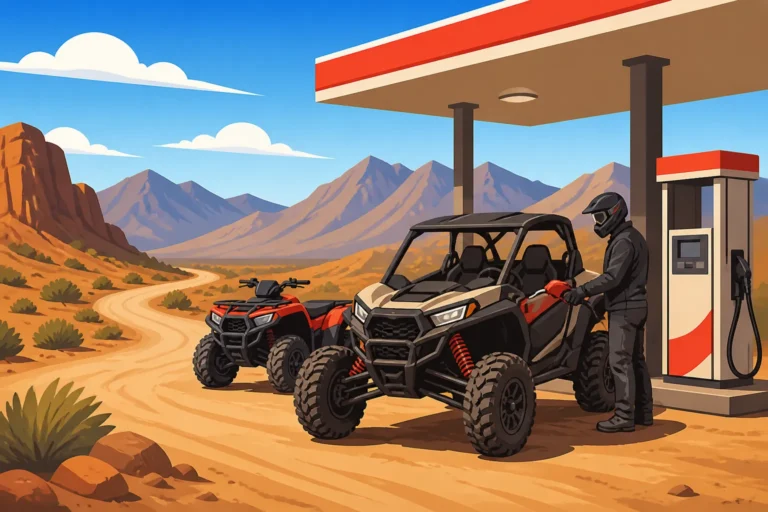
Many of Nevada's remote trail systems are near small towns that rely on OHV tourism. These towns often have gas stations, convenience stores, and diners that riders want to access. If the establishment is within that 2-mile window from the nearest trail access, and local ordinances don't prohibit it, a quick trip for fuel or food is often permissible. However, always be respectful of the local community. Ride slowly, quietly, and park your machine thoughtfully. Remember, these towns welcome riders, but they expect responsible behavior.
What Deputies or Rangers Look For
When a law enforcement officer pulls over an OHV on a paved road, they're typically checking for a few key things:
- OHV Registration Decal: Is it current and properly displayed?
- Driver's License: Do you have a valid one?
- Proof of Insurance: Is your machine covered for road use?
- Required Equipment: Do you have functioning headlights, taillights, mirrors, and a horn?
- Compliance with the 2-mile rule: Are you riding beyond the permissible distance without a specific exception?
- Designated Route Adherence: If you're on a designated route, are you staying on it?
They are looking for common sense and adherence to the rules. Don't give them a reason to stop you. [What a Nevada Trooper Looks For on a County Road] is worth a read.
Summary of Nevada OHV Pavement Use
To help clarify the general rules, here's a quick reference table:
| Scenario | Legality in Nevada (General Rule) | Key Considerations |
|---|---|---|
| Riding on Paved County Roads | Generally allowed for up to 2 miles to access trails or services. | Requires valid driver's license, insurance, current registration, and proper equipment (lights, horn, mirrors, helmet). |
| Riding on Major State Highways / Interstates | Strictly Prohibited (except for designated crossings). | Only permitted to cross at 90-degree angles, where safe and allowed. Never ride along them. |
| Designated OHV Routes (City/County) | Permitted for longer distances if specifically designated by local ordinance. | Always verify local ordinances and signage. May require a "Large ATV" decal for UTVs. |
| Accessing Fuel/Food in Small Towns | Permitted if within the 2-mile limit or on a designated route. | Be respectful, ride slowly, and park appropriately. Carry all required documents. |
| Riding a "Large ATV" with Decal | Allowed on certain designated minor county roads; may exceed 2-mile rule. | UTV must meet specific criteria (e.g., 4 seats, cargo bed). Still requires proper equipment and adherence to local rules. |
| Riding Without a Helmet on Pavement | Prohibited. Helmets are mandatory for all riders on paved public roads. | No exceptions. |
Understanding how far you can legally ride pavement in Nevada on your ATV or UTV boils down to remembering the 2-mile rule as your baseline. Any deviation from that requires specific knowledge of local ordinances, designated routes, or special vehicle classifications like the Large ATV decal. Always prioritize safety, equip your machine properly, and carry all necessary documentation. By doing so, you'll ensure your Nevada off-roading adventures remain thrilling and free from legal headaches.
Disclaimer
This article is for general informational purposes only and does not constitute professional advice. Laws, prices and regulations vary by location and change over time. Consult a qualified professional for guidance on your specific situation.