Are ATVs Street Legal in Nevada?
It's a question that plagues every off-road enthusiast in the Silver State: Can I ride my ATV or UTV on the actual street in Nevada? The desire to simply hop on your machine and cruise from your house to the trailhead, or even just to the corner store, is completely understandable. Unfortunately, the answer isn't a simple "yes" or "no," and misunderstanding it can lead to frustrating fines. This guide will cut through the confusion and explain exactly when and where you might be able to legally take your off-highway vehicle (OHV) on Nevada's paved roads.
The Short Answer: Generally No, But With Big Exceptions
Let's get straight to it: for most people and most traditional ATVs, the general rule in Nevada is that off-highway vehicles are not street legal. You cannot just register your quad with the Department of Motor Vehicles (DMV) and expect to ride it like a car or motorcycle on public roads. Nevada Revised Statute (NRS) 490.060 clearly states that OHVs are designed for off-highway use and are generally prohibited on highways, which includes most paved roads. This can be a real bummer when you see other machines on the road, leaving you wondering if they know something you don't.
But here's where the nuance, and often the confusion, comes in: Nevada has a specific, somewhat unique provision for what it calls "large all-terrain vehicles." If your machine fits this particular definition and you meet certain equipment and registration requirements, then yes, there are specific, limited circumstances where you can ride on certain public roads. This isn't about getting a standard ATV plated; it's about a distinct category of OHV that the state recognizes differently. It's easy to get this mixed up with street legal kits you might see advertised elsewhere, but Nevada has its own very precise criteria.
Why Most ATVs Don't Make the Cut
The primary reason your average ATV, or quad, doesn't qualify for street legal status in Nevada is because it simply doesn't meet the state's definition of a "large all-terrain vehicle." This isn't a judgment on the machine itself or its power, but rather a legislative classification. Many riders assume that because their quad is powerful or has a big engine, it should be able to handle road travel, but the law looks at specific design elements, not just performance. It’s a common point of frustration for riders who see utility-style side-by-sides on the road but are told their sport quad can't go.
The law focuses on a few key structural features that differentiate a machine meant primarily for recreational trail use from one that might have more practical, road-adjacent utility. Without those specific features, no amount of aftermarket parts or modifications will change its legal classification for road use. This is crucial to understand before you invest time and money into modifications, hoping to get your beloved quad on the asphalt.
The "Large All-Terrain Vehicle" Definition
So, what exactly does Nevada count as a "large all-terrain vehicle" that opens the door to limited road use? This is the linchpin of the entire discussion. Under [What Nevada's NRS 490.043 Counts as a Large ATV], a large all-terrain vehicle must meet one of two specific criteria: it must have at least four seats or have a truck bed. That's it. It's a very clear, black-and-white rule that surprisingly few people know about.
This means that most traditional ATVs, which are designed for one or two riders and lack a dedicated cargo bed that qualifies as a "truck bed," are immediately excluded. Even if your quad is a beast, with huge tires and a powerful engine, if it doesn't have those four seats or a truck bed, it simply won't qualify under Nevada law. This is where many riders get stuck, realizing their two-seat sport quad or utility ATV, no matter how capable, can't fulfill this basic requirement.
The Four-Seat or Truck Bed Requirement
Let's break down this definition further. The "four seats" aspect typically applies to many larger side-by-sides (UTVs) that are designed to carry multiple passengers. Think about those family-friendly models that have two rows of seating, often with seatbelts for everyone. If your UTV has four factory-installed seats, you're on the right track for meeting this part of the definition. Similarly, a UTV that comes equipped from the manufacturer with a proper "truck bed" – a distinct, open cargo area behind the passenger compartment, separate from a simple rack or small storage box – also qualifies. This is often seen on utility-focused side-by-sides, like many popular work or ranch machines.
For instance, a Polaris RZR XP 4 1000 would typically meet the four-seat requirement, while a Can-Am Defender with its dedicated cargo box would meet the truck bed requirement. Understanding this specific legal language is key to determining if your machine even has a chance at limited street legality in Nevada. [Does a Four-Seat RZR Pass Nevada's Seating Test?] Yes, if it has those four seats! But conversely, a two-seat RZR, even a powerful one, would not.
Why Your Sport Quad Won't Qualify
This is often the most heartbreaking part for many riders. You love your sport quad, maybe a Yamaha YFZ450R or a Honda TRX450R, and you've put a lot of time and money into it. It feels like a miniature race car, powerful and agile. You see a big, slow utility UTV puttering down a county road and think, "My quad is way more capable!" But here's the cold truth: [Why a Sport Quad Never Passes the Test] in Nevada. A sport quad, by design, has either one or two seats. It doesn't have four seats, and it certainly doesn't have a truck bed.
No matter how many accessories you bolt onto it – turn signals, mirrors, a horn – it will never meet the foundational requirement of being a "large all-terrain vehicle" under NRS 490.043. This isn't about roadworthiness in a practical sense; it's about a very specific legal definition. So, while it stings, it's important to be realistic about your sport quad's limitations when it comes to riding on Nevada's paved roads.
Equipping Your Large ATV for Nevada Road Use
Okay, so you've got a "large all-terrain vehicle" – a four-seater UTV or one with a proper truck bed. Congratulations, you've cleared the first, and often most difficult, hurdle! But you're not ready to hit the pavement just yet. Even if your machine fits the definition, it still needs to be properly equipped to be considered road-legal in those limited circumstances. Think of it like getting a regular car ready for the road; there are minimum safety and visibility standards to meet. Ignoring these requirements is an easy way to attract the attention of law enforcement and earn yourself a citation.
The requirements are quite specific and aim to ensure that your OHV is as visible and controllable as any other vehicle on the road. You can't just slap a license plate on it and go; you need the right lights, mirrors, and safety features. Many of these items are readily available from aftermarket suppliers, including reputable brands like SuperATV, which offer a wide range of accessories designed to help you meet these road-use specifications.
Essential Safety Gear and Lighting
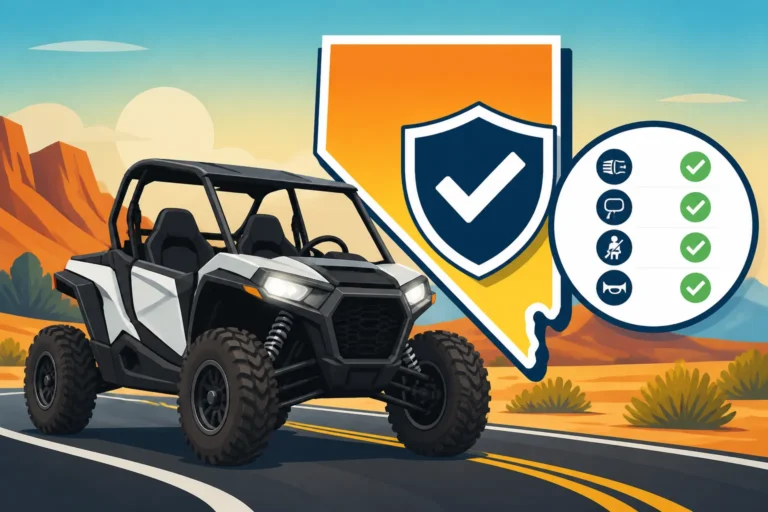
For your large ATV to be considered road-ready, it needs to be visible and signal its intentions clearly. Here’s a rundown of the essential equipment:
- Headlights and Taillights: These aren't just for looking cool; they're vital for visibility, especially during dawn, dusk, or any low-light conditions. Your machine needs working headlights that illuminate the road ahead and taillights that are clearly visible from at least 500 feet to the rear. This isn't just a suggestion; it's a legal requirement to ensure other drivers can see you coming and going. [Headlights and Taillights Visible 500 Feet] are paramount.
- Brake Lights (Stop Lamp): Just like any car, your large ATV must have a functioning stop lamp that illuminates when you apply the brakes. This is critical for preventing rear-end collisions and letting drivers behind you know you're slowing down or stopping.
- Turn Signal Lamps: While not always standard on OHVs, if you're riding on public roads, you need to be able to signal your turns and lane changes. Many aftermarket kits, including those from SuperATV, offer integrated turn signal solutions that are easy to install.
- Reflectors: Red reflectors must be mounted on the rear of the vehicle, though a taillight designed to reflect light can sometimes satisfy this requirement. These provide passive visibility, which is important even when your machine is parked or powered off.
- Mirrors: You must have at least one rearview mirror, and it must be mounted in such a way that you can see at least 200 feet to the rear. Many riders opt for a combination of a central rearview mirror and side mirrors for optimal visibility.
- Horn: A working horn is necessary to alert others to your presence or to avoid potential hazards. It needs to be audible from a reasonable distance.
- Spark Arrester and Muffler: Your machine must be equipped with an approved spark arrester to prevent wildfires and a muffler that keeps noise within reasonable limits. While this is primarily an off-road rule, it applies universally when operating on public lands or roads to reduce environmental impact and noise pollution.
- Tires: While Nevada law doesn't explicitly mandate DOT-approved tires for OHVs on roads, it's a very strong recommendation for safety. Off-road tires are designed for traction on dirt, mud, and rocks, not for high-speed stability or grip on asphalt. Running road-legal tires will significantly improve handling, braking, and overall safety when on pavement. [Nevada Equipment List for Road-Legal UTVs] covers these and other considerations.
Licensing, Insurance, and Documentation
Beyond the physical equipment, you also need to ensure you, as the operator, are properly licensed and that your machine is insured and documented. You can't just be an unlicensed rider on a legal machine.
- Driver's License: Anyone operating a large ATV on a Nevada public road must possess a valid driver's license. This means you need to be at least 16 years old and have successfully passed the state's driving tests, just as you would for a car. There are no special OHV-specific road licenses.
- Liability Insurance: Nevada law requires liability insurance for any motor vehicle operated on a public highway. Your large ATV is no exception. This insurance provides financial protection in case you cause an accident resulting in injury or property damage to others. Make sure your policy specifically covers road use for your OHV. [Insurance Nevada Requires for Road Use] is a must.
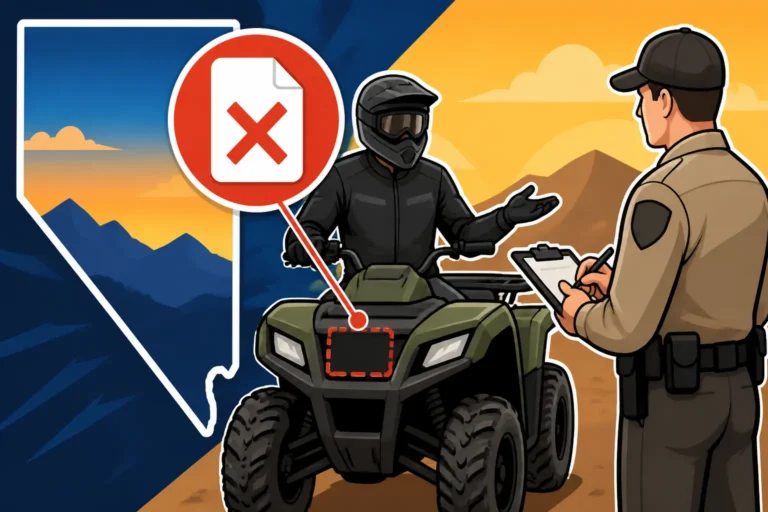
- Registration and Decal: Your large ATV must be properly registered with the Nevada DMV and display a current OHV decal. This decal, typically placed on the left side or rear of the vehicle, proves that your machine is legally registered for off-highway use, which is a prerequisite for its limited road use. Don't confuse this with a traditional license plate, as Nevada OHVs don't get those. You'll need to apply for a [Nevada Large ATV Decal] after ensuring your machine meets the "large ATV" definition.
- Proof of Ownership and Registration: Always carry your physical registration card and proof of insurance with you when riding. A photo on your phone might not always be accepted by law enforcement. Keeping these documents dry and accessible is always a good idea.
Where You Can and Cannot Ride Your OHV on Nevada Roads
Even if your machine is a certified "large all-terrain vehicle" and you've equipped it perfectly, you still can't just ride anywhere. Nevada has very specific rules about which roads are permissible for OHV use and under what conditions. This is where many riders get into trouble, assuming that "street legal" means "ride anywhere." It doesn't. Nevada's approach is about allowing access to trails and connecting rural communities, not replacing cars for urban commuting.
Understanding these geographical and situational limitations is just as important as knowing the equipment requirements. A properly equipped large ATV can be lawfully on some roads, but not others, and certainly not indefinitely. This is where the local ordinances and specific county designations come into play, making it a bit of a patchwork across the state.
Designated County Roads and the 2-Mile Rule
Nevada generally restricts OHV road use to "minor county roads" and then only under specific circumstances. A "minor county road" is a county-maintained public road that often leads to trailheads or provides access within rural areas. It's usually unpaved or lightly paved, and not a major thoroughfare. However, even on these roads, there's a critical limitation: the "2-mile rule." You can operate your large ATV on these roads for a maximum distance of two miles to connect from one off-highway route to another, or to access services like fuel or food. [How Far You Can Ride Pavement in Nevada] is limited.
This rule is designed for practicality, allowing riders to bridge short gaps between trails or make necessary stops without having to trailer their machines. For instance, if you're riding the Logandale Trails and need to get fuel in Logandale town, you might use a county road for a short distance. This isn't permission to joyride through town, but rather to facilitate your off-highway adventure. Always be aware of your location and the types of roads you're on, as enforcement can be strict, particularly in populous areas. [Nevada County Roads Open to UTVs] are typically these minor, less-trafficked routes.
| Road Type | General OHV Legality (Non-Large ATV) | Large ATV Legality (With Equipment & Registration) |
|---|---|---|
| State Highways (e.g., US 95, I-15) | No | No (Except to cross) |
| Major County Roads | No | Usually No (Check local ordinances) |
| Minor County Roads | No | Yes, with 2-mile limit |
| City Streets | No (Unless designated) | Usually No (Unless designated) |
| Private Property | Yes (With permission) | Yes (With permission) |
| Designated OHV Routes | Yes | Yes |
City and State Highway Restrictions
This is where the "no" answer becomes very firm. You absolutely cannot ride your ATV or large ATV on interstate highways or state routes (e.g., US 93, SR 169) for travel. The only exception is to cross them at a designated intersection, and even then, you must do so safely and quickly, obeying all traffic laws. [Nevada Rules for Crossing a State Route] are strict, and you cannot ride along the shoulder or in ditches of these major thoroughfares.
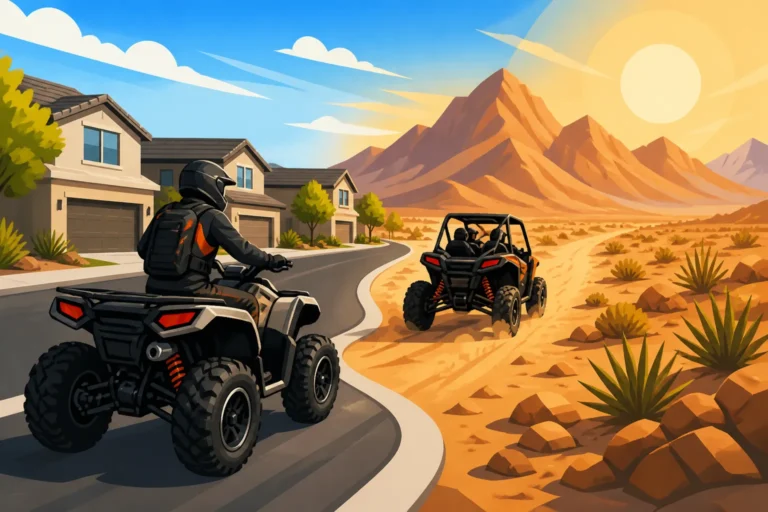
Furthermore, many Nevada cities have ordinances that prohibit OHV use on their streets, regardless of whether the machine technically qualifies as a "large all-terrain vehicle." Cities over 100,000 population, like Las Vegas, Reno, and Henderson, typically have very strict bans on OHVs on city streets unless they are specifically designated OHV routes. These designated routes are rare and usually exist to connect a trail system to an authorized staging area. You cannot, for example, ride your UTV through the Las Vegas Strip or residential neighborhoods in Reno. [Nevada Cities That Require Designated OHV Routes] are the exception, not the rule. Some smaller towns, however, like Mesquite, have a more permissive reputation, sometimes allowing OHV travel on certain streets to access trail systems directly from town. But this varies greatly, so always check local ordinances before assuming anything. A call to the local sheriff's office or city hall can save you a lot of grief.
This article is for general informational purposes only and does not constitute professional advice. Laws, prices and regulations vary by location and change over time. Consult a qualified professional for guidance on your specific situation.