Road Rules for a Registered UTV in Nevada
There's nothing quite like the thrill of exploring Nevada's incredible backcountry in your UTV. But let's be real: trying to figure out which roads you can legally ride on, what equipment you need, and what rules you have to follow can feel like navigating a maze blindfolded. This guide is here to clear up that confusion, offering a realistic look at the road rules for registered UTVs in Nevada so you can ride safely and legally, without constantly worrying about a citation.
Understanding Nevada's "Large All-Terrain Vehicle" Definition
Before we even talk about hitting the pavement, it's crucial to understand how Nevada defines an off-highway vehicle (OHV) that's permitted on certain roads. This isn't just a technicality; it's the very foundation of whether your machine has any business being on a public road, even for a short hop. Nevada uses a specific category called a "large all-terrain vehicle" for street-legal purposes, and it's much stricter than many people realize.
What Nevada's Law Considers a "Large ATV"
In Nevada, the key to taking your UTV on designated roads isn't just about having an OHV registration decal. It's about qualifying as a "large all-terrain vehicle" under Nevada Revised Statutes (NRS) 490.043. This is where many riders get tripped up, thinking their side-by-side automatically fits the bill. The law specifies that a large all-terrain vehicle must meet one of two criteria: it must have four or more seats, or it must have a truck bed. Yes, you read that right—a truck bed. This distinction is vital, as it immediately excludes a vast number of popular sport UTVs.
Imagine you've got a four-seat Polaris RZR. Great news, that often fits the "four or more seats" requirement. But what if you have a two-seat RZR XP 1000? Or perhaps a souped-up two-seat sport quad? Suddenly, those machines, despite being perfectly capable off-road, are out of the running for a street-legal designation under this specific clause. This rule is designed to distinguish utility-focused or larger family-oriented machines from smaller, sportier ones. If you're looking at a Can-Am Defender with its cargo box, that machine is usually a shoo-in for the "truck bed" definition. But a compact two-seater? Not so much. It’s a frustrating hurdle for many, especially those who just want to legally connect trails. You can dive deeper into this specific legal definition with [What Nevada's NRS 490.043 Counts as a Large ATV].
Why Many ATVs and UTVs Don't Qualify
This definition is why you rarely see traditional sport quads or even many two-seat performance UTVs with a large ATV decal. For instance, [Why a Two-Seat Sport Quad Fails Nevada's Test] is a common question, and the answer lies squarely in NRS 490.043. A sport quad, by its very nature, has one or two seats and no truck bed. It simply doesn't fit the criteria. Similarly, a two-seat UTV without a distinct cargo bed—even if it's spacious—won't qualify. The intent of the law is to allow machines that resemble smaller utility trucks or larger passenger vehicles onto certain roads, not every off-highway vehicle.
This distinction is important because it dictates everything else about road use. If your machine doesn't meet the "large all-terrain vehicle" definition, then the other rules about where and how you can ride on pavement don't even apply to you. It's a binary choice: either you qualify and can pursue the large ATV decal, or you don't, and your machine is strictly for off-road use, with very limited exceptions for crossing highways. This can be a major disappointment for riders who’ve invested in machines that are perfect for the dunes and trails but not for linking those trails via a county road. For more on the broad topic, see [Street Legal ATVs in Nevada: The Short Answer].
Where You Can (and Can't) Ride Your UTV on Nevada Roads
Even if your UTV qualifies as a "large all-terrain vehicle" and you've secured the proper decal, you can't just cruise anywhere you please. Nevada's road rules are quite specific about where these machines are permitted. It's not like driving a car; there are strict limitations on the types of roads, the distance you can travel, and even which cities or counties might have their own specific ordinances. This patchwork of rules can be incredibly frustrating for riders trying to plan a trip.
Navigating County Roads and Designated Routes
Nevada allows large all-terrain vehicles on what it defines as "minor county roads" and, in some cases, "general county roads." The key here is "minor." These are typically unpaved, less-trafficked routes, often found out in the rural and undeveloped parts of the state. Think about those dusty roads leading out to a remote trailhead near Logandale or those crisscrossing the vast expanses around Caliente and Pioche—these are the kinds of routes where you're most likely to be legal.
However, it's not a free-for-all. Individual counties have the authority to opt out of allowing OHVs on their county roads by passing local ordinances. This means what's legal in one county might be forbidden just across the county line. [Nevada County Roads Open to UTVs] provides a good overview, but always check with the specific county's sheriff's department or website if you're unsure about a particular area. For example, Washoe County, especially near urban centers like Reno and Sparks, has different rules than, say, Lincoln County, where the population is sparse and access to public lands is more prevalent. It’s a classic case of knowing your local laws before you roll out.
The Strict 2-Mile Paved Highway Limit
This is perhaps one of the most misunderstood and restrictive rules for UTV riders. Even on designated county roads, there's a strict limit on how far you can travel on paved sections of highways. Nevada law allows a large all-terrain vehicle to operate on a paved highway for a maximum distance of two miles. This isn't two miles per trip, or two miles in any direction; it's a hard limit for connecting trails or accessing services like gas or food.
This two-mile rule, covered in [Nevada's 2-Mile Limit on Paved Highway], means you can't just ride your UTV into town for a full grocery run. It's designed for short transitions, like getting from a trailhead to an adjacent section of dirt road, or crossing a main highway to access more trails. Riding from Mesquite town to the Logandale Trails, for instance, might involve some pavement, but you'll be constantly aware of that two-mile clock ticking. Exceeding this limit, even accidentally, can lead to a citation. It really emphasizes that these machines are meant for off-road use, with minimal, necessary road travel.
Highways, Interstates, and Urban Areas
It's absolutely critical to understand that Nevada's allowance for large ATVs on certain roads never extends to state highways (like US 93 or SR 375 for extended travel), interstate highways, or within the city limits of larger municipalities unless specific routes are designated by local ordinance. You will not see a large ATV decal allowing you to legally cruise down the Las Vegas Strip or even a busy arterial road in Reno. These are strictly forbidden. The rules are in place to ensure rider safety and the smooth flow of conventional traffic.
Cities over 100,000 residents, such as Las Vegas, Henderson, and Reno, almost universally restrict OHV use to very specific, designated routes, if any. You cannot ride your UTV on a sidewalk, and attempting to cut through a subdivision to reach a trail is also generally illegal trespassing unless the roads are specifically designated. This can be a rude awakening for riders from other states with more lenient street-legal UTV laws. For the most part, if you're on a major paved road or in an urban area, your UTV should be on a trailer. This is a crucial distinction that can save you from a costly ticket.
Essential Equipment for Street-Legal UTVs in Nevada
If your UTV qualifies as a "large all-terrain vehicle" and you plan to utilize those limited road privileges, simply having the registration isn't enough. Nevada law mandates specific equipment for these machines to ensure they are as visible and safe as possible for road use. This isn't just about personal preference; these are legal requirements designed to make your UTV more like a conventional vehicle when it shares the road. Failing to have the correct equipment can result in fines and having your ride cut short.
Lighting and Signaling Requirements
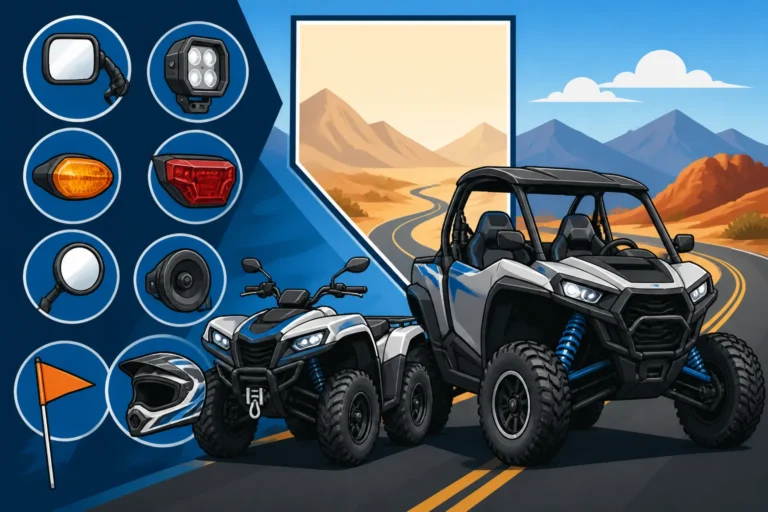
When you're sharing the road, visibility is paramount, especially if you find yourself out as dusk approaches. Nevada law requires your large ATV to have working headlights and taillights that are visible from at least 500 feet. This isn't just for looking cool; it's a safety feature that ensures other drivers can see you coming or going. Furthermore, a functional stop lamp (brake light) is required, signaling to vehicles behind you when you're slowing down or stopping. This is standard safety equipment on any road vehicle, and your UTV is no exception.
Many aftermarket lighting solutions, like those from SuperATV, offer robust and bright options that can meet these requirements, but always ensure they are properly installed and adjusted. Regular off-road lights might be great for illuminating the desert, but they need to function correctly as legal road lights. Turn signals, while not explicitly mentioned as mandatory for all large ATVs in the same way headlights and brake lights are, are highly recommended for safety and clarity when changing direction on a public road. Clarity in your intentions makes for safer shared roads.
Mirrors, Horns, and Other Safety Gear
Beyond lighting, your UTV needs other critical safety features. A functional horn is a must. This allows you to alert other drivers or pedestrians to your presence, which is especially important on dusty rural roads or when navigating tight spots. You'll also need at least one rearview mirror, typically mounted on the left side, providing a clear view of traffic behind you. Many riders opt for a full set, including a center rearview mirror and side mirrors, for maximum visibility. Again, a brand like SuperATV offers a wide range of mirrors designed specifically for UTVs, often more durable than standard automotive mirrors.
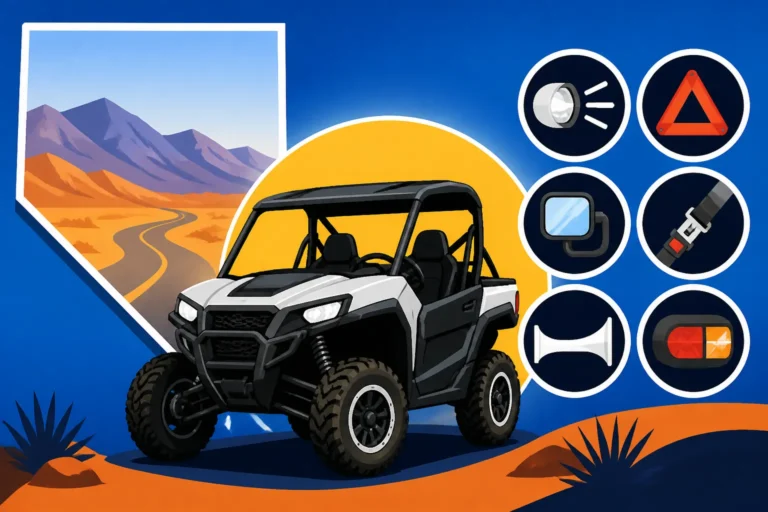
Beyond these, your UTV must be equipped with a muffler that is in good working order to prevent excessive noise, and a spark arrester that is approved by the U.S. Forest Service. This last part is particularly crucial for fire prevention, as a spark from an unarrested exhaust can quickly ignite dry brush in Nevada's arid environment, a concern for both on-road and off-road riding. These aren't just suggestions; they are part of the [Nevada Equipment List for Road-Legal UTVs] that you must adhere to. Getting these components sorted before you hit the blacktop is not just about avoiding a ticket, it’s about responsible riding.
Helmets, Seatbelts, and DOT-Approved Tires
When it comes to personal safety, Nevada has specific rules for helmets and seatbelts for UTV occupants on public roads. If your UTV is equipped with seatbelts, they must be used by all occupants. This is a common-sense safety measure that can significantly reduce injury in the event of an accident. As for helmets, riders and passengers under the age of 18 are generally required to wear a helmet when operating or riding in a large ATV on a public road. Even if you're over 18, wearing a helmet is always a good idea, particularly on county roads where speeds can be higher and road surfaces unpredictable. [Nevada Helmet Law for Road Riding] provides more details on this.
Finally, while not always explicitly stated for the "large ATV" decal itself, if you are driving on paved surfaces, especially at higher speeds, you should consider DOT-approved tires. Off-road specific tires might be fantastic for mud and rocks, but they can wear quickly, handle poorly, and offer less grip on asphalt. While the state doesn't typically inspect for specific tire ratings for the large ATV decal, it's a practical safety consideration. Ensuring your machine is equipped correctly helps keep you, your passengers, and other road users safe.
| Equipment Item | Requirement for Road Use (Large ATV) | Typical Off-Road Requirement | Notes |
|---|---|---|---|
| Headlights | Visible 500 feet | Functional (often 1) | Essential for visibility, day or night. |
| Taillights | Visible 500 feet | Functional (often 1) | Crucial for rear visibility. |
| Stop Lamp (Brake Light) | Required | Required | Indicates braking to following traffic. |
| Horn | Required | Recommended | For alerting others. |
| Rearview Mirror | At least 1 (left side) | Recommended | Essential for situational awareness. |
| Muffler | Required (good working order) | Required | Noise control. |
| Spark Arrester | USFS approved | USFS approved | Mandatory for fire prevention. |
| Seatbelts | Required if installed, must be worn | Recommended if installed | Safety for all occupants. |
| Helmet | Required for under 18 | Recommended for all riders | Critical head protection. [Nevada Helmet Rules Off-Road Versus On-Road] outlines this difference. |
| Turn Signals | Not explicitly mandatory | Not required | Highly recommended for safety. |
| DOT-Approved Tires | Recommended for paved surfaces | Not required | Better handling and wear on asphalt. |
Driver Requirements and Passenger Rules for Nevada Road Use
Getting your UTV properly equipped and understanding where you can ride are huge steps, but don't overlook the rules pertaining to the people operating and riding in the machine. Nevada has specific requirements for who can drive a large ATV on public roads and who can be a passenger. These rules are in place for safety, particularly concerning minors, and they align with general motor vehicle laws. Ignorance of these requirements isn't a valid excuse if you're stopped by law enforcement.
Who Can Legally Drive on Nevada Roads
To drive a large all-terrain vehicle on any public road where it's legally permitted, you must possess a valid driver's license. This means a standard Class C non-commercial driver's license, just like you'd need to drive a car or pickup truck. An OHV safety certificate or permit alone isn't sufficient for road use. This requirement immediately sets a minimum age for drivers, as you must be at least 16 years old to obtain a driver's license in Nevada. [Nevada Driver's License Rules for UTV Road Use] provides more context.
It's a common misconception that because it's an OHV, the same rules apply as strictly off-road. That's simply not the case when you hit the pavement. Law enforcement will check for your license, just as they would with any other motor vehicle stop. If you're riding with friends or family and someone without a valid license takes the wheel on a county road, you're looking at potential citations for both the driver and possibly the owner of the vehicle for allowing an unlicensed driver.
Rules for Passengers and Young Riders
Nevada also has rules for passengers, especially young ones, when a large ATV is operating on a public road. Generally, all passengers must be able to sit with their feet flat on the floorboard and their backs against the seatback. For younger children, this often means they need to be of a certain size to safely occupy a seat and properly use a seatbelt if equipped. [Nevada Rules for a Child Passenger on a Road] highlights this.
When it comes to minors driving, the rules are even stricter. While a person under 16 might be allowed to operate an OHV on private land or designated off-road areas with appropriate supervision, they are generally not permitted to drive a large ATV on public roads, even minor county roads. If a rider is under 16, even if they have an OHV safety course certificate, they cannot legally operate a large ATV on a county road. They must be supervised by an adult at least 18 years old and possess a valid driver's license if they are old enough to have a learner's permit, but the primary restriction is the driver's license requirement itself. This is outlined further in [Nevada Rules for Riders Under 16 on Roads]. It’s about ensuring that everyone on the public road has a basic level of driving experience and legal accountability.
What to Expect During a Roadside Stop in Nevada
Even when you're doing everything right and your UTV is perfectly legal for the road you're on, a roadside stop by law enforcement can still happen. It's a reality of sharing the roads, and knowing what to expect can help make the experience smooth and stress-free. Deputies, state troopers, and rangers are all within their rights to pull you over to verify compliance.
Documentation Checks
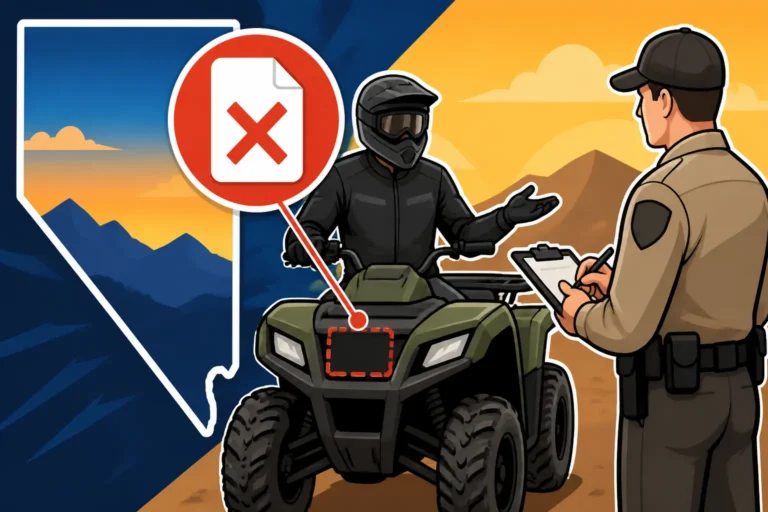
The first thing a Nevada deputy or ranger will likely ask for during a roadside stop is your documentation. This includes proof of registration for your OHV (the physical registration card), your driver's license, and proof of liability insurance. Yes, you read that right: insurance. While off-road insurance isn't strictly mandatory for all OHVs in Nevada, if you're operating your large ATV on a public road, you absolutely need liability insurance, similar to what's required for a car. This is covered by NRS 485.185. [Insurance and Nevada OHV Registration] touches on this, but it's a critical point for road-legal use.
Make sure all your documents are current and easily accessible. Keeping them in a waterproof bag or container is a wise move, especially given the dusty, sometimes wet conditions we ride in. While some officers might accept photos of your documents on your phone, it's always best practice to have the physical copies on hand. They want to see current, valid paperwork.
Equipment and Compliance Verification
Beyond your paperwork, the officer will likely conduct a visual inspection of your UTV to ensure it meets all the mandated equipment requirements. They'll be looking for things like functioning headlights, taillights, brake lights, a horn, and at least one rearview mirror. They might also check for a USFS-approved spark arrester. If you're stopped in an area known for specific local ordinances, they may also verify compliance with those.
This is where all that preparation pays off. If your SuperATV mirrors are securely installed, your horn lets out a clear blast, and your lights are shining brightly, you're in good shape. [What a Nevada Trooper Looks For on a County Road] often includes these equipment checks. If your machine is found to be missing required equipment or you're operating it on a forbidden road, you could face citations and, in some cases, be asked to trailer your machine off the road immediately. Being knowledgeable and prepared is your best defense.
Maintaining a Respectful Demeanor
Just like with any traffic stop, maintaining a calm and respectful demeanor goes a long way. Pull over safely, turn off your engine, remove your helmet (if applicable), and keep your hands visible. Answer questions honestly and provide the requested documentation without argument. Officers are primarily concerned with safety and compliance, and a cooperative attitude can often de-escalate any tension.
Remember, the goal of these laws and enforcement is not to ruin your fun, but to ensure that everyone sharing Nevada's beautiful landscapes—whether on two wheels, four wheels, or four legs—can do so safely. Understanding and adhering to these rules not only protects you from legal trouble but also contributes to a positive public perception of OHV riders, helping to preserve our access to these incredible lands.
Disclaimer
This article is for general informational purposes only and does not constitute professional advice. Laws, prices and regulations vary by location and change over time. Consult a qualified professional for guidance on your specific situation.