Why Nevada Will Not Plate a Quad
It’s a common frustration among Nevada ATV owners: you’ve got your quad, you want to get it from point A to point B on a paved road, and you think, “Why can’t I just put a license plate on this thing?” The truth is, Nevada law has very specific ideas about what can and cannot be considered "street legal," and unfortunately for traditional quads, they simply don't make the cut for a license plate. This comprehensive guide will break down the nuances of Nevada's off-highway vehicle (OHV) laws, explaining exactly why your quad won't get a plate, what alternatives exist for certain machines, and how you can still legally navigate paved roads with your OHV under strict limitations.
The Core Disconnect: Why Quads Aren't "Street Legal" in Nevada
Many riders arrive in Nevada, perhaps from states with more lenient street-legal OHV laws, or they see side-by-sides with a special decal and assume their quad can follow suit. It's a natural assumption, especially when you consider how versatile these machines are. However, Nevada's legal framework for off-highway vehicles draws a clear line in the sand, and traditional ATVs, by definition, fall on the "off-road only" side of that line when it comes to full street legality.
The state isn't trying to make things difficult for you; it's a matter of safety regulations, vehicle design, and how the law categorizes different types of machines. A typical quad, with its saddle-style seat and handlebar steering, is designed for agility and performance on varied terrain, not for the demands of sharing asphalt with cars and trucks. The lack of standard safety features, such as enclosed cabins, automotive-style steering, and passenger restraints beyond basic handholds, is a major factor in this legislative decision.
Nevada's Definition of an All-Terrain Vehicle (ATV)
To understand why your quad won't get a license plate, we first need to look at how Nevada defines an ATV. In a nutshell, Nevada Revised Statute (NRS) 490.021 defines an "all-terrain vehicle" as a motor vehicle that is:
- Designed to travel on three or more wheels.
- Designed for use on unimproved terrain.
- Has a saddle-style seat.
- Is steered by handlebars.
- Has an engine displacement of 50 cubic centimeters or more.
Think about your typical sport quad or utility quad. It perfectly fits this description: you straddle a seat, grip handlebars, and you're ready to tackle trails, dunes, or ranch work. This definition is crucial because it sets the vehicle apart from cars, trucks, and even some types of side-by-sides (UTVs) that might have a steering wheel, bucket seats, and other automotive features. The fundamental design — saddle seat and handlebars — is a major barrier to traditional street registration. It's not just a technicality; it’s a reflection of the vehicle's intended use and the safety standards associated with it.
The Difference Between an ATV and a Large ATV
Here's where the plot thickens, and where many riders get confused. Nevada law differentiates between a standard "all-terrain vehicle" (ATV) and a "large all-terrain vehicle" (Large ATV). It's the "large ATV" category that offers a glimmer of street-legal hope, but crucially, it almost exclusively applies to many side-by-sides, not traditional quads.
The designation of "large ATV" under [What Nevada's NRS 490.043 Counts as a Large ATV] is what allows certain OHVs to gain limited street access. A "large all-terrain vehicle" is defined differently, focusing on key characteristics that traditional ATVs simply don't possess. This legal distinction is what prevents your four-wheeled quad from ever receiving a conventional license plate for road use. It's not about the size of the engine or the number of wheels, but specific design elements that Nevada considers essential for safer mixed-traffic operation.
Decoding Nevada Revised Statute (NRS) 490.043: The "Large ATV" Rule
NRS 490.043 is the specific section of Nevada law that outlines the requirements for a "large all-terrain vehicle" to be considered street-legal for certain county roads. This statute is the foundation of why some OHVs, primarily UTVs, can gain a special decal for road use, while traditional ATVs cannot. It's a critical piece of legislation that clarifies the distinction and sets the bar for what types of off-highway machines can venture onto pavement. Understanding this section is key to grasping the limitations placed on your quad.
The intent behind this statute is to allow larger, more stable, and more car-like OHVs to traverse specific, usually rural, paved roads for short distances or to access trails. It's not an open invitation for all OHVs to become commuter vehicles. The requirements listed are very specific and are designed to ensure a minimum level of safety and visibility when these machines share the road with other vehicles.
Seating and Bed Requirements for Road Legality
This is the big one that separates your quad from a potentially road-legal UTV. To be classified as a "large all-terrain vehicle" in Nevada and qualify for a special decal, the machine must meet one of two specific criteria regarding its seating and cargo capacity:
- It must be designed to carry four or more passengers. This typically means having four distinct seats, often arranged in two rows, much like a small car. Think about the common four-seat side-by-sides you see on the trails – they fit this bill.
- It must have a truck bed. This isn't just a small storage compartment; it's a dedicated cargo area designed to haul materials, similar to the bed of a pickup truck. The bed must be an integral part of the vehicle's design and purpose, indicating a utility focus.
Neither of these descriptions applies to a traditional quad. A quad, by design, has a saddle seat for one or two riders (if it's a two-up model), and while some utility quads might have small racks for cargo, they lack a true "truck bed" in the legal sense. This is the primary reason [Why a Two-Seat Sport Quad Fails Nevada's Test] for road legality. Even if you've added an aftermarket seat to your quad, it still won't meet the "four or more passengers" criterion in the eyes of the law, as the vehicle wasn't designed for that capacity in the same way a UTV is.
What a "Truck Bed" Means in Nevada Law
Let's dive a little deeper into that "truck bed" requirement, because it's often misunderstood. When Nevada law refers to a "truck bed," it's picturing something substantial and functional for hauling, not just a small cargo rack or a flat area where you might strap a cooler. Imagine the rear cargo area of a utility side-by-side like a Polaris Ranger, a Can-Am Defender, or a Honda Pioneer. These vehicles typically have a defined, box-like cargo area with walls, a tailgate, and a significant load capacity, designed for carrying tools, supplies, or equipment.
This distinction is important because while many utility ATVs have front and rear racks, these are not considered "truck beds" by the state of Nevada. The racks are meant for securing items temporarily, not for containing and transporting bulk cargo in the same manner as a truck. The law looks at the fundamental design and purpose of the cargo area. A machine like a [Why a Defender's Truck Bed Meets Nevada's Definition] because its integrated bed is clearly designed for substantial utility work, meeting the state's intent for a "large ATV." This design feature reinforces the utility-first nature that Nevada associates with machines allowed on certain paved roads.
Why Your Beloved Sport Quad Doesn't Make the Cut
It's a tough pill to swallow for many quad enthusiasts, especially those with powerful sport quads or even larger utility quads. You might look at your machine and think it's robust enough, visible enough, or powerful enough to handle a paved road. However, Nevada's laws are less concerned with raw power or perceived robustness and more with specific design criteria that prioritize safety and consistency with other road vehicles. Your sport quad, while an incredible machine for its intended purpose, is fundamentally designed differently from what the state considers appropriate for limited road use.
The very features that make a sport quad exhilarating off-road — its narrow stance, high center of gravity with a rider perched on top, and nimble steering — are the same characteristics that make it less suitable for pavement. The dynamics of cornering and braking on asphalt are vastly different from dirt, and the design of a quad is optimized for the latter. Adding aftermarket accessories like turn signals or mirrors doesn't change the underlying vehicle classification or its core design limitations in the eyes of Nevada law.
The Two-Seat Conundrum for Sport Quads
Even if you have a two-up quad, designed to carry a driver and one passenger, it still won't meet the "four or more passengers" requirement for a large ATV decal. The critical number in NRS 490.043 is four. Your standard quad, whether it's a single-rider sport model or a two-rider utility version, is simply not engineered to safely accommodate four individuals. The seating arrangement, the frame structure, and the suspension are all built for fewer occupants.
This means that even if you somehow manage to squeeze four people onto a quad – which is unsafe and illegal – the vehicle's inherent design prevents it from ever being designated as a "large ATV." The law is very clear on this: the vehicle must be designed to carry four or more passengers, not just capable of it under duress. This is a fundamental structural and design difference that disqualifies all traditional ATVs from this specific road-legal classification. So, while your two-up Polaris Sportsman might be great for trail riding with a friend, it still won't get a [Nevada Large ATV Decal] due to its seating limitations.
Dimensions and Intent: Sport Quads vs. Utility UTVs
Beyond seating, the overall dimensions, weight distribution, and design intent of a sport quad are vastly different from a UTV. Sport quads are typically lighter, narrower, and have a higher center of gravity when a rider is seated, making them highly responsive but also more prone to rollovers in certain situations, especially on hard, uneven surfaces like pavement. Their primary design intent is performance, agility, and aggressive riding on natural terrain.
Contrast this with many utility UTVs, which often have a wider stance, lower center of gravity, enclosed cabins (or at least roll cages), automotive-style controls, and a design geared towards stability and carrying capacity. A UTV's design often mimics a small car or truck more closely than an ATV, which makes it a more suitable candidate for limited road use in the eyes of the law. While a [Does a Four-Seat RZR Pass Nevada's Seating Test?] for the large ATV definition, a sport quad, regardless of its engine size, never will. It's a matter of inherent vehicle architecture and its intended purpose. Many aftermarket companies, like SuperATV, offer accessories that enhance the utility and safety of UTVs, but these additions cannot fundamentally change the core classification of a quad.
Understanding the "Large ATV" Decal Versus a License Plate
It's crucial to understand that even for machines that do qualify as "large ATVs" under Nevada law (i.e., most side-by-sides that meet the seating or bed requirements), what they receive is a special "large ATV decal," not a traditional license plate. This is a significant distinction, as it highlights the limited nature of their road privileges. A license plate signifies full street legality, allowing travel on most public roads, highways, and interstates. A large ATV decal, however, comes with very specific restrictions.
This decal is effectively an extension of your OHV registration, not a separate class of vehicle registration like a car or motorcycle. It indicates that while the machine is primarily an off-highway vehicle, it has met certain criteria that allow it to temporarily and conditionally operate on a select few public roads. It's not a green light to drive your UTV wherever you please, but rather a carefully regulated allowance for specific situations.
What the Large ATV Decal Does Allow
If your side-by-side meets the "large ATV" criteria and you've successfully applied for and received the special decal (which is separate from your standard OHV registration decal), you gain the ability to operate it on:
- Minor county roads: These are typically unpaved or lightly paved roads in rural areas, often connecting to trail systems. The specific definition of "minor county road" can vary by county, so it's always important to check local ordinances.
- Designated OHV routes within some cities or counties: A handful of communities, recognizing the economic and recreational benefits of OHVs, have established specific routes within their limits where large ATVs are permitted. [Mesquite and Its Reputation for Open Streets] is one example where riders might find more opportunities, but even there, rules apply.
The decal provides a pathway for UTV owners to legally connect trails or access services like fuel or food in specific, approved areas. It's designed to enhance the OHV experience by reducing the need to trailer short distances between off-road areas, but it's not a carte blanche for urban commuting. When applying for one, you'll go through a specific process described in [Applying for a Nevada Large ATV Decal], which confirms your machine meets the structural and safety prerequisites.
The Limitations of the Large ATV Decal
Despite the privileges it grants, the large ATV decal comes with strict limitations that underscore its difference from a full license plate:
- No State Highways or Interstates: Large ATVs are explicitly prohibited from operating on any state highway or interstate freeway. This means no driving on major routes like US 95, I-15, or US 50, which are typically designated by route numbers on signs. [US 93 and the Roads You Cannot Ride Along] is another example of a major state highway that is off-limits.
- Limited Pavement Travel: Even on approved county roads, there are restrictions. Generally, you cannot travel more than 2 miles on paved surfaces to connect to an OHV trail. This is known as the [Nevada's 2-Mile Limit on Paved Highway] and it's a critical rule to remember. The intent is to facilitate access, not extended travel.
- Local Ordinances Trump State Law: While state law outlines the general framework, individual counties and cities have the power to enact more restrictive ordinances, or even ban large ATVs from their roads entirely. [Washoe County Ordinance 1507] is an example where a county has chosen to limit OHV access, so always check with local authorities for the most current rules.
- Specific Equipment Required: To utilize the large ATV decal, your machine must also be equipped with certain safety features, such as mirrors, a horn, headlights, taillights, and brake lights. We'll delve into these specifics in a later section.
Essentially, the large ATV decal allows a select class of OHVs (UTVs) to bridge the gap between off-road trails and necessary services or connecting routes, but it does not confer full road-legal status. It's a conditional permit for specific, limited circumstances, far from the freedom a license plate provides.
The Road Rules You Can Follow: Limited Pavement Use for All OHVs
Even though your quad can't get a license plate or a "large ATV" decal, that doesn't mean it's entirely forbidden from touching pavement in Nevada. There are very specific, highly restricted circumstances under which any registered off-highway vehicle, including your quad, can legally operate on a paved road. These rules are designed to allow practical maneuvers like crossing a highway or briefly connecting short segments of trails, not for casual road cruising. It's important to know these rules inside and out, because violating them can lead to significant fines and penalties.
The key here is "limited pavement use." Nevada's goal is to keep OHVs primarily off-road, but the state recognizes that sometimes a brief encounter with pavement is unavoidable or necessary to access riding areas. These allowances are not for convenience, but for functionality and safety in a controlled manner. Deputies and rangers are well-versed in these rules and will not hesitate to issue citations for violations. Always assume you are expected to be off-road, and only use paved surfaces as a means to an end, strictly adhering to the letter of the law.
The 2-Mile Rule and Designated Crossings
For all OHVs, including traditional quads, there are two primary allowances for limited pavement use:
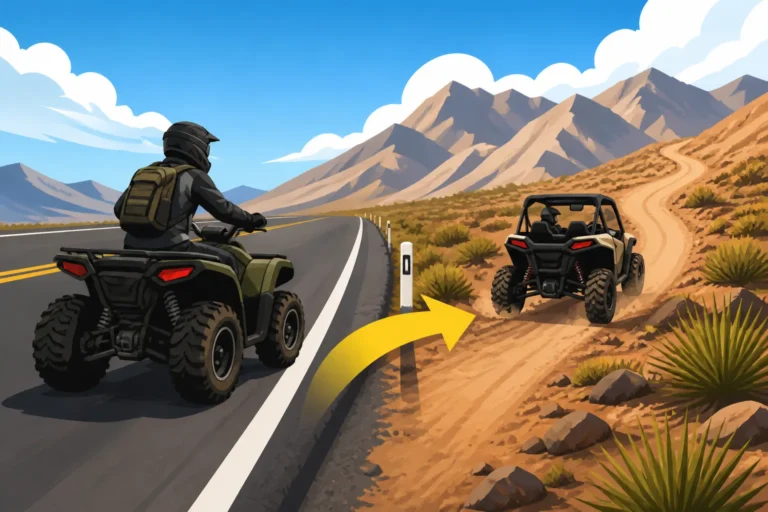
- Crossing Paved Highways: You are generally permitted to cross any paved highway (state, county, or municipal) at approximately a 90-degree angle to get from one section of off-road trail to another. This is not for riding along the highway, but directly across it. Think of it as crossing a street to continue on the other side. This maneuver must be done safely and quickly, yielding to all vehicular traffic.
- The 2-Mile Limit on Certain Roads: Similar to the large ATV decal rules, a standard registered OHV (like your quad) can operate on certain county or minor public roads for a maximum distance of 2 miles to connect to an OHV trail. This is the [Nevada's 2-Mile Limit on Paved Highway] rule in action. Again, this is not for joyriding. The purpose is strictly to get from your staging area to the trail, or from one trail segment to another, where trailering isn't practical for a very short distance. You must have valid OHV registration (the standard decal) to do this.
It's critical to understand that this 2-mile rule is often subject to local ordinances. Just because state law allows it, doesn't mean every county or city has adopted it, or hasn't further restricted it. Always check local laws for the area you plan to ride. For example, [Riding County Roads Legally in Nevada] means understanding the local landscape, not just the statewide statutes.
When Local Ordinances Change the Game
This is arguably the most confusing aspect for many riders: the patchwork of local rules. While NRS 490 provides a general framework, Nevada Revised Statute (NRS) 490.100 grants counties and incorporated cities the power to prohibit the operation of OHVs on public highways within their jurisdiction. This means a city or county can, by local ordinance, opt out of the state's limited road-use allowances.
For instance, [Nevada Cities That Require Designated OHV Routes] might only allow OHVs on very specific, clearly marked routes, or they might ban them altogether from all paved roads within city limits. What's legal in rural Lincoln County might be strictly forbidden in the urban sprawl of Las Vegas or Reno. [Washoe County Roads and Large ATVs] might have different rules than those around Pioche or Caliente. This local control means that even if your side-by-side has a large ATV decal, or if your quad is within the 2-mile limit, you could still be in violation if a specific city or county has an ordinance prohibiting it.
Before you head out, especially if you plan to navigate any paved roads, even briefly, it is absolutely essential to check the local ordinances for that specific area. A quick call to the local sheriff's department or city hall can save you a hefty fine. Always assume caution and err on the side of staying off paved roads unless you are 100% certain it's allowed and you meet all conditions.
Essential Equipment for Any Road-Legal Machine in Nevada
While your quad won't get a license plate, if you have a side-by-side that qualifies for a "large ATV" decal and you intend to use it on the limited paved roads allowed, or if you're making one of those permitted 2-mile connections or crossings, your machine needs to be equipped to a certain standard. This isn't just about what looks good; it's about what the law mandates for safety and visibility when sharing the road with other vehicles. These requirements are in place to ensure that even for brief encounters with pavement, your OHV can be seen and can signal its intentions effectively.
The equipment list for road-legal operation in Nevada is quite specific, drawing parallels with basic automotive safety features. It’s not just about having the item, but ensuring it’s functional and meets visibility standards. Many riders will turn to aftermarket companies like SuperATV for these types of upgrades, ensuring they meet legal requirements and enhance safety.
Lighting and Visibility Requirements
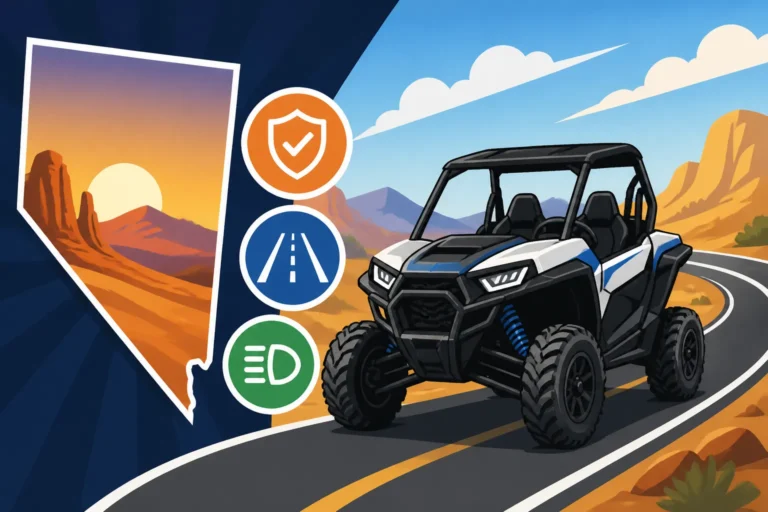
For any OHV operating on a paved road, even for a short distance or crossing, the following lighting and visibility equipment is generally required:
- Headlights: Must be on and visible from a distance of 500 feet to the front. This means properly functioning, clear headlights, not just dim, dusty ones.
- Taillights: Must be on and visible from a distance of 500 feet to the rear. Often, this requires a specific taillight, not just a red reflector.
- Brake Lights/Stop Lamps: A functioning stop lamp that illuminates when the brakes are applied, visible from 500 feet to the rear. This is crucial for signaling your intentions to traffic behind you.
- Reflectors: At least one red reflector must be mounted on the rear, or a taillight that also serves as a reflector is acceptable.
- Mirrors: You must have at least one rearview mirror mounted to provide a view of the highway to the rear for at least 200 feet. Many riders opt for a full set from SuperATV or similar brands for better visibility.
- Horn: A functioning horn that can be heard for at least 200 feet. This is vital for alerting other drivers to your presence.
- Muffler and Spark Arrester: A muffler in good working order to prevent excessive or unusual noise, and a spark arrester (required for all off-road use anyway).
These requirements, outlined in [Nevada Equipment List for Road-Legal UTVs], are not optional. Operating on pavement without them is a clear violation and can result in a citation. Ensure all your lights are clean and working, your mirror is properly adjusted, and your horn gives a good, clear blast.
Safety Gear Beyond the Vehicle Itself
Beyond the vehicle-mounted equipment, there are also personal safety gear considerations and operational rules that apply when you're on a paved road:
- Helmets: If your OHV does not have a fully enclosed cab (like a car), all occupants must wear an approved helmet when operating on a paved road. This includes drivers and passengers in side-by-sides, even if they have seatbelts. The [Nevada Helmet Law for Road Riding] is strict and applies to both quads and UTVs on pavement.
- Driver's License: Any person operating an OHV on a paved public road must possess a valid driver's license. This means a standard automobile driver's license, not just an OHV safety certificate.
- Liability Insurance: For any OHV operating on a paved public road, even for the briefest crossing, you must carry proof of liability insurance. This is the same type of insurance required for cars and trucks and is mandated by [Insurance Nevada Requires for Road Use].
- Supervision for Minors: If a rider under 16 is operating an OHV on a paved road (even if permissible by local ordinance), they must be under the direct supervision of a licensed adult who is also operating an OHV.
- Seatbelts: If your large ATV (UTV) is equipped with seatbelts, all occupants must wear them when operating on a paved road. Many new UTVs come with multi-point harnesses, and these should always be used.
Ignoring these personal and operational safety rules can be just as costly as lacking the proper vehicle equipment. The intent is to bring OHV operation on roads as close to standard vehicle operation as possible in terms of safety.
What About Out-of-State Plates? Do They Work Here?
It's a common tactic some riders explore: trying to circumvent Nevada's strict plating rules by registering their OHV in another state that has more lenient street-legal provisions, like Montana or South Dakota, and then bringing it back to Nevada. The idea is that if it's legally plated elsewhere, Nevada must recognize it through reciprocity, right? Unfortunately, for the vast majority of cases and for quads specifically, this approach often falls short and can lead to legal trouble.
Nevada has specific laws regarding out-of-state registrations and how long non-residents can operate their OHVs here before needing a Nevada decal. While there are reciprocal agreements for standard off-highway registration, the concept of "street legality" from another state is often not directly transferable, especially for vehicles that Nevada explicitly classifies as non-roadworthy.
The Reality of Montana or South Dakota Plates in Nevada
While states like Montana and South Dakota offer various options for plating OHVs, often without strict inspection requirements or the "large ATV" criteria Nevada imposes, relying on these plates for street legality in Nevada is generally a bad idea, particularly for quads.
- Nevada's Primary Purpose Rule: Nevada law often considers the primary purpose and design of the vehicle. If your quad is clearly an off-highway vehicle by Nevada's definitions (saddle seat, handlebars), a Montana or South Dakota plate is unlikely to override Nevada's classification for extended road use. A Nevada law enforcement officer will still look at the vehicle's fundamental design.
- Targeting of "Plate Mills": Law enforcement agencies in Nevada are well aware of the "plate mill" phenomenon, where residents attempt to avoid local regulations by registering vehicles in states known for easier processes. If you're a Nevada resident operating an OHV with an out-of-state plate, and it clearly doesn't meet Nevada's criteria for road use, you're likely to be stopped and cited. [Plating a Machine in Another State to Ride Nevada] outlines why this strategy rarely works as intended for residents.
- Reciprocity Limits: While Nevada grants reciprocity for off-highway registration (meaning a properly registered OHV from California with a green sticker, or an Arizona-registered machine, can ride Nevada's trails for a limited period), this reciprocity does not automatically extend to street-legal status if the vehicle doesn't meet Nevada's own road-legal definitions. A California Green Sticker is for trails, not roads, and the same applies to other states' primary off-road registrations.
So, while you might find services that offer out-of-state plating for your quad, understand that it offers very little, if any, protection or legality for riding on Nevada's paved roads beyond the extremely limited exceptions discussed above. You're simply adding a plate to a machine that Nevada still considers fundamentally off-road for anything but those brief crossings or 2-mile connections.
Nevada's Reciprocity for Legitimate Visitor Registration
If you are a legitimate visitor to Nevada (i.e., not a Nevada resident trying to avoid local laws) and your OHV is properly registered for off-highway use in your home state, Nevada offers a grace period. [How Long an Out-of-State ATV Can Stay in Nevada] without needing a Nevada OHV decal is generally 15 days within a 365-day period. This is for off-highway riding only.
During this 15-day window, your out-of-state registration (like a California Green Sticker, an Arizona OHV decal, or a Utah registration) is generally recognized for trail riding. However, this reciprocal agreement pertains to off-highway operation and does not grant street-legal privileges that your home state might not even offer, or that Nevada explicitly denies. If your machine isn't considered street-legal in Nevada, it won't magically become so with an out-of-state plate, even during the visitor grace period. The limited road rules (2-mile connection, crossings) apply to all OHVs, regardless of where they are registered, as long as they carry a valid OHV registration of some kind.
It’s crucial to distinguish between off-highway registration reciprocity and street-legal status. They are distinct concepts under Nevada law. Don't let the promise of an out-of-state plate mislead you into thinking your quad can become a legal road vehicle in Nevada.
| Feature | Traditional ATV (Quad) | Large ATV (Qualifying UTV) | Automobile/Truck |
|---|---|---|---|
| Seating | Saddle-style, 1 or 2 riders | Bench or bucket seats, 2 or 4+ riders | Bucket or bench, 2 to 8+ riders |
| Steering | Handlebars | Steering wheel | Steering wheel |
| Cargo | Racks (not a "truck bed") | Often has a "truck bed" | Enclosed trunk/cargo, or truck bed |
| Nevada Plate | No | No (receives special decal) | Yes |
| Primary Use | Off-highway trails, dunes, utility work | Off-highway trails, utility work | Paved roads, highways |
| Paved Road Use | Limited: 2-mile connection or crossing | Limited: 2-mile connection, minor county roads | General use on all public roads |
| State Highway | No | No | Yes |
| Required Decal | Standard OHV Decal | Standard OHV Decal + Large ATV Decal | License Plate |
| Common Brands | Honda, Yamaha, Polaris, Kawasaki | Polaris, Can-Am, Yamaha, Honda | Ford, Chevy, Toyota, etc. |
It can be disappointing to learn that your quad, despite its power and versatility, is unlikely to ever wear a traditional license plate in Nevada. The state's laws are designed with specific safety and design parameters in mind, largely differentiating between agile, saddle-seated off-road machines and more car-like utility vehicles when it comes to road privileges.
While the dream of fully street-legal quads remains largely unattainable in Nevada, understanding these nuances allows you to ride legally and responsibly. For quad owners, this means embracing the vast off-road opportunities Nevada offers and strictly adhering to the 2-mile rule for brief pavement encounters. For UTV owners, the large ATV decal opens up a bit more flexibility, but it still comes with significant limitations and equipment requirements.
Always ride prepared, know the local rules, and prioritize safety. Nevada's deserts, mountains, and trails are incredible places to explore, and by respecting the regulations, we can all ensure these riding opportunities remain available for years to come.
Disclaimer
This article is for general informational purposes only and does not constitute professional advice. Laws, prices and regulations vary by location and change over time. Consult a qualified professional for guidance on your specific situation.