Which Visitors the Nevada Exemption Leaves Out
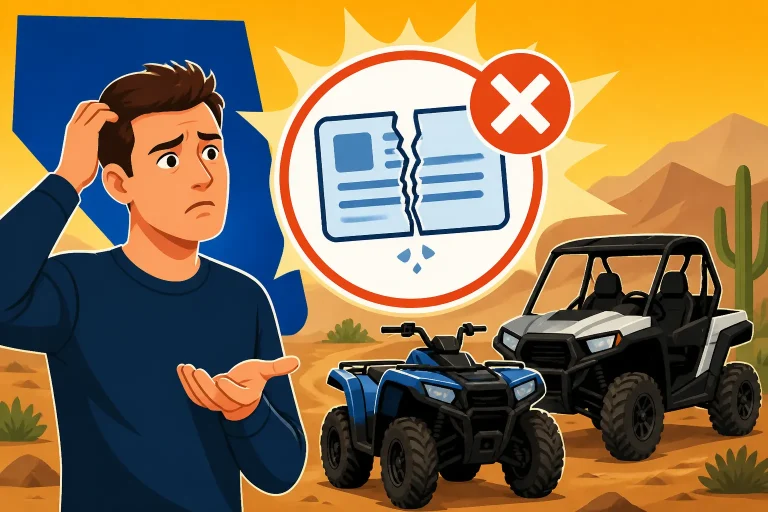
Nevada’s out-of-state OHV exemption is narrow: it depends on how the machine is registered or certified elsewhere and how long it is in Nevada. If you are bringing an ATV or UTV for a ride, the key question is not simply whether you are a visitor. It is whether your machine meets both conditions of the exemption.
What Nevada’s visitor exemption covers
According to the Nevada Commission on Off-Highway Vehicles, an OHV is exempt from Nevada registration if it is registered or certified in another state and located in Nevada for not more than 15 days. Both parts matter: the machine needs qualifying registration or certification from another state, and its time in Nevada must stay within the stated limit.
The rule is about the vehicle’s status and presence in Nevada. The official information does not identify a separate list of visitor types, such as tourists, seasonal residents, or riders from particular states, who are excluded simply because of who they are. Nor does it list a special type of ATV or UTV that is barred from the exemption. It identifies the conditions a machine must meet.
| Situation | How it relates to the exemption |
|---|---|
| OHV properly registered or certified in another state and in Nevada for no more than 15 days | Meets the stated conditions for the exemption |
| OHV in Nevada longer than 15 days | Falls outside the stated time limit |
| OHV without qualifying registration or certification from another state | Does not meet the stated out-of-state-status condition |
| Rider’s state or visitor status, by itself | Not listed as a separate exclusion in the official explanation |
The short answer to Do Nonresidents Need a Nevada OHV Decal? is that a nonresident may ride under this exemption only when the vehicle also meets its conditions. Being from another state does not make a machine exempt on its own.
Likewise, the exemption is not a general permit to ride anywhere. It addresses Nevada OHV registration. It does not establish that a route or recreation area is open, waive other applicable rules, or replace a separate pass that a particular riding area may require. For a broader explanation of how the decal and registration rules work, see Nevada OHV Reciprocity With Other States and Nevada’s 15-Day Window for Out-of-State Machines.
Which visitors and machines fall outside the rule
The official explanation does not name special visitor categories that are excluded. Instead, a visitor falls outside the exemption when the machine does not meet one of its two stated conditions.
A machine that stays in Nevada beyond the limit
The clearest case is an OHV that remains in Nevada for more than 15 days. According to the Nevada Commission on Off-Highway Vehicles, the exemption applies when the vehicle is in Nevada for not more than 15 days. Once the machine is beyond that limit, it no longer meets the stated exemption.
That distinction can matter for a long vacation, an extended stay with family, a seasonal trip, or a machine kept at a Nevada property. The rider’s reason for staying does not change the stated time condition. If your plans may extend beyond the limit, sort out the registration question before relying on the exemption. What a Visitor Does After 15 Days in Nevada explains the next step in more detail.
The available official information does not explain every practical detail of how to count days in a complicated situation, such as a machine that leaves Nevada and returns, or one that is stored in the state while its owner travels elsewhere. Don’t assume that a brief trip across a state line resets the clock. If your machine’s itinerary makes the count unclear, ask the DMV OHV Unit how the rule applies before you ride.
A machine without qualifying home-state registration or certification
The other condition is the machine’s status in its home state. A vehicle that is not properly registered or certified elsewhere does not meet the stated condition just because its owner is visiting Nevada.
Check the paperwork for the specific machine you plan to bring. A registration or certificate belonging to a different vehicle will not establish that this machine qualifies. If the document is expired, incomplete, or does not clearly identify the OHV, ask the issuing state or Nevada DMV what documentation is acceptable before traveling. The official explanation identifies proper out-of-state registration or certification as a condition, but it does not provide a detailed list of documents for every state’s system.
This is why it helps to review Riding Nevada With an Out-of-State Registration before departure. Riders with a California green sticker can also check Riding Nevada on a California Green Sticker, while visitors from other states should confirm that their own machine’s document qualifies rather than assuming every state uses the same form or terminology.
A visitor who assumes residency alone settles the question
The exemption is often described as a visitor rule, but the stated criteria are the machine’s out-of-state registration or certification and its time in Nevada. The official information does not list residency as an additional disqualifier or explain how every move, relocation, or change of residence affects a particular case.
That does not mean a person who has moved to Nevada should automatically treat the vehicle as exempt. A move may raise registration or title questions beyond the narrow visitor exemption. If you are relocating, or if your home-state paperwork and Nevada residence do not line up neatly, get a determination from the DMV rather than relying on the word “visitor.” Nevada OHV Registration After Moving to the State is relevant when the machine is part of a move.
The same caution applies to machines that are rented, borrowed, or owned by someone else. The exemption information does not specify a separate exception based on who is operating or owning the vehicle. Confirm that the machine itself meets the conditions, and ask the rental company or owner what registration documentation accompanies it. For rental-specific questions, see Paperwork a Nevada ATV Rental Company Handles for You.
How to check your situation before riding
A quick paperwork check can prevent a trip from turning into a registration problem. Before loading the machine, work through these steps:
- Identify the exact vehicle. Check that the paperwork matches the ATV, UTV, dirt bike, or other OHV you intend to bring. The Nevada Off-Highway Vehicles Program includes several kinds of off-highway machines in its registration program, so do not assume a document for another vehicle covers yours.
- Confirm its status in the home state. Make sure the machine is properly registered or certified there. If the status is unclear, contact the issuing agency before leaving.
- Work out how long the machine will be in Nevada. Compare your expected arrival and departure plans with the 15-day limit. If you expect a longer stay, do not plan on the exemption covering the entire time.
- Keep the relevant paperwork with the machine. Carry the registration or certification information that shows the vehicle’s status. Keeping a copy in a waterproof document sleeve can help protect it from dust and moisture; an inexpensive sleeve from a retailer such as Amazon may be useful, but it does not replace the original documents or make an ineligible machine exempt.
- Ask before traveling if a detail is uncertain. The DMV OHV Unit handles registration information. According to the Nevada Off-Highway Vehicles Program, its registration-information phone number is 775.684.4381.
Do not confuse proof that the vehicle is registered elsewhere with proof that a riding area is open to OHVs. Route access, land-management restrictions, and any area-specific requirements are separate questions. Use current trail and land information when choosing where to ride; the Nevada Trail Finder is a resource for off-road trail maps throughout the state.
It is also worth checking that the machine remains in the status you expect during the trip. A paperwork issue can be easy to overlook when a vehicle is borrowed or transported by someone else. Ask the owner for the vehicle’s documents before departure, not after arriving at the trailhead. If your machine’s state uses an unfamiliar certificate or decal, confirm what it proves and whether it applies to the specific OHV.
What to do if the exemption does not fit
If the OHV will be in Nevada beyond the stated limit, or it lacks qualifying home-state registration or certification, contact the Nevada DMV about the appropriate registration process. Do not assume that a visitor decal, trail pass, or payment at a recreation area substitutes for OHV registration.
According to Off Road Nevada, Nevada OHV registration is annual and costs $20.00 as of November 2026. The registration process and documentation can depend on the vehicle and how it was acquired, so confirm the requirements with the DMV rather than treating the fee as the only step. If you have purchased the machine, Off Road Nevada says it must be registered within 30 days of purchase from a dealer or private party. Registering Here After a Long Stay and Nevada OHV Registration Without a Title may help with different situations, but a DMV answer is important when your circumstances do not fit a straightforward purchase.
If your trip is already underway, do not keep riding on the assumption that the exemption still applies after the machine is outside its conditions. Contact the DMV OHV Unit and ask what to do before continuing. The responsible next step may depend on the machine’s paperwork and situation. You can also read Nevada Fines for Riding Without Registration to understand why it is better to resolve an eligibility question before riding.
The practical takeaway is simple: there is no separate visitor category named in the official explanation as automatically excluded. The exemption leaves out machines that do not satisfy the home-state registration or certification condition, and machines that are in Nevada longer than the permitted period. Check both facts for your specific OHV, keep its paperwork accessible, and confirm uncertain cases with the DMV.
Sources
- Off Road Nevada — Frequently asked questions about off-highway vehicle registration in Nevada | Off Road Nevada (checked November 3, 2026)
- Nevada Off-Highway Vehicles Program — Off-Road Nevada | OFF-ROAD Nevada (checked November 3, 2026)
- Department of Motor Vehicles — Register your Off-Highway Vehicle | Off Road Nevada (checked November 3, 2026)
Disclaimer
This article is for general informational purposes only and does not constitute professional advice. Laws, prices and regulations vary by location and change over time. Consult a qualified professional for guidance on your specific situation.