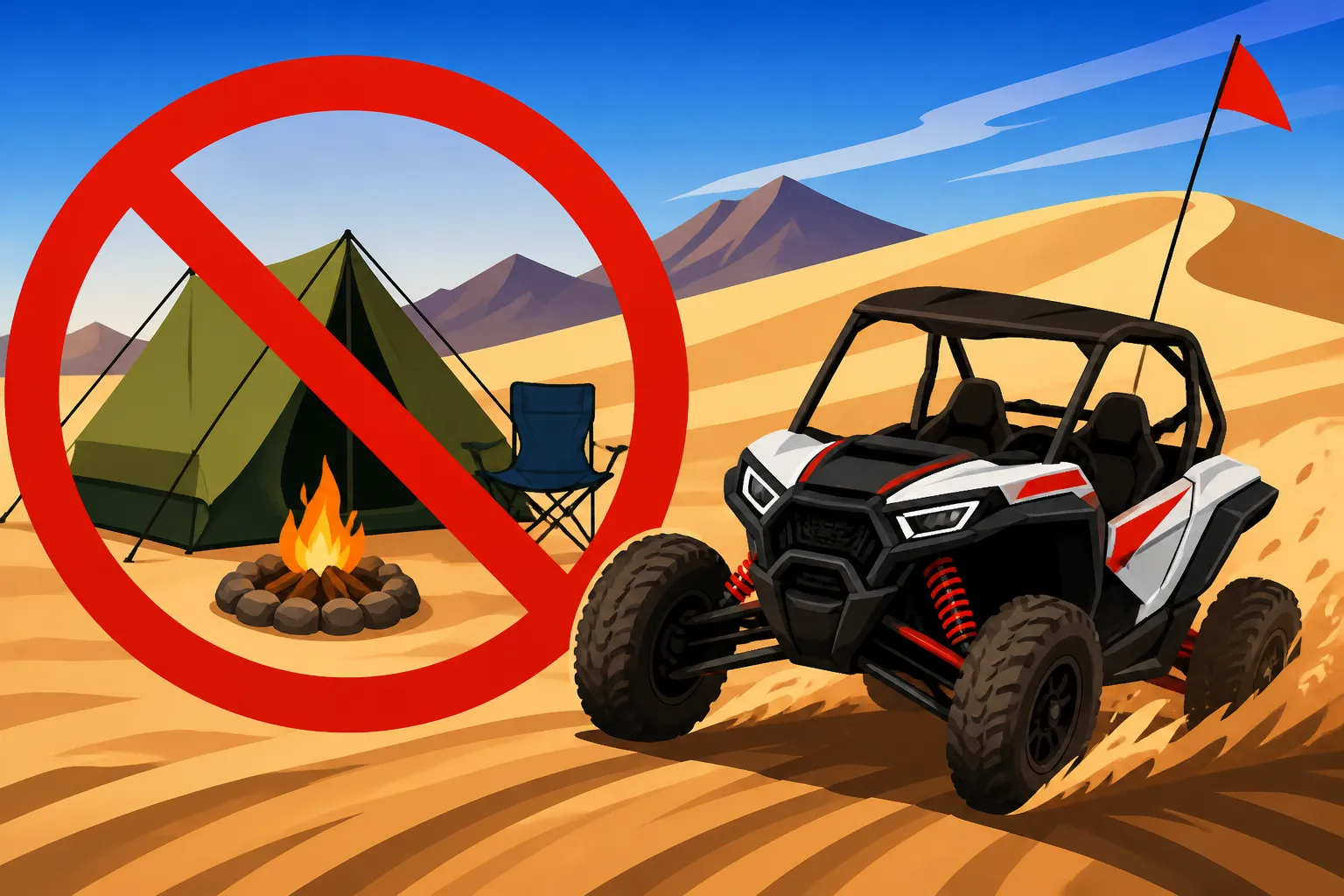
Why You Cannot Camp at Nellis Dunes
Nellis Dunes is a popular place to ride near Las Vegas, but it is not a place to set up camp after the ride. That difference can catch visitors off guard: an open riding area may look like a convenient overnight stop, especially when you have a trailer and gear in tow. This guide explains the camping restriction, how to plan your visit, and what to do instead.
Why camping is not allowed at Nellis Dunes
Riding access does not mean overnight access
Nellis Dunes is known as an off-highway vehicle area, not a campground. The fact that you can unload, ride, and spend time there during the day does not automatically mean you can pitch a tent, park an RV overnight, or sleep beside your machine. Recreation areas have specific permitted uses, and day riding and overnight camping are different activities.
That distinction matters when you are planning a trip. A wide, open patch of desert may seem like a natural campsite, but the appearance of undeveloped land is not permission to stay overnight. At Nellis Dunes, visitors should treat the area as a place to ride and leave when their day is done. For more on how the area works as a riding destination, see [Nellis Dunes, Nevada's Free Dune Ride].
The restriction can be frustrating if you arrive with a camper or are hoping to avoid another drive after riding. It is still better to plan around it than to assume an overnight stay will be allowed. Rules can differ between nearby parcels and recreation sites, so do not treat a spot just beyond the visible riding area as an approved campsite either.
Protecting a busy desert recreation area
Nellis Dunes is close to a large urban area, which makes it a convenient outing for Las Vegas riders. That convenience also means the area can see substantial vehicle traffic and repeated use. Adding overnight stays can bring extra pressure: more vehicles parked for longer periods, campfire risks, litter, sanitation concerns, and people spreading beyond established riding routes while looking for a place to settle in.
Desert ground can look tough, but it does not quickly recover from repeated disturbance. Tires can widen informal tracks, crush vegetation, and damage fragile surfaces. Trash and human waste are especially difficult problems in a place without campground services. A no-camping rule helps keep a high-use riding area focused on its intended purpose and reduces the chance that overnight use creates impacts that are harder to manage.
It is also a practical safety issue. Riding areas are active spaces, not quiet campgrounds. Machines may be moving through the area, visibility can be limited by dust and terrain, and a group settling in for the night may be exposed to traffic or other hazards. For related advice about conditions on busy riding days, read [Dust and Traffic at Nellis Dunes].
What the restriction means for your ride
Plan to leave the riding area after your session
The simplest way to avoid trouble is to treat Nellis Dunes as a day-use riding stop. Arrive with enough time to unload, ride, take breaks, and pack up before you need to leave. If your group is coming from elsewhere in the Las Vegas Valley, build in extra time for traffic, fueling, and getting trailers positioned safely.
A short evening ride can work well when you have a clear return plan. Set a turnaround time before anyone starts riding, especially if your group includes new riders or children. It is easy to lose track of time while exploring different lines, and loading machines in fading light takes longer than expected. [Nellis Dunes for a Quick Evening Ride] offers a useful way to think about keeping a shorter outing manageable.
Do not turn a daytime parking spot into an overnight camp by leaving a trailer, tent, or vehicle behind. Nor should you assume that sleeping in a vehicle is different from camping simply because you have not set up a tent. If you are unsure whether a planned activity counts as camping, ask the land manager before your trip rather than trying to interpret the boundary on the spot.
Keep riding, parking, and camping locations distinct
A useful trip plan separates three questions: where you can ride, where you can park and unload, and where you can legally stay overnight. Those locations may be different. A legal ride area does not necessarily have overnight parking, and a nearby open-looking area may have its own restrictions.
Before heading out, check the official information for Nellis Dunes and the relevant land manager. Mapping tools can also help you understand where your route sits in relation to roads, boundaries, and nearby public land. For example, onX Offroad can help you review mapped access and plan a route, but a map app should not be treated as a substitute for current land-use rules or posted signs. Use it as one planning aid, then confirm the rules with the agency responsible for the area.
If your plans include other public lands, remember that camping permissions are not automatically transferable from one site to another. [Riding BLM Land in Nevada] explains why riders need to pay attention to land status and route rules instead of assuming that all open-looking desert has the same access conditions.
| Your plan | What to do |
|---|---|
| Ride at Nellis Dunes for the day | Use the area for riding, follow posted directions, and leave when finished |
| Bring an RV or trailer | Confirm where parking and unloading are allowed; do not assume overnight parking is permitted |
| Camp near the riding area | Find a separate, approved campground or camping location and verify its rules |
| Explore nearby routes | Check land boundaries, route access, closures, and any local restrictions before riding |
| Arrive late or leave after dark | Reconsider the schedule; riding areas are not a substitute for an overnight stop |
How to plan an overnight trip instead
Choose a separate place that allows camping
If you want to camp during a Nellis Dunes trip, choose a campground or other location where overnight stays are explicitly allowed. That may mean staying at an established campground, an RV facility, or a permitted dispersed-camping area elsewhere. The right option depends on your vehicle, equipment, group size, and willingness to drive between camp and the riding area.
Do not rely on a general map label or a social media post as your only confirmation. Check the rules for the specific site, including whether vehicles can reach it, whether trailers are allowed, and whether there are limits on fires, length of stay, or the number of vehicles. Conditions and restrictions can vary by land manager and location. For a broader planning overview, see [Nevada Dispersed Camping Rules for Riders].
If you are choosing between an established campground and a more remote site, think about what your group actually needs. A campground may offer defined parking and basic facilities, while a dispersed location may require more self-sufficiency and careful checking of access rules. Neither option should be assumed to be close enough for a simple back-and-forth trip until you have checked the route and travel time.
Check the map and rules before loading up
A little planning can prevent a frustrating arrival. Confirm the location of the riding area, the permitted access roads, and the place where you intend to sleep. Review recent notices from the responsible land manager for closures or changed access, and pay attention to signs when you arrive. A route that appears straightforward on a screen may be blocked, private, or closed to motor vehicles on the ground.
onX Offroad can help you compare a planned route with mapped roads and boundaries, but treat that information as a starting point. Cross-check important decisions with official land-management information, particularly if your route approaches a boundary or a restricted area. Keep a backup plan in case the intended camping location is full, inaccessible, or subject to a closure.
It is also worth checking [Nevada Trail Closures to Check Before You Go] before a trip. A closure can affect more than the riding itself: it may change how you reach a trailhead or whether your chosen overnight location makes sense. For more options in the region, [Nevada OHV Areas Near Las Vegas] can help you compare riding destinations, while [Where to Park a Trailer at Nellis Dunes] focuses on a separate but equally important part of the visit.
Common mistakes to avoid at Nellis Dunes
Assuming nearby land has the same rules
One of the easiest mistakes is treating the entire desert around Nellis Dunes as a single recreation area with one set of rules. In reality, the riding area, access routes, neighboring public land, and private or restricted parcels may be managed differently. A campsite that seems close to the dunes may fall under a different rule set—or may not be open to camping at all.
Do not assume that a location is legal just because another vehicle is parked there or because you see old tire tracks. Existing use is not proof of permission. The same goes for downloaded maps: a line or open-looking area is not a guarantee that camping or motorized access is allowed. Verify the precise location and current rules before you settle in.
If you are using onX Offroad or another mapping app, check that the planned campsite and riding route are separate points and that you understand how you will travel between them. Then confirm any uncertain access with the land manager. It is much easier to adjust the plan at home than to discover a restriction when your group is tired and the machines are already unloaded.
Confusing a ride stop with a place to stay
Nellis Dunes can be a convenient place to spend hours riding, but convenience is not the same as overnight permission. Leaving a tent, cooking gear, or a vehicle for the night can create problems even if you plan to return early the next morning. If you need an overnight stay, arrange it somewhere designated or otherwise confirmed as legal.
Visitors who want to make the most of a short visit can plan a focused ride, pack up, and head to their chosen lodging or campsite. That approach may involve a little more driving, but it avoids a last-minute scramble and keeps the riding area available for its intended use. It also makes the trip more comfortable: you can plan for water, food, sanitation, and rest without expecting a day-use area to provide campground services.
For a smoother outing, decide in advance where you will unload, where you will ride, and where you will sleep. Keep the rules for each place separate, carry out your trash, and leave the area as you found it. At Nellis Dunes, the key point is straightforward: ride there, but make your overnight plans somewhere that allows camping.
Disclaimer
This article is for general informational purposes only and does not constitute professional advice. Laws, prices and regulations vary by location and change over time. Consult a qualified professional for guidance on your specific situation.