Where to Park a Trailer at Nellis Dunes
A trailer can turn a quick Nellis Dunes ride into a frustrating start if you arrive without knowing where you can safely stage. The area is open desert, not a conventional trailhead with a guaranteed large parking lot, so it pays to confirm your route, assess the space before committing, and avoid blocking roads, gates, or other riders.
What to know about parking at Nellis Dunes
Expect desert staging, not a full-service trailhead
Nellis Dunes is a popular off-highway riding area north of Las Vegas, near U.S. 95. People commonly bring ATVs and UTVs on trailers, but the area is not best approached as if it has a staffed entrance, reserved trailer stalls, or an orderly paved parking lot. Staging conditions can vary with traffic, weather, and where riders are gathering.
Before you leave home, identify the access area you intend to use and check current land-management information. Map pins and older directions can lead to a shoulder, an informal pullout, or a spot that is unsuitable for a long truck-and-trailer combination. A location that looks roomy on a phone screen may be uneven, sandy, or already crowded when you arrive.
If you have never been there, read [Nellis Dunes, Nevada's Free Dune Ride] and [Nellis Dunes for Beginners] before planning your first trip. They can help you think about the riding environment as well as the approach. For broader context on nearby recreation areas, see [Nevada OHV Areas Near Las Vegas].
Do not treat a highway shoulder as your staging area
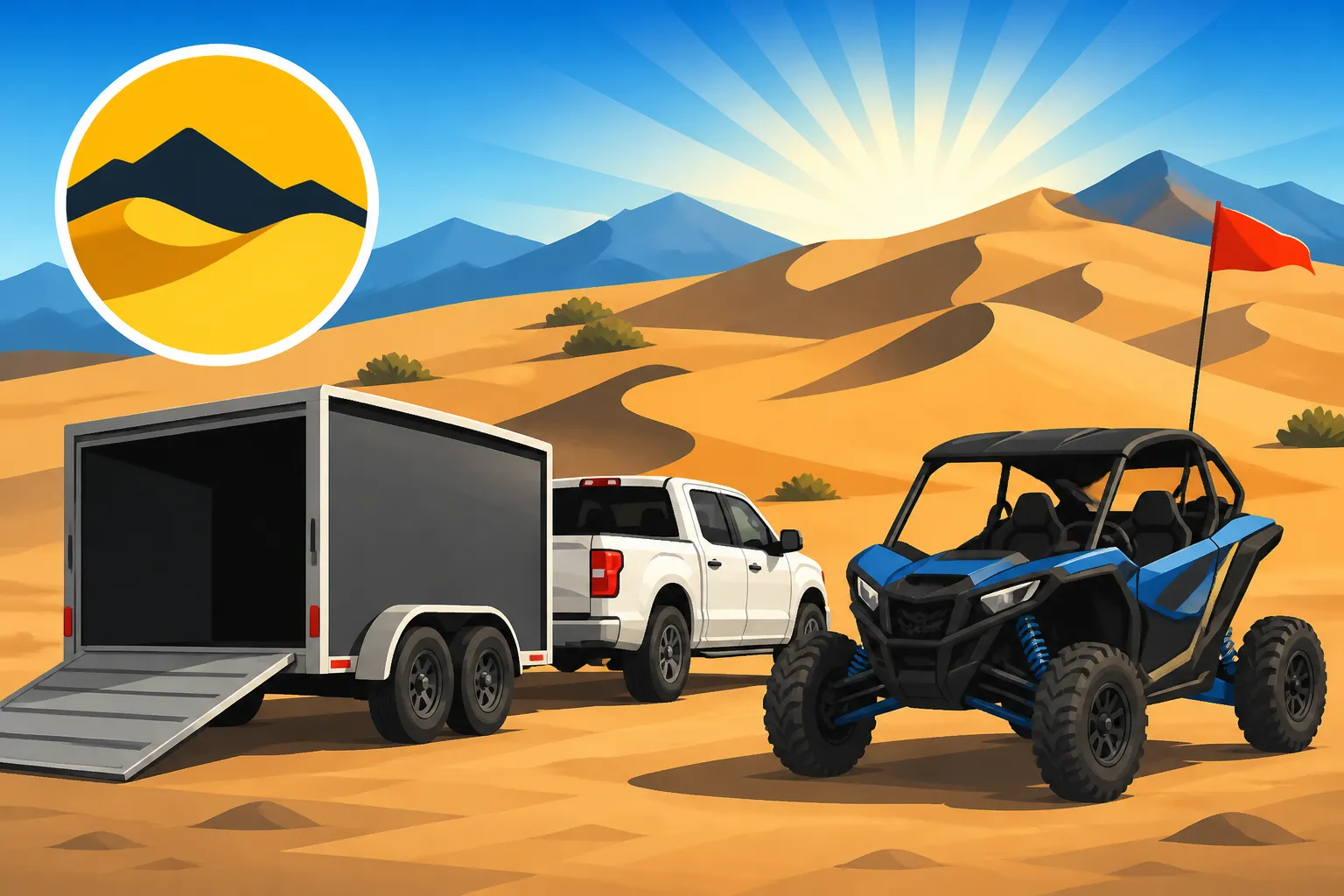
A safe trailer parking spot needs to be well away from moving traffic and positioned so you can unload without putting people or machines in the roadway. Pulling onto a narrow shoulder because it appears close to the dunes can create serious risks: passing vehicles have little room, dust can reduce visibility, and a trailer may obstruct access for emergency or maintenance vehicles.
Do not stop on a ramp, block a gate, or leave a trailer across a road or established access route. If the space you expected to use is full or does not feel safe, do not force the fit. Continue to a suitable legal staging area, turn around where it is safe, or postpone unloading until you have found a place with enough room.
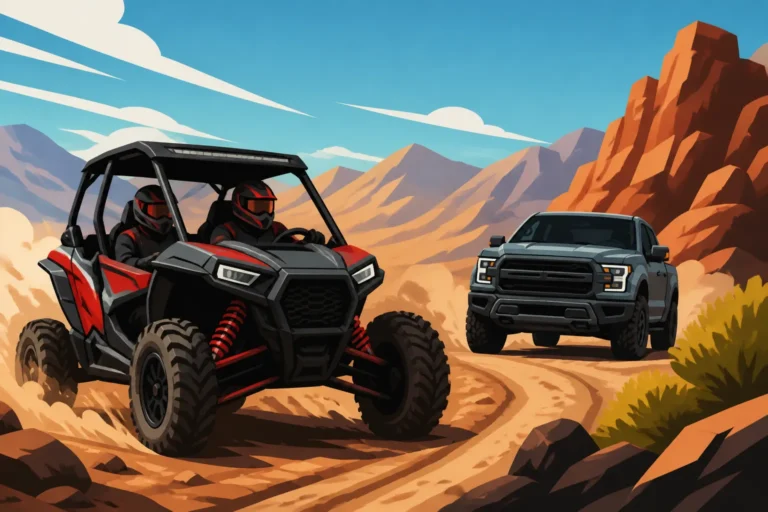
This is especially important when towing a long trailer. A truck may fit in a pullout while the trailer’s rear still sticks into traffic or blocks another vehicle’s turning path. Before unhitching, consider the entire rig—not just the tow vehicle.
How to choose a suitable place to leave your trailer
Check the ground, space, and exit route
A useful staging spot is firm enough to support your truck and trailer, relatively level, and large enough for you to maneuver without crossing into active riding space. Avoid soft sand, steep edges, drainage channels, and places where rain could send water through the parking area. Desert ground can look solid while hiding loose sand that makes it difficult to pull away.
Think through the full sequence before you park:
- Enter the area slowly and look for an established place where vehicles are already staging.
- Check that your rig can fit without blocking traffic, gates, signs, or another vehicle’s access.
- Confirm that you can turn around or exit without backing a long distance through moving vehicles.
- Park on stable ground and leave enough room to unload and reload safely.
- If the approach looks questionable, stop before committing and choose another option.
A map app can help you understand the surrounding roads, but it cannot tell you whether a particular patch of ground is firm, open, or appropriate for parking that day. If you use onX Offroad to plan, compare its map view with signs on the ground and current land-management guidance. Download the area ahead of time if you expect to be outside reliable cell coverage; do not rely on a blue-dot location alone to decide that a route or parking area is open.
Keep the trailer outside active riding lines
At a busy riding area, the edge of an open staging space can quickly become part of the traffic pattern. Riders may arrive, unload, and head toward the dunes, while others return with limited visibility through dust. Place your truck and trailer where they are clearly out of the way and not positioned across a natural entrance or a route riders are using.
Leave extra clearance around your rig. A UTV or ATV may need space to turn, and another truck may need room to maneuver its trailer. Avoid parking directly behind another trailer if it would trap that driver, and do not assume that an empty patch is available for parking simply because no one is using it at that moment.
| Parking situation | Why it can be a problem | Better approach |
|---|---|---|
| Narrow shoulder beside U.S. 95 | Passing traffic leaves little room, and unloading may put people near the roadway | Continue to a suitable legal staging location |
| Soft sand or an uneven slope | The trailer may sink, shift, or be difficult to tow out | Choose firm, level ground and assess the surface first |
| Gate, sign, or access road | Parking may block land managers, emergency vehicles, or other users | Keep access points and marked routes clear |
| Busy riding line | Riders may not see a parked trailer through dust or around a rise | Stage well outside active travel paths |
| Crowded informal pullout | A long rig may block turning and unloading space | Wait, reposition safely, or use another appropriate staging area |
A practical arrival and unloading plan
Prepare before you reach the dunes
Set up your phone, navigation, and trailer checks before driving into the area. Looking for a map pin while towing can distract you at precisely the moment when the road surface and other vehicles need your attention. Use onX Offroad or another mapping tool to review the general approach in advance, but treat posted signs and current access information as the deciding guide.
If you are using a mapping app, check that you understand what the line on the screen represents. A track shown on a map is not automatically a public route, an approved trailer approach, or a place where parking is allowed. [Nevada Trail Maps Worth Downloading] and [What the Trail Finder Site Shows You] offer useful background on reading route information without assuming every mapped line is open for every use.
Before departing, check that the trailer is road-ready: secure the load, confirm the hitch and safety connections, and make sure your lights work. Bring wheel chocks if appropriate for your trailer, and keep tie-downs, ramps, gloves, and basic tools organized so you are not searching through the truck while vehicles are moving around you.
Unload in a controlled order
Once parked, keep children and passengers away from the path of other vehicles and from the trailer’s moving parts. Unload one machine at a time, using ramps suited to the machine and trailer. Keep the ramp connection secure, avoid standing directly in a machine’s downhill path, and do not rush because other riders are waiting.
After unloading, check that the trailer is still stable and that your truck and equipment remain clear of access routes. Secure loose gear rather than leaving straps or ramps where a gust, passing vehicle, or curious rider could move them. If the space becomes congested, take a moment to reposition only when you can do so safely.
Dust and traffic are part of the experience at a busy riding area. [Dust and Traffic at Nellis Dunes] and [Nellis Dunes on a Saturday] are worth reviewing if you are choosing when to go or preparing for heavier arrival and departure activity. Give yourself more time than you think you need, especially if you are new to unloading a machine in a shared staging area.
Leaving your rig safely and respecting the area
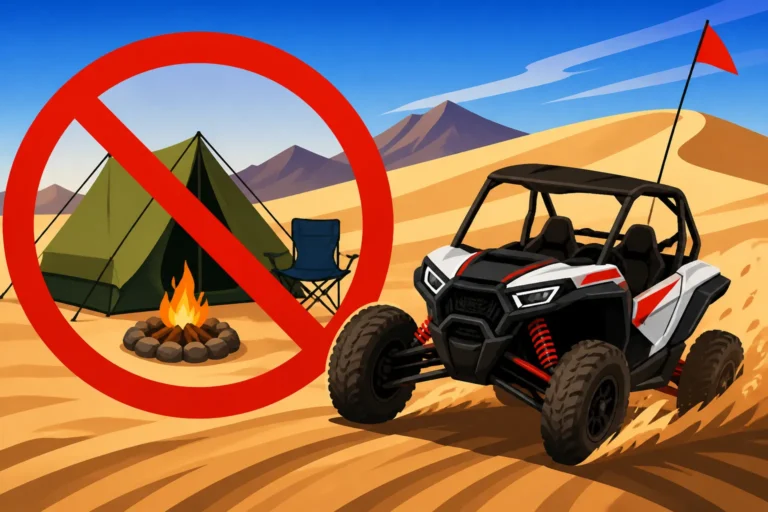
Do not confuse parking with camping
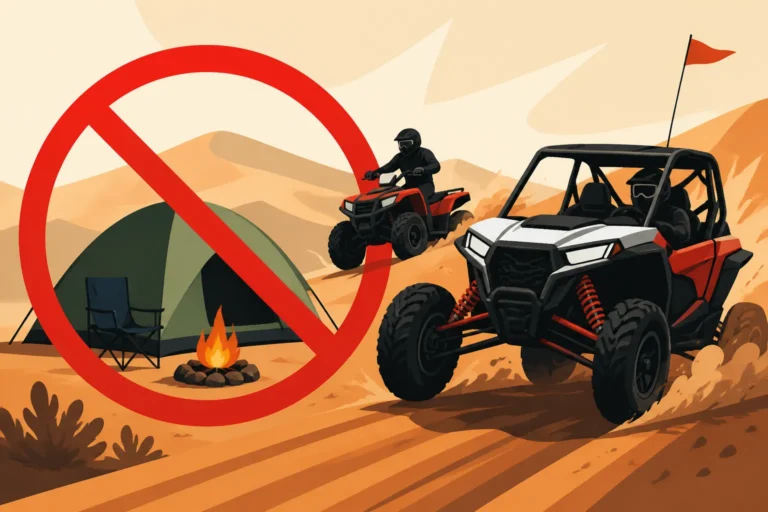
Parking for the day is not the same as setting up camp. Do not assume that because you can stage a trailer in an area, you may stay overnight or use it as a campsite. Confirm the rules for the precise location and follow posted restrictions. For details about the distinction at this riding area, see [Why Nellis Dunes Bans Camping].
Take everything you brought with you, including food wrappers, broken straps, and small pieces of packaging that are easy to lose in the sand. Keep fires, fuel, and other equipment subject to posted restrictions. Leave gates and signs accessible, and do not move barriers or drive around a closure to find a more convenient place to park.
Nellis Dunes can feel informal, but public-land access still comes with responsibilities. Stick to routes and areas that are open, respect closures, and avoid expanding parking into fragile or restricted ground. If you are uncertain whether a particular patch is appropriate, choose a clearly established staging area or contact the relevant land manager before your trip.
Make your departure as deliberate as your arrival
Before loading, look around your truck and trailer for people, machines, and traffic. Riders may return quickly from the dunes, sometimes with limited visibility because of dust. Load only when you have enough room to use your ramps safely and are not forcing other vehicles to squeeze past.
Do a final walk-around before pulling away. Check that ramps are secured, tie-downs are tight, hitch connections are properly set, and no gear is left behind. Take care when merging back onto the road, particularly if dust, parked vehicles, or other trailers limit your view.
A little planning makes trailer parking at Nellis Dunes much less stressful: know your intended access, choose a stable spot with room for the whole rig, keep active routes clear, and be ready to change plans if conditions do not suit your trailer. The best place to park is not necessarily the closest patch of sand; it is the one where you can unload, ride, and leave without creating a hazard for yourself or anyone else.
Disclaimer
This article is for general informational purposes only and does not constitute professional advice. Laws, prices and regulations vary by location and change over time. Consult a qualified professional for guidance on your specific situation.